Private Label, White Label, Wholesale partnerships available - EU, USA and UK - Free shipping from €75

Quality assurance in bacteriostatic water for lab reliability
Discover how quality assurance prevents contamination in bacteriostatic water through validation, risk management, and proven lab protocols for reliable research.
Many researchers assume rigorous product testing guarantees lab product safety, yet that reactive approach only catches problems after they occur. Quality assurance (QA) is process-oriented and preventive, establishing controls throughout the entire lifecycle to prevent contamination and errors before they compromise your research. For bacteriostatic water and reconstitution solutions, QA protocols become essential to maintaining the sterility and preservative efficacy that independent researchers across Europe depend on. This guide walks you through QA fundamentals, validation methods, risk management strategies, and actionable protocols to ensure your bacteriostatic water meets the highest reliability standards for scientific applications.
Table of Contents
- Key takeaways
- Understanding quality assurance vs quality control in lab products
- Quality assurance standards and validation methods for bacteriostatic water
- Handling risks and special considerations in quality assurance for bacteriostatic water
- Best practices for applying quality assurance in lab protocols using bacteriostatic water
- Explore Herbilabs’ quality lab solutions
- Frequently asked questions
Key Takeaways
| Point | Details |
|---|---|
| QA is preventive | QA is a preventive, process oriented framework that spans the product lifecycle to stop contamination and errors before they occur. |
| QA vs QC | QA prevents defects by design while QC tests for defects after production. |
| Bacteriostatic water QA | QA protocols ensure sterility and preservative efficacy throughout manufacturing and use. |
| Method validation and audits | Regular method validation, risk assessments, and internal audits support reliable handling and storage procedures. |
Understanding quality assurance vs quality control in lab products
Quality assurance and quality control serve distinct but complementary roles in maintaining lab product integrity. QA establishes a preventive framework that spans the entire product lifecycle, from raw material sourcing through manufacturing, storage, and final use. This process-oriented approach builds quality into every step rather than inspecting it in at the end. QC, by contrast, focuses on product testing and inspection to detect defects after production. While both are necessary, QA’s preventive nature addresses root causes before they compromise product safety.
For bacteriostatic water, QA encompasses standard operating procedures (SOPs), internal audits, risk assessments, and method validation protocols that ensure consistent quality. These tools create systematic controls preventing contamination during manufacturing, storage, and handling. Without robust QA, even rigorous QC testing cannot catch process failures that introduce microbial contamination or preservative degradation between production and use. Understanding what bacteriostatic water is helps clarify why these preventive measures matter so much for multi-dose vials.
The distinction becomes clearer when examining their characteristics:
- QA is proactive and system-focused, preventing defects through process design
- QC is reactive and product-focused, identifying defects through testing
- QA involves everyone in the organization and covers all processes
- QC typically involves dedicated quality teams performing inspections
- QA establishes the framework that makes effective QC possible
Method validation, a core QA activity, ensures your analytical procedures consistently produce reliable results. Risk assessments identify potential failure points in handling or storage before they cause problems. Regular audits verify that established procedures are followed correctly. These preventive measures become particularly important for bacteriostatic water because common questions about safety often stem from inadequate QA rather than product defects.
“Quality assurance is not about testing quality into products after the fact. It’s about building quality into processes from the beginning, ensuring that every step contributes to the final product’s safety and efficacy.”
This preventive philosophy transforms how labs approach bacteriostatic water protocols. Rather than relying solely on sterility testing after opening a vial, QA establishes aseptic handling procedures, proper storage conditions, and documentation requirements that prevent contamination throughout the product’s in-use period. The systematic approach reduces variability and improves reproducibility across research studies.
Quality assurance standards and validation methods for bacteriostatic water
Bacteriostatic water must meet specific pharmacopeial standards to ensure safety for reconstitution applications. The United States Pharmacopeia (USP) requires 0.9% benzyl alcohol as the preservative agent, maintaining a pH between 4.5 and 7.0 to prevent microbial growth while remaining compatible with most peptides and proteins. European Pharmacopoeia (EP) standards align closely with USP requirements, establishing baseline quality parameters that QA systems must verify. Method validation per ICH Q2(R2) provides the analytical framework ensuring these parameters are measured accurately and consistently.
Validation parameters define how reliably your analytical methods detect quality attributes. Specificity confirms your test measures only the intended analyte without interference. Accuracy demonstrates that results reflect true values within acceptable tolerance. Precision shows that repeated measurements yield consistent results under the same conditions. Robustness verifies that minor procedural variations don’t compromise test reliability. These parameters become critical when verifying benzyl alcohol concentration or detecting microbial contamination in bacteriostatic water.
Implementing validation for bacteriostatic water QA follows these essential steps:
- Define the analytical procedure’s intended use and performance requirements
- Establish acceptance criteria for each validation parameter based on regulatory standards
- Execute validation protocols using representative samples across the specification range
- Document all validation data, deviations, and corrective actions taken
- Perform periodic revalidation when methods, equipment, or materials change
- Maintain validation records as part of your quality management system
Pro Tip: Audit pre-analytical variables like sample collection, storage temperature, and handling time. Studies show these factors cause up to 70% of laboratory errors, making them prime targets for QA improvement before analytical testing even begins.
Analytical validation parameters and their acceptance criteria ensure consistent bacteriostatic water quality:
| Validation parameter | Acceptance criteria | Testing frequency |
|---|---|---|
| Benzyl alcohol content | 0.9% ± 10% | Every production batch |
| pH range | 4.5 to 7.0 | Every production batch |
| Sterility assurance | No microbial growth | Every production batch |
| Particulate matter | <25 particles ≥10μm per mL | Every production batch |
| Endotoxin level | <0.5 EU/mL | Every production batch |
Continuous quality control complements validation by monitoring ongoing performance. Internal QC uses control samples with known values to verify that analytical systems function correctly each day. External QC through proficiency testing programs compares your results against peer laboratories, identifying systematic biases. Risk management tools like Failure Mode and Effects Analysis (FMEA) systematically evaluate potential failure points in your QA system, prioritizing preventive actions based on severity and likelihood. Understanding why lab-grade quality matters helps justify the investment in these comprehensive validation and monitoring systems.
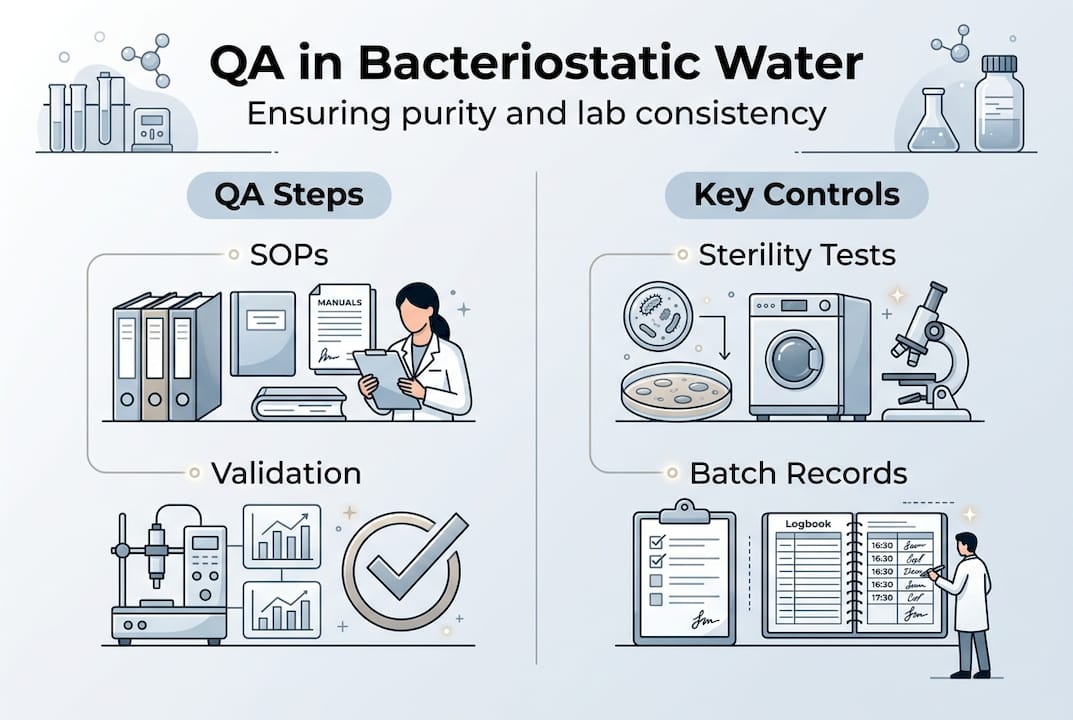
The validation framework extends beyond initial testing to encompass change control procedures. Any modification to analytical methods, equipment calibration, or reagent suppliers triggers revalidation to verify continued performance. This systematic approach ensures that proper storage conditions and handling procedures maintain validated quality throughout the product’s lifecycle. Documentation requirements include validation protocols, raw data, statistical analysis, and formal approval by quality personnel before methods are implemented.
Handling risks and special considerations in quality assurance for bacteriostatic water
Bacteriostatic water presents unique challenges that standard QA frameworks must address proactively. While the benzyl alcohol preservative extends multi-dose use, specific scenarios demand heightened vigilance:
- Neonatal toxicity from benzyl alcohol requires absolute prohibition in pediatric applications
- Enzymatic incompatibilities occur with certain proteins and peptides, necessitating compatibility testing
- Multiple punctures through rubber stoppers introduce contamination risk despite preservative presence
- Temperature excursions during storage or transport can compromise preservative efficacy
- Extended in-use periods beyond 28 days allow microbial adaptation and growth
Contamination risks persist even with proper preservative concentrations because benzyl alcohol inhibits rather than eliminates microbial growth. Each needle puncture introduces potential contaminants from the environment or handling. Repeated withdrawals increase cumulative risk, particularly if aseptic technique lapses. QA protocols must establish strict limits on puncture frequency and implement visual inspection procedures to detect early signs of contamination like cloudiness or particulate formation.
Comparing bacteriostatic and sterile water clarifies distinct QA requirements:
| Characteristic | Bacteriostatic water | Sterile water |
|---|---|---|
| Preservative content | 0.9% benzyl alcohol | None |
| Multi-dose capability | Yes, up to 28 days | Single use only |
| Neonatal safety | Contraindicated | Safe for all ages |
| Storage after opening | Refrigerate 2-8°C | Immediate use required |
| Contamination risk | Lower with proper handling | Higher if not used immediately |
Microbial recovery benchmarks establish quantitative limits for acceptable contamination levels. Total Aerobic Microbial Count (TAMC) must remain below 10³ colony-forming units per gram (CFU/g) for non-sterile products, though bacteriostatic water should maintain sterility throughout its use period. R2A agar provides optimal recovery conditions for environmental bacteria that might contaminate vials during handling. Incubation at 25°C for 5-7 days captures slow-growing organisms that standard methods might miss.

Pro Tip: Perform daily visual inspections before each use, checking for cloudiness, color changes, or visible particulates. These early warning signs indicate potential contamination requiring immediate vial discard, even if the 28-day limit hasn’t been reached.
The 28-day discard rule represents a critical QA control point that prevents microbial adaptation to preservative concentrations. Even with proper refrigeration and aseptic technique, benzyl alcohol efficacy gradually decreases through volatilization and chemical degradation. Labeling each vial with the opening date and discard date creates a visual reminder preventing inadvertent use of expired solutions. This simple QA measure prevents the most common safety failure in bacteriostatic water use.
Documentation requirements extend beyond basic labeling to include batch traceability, storage temperature logs, and handling records. When contamination or adverse events occur, this documentation enables root cause analysis and corrective action. QA systems should mandate recording each vial opening, the number of withdrawals, and any deviations from standard procedures. Understanding key differences between bacteriostatic and sterile water helps researchers select appropriate products and apply corresponding QA controls.
Best practices for applying quality assurance in lab protocols using bacteriostatic water
Implementing effective QA requires translating standards and principles into concrete laboratory procedures. These step-by-step protocols ensure consistent quality throughout bacteriostatic water handling and use:
- Flush water lines for at least 2 liters before collecting samples to eliminate stagnant water
- Disinfect vial stoppers with 70% isopropyl alcohol and allow complete air drying before puncture
- Use aseptic technique with sterile needles and syringes for each withdrawal
- Inject reconstitution solution gently along the vial wall rather than directly onto lyophilized material
- Swirl gently to dissolve, never shake vigorously, preventing protein denaturation and foaming
- Label each vial immediately after opening with date, time, and discard date (28 days maximum)
Lab best practices emphasize that proper technique begins before the vial is ever opened. Environmental controls in the preparation area minimize airborne contamination. Personal protective equipment including gloves prevents transfer of skin flora to sterile surfaces. These foundational QA elements create the conditions for successful aseptic manipulation.
Storage conditions directly impact bacteriostatic water quality and preservative efficacy:
- Maintain refrigeration at 2-8°C after opening to slow microbial growth and preservative degradation
- Store unopened vials at controlled room temperature (15-25°C) away from direct light
- Avoid temperature cycling by keeping vials in consistent storage locations
- Discard any vial exposed to freezing temperatures, as ice crystal formation compromises sterility
- Keep vials in original packaging until use to protect from light and environmental contamination
Pro Tip: Record batch numbers, lot codes, and expiration dates in your laboratory notebook for every vial used. This traceability becomes essential if quality issues emerge, allowing you to identify affected experiments and implement corrective actions quickly.
Documentation transforms individual procedures into a comprehensive QA system. Standard operating procedures (SOPs) should detail every step from receiving shipments through final disposal. Deviation logs capture any departure from established procedures, triggering investigation and corrective action. Training records verify that all personnel understand and can execute procedures correctly. These documentation elements create accountability and enable continuous improvement through trend analysis.
Regular audits verify that written procedures match actual practice. Internal audits by laboratory supervisors identify gaps between SOPs and daily operations. Peer reviews where colleagues observe each other’s technique catch subtle deviations before they become habitual. External audits by quality professionals provide independent assessment of your entire QA system. Understanding proper storage protocols provides the foundation for audit-ready procedures.
Validated reconstitution techniques ensure consistent results across research applications. Gentle mixing preserves protein structure while achieving complete dissolution. Appropriate diluent volumes maintain target concentrations without requiring multiple vials. Visual inspection after reconstitution confirms complete dissolution and absence of particulates. These quality checks, documented for each preparation, demonstrate that laboratory protocols maintain validated performance.
Continuous improvement closes the QA loop by using data to refine procedures. Tracking contamination incidents reveals patterns pointing to specific failure modes. Analyzing deviation frequency identifies procedures needing clearer instructions or additional training. Monitoring storage temperature logs detects equipment issues before they compromise product quality. This data-driven approach transforms QA from a compliance burden into a competitive advantage through enhanced reliability and reproducibility.
Explore Herbilabs’ quality lab solutions
Implementing the QA practices outlined above requires reliable products manufactured to exacting standards. Herbilabs specializes in lab-grade bacteriostatic water and reconstitution solutions produced in dedicated facilities with rigorous quality controls. Every batch undergoes comprehensive testing for sterility, preservative concentration, pH, and particulate matter before release.
Our complete guide to bacteriostatic water provides detailed technical information supporting your QA protocols, from proper handling through disposal. The Herbilabs shop offers convenient ordering with reliable delivery across Europe, ensuring you have the quality products your research demands. Whether you’re establishing new QA procedures or refining existing protocols, Herbilabs provides both the products and technical resources to support scientific excellence in your laboratory.
Frequently asked questions
What is the difference between quality assurance and quality control in labs?
Quality assurance focuses on preventing defects through systematic process controls across the entire product lifecycle, while quality control detects defects through testing and inspection of finished products. QA is proactive and process-oriented, establishing procedures, validations, and audits that build quality into every step. QC is reactive and product-oriented, verifying that final products meet specifications through analytical testing.
Why does bacteriostatic water contain benzyl alcohol?
Bacteriostatic water contains 0.9% benzyl alcohol as a preservative that inhibits microbial growth in multi-dose vials. This preservative extends safe use up to 28 days after opening when stored properly, reducing waste compared to single-use sterile water. The preservative concentration is carefully controlled to provide antimicrobial activity without causing tissue irritation or interfering with most peptide and protein reconstitutions.
How does quality assurance improve research reproducibility?
Proper QA protocols reduce variability in bacteriostatic water handling, storage, and use, ensuring consistent product quality across experiments. By preventing contamination, maintaining validated storage conditions, and documenting all procedures, QA eliminates common sources of experimental error. This systematic approach means your reconstitution solutions perform identically from one experiment to the next, improving data reliability and study outcomes.
Why must bacteriostatic water be discarded after 28 days?
The 28-day limit prevents microbial adaptation to benzyl alcohol and accounts for gradual preservative degradation through volatilization and chemical breakdown. Even with proper refrigeration and aseptic technique, repeated punctures introduce cumulative contamination risk that eventually overcomes preservative efficacy. Discarding vials after 28 days provides a safety margin preventing microbial growth that could compromise research or pose health risks. For more details, visit our bacteriostatic water FAQ.
How do regular audits ensure lab compliance with quality standards?
Audits verify that written procedures match actual practice, identifying gaps between SOPs and daily operations before they cause quality failures. Internal audits by supervisors catch procedural drift, while external audits by quality professionals provide independent assessment of your entire QA system. Regular auditing creates accountability, reinforces training, and generates data for continuous improvement of your quality management system.
Recommended
- Bacteriostatic vs Sterile Water: Safe Lab Application Guide 2025 – Herbilabs Labware
- How to Store Bacteriostatic Water Safely in the Lab – Herbilabs Labware
- What is Bacteriostatic Water? Best 2025 Guide for Labs in Europe – Herbilabs Labware
- How to Use Bacteriostatic Water in Lab Protocols? Valuable skills in 2025 – Herbilabs Labware