Private Label, White Label, Wholesale partnerships available - EU, USA and UK - Free shipping from €75

Lab sterilization tips for pure injectable peptides
Master lab sterilization for injectable peptides with expert tips on sterile filtration, aseptic technique, and contamination prevention for European researchers.
Sterilizing peptides for injection demands precision. Unlike bulk chemicals, peptides degrade under heat and adsorb onto certain materials, making traditional autoclaving impractical. Independent researchers across Europe face the challenge of achieving pharmaceutical-grade sterility without compromising peptide integrity. This article delivers practical, expert-backed lab sterilization tips tailored specifically for peptide work. You’ll learn critical criteria for selecting sterilization methods, master sterile filtration techniques, implement aseptic handling protocols, avoid common pitfalls that cause peptide loss, and align your processes with regulatory safety standards to ensure every injectable is pure and safe.
Table of Contents
- Key takeaways
- Criteria for effective lab sterilization of injectable peptides
- Sterile filtration: the preferred method for peptide sterilization
- Best practices for aseptic handling and contamination prevention
- Common pitfalls and how to avoid peptide loss and contamination
- Ensuring regulatory compliance and safety standards in independent labs
- Explore Herbilabs solutions for premium lab sterilization supplies
- Frequently asked questions about lab sterilization for peptides
Key Takeaways
| Point | Details |
|---|---|
| No autoclaving | Autoclaving denatures heat labile peptides, so heat based sterilization is avoided to preserve integrity. |
| 0.22 micron filtration | Sterile filtration through a 0.22 μm membrane provides sterility without heat exposure, preserving peptide activity. |
| Low binding membranes | Choose membranes such as PES or PVDF to minimize peptide adsorption and maximize recovery. |
| Single use pre rinse | Use pre sterilized single use filters and pre rinse with sterile buffer to saturate binding sites and reduce losses. |
| Method validation | Validate the filtration process with small scale recovery studies and ensure documentation meets pharmaceutical standards. |
Criteria for effective lab sterilization of injectable peptides
Choosing the right sterilization method for peptides requires evaluating multiple factors that balance safety with product integrity. Your approach must preserve chemical stability and biological activity while achieving absolute sterility. Many peptides contain heat-labile amino acid sequences that denature above 40°C, ruling out autoclaving entirely. The method you select must also prevent introducing impurities, avoid peptide loss through adsorption, and support adherence to regulatory frameworks like EU GMP Annex 1.
Material compatibility stands as a critical consideration. Cellulose-based filters, commonly used for aqueous solutions, bind peptides through electrostatic interactions, causing significant product loss. Instead, focus on materials engineered for low protein binding. Sterile filtration using 0.22 μm filters protects peptides from heat degradation and ensures pathogen removal, making it the gold standard for heat-sensitive compounds.
Key criteria include:
- Chemical stability preservation throughout the sterilization process
- Sterility assurance level of at least 10⁻⁶ (one viable organism per million units)
- Zero introduction of extractables, leachables, or endotoxins
- Minimal peptide adsorption to filtration materials
- Compatibility with downstream lab protocols for bacteriostatic water reconstitution
- Documented validation matching pharmaceutical manufacturing standards
Pro Tip: Always conduct small-scale recovery studies with your specific peptide before committing to a sterilization method. Test filtrate peptide concentration against pre-filtration levels to quantify any losses.
Sterile filtration: the preferred method for peptide sterilization
Sterile filtration at 0.22 μm represents the optimal sterilization approach for injectable peptides. This membrane-based method physically removes bacteria, fungi, and mycoplasma without exposing peptides to destructive heat. The 0.22 μm pore size serves as the industry standard because it effectively retains Brevundimonas diminuta, the smallest bacterium used in validation testing, while allowing peptide molecules to pass freely through the membrane.
Polyethersulfone (PES) and polyvinylidene fluoride (PVDF) membranes deliver superior performance for peptide applications. These hydrophilic materials exhibit minimal protein binding compared to cellulose acetate or nylon alternatives. Sartopore® 2 filters show over 98% peptide recovery while effectively removing microorganisms down to 0.22 μm, making them ideal for research applications demanding both purity and yield.
Best practices for sterile filtration:
- Select single-use, pre-sterilized filter units to eliminate cross-contamination risks
- Pre-rinse the membrane with sterile buffer matching your peptide solvent to saturate binding sites
- Apply gentle, consistent pressure to avoid membrane rupture
- Filter slowly to maximize contact time and removal efficiency
- Collect filtrate in pre-sterilized glass or polypropylene vials
- Verify filter integrity post-use when working with high-value peptides
Consider the difference between bacteriostatic vs sterile water when selecting your reconstitution medium. Bacteriostatic water contains 0.9% benzyl alcohol to inhibit bacterial growth during multi-dose use, while sterile water requires single-use application to maintain purity.
Pro Tip: For peptides dissolved in organic solvents like DMSO or acetonitrile, use PTFE membranes instead of PES to ensure chemical compatibility and prevent membrane dissolution.
Statistic Spotlight: Validated sterile filtration systems achieve sterility assurance levels exceeding 10⁻⁶, meaning fewer than one viable microorganism per million filtered units.
More details on sterile filtration for peptides demonstrate how membrane technology continues advancing to meet biopharmaceutical purity standards.
Best practices for aseptic handling and contamination prevention
Even perfectly filtered peptides become contaminated through poor handling technique. Aseptic practice forms the protective barrier between your sterile product and environmental microorganisms. Every surface, tool, and container introduced during reconstitution and transfer represents a potential contamination vector that demands deliberate control.
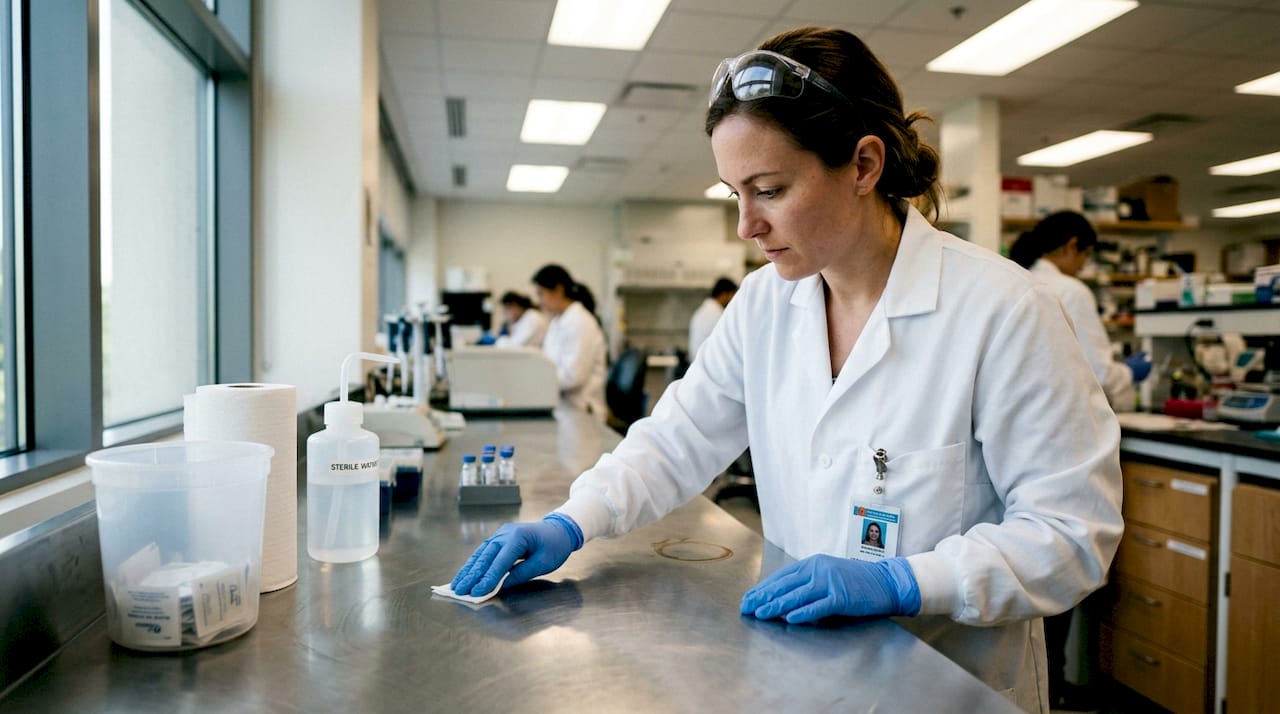
Begin by establishing a clean workspace. Ideally, perform all manipulations inside a laminar flow hood with HEPA-filtered air creating positive pressure that sweeps particles away from your work area. If a hood isn’t available, work in a draft-free room after thorough surface disinfection with 70% isopropyl alcohol. Wiping vial septa with 70% isopropyl alcohol and using sterile, single-use syringes minimizes contamination during the critical reconstitution step.
Critical aseptic techniques:
- Wear powder-free nitrile gloves and avoid touching sterile components
- Disinfect rubber septa with 70% isopropyl alcohol, allowing complete evaporation before puncture
- Use only sterile, single-use syringes and needles, never reusing between vials
- Minimize vial opening time and exposure to ambient air
- Equalize vial pressure after reconstitution by withdrawing an equivalent air volume
- Label and date all reconstituted peptides immediately
Follow this sequence for aseptic reconstitution:
- Gather all materials and disinfect work surface thoroughly
- Remove peptide vial cap and disinfect rubber septum, allowing full drying
- Draw calculated volume of sterile diluent into syringe using aseptic technique
- Inject diluent slowly down vial wall, avoiding foam formation
- Gently swirl vial to dissolve, never shake vigorously
- Withdraw air volume equal to liquid added to prevent pressure buildup
- Store immediately according to peptide stability requirements
Consult guidelines on storing bacteriostatic water safely and using bacteriostatic water aseptically to maintain diluent quality throughout your research timeline.
Pro Tip: Coring occurs when repeated needle punctures cut rubber fragments into the vial. Use a smooth, perpendicular insertion angle and limit punctures to five per septum maximum.
Common pitfalls and how to avoid peptide loss and contamination
Researchers frequently encounter peptide loss through preventable errors in material selection and handling. Understanding these pitfalls allows you to design protocols that maximize recovery while maintaining sterility. The most significant loss mechanism involves peptide adsorption to surfaces, particularly during filtration and storage.
Cellulose-based filters represent the primary culprit in peptide loss. Cellulose filters cause over 50% loss of β-endorphin peptide through irreversible binding to the membrane matrix. Switching to low-binding PES or PVDF membranes immediately recovers this loss. Similarly, glass vials, while chemically inert, can adsorb peptides containing hydrophobic sequences. Polypropylene vials offer superior recovery for most peptide applications.
| Risk Factor | Problem | Solution |
|---|---|---|
| Cellulose filters | Over 50% peptide adsorption | Use PES or PVDF membranes |
| Multiple vial punctures | Coring and contamination | Limit to 5 punctures maximum per septum |
| Freeze-thaw cycles | Activity loss and aggregation | Aliquot into single-use portions |
| Cysteine oxidation | Disulfide bond scrambling | Store under inert gas or add reducing agents |
| Room temperature storage | Degradation and bacterial growth | Refrigerate or freeze immediately |
Oxidation poses particular challenges for cysteine-containing peptides. Atmospheric oxygen converts free thiols to disulfides, creating unwanted dimers and scrambled products. Combat this by overlaying peptide solutions with nitrogen or argon gas before sealing, or include trace amounts of reducing agents like dithiothreitol in storage buffers.
Additional contamination prevention strategies:
- Never reuse syringes or needles between different peptide vials
- Aliquot reconstituted peptides immediately to avoid repeated freeze-thaw damage
- Store lyophilized peptides desiccated at temperatures below 20°C
- Reconstitute only the quantity needed for immediate use when possible
- Monitor storage vials for visible particulates or cloudiness indicating contamination
Learn more about common questions in our bacteriostatic water FAQs covering storage, handling, and quality verification.
Detailed information on cysteine oxidation in peptides explains the chemical mechanisms behind degradation and offers advanced stabilization strategies.
Ensuring regulatory compliance and safety standards in independent labs
Independent researchers benefit from adopting pharmaceutical manufacturing standards even when not legally required. These frameworks exist because they demonstrably reduce contamination, improve reproducibility, and protect end users. EU GMP Annex 1 provides the most comprehensive guidance for sterile product preparation, outlining validation requirements that translate directly to research settings.
Pre-use post-sterilization integrity testing (PUPSIT) stands as a cornerstone practice. EU GMP Annex 1 mandates pre-use post-sterilization integrity testing for sterile filters to verify membrane integrity before processing valuable materials. This non-destructive test confirms the filter can retain bacteria-sized particles, preventing costly batch failures from defective membranes.
Practical compliance steps for independent labs:
- Source pharma-grade sterile filtration units with certificates of quality
- Purchase bacteriostatic water from suppliers providing certificates of analysis
- Document every sterilization event including date, method, materials, and operator
- Validate your aseptic technique through periodic environmental monitoring
- Implement written standard operating procedures for all sterile processes
- Conduct regular training reviews to maintain technique proficiency
Independent labs should mimic pharma standards for maximum safety and reproducibility. The investment in proper materials and validation pays dividends through consistent results and eliminated contamination events.
Environmental monitoring involves periodically testing your workspace for microbial contamination using settle plates or surface swabs. This practice identifies hygiene gaps before they compromise your peptides. Even without regulatory oversight, maintaining these records builds confidence in your results and facilitates troubleshooting when unexpected issues arise.
Explore lab-grade bacteriostatic water quality standards to understand the specifications distinguishing research-grade from pharmaceutical-grade products.
Explore Herbilabs solutions for premium lab sterilization supplies
Implementing these sterilization best practices requires access to reliable, pharmaceutical-grade supplies designed specifically for peptide research. Herbilabs Labware specializes in providing the exact products independent researchers need to maintain sterility and maximize peptide recovery.
Our catalog includes professional-grade sterile filtration units featuring low-binding PES membranes validated for peptide applications. Each unit ships with certificates of quality documenting sterility and integrity testing. We also offer premium bacteriostatic water manufactured under strict GMP conditions, ensuring your reconstitution medium meets pharmaceutical purity standards.
Browse our complete selection at the Herbilabs labware shop where you’ll find sterile syringes, needles, vials, and all essential supplies for aseptic peptide handling. Our comprehensive guide to bacteriostatic water answers technical questions about storage, compatibility, and proper usage protocols.
Pro Tip: Source all supplies from trusted labware suppliers to maintain quality and sterility. Mixing products from unknown vendors introduces variables that compromise reproducibility.
Frequently asked questions about lab sterilization for peptides
What is the best filter type for peptide sterilization?
PES or PVDF membranes with 0.22 μm pore size deliver optimal results for peptide sterilization. These materials exhibit minimal protein binding while effectively removing all bacteria and fungi. Avoid cellulose-based filters that cause significant peptide loss through adsorption.
How often should sterile filtration units be replaced?
Use single-use, disposable sterile filters for every filtration event. Never reuse filters between batches as membrane integrity degrades and trapped microorganisms can proliferate. Each new peptide batch demands a fresh, pre-sterilized filter unit.
Can I reuse needles for multiple peptide vial punctures?
Never reuse needles between different vials as this transfers contamination and creates cross-contamination risks. Even for the same vial, limit punctures to five maximum per septum to prevent coring. Always use fresh, sterile needles for each withdrawal.
What storage method preserves peptide activity best?
Store lyophilized peptides desiccated at temperatures between negative 20°C and negative 80°C for maximum stability. After reconstitution, aliquot into single-use portions and freeze immediately to avoid repeated freeze-thaw cycles that cause aggregation and activity loss. Understanding bacteriostatic vs sterile water helps you choose the appropriate diluent for your storage timeline.
How do I verify sterile filter integrity before use?
Conduct a bubble point test or diffusive flow test before filtering valuable peptides. These non-destructive methods confirm membrane integrity by measuring air pressure required to displace liquid from pores. Many commercial filter units include built-in integrity test ports for this purpose.
Does bacteriostatic water require sterilization before use?
Quality bacteriostatic water arrives pre-sterilized from reputable suppliers and requires no additional sterilization. Verify your supplier provides certificates of analysis documenting sterility testing. Once opened, maintain aseptic technique during withdrawal and refrigerate between uses to preserve the 0.9% benzyl alcohol preservative effectiveness.
Recommended
- How to Use Bacteriostatic Water in Lab Protocols? Valuable skills in 2025 – Herbilabs Labware
- Bacteriostatic vs Sterile Water: Safe Lab Application Guide 2025 – Herbilabs Labware
- Top 5 Lab Applications of Bacteriostatic Water – Herbilabs Labware
- How to Store Bacteriostatic Water Safely in the Lab – Herbilabs Labware
- Hand Sanitizer – EarthquakeKit.ca