Private Label, White Label, Wholesale partnerships available - EU, USA and UK - Free shipping from €75

Can You Reuse Bacteriostatic Water Vials? Safe Guide
Learn when and how to safely reuse bacteriostatic water vials, including the 28-day rule, aseptic technique steps, and clear discard guidelines for researchers.
TL;DR:
- Bacteriostatic water contains benzyl alcohol, allowing safe multi-dose use up to 28 days.
- Proper aseptic technique is essential to prevent contamination during reuse.
- Discard the vial if visual signs of contamination or the 28-day period have passed.
Most researchers assume that once a vial is punctured, the clock is ticking toward a single-use finish. That assumption costs money and wastes product, but the opposite mistake, reusing carelessly, can wreck an entire experiment. Bacteriostatic water sits in a genuinely different category from standard sterile water, and the rules governing its reuse are specific and science-backed. If you work with peptides or run reconstitution protocols regularly, understanding exactly where the line is drawn between safe reuse and dangerous misuse is not optional. This guide lays out the science, the practical steps, and the warning signs you cannot afford to ignore.
Table of Contents
- What is bacteriostatic water and how does it differ from sterile water?
- Can you safely reuse a bacteriostatic water vial?
- Best practices for safe reuse: lab and home environments
- When should you discard a reused bacteriostatic water vial?
- The overlooked reality: Reuse is about risk management, not just guidelines
- Find high-quality bacteriostatic water and labware
- Frequently asked questions
Key Takeaways
| Point | Details |
|---|---|
| Reusable up to 28 days | Bacteriostatic water vials can be reused for up to 28 days with proper handling to prevent contamination. |
| Use aseptic techniques | Sterile withdrawal, storage, and single-user access are critical for safe reuse of bacteriostatic water. |
| Discard if compromised | Always dispose of the vial if it shows any signs of contamination or after the labeled timeframe, even if water remains. |
| Focus on technique | Consistent, careful technique is more important than just following timelines for vial reuse safety. |
What is bacteriostatic water and how does it differ from sterile water?
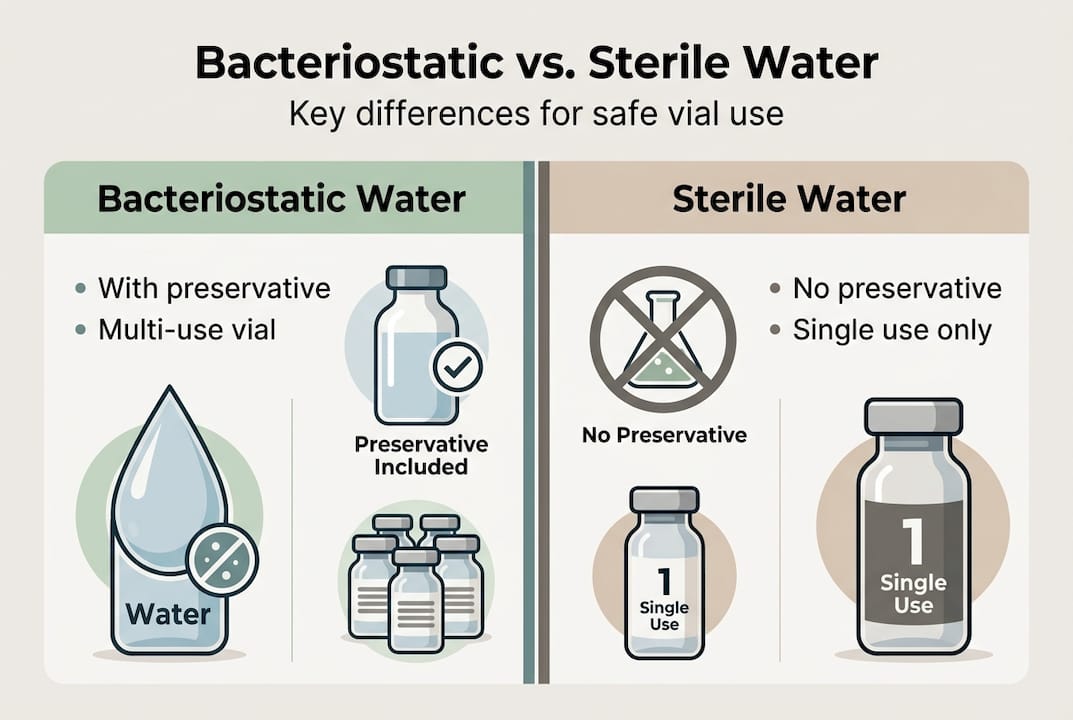
Bacteriostatic water is sterile water for injection that contains 0.9% benzyl alcohol as a preservative. That single ingredient changes everything about how the product behaves after you first puncture the stopper. The bacteriostatic water explained guide on Herbilabs walks through the full chemistry, but the short version is this: benzyl alcohol actively suppresses bacterial growth inside the vial, buying you repeated safe access over time.
Sterile water for injection contains no preservative. It is designed for one access, one use, and immediate discard. Once you puncture the septum of a sterile water vial, airborne microorganisms and contact contamination can enter freely, with nothing inside the solution to stop them multiplying.
Bacteriostatic vs sterile water differences matter enormously at the bench. Here is a direct comparison:
| Feature | Bacteriostatic water | Sterile water |
|---|---|---|
| Preservative | 0.9% benzyl alcohol | None |
| Multi-dose use | Yes, up to 28 days | No, single use only |
| Post-puncture safety | Extended with aseptic technique | Immediate discard required |
| Peptide reconstitution | Commonly used | Limited, high contamination risk |
| Typical vial sizes | 10 mL, 30 mL | 2 mL, 5 mL, 10 mL |
The practical implications for independent researchers are significant. Bacteriostatic water is multi-dose use up to 28 days, which means a single 30 mL vial can support multiple reconstitution sessions across weeks of work without compromising research integrity, provided your technique is solid.
Here is what that multi-use design is specifically suited for:
- Peptide reconstitution across multiple sessions from a single source vial
- Sequential dilutions in protocols that require repeated additions of diluent
- Small-volume withdrawals across several days without opening a new vial each time
- Cost efficiency in home research environments where reagent waste is a real concern
Sterile water, by contrast, is used when benzyl alcohol would interfere with a specific assay or reagent interaction. Knowing which to reach for is foundational. Getting it wrong is not just an efficiency issue; it is a safety and reproducibility issue.
Can you safely reuse a bacteriostatic water vial?
Yes, with a clear and non-negotiable set of conditions. Vials can be reused up to 28 days if proper aseptic techniques are used. That 28-day window is not arbitrary. It reflects the measured duration over which benzyl alcohol maintains effective bacteriostatic activity after the vial seal is first broken.
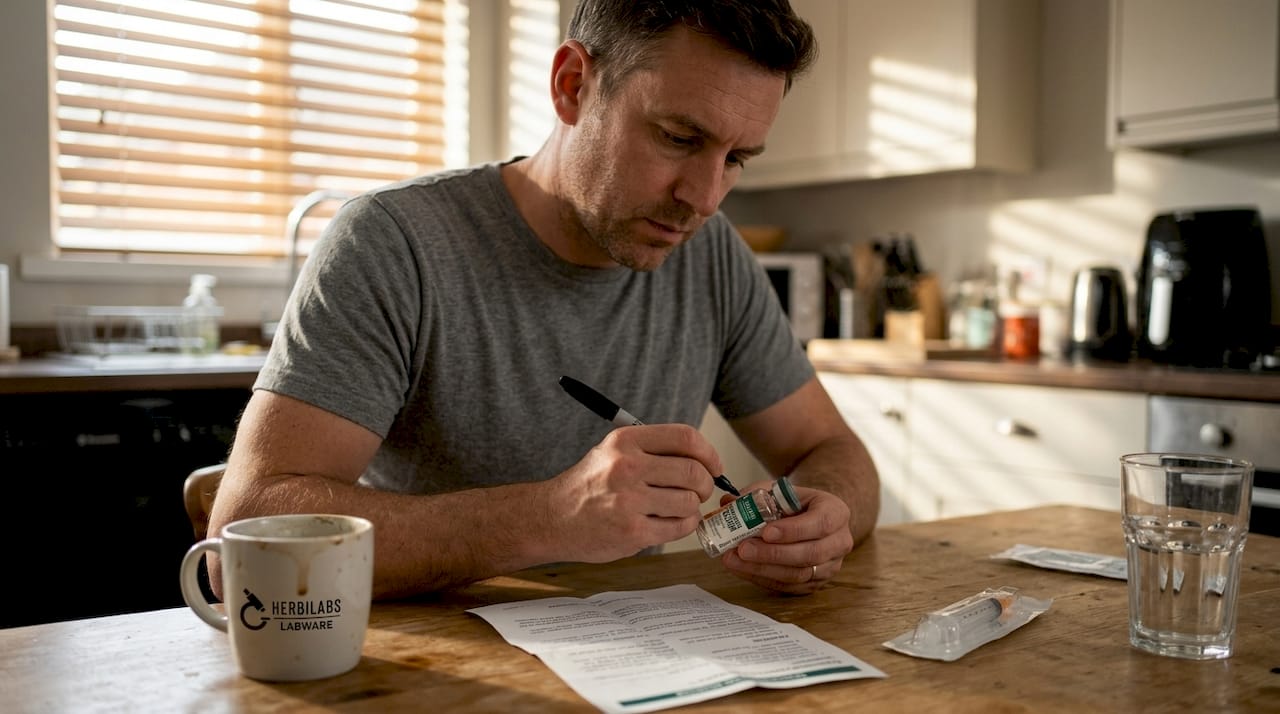
But the 28-day rule is the ceiling, not the guarantee. The guarantee comes from your technique, your environment, and your attentiveness every single time you access the vial.
Here is what must happen on every access to keep reuse genuinely safe:
- Check the vial’s discard date before you even uncap the needle. If the date has passed, stop.
- Inspect the solution visually in good lighting. It should be completely clear and colorless.
- Wipe the rubber stopper with a fresh 70% isopropyl alcohol swab and allow it to dry fully.
- Use a new sterile syringe and needle every single time. No exceptions, no reusing needles.
- Withdraw your volume using a slow, controlled draw to minimize particulate disturbance.
- Cap the needle immediately after use and store the vial properly.
The risks of skipping any of these steps are not theoretical. Contamination introduced through a reused needle or an unwiped stopper will not always produce visible changes in the solution right away. That is the danger. You can inoculate a vial with organisms and not see cloudiness until hours later, by which point you may have already used the contaminated solution.
Review the bacteriostatic water shelf life data to understand how preservative action degrades over time. And bookmark the bacteriostatic water FAQs for quick reference when you’re mid-protocol.
| Access number | Risk level | Key check |
|---|---|---|
| 1st puncture | Lowest | Confirm sterility before use |
| 2nd to 5th | Low, if technique is correct | Wipe stopper, fresh needle always |
| 6th and beyond | Moderate | Strict visual check each time |
| Post 28 days | High, discard regardless | Do not use |
Pro Tip: Write the date of first puncture directly on the vial label in permanent marker the moment you open it. If you’re working across multiple vials, number them. Confusion between vials is one of the most common and avoidable errors in home research settings.
Best practices for safe reuse: lab and home environments
Having the right information is one thing. Executing it consistently under real-world conditions is another. Whether you work in a dedicated lab or at a clean home bench, the following practices are non-negotiable for safe vial reuse.
Step-by-step reuse protocol:
- Confirm the label shows a bacteriostatic water designation and an in-use discard date that has not passed.
- Prepare your workspace by wiping the surface with 70% isopropyl alcohol and allowing it to dry before placing any equipment down.
- Wash your hands thoroughly and put on nitrile gloves before handling the vial or syringe.
- Wipe the vial stopper with a fresh alcohol swab using a single, firm stroke. Do not scrub back and forth.
- Attach a new needle to a new syringe. Remove packaging only at the point of use.
- Insert the needle at a slight angle, draw your required volume, and remove the needle cleanly.
- Store the vial immediately in a cool, dry location away from direct sunlight. Proper storage between uses maintains sterility for up to 28 days.
For home users, one additional rule applies firmly: one vial per user. Sharing a multi-dose vial between users, even family members or lab partners, multiplies contamination risk in ways that aseptic technique alone cannot fully mitigate.
Pro Tip: If you’re using bacteriostatic water for peptide reconstitution, reconstitute into the peptide vial rather than drawing the peptide out repeatedly. This minimizes the total number of accesses to your bacteriostatic water vial and reduces cumulative risk across your protocol.
A detail many researchers overlook is needle gauge. A finer needle creates a smaller puncture in the rubber stopper, which reduces the mechanical degradation of the septum over repeated entries. After too many punctures, the stopper itself becomes a contamination vector through coring, tiny fragments of rubber entering the solution. Visually inspect the stopper surface periodically. If it looks rough or pitted, discard the vial regardless of the date.
When should you discard a reused bacteriostatic water vial?
Knowing when to stop is just as important as knowing how to proceed. The following signs mean immediate discard, no second-guessing:
- Cloudiness or turbidity in a solution that should be perfectly clear
- Any visible particles floating or settled at the bottom of the vial
- A change in color, even a faint yellow or gray tint
- An unusual odor when the stopper is accessed
- Physical damage to the vial, including cracks, chips, or a deeply pitted stopper
- Crossing the 28-day mark, regardless of how much solution remains
That last point deserves emphasis. Discard the vial after 28 days or sooner if signs of contamination are present. It does not matter if you have 20 mL left. The preservative is not performing its function reliably after that window, and no amount of careful technique compensates for diminished benzyl alcohol activity.
Research note: Contamination in bacteriostatic water is not always visible. Microbial growth can begin before turbidity develops. A vial that looks fine can carry organisms in numbers high enough to compromise your reagent or experiment. Never rely on visual inspection alone as proof of safety. The facts about bacteriostatic water discard reinforce why timeline adherence is the primary safeguard.
Another commonly missed discard trigger is temperature excursion. If your vial was left out in a warm room, near a window, or accidentally exposed to heat, the degradation of benzyl alcohol accelerates. Heat-exposed vials should be discarded even if they are within the 28-day window and look visually clear.
Build a discard log if you manage multiple vials. A simple spreadsheet with vial ID, first puncture date, and discard date prevents the confusion that leads to expired vials staying in rotation.
The overlooked reality: Reuse is about risk management, not just guidelines
Here is something the standard protocol guides rarely say out loud: the 28-day window is the maximum a well-handled vial can last, not a promise that yours will last that long. Most contamination events we see in research contexts do not happen at day 25. They happen at day 3, because someone reused a needle once, skipped an alcohol wipe because they were in a hurry, or handled a vial without gloves.
The guidelines are necessary scaffolding. But they do not protect you from yourself. The real discipline of safe reuse is self-honesty. Did you actually wipe the stopper, or did you just think about it? Was the needle genuinely new, or did it touch a non-sterile surface before insertion?
At Herbilabs, we see researchers fixate on the 28-day number while the actual vulnerability is in their daily insights on lab safety habits. Our position is straightforward: if you’re not certain your technique was correct, discard and start fresh. The cost of a new vial is nothing compared to the cost of a ruined peptide batch or a compromised experiment result.
Find high-quality bacteriostatic water and labware
Getting the technique right starts with using a product you can trust at the source. If your bacteriostatic water carries inconsistent purity or uncertain benzyl alcohol concentration, no amount of perfect aseptic technique will fully protect your research.
At Herbilabs, we manufacture to strict research-grade standards with rigorous quality control at every stage. Whether you need quick answers on bacteriostatic water for your specific protocol, detailed guidance on storing bacteriostatic water between sessions, or you’re ready to stock up on verified product, you can browse labware shop and find exactly what your research demands. Trusted by independent researchers and institutions across the UK and Europe.
Frequently asked questions
How many times can you reuse a vial of bacteriostatic water?
A bacteriostatic water vial can be used repeatedly for up to 28 days after initial puncture, if proper aseptic technique is followed on every access. Multi-dose vials remain safe for 28 days post-opening with correct usage.
What are the signs that bacteriostatic water is contaminated?
Changes in clarity, color, cloudiness, or any strange odor indicate possible contamination; discard the vial immediately if noticed. Physical or visual changes are primary warning signs that should never be ignored.
Is it safe to share a bacteriostatic water vial between users?
No. Using the same vial for multiple users increases contamination risks significantly and is strongly discouraged outside supervised lab environments. Single-user access is advised to minimize contamination risk at every stage.
Can bacteriostatic water be used after the 28-day window?
No. After 28 days, the preservative is no longer effective and the risk of microbial contamination rises significantly. Use after 28 days is not recommended due to diminishing preservation activity.
Do you need to refrigerate bacteriostatic water after opening?
Most vials do not require refrigeration but should be stored in a cool, dry place away from sunlight as indicated on the label. Proper storage conditions support sterility without the need for refrigeration in most standard research settings.