Private Label, White Label, Wholesale partnerships available - EU, USA and UK - Free shipping from €75

Why Is Bacteriostatic Water Cloudy After Mixing?
Bacteriostatic water should always be clear. Learn why it turns cloudy after mixing with peptides, what causes it, and when to discard for safe research.
TL;DR:
- Clear, colorless bacteriostatic water is essential; cloudiness indicates contamination or degradation.
- Proper technique, temperature matching, and quality sourcing prevent cloudiness during peptide reconstitution.
- Always discard solutions that turn cloudy; adhere to the 28-day opening safety guideline.
Even seasoned peptide researchers do a double-take the first time they pull a syringe and find their freshly mixed vial looking hazy instead of crystal clear. Bacteriostatic water is supposed to be just that: clear, colorless, and visually indistinguishable from purified water. When it isn’t, the instinct to push forward anyway is surprisingly common and genuinely risky. This guide breaks down exactly why cloudiness appears after mixing, what each type of haziness signals, and what your next move should be depending on the cause. Whether you’re troubleshooting a single batch or building tighter protocols, the information here will help you make a fast, informed call.
Table of Contents
- Understanding bacteriostatic water: Properties and clarity standards
- Common causes of cloudiness after mixing with peptides
- Edge cases and advanced troubleshooting
- When to discard and how to prevent future problems
- Why most people get cloudy BAC reconstitution wrong: A researcher’s take
- Find reliable solutions and trusted labware for peptide research
- Frequently asked questions
Key Takeaways
| Point | Details |
|---|---|
| Clarity is critical | Any cloudy, hazy, or particulate BAC solution should be discarded. |
| Proper technique matters | Gentle mixing and temperature control minimize cloudiness risks. |
| Some peptides need special handling | Hydrophobic peptides or incompatible solvents may require alternatives like acetic acid. |
| Discard after 28 days | Apply the 28-day rule post-opening, regardless of solution appearance. |
Understanding bacteriostatic water: Properties and clarity standards
Bacteriostatic water (BAC) is sterile water for injection containing 0.9% benzyl alcohol as a preservative. The benzyl alcohol inhibits microbial growth, which is why a multi-dose vial can be accessed repeatedly over time without the same contamination risk as plain sterile water. If you want a full breakdown of its properties and lab applications, the what is bacteriostatic water guide covers every angle. The key thing to understand for this discussion: BAC exits the manufacturing process as a perfectly clear, colorless solution. That clarity is not cosmetic. It is a direct indicator of chemical integrity.
The standard for injectable solutions is unambiguous. Any cloudiness, particulate matter, or color change in BAC is a disqualifying finding before use. This is not a subjective call left to the researcher. USP and CDC guidelines state clearly: discard any solution that appears cloudy, hazy, or contains particles. The logic is straightforward. A change in visual clarity signals that something has entered or changed within the solution, whether that is microbial growth, chemical degradation, protein aggregation, or contamination from outside sources.
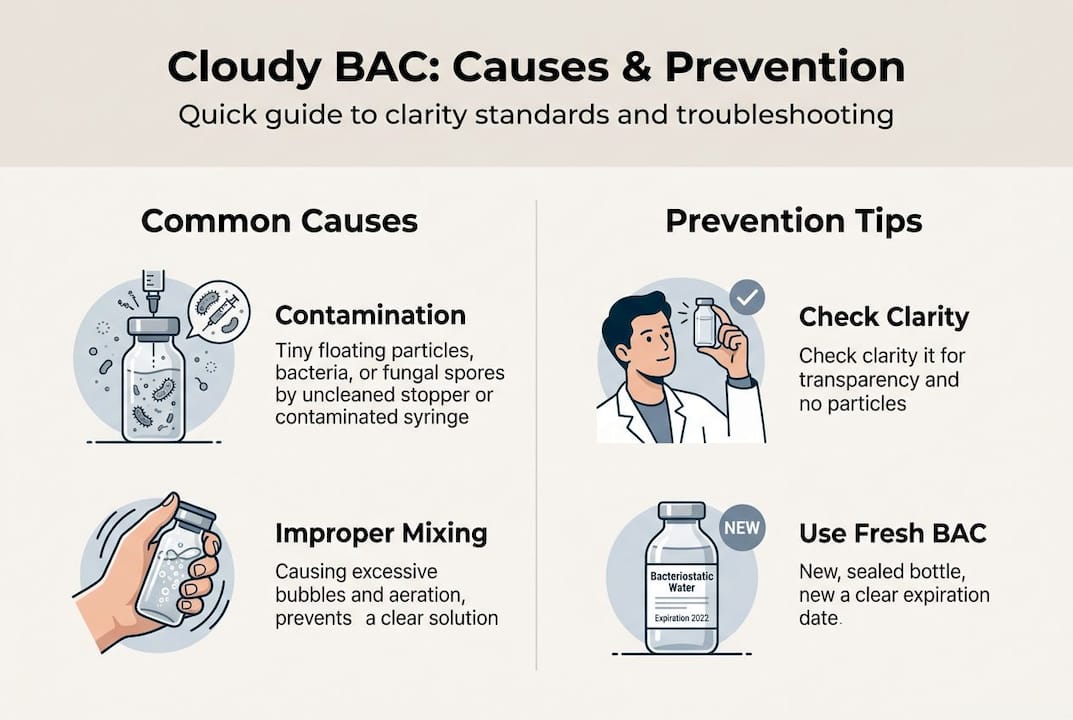
As one widely cited reference puts it, bacteriostatic water must always be perfectly clear and colorless; cloudiness means contamination or degradation. That standard applies both to the BAC before mixing and to the final reconstituted solution after a peptide is added.
Compare BAC to plain sterile water, and the differences in application are significant. For a side-by-side breakdown of their use cases, see BAC vs sterile water. For clarity assessment specifically, both share the same visual standard: crystal clear or discard.
Clarity states at a glance:
| Visual appearance | What it means | Action |
|---|---|---|
| Clear, colorless | Normal, acceptable | Proceed with protocol |
| Slight haze, no particles | Possible early issue | Rest, inspect again |
| Cloudy or milky | Contamination or aggregation | Discard immediately |
| Visible particles or color | Definite contamination | Discard immediately |
Key markers that require immediate discard:
- Any visible floating particles, even fine ones
- A milky or opaque appearance after mixing
- An unexpected color (yellow tint is a common early degradation signal)
- Persistent cloudiness that does not clear after 10 minutes of gentle rest
With the importance of clarity established, let’s explore what causes cloudiness after mixing.
Common causes of cloudiness after mixing with peptides
Now that we know clarity is essential, let’s uncover the science and handling errors that turn solutions cloudy. The causes break into two broad categories: technique errors and inherent peptide properties. Both are worth understanding because the fix is completely different for each.
Cloudiness after mixing usually results from improper technique, peptide aggregation, incompatible solvent, or degraded BAC. Let’s go through the most common triggers researchers encounter:
Technique errors that trigger cloudiness:
- Injecting BAC forcefully directly onto the lyophilized peptide cake instead of along the vial wall
- Shaking the vial vigorously instead of gently swirling
- Using BAC straight from the refrigerator when the peptide is at room temperature, causing a thermal shock that can disrupt solubility
- Skipping the rest period after reconstitution
Peptide-specific factors:
Some peptides are inherently hydrophobic, meaning they resist dissolving in water-based solvents. When a hydrophobic peptide encounters BAC, partial aggregation can occur almost immediately, producing a cloudy appearance that has nothing to do with contamination. This is a real-world issue that community troubleshooting examples highlight regularly with peptides like retatrutide. The peptide’s concentration also matters: a high peptide-to-solvent ratio pushes the solution closer to its solubility limit, where even minor disturbances cause aggregates.
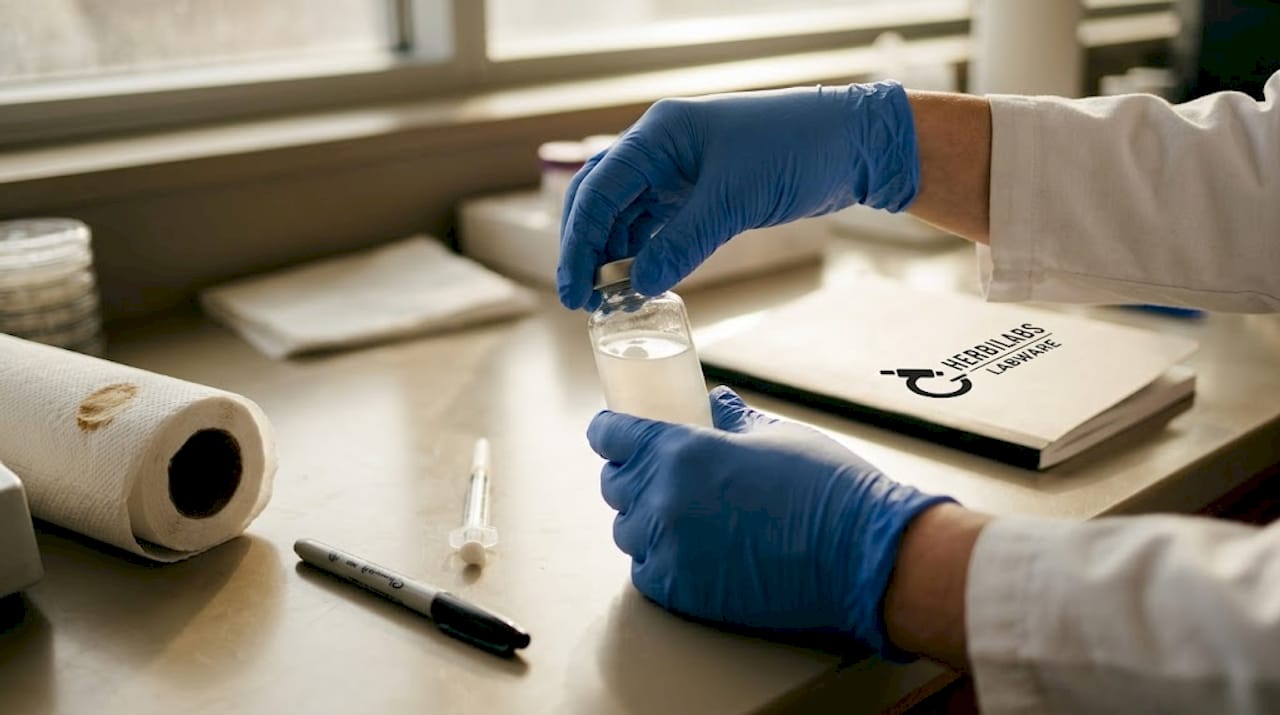
The quality of your BAC itself is another variable. Low-quality or improperly stored BAC may have already begun degrading before it reaches your bench. Checking BAC shelf life expectations before you mix is a habit worth developing.
Proper vs. improper mixing methods:
| Method | Result |
|---|---|
| Inject BAC slowly along vial wall | Minimal disruption, clear solution |
| Inject BAC directly onto peptide | Mechanical stress, aggregation risk |
| Gently swirl until dissolved | Even mixing, preserved structure |
| Vigorous shaking | Foam, denaturation, cloudiness |
| BAC and peptide at matching temperatures | Smooth dissolution |
| Cold BAC into warm peptide | Thermal mismatch, haze risk |
Step-by-step mixing process to prevent cloudiness:
- Remove both vials from storage and let them reach room temperature, approximately 20 to 25 minutes.
- Wipe both vial tops with an alcohol swab and let dry.
- Draw the calculated volume of BAC into your syringe.
- Insert the needle into the peptide vial at an angle and direct BAC slowly down the inner glass wall.
- Remove the needle and let the vial rest undisturbed for 5 to 10 minutes.
- Gently swirl (never shake) until the lyophilized material fully dissolves.
- Hold the vial up to light and inspect before drawing any dose.
Pro Tip: Before every use, hold the vial up against a white background and a bright light source. Even fine particulate matter becomes visible with this simple check. If you see anything floating, the vial is done.
Edge cases and advanced troubleshooting
Not all causes of cloudiness are solved by better mixing; some require expert troubleshooting and advanced tactics. If you’ve followed proper technique and switched to fresh BAC but cloudiness persists, the issue is almost certainly peptide-specific or source-related.
When mild cloudiness may be reversible:
- If the haziness appeared right after mixing but the vial was cold, allow it to rest at room temperature for 15 minutes and inspect again.
- If concentration was high, try gently adding a small additional volume of BAC to dilute slightly, swirl, and observe.
- If the peptide is known to be hydrophobic, a small amount of dilute acetic acid (0.1% to 1%) as a pre-solubilization step before adding BAC can dramatically improve solubility.
Important: Acetic acid pre-treatment is a technique used specifically for hydrophobic peptides. It is not a substitute for quality BAC and it does not salvage contaminated solutions.
Risks of sourcing BAC from unreliable suppliers:
One of the more frustrating situations in peptide research is discovering that the BAC itself is the problem. Bad BAC from Amazon and similar unvetted platforms has been a recurring issue in the research community, with users reporting persistent cloudiness that only resolved after switching to pharmaceutical-grade BAC from a reputable source. Bacterial contamination introduced during poor manufacturing, incorrect pH, or improper packaging can all produce a solution that looks acceptable in the vial but turns hazy the moment it contacts your peptide.
- Buy BAC only from suppliers who manufacture under controlled conditions with documented quality control
- Confirm the product is specifically labeled for research or injection use, not a generic water product
- Follow proper peptide storage practices to avoid compounding BAC quality issues with storage-related peptide degradation
- Never use BAC from a vial with a damaged seal, unusual smell, or any prior sign of cloudiness
Pro Tip: If cloudiness persists after you’ve troubleshot technique, temperature, and concentration, the next step is to replace the BAC entirely before assuming the peptide is at fault. Substandard BAC is more common than most researchers expect.
When to discard and how to prevent future problems
With troubleshooting covered, let’s clarify when to throw out a solution and how to make sure it stays clear next time.
Stepwise discard and inspection procedure:
- After reconstitution, hold the vial against bright light and a white background.
- Gently tip the vial and observe whether any particles float or swirl.
- Check for any haze at the liquid-air interface, a subtle sign often missed.
- If the solution is clear, proceed. If any doubt exists, rest for 10 to 15 minutes and reinspect.
- If cloudiness is still present, do not use the solution. Discard immediately.
- Record the date of opening on every BAC vial.
The consensus is firm on this point: discard if hazy or cloudy, even if you cannot identify the exact cause. Clarity is necessary but not sufficient proof of safety, which means a clear solution can still carry risks, but a cloudy one always does.
The 28-day rule: The 28-day rule for opened BAC is non-negotiable. After 28 days, the preservative efficacy of benzyl alcohol cannot be relied upon to maintain sterility, regardless of appearance. Date your vials. Follow the rule. There is no exception worth the risk.
Key preventative habits:
- Source BAC only from verified, research-grade suppliers
- Equilibrate all vials to room temperature before mixing
- Use proper slow-injection technique along the vial wall
- Store reconstituted solutions refrigerated at 2 to 8°C and protect from light
- Review storing bacteriostatic water protocols periodically, especially when onboarding new lab members
- Inspect every vial at every use, not just at the time of reconstitution
A clear solution today can become cloudy tomorrow if storage conditions change. The habit of checking before every draw is what separates careful researchers from those who encounter preventable problems.
Why most people get cloudy BAC reconstitution wrong: A researcher’s take
The most persistent misconception in peptide reconstitution is that cloudiness is only a dealbreaker when it’s obvious. Researchers will accept a “slight haze” because the peptide is expensive, the batch was hard to source, or they’ve convinced themselves the cloudiness will clear on its own. It usually doesn’t. And even when it does, you have no way to confirm what caused it or whether it resolved completely.
The guides tell you to discard cloudy solutions. What they don’t tell you is that the temptation to rationalize is strongest precisely when the stakes feel highest. That’s the real hazard. At Herbilabs, we’ve seen this pattern repeatedly: researchers who follow every other protocol correctly cut corners on visual inspection because they’re confident in their sourcing.
Clarity can also be misleading in the other direction. A clear solution is not guaranteed to be safe, which is why sourcing, handling, and storage all matter even when the vial looks perfect. Experienced researchers build redundancy into their protocols: they verify the BAC source, follow mixing technique to the letter, and treat the 28-day discard rule as a hard deadline rather than a guideline. The protocol exists because visual inspection alone is never enough.
Find reliable solutions and trusted labware for peptide research
Getting consistent clarity in your reconstituted peptide solutions starts before you ever pick up a syringe. It starts with the quality of your BAC.

At Herbilabs, we manufacture bacteriostatic water to strict research-grade purity standards, with documented quality control at every production stage. If you want to understand BAC fully before ordering, the BAC complete guide is the right starting point. For step-by-step protocols on keeping your solutions clean and consistent, safe peptide solution prep covers the practical side. And when you’re ready to stock your lab with verified supplies, browse the full range at our shop labware page. Reliable results start with reliable inputs.
Frequently asked questions
Should I use bacteriostatic water if it turns cloudy after mixing?
No. Any solution that becomes cloudy after mixing must be discarded, as cloudiness means discard according to established guidelines. It may indicate contamination, aggregation, or a procedural error that cannot be reversed.
What are safe techniques to prevent cloudiness when mixing peptides?
Inject BAC slowly along the inner vial wall rather than directly onto the peptide, and gently swirl rather than shake. Proper technique prevents aggregation, foam formation, and the mechanical stress that leads to cloudiness.
Why does cloudiness persist even after using new BAC and careful mixing?
Some peptides are inherently hydrophobic and resist dissolving in standard BAC. Hydrophobic peptides may need acetic acid pre-treatment, and persistent cloudiness despite good technique can also indicate impurities in the peptide itself.
Does storing bacteriostatic water at room temperature impact clarity?
Temperature mismatches between BAC and the peptide vial are a known cause of initial cloudiness. Room temp equilibration prevents thermal shock, and reconstituted solutions should always be refrigerated between uses.
How long can I keep BAC after opening if it remains clear?
Even if visually clear, opened BAC must be discarded after 28 days. The 28-day rule for opened bacteriostatic water is a firm safety boundary, not an estimate.
Recommended
- What is the Composition of Bacteriostatic Water? – #1 hack to know – Herbilabs Labware
- Is Bacteriostatic Water Safe? #1 hack Labs Need to Know – Herbilabs Labware
- What is Bacteriostatic Water? Best 2025 Guide for Labs in Europe – Herbilabs Labware
- Bacteriostatic Water FAQs: Things professional Researchers Like To Ask in 2025 – Herbilabs Labware