Private Label, White Label, Wholesale partnerships available - EU, USA and UK - Free shipping from €75

Reconstitution Procedures: Why They Matter in Research
Discover the importance of reconstitution procedures in research. Ensure your peptides remain bioactive for reliable and valid results.
TL;DR:
- Reconstitution is the precise process of transforming lyophilized peptides or powders into stable, bioactive liquid forms essential for research and therapy. Proper technique, solvent selection, and regulatory compliance are critical to prevent peptide degradation, ensure reproducibility, and avoid medication errors. Following structured protocols and documenting every step improve peptide stability, data validity, and patient safety in clinical applications.
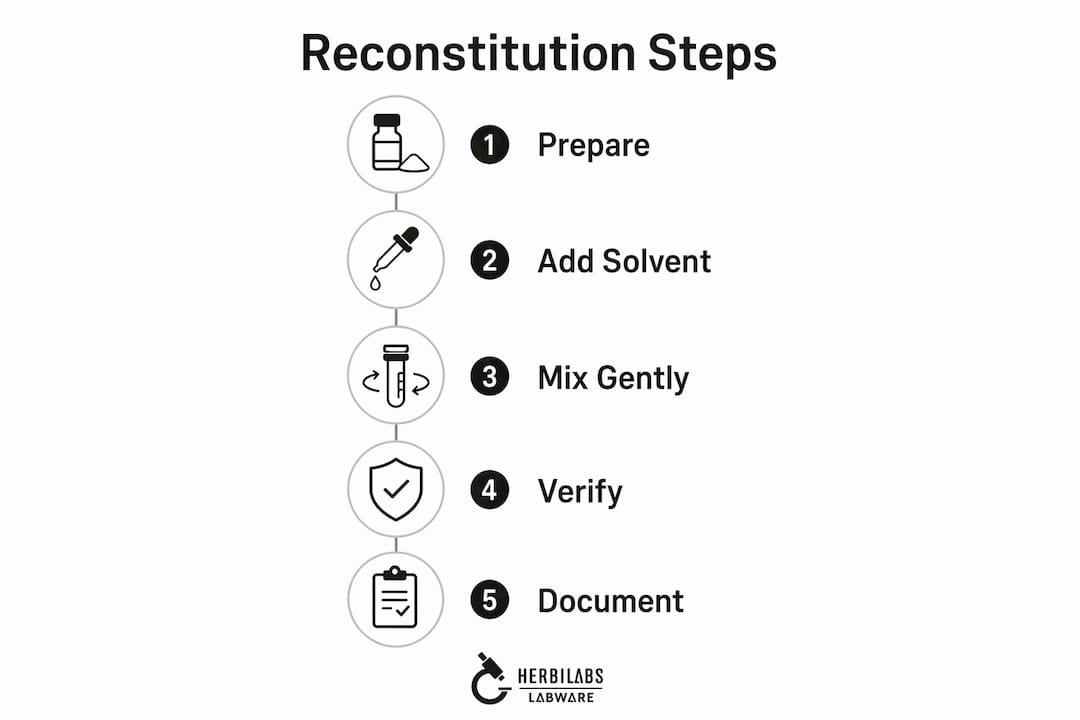
Reconstitution is the precise process of converting lyophilized peptides or powdered injectable medicines into stable, bioactive liquid forms required for effective research and therapeutic use. The importance of reconstitution procedures extends far beyond simply adding water to a vial. Every variable, from solvent selection to injection technique, directly determines whether your peptide retains its biological activity or becomes useless before the first assay. This guide covers the chemical principles, procedural standards, and risk frameworks that define reliable reconstitution in biomedical research.
Why do reconstitution procedures matter for peptide research?
Reconstitution procedures are the single most consequential step between a lyophilized peptide and a valid experimental result. Lyophilized peptides remain stable in their dry state, but the moment moisture contacts the powder, degradation begins if the protocol is incorrect. Vacuum-sealed or inert gas-sealed vials prevent oxidation and humidity ingress until reconstitution begins. That protection disappears the instant you breach the vial.
The downstream consequences of poor technique are not subtle. A denatured peptide does not produce a failed assay with an obvious error message. It produces data that looks plausible but is wrong. That outcome is far more damaging to a research program than a clearly failed experiment.
Regulatory bodies including the FDA, EMA, and MHRA all specify stability and efficacy requirements that directly shape how reconstitution protocols are designed for biologics and vaccines. In-use stability studies determine acceptable use intervals after reconstitution to confirm product safety and potency. Those intervals are not conservative suggestions. They are the outer boundary of reliable data.

How does the role of reconstitution solutions affect peptide integrity?
The reconstitution solution is not a neutral carrier. It is an active chemical environment that either supports or degrades the peptide from the first second of contact. Choosing the correct solution prevents analyte degradation, microbial contamination, and assay interference. Generic sterile water is not always appropriate, and using it by default is one of the most common errors in peptide research.
The main variables to control in any reconstitution solution are:
- pH compatibility: Peptides with charged residues are sensitive to pH shifts. Phosphate-buffered saline (PBS) at pH 7.4 is appropriate for many cell-based assays, while acidic peptides may require dilute acetic acid as the initial solvent.
- Microbial safety: Single-use sterile water for injection eliminates bacterial risk for one-time preparations. Multi-use vials require bacteriostatic water, which contains 0.9% benzyl alcohol to inhibit bacterial growth between draws.
- Chemical compatibility: Organic cosolvents like DMSO or acetonitrile are sometimes necessary for hydrophobic peptides but must be diluted to non-toxic concentrations before use in cell assays.
- Temperature at reconstitution: Cold solvents slow dissolution and can cause aggregation in some peptide classes. Room temperature is the standard starting point unless the protocol specifies otherwise.
In LC-MS and cell-free assays, the choice of reconstitution solution can be the difference between reproducible results and compromised data. That is not an exaggeration. Residual ion-pairing agents from HPLC purification can interfere with mass spectrometry signals if the reconstitution buffer is not matched to the downstream method.
Pro Tip: If your peptide resists dissolution in aqueous buffers, dissolve it first in a minimal volume of DMSO, then dilute stepwise with your aqueous solvent. This prevents aggregation and preserves secondary structure.
How do proper reconstitution procedures minimize medication errors?
Medication errors during reconstitution are a documented patient safety risk in clinical settings. Advanced reconstitution systems reduce medication errors by ensuring correct dilution of lyophilized therapeutics, providing consistent dosing accuracy and minimizing preparation errors during dilution and injection. These systems matter most in high-throughput clinical environments where manual preparation introduces variability.
The NHS Specialist Pharmacy Service (NHS SPS) has formalized this risk through a structured assessment framework. The following steps reflect the NHS SPS approach to safe reconstitution in clinical areas:
- Identify the preparation. Classify the injectable medicine by type, concentration, and intended route of administration.
- Score the risk. Apply the NHS SPS risk matrix, which evaluates factors including complexity of preparation, consequences of error, and frequency of preparation.
- Determine the preparation location. Preparations scoring 8 or above are classified as high-risk and require either mitigation measures or transfer to an aseptic unit.
- Document the assessment. Record the risk score, rationale, and any mitigation steps taken before preparation begins.
- Review periodically. Risk scores must be reassessed when formulations, staff, or equipment change.
“Implementing formal risk assessments with strict mitigation protocols contributes significantly to patient safety in injectable medicine preparation.” — NHS SPS
This framework applies directly to research settings as well. Any lab preparing injectable peptide solutions for in vivo studies operates under comparable risk conditions and benefits from the same structured approach.
What are the common pitfalls in peptide reconstitution?
The most damaging mistakes in peptide reconstitution are mechanical, not chemical. Researchers who understand pH and buffer selection still routinely destroy peptide samples through poor injection and mixing technique.
The core pitfalls to avoid are:
- Direct powder injection: Directing the diluent stream straight onto the peptide cake breaks peptide chains through shear force. The side-wall injection method is the standard technique. You direct the solvent against the inner wall of the vial, allowing it to run down gently and contact the powder without mechanical disruption.
- Shaking the vial: Agitation causes aeration and denaturation that compromises research validity. Proper mixing means gentle swirling or slow rotation, not vortexing or vigorous shaking.
- Rushing dissolution: Some peptides require several minutes to dissolve completely. Forcing the process by adding heat or agitation introduces structural damage. Let the vial sit undisturbed after adding solvent, then swirl gently.
- Ignoring reconstitution volume: Adding too little solvent produces a concentration that exceeds the peptide’s solubility limit, causing aggregation. Use a peptide calculator to confirm target concentration before you begin.
- Skipping vial equilibration: Moving a cold vial directly from the freezer to room-temperature solvent creates condensation inside the vial. Allow the sealed vial to reach room temperature before opening.
Pro Tip: After adding solvent via the side-wall method, place the vial on a laboratory roller mixer at low speed for 10–15 minutes rather than swirling by hand. This produces consistent, gentle dissolution without introducing air bubbles.
Reviewing common lab reconstitution errors before establishing a new protocol can prevent the most frequent sources of sample loss in peptide research.
How do regulatory guidelines shape reconstitution practices?
Regulatory frameworks from the FDA, EMA, and MHRA define the minimum acceptable standards for reconstitution in both clinical and research contexts. These agencies do not treat reconstitution as a minor procedural detail. They treat it as a critical quality attribute of the final preparation.
| Regulatory Body | Key Requirement | Application |
|---|---|---|
| FDA | In-use stability data required for multi-dose biologics | Determines post-reconstitution shelf life for injectable drugs |
| EMA | Aseptic preparation standards for high-risk reconstitution | Governs manufacturing and clinical pharmacy environments |
| MHRA | GMP compliance for reconstituted injectable medicines | Applies to UK-based research and clinical preparation sites |
| NHS SPS | Risk matrix scoring for all injectable reconstitution | Guides preparation location decisions in NHS clinical areas |
The NHS SPS 2026 updated guidelines reinforce that preparations with complex dilution steps or high error consequences must be prepared in licensed aseptic units rather than clinical areas. This distinction matters for research labs that prepare injectable peptide solutions for animal studies. The same logic applies: higher complexity requires higher environmental controls.
Documentation is not optional under any of these frameworks. Every reconstitution event in a regulated environment requires a record of the solution used, the volume added, the time of preparation, and the identity of the preparer. For research labs pursuing publication, this documentation also supports reproducibility claims in methods sections.
Comparing the top reconstitution solutions for research
Selecting the right solvent is a decision that affects stability, safety, and downstream compatibility. The table below compares the most widely used reconstitution solutions in biomedical research settings.
| Solution | Best Use Case | Key Advantage | Limitation |
|---|---|---|---|
| Bacteriostatic water (0.9% benzyl alcohol) | Multi-use peptide vials, repeated sampling | Inhibits bacterial growth between draws | Not suitable for neonates or benzyl alcohol-sensitive preparations |
| Sterile water for injection | Single-use preparations, sensitive assays | No additives, minimal interference | No antimicrobial protection after opening |
| Phosphate-buffered saline (PBS) | Cell-based assays, in vivo studies | Physiological pH and osmolarity | May cause precipitation with some peptides |
| Dilute acetic acid (0.1%) | Hydrophobic or aggregation-prone peptides | Improves solubility of difficult sequences | Requires neutralization before cell-based use |
| DMSO/aqueous blend | Highly hydrophobic peptides | Dissolves sequences resistant to aqueous solvents | Cytotoxic above 0.1% in cell assays |
Bacteriostatic water is the preferred choice for multi-use research vials because it provides microbial protection across multiple draws without requiring single-use aliquoting. For guidance on storing reconstitution solutions safely, including temperature requirements and shelf-life considerations after opening, Herbilabs provides a dedicated lab guide for researchers.
Key takeaways
Reconstitution procedure quality determines whether a lyophilized peptide delivers valid, reproducible data or produces results that cannot be trusted.
| Point | Details |
|---|---|
| Solution selection is critical | Match the reconstitution solvent to peptide chemistry, assay type, and vial use pattern. |
| Mechanical technique matters | Use the side-wall injection method and gentle swirling to prevent shear-induced denaturation. |
| Risk scoring guides location | NHS SPS scores of 8 or above require aseptic unit preparation or formal mitigation. |
| Regulatory compliance is mandatory | FDA, EMA, and MHRA all require in-use stability data and documentation for reconstituted injectables. |
| Bacteriostatic water suits multi-use vials | Its benzyl alcohol content inhibits bacterial growth between draws, making it the standard for repeated sampling. |
Why reconstitution reproducibility is the metric that matters
I have reviewed enough failed peptide studies to identify a pattern. The experiment design is sound, the peptide sequence is correct, and the assay is validated. The results are still inconsistent across replicates. When you trace the variance back to its source, reconstitution technique is the culprit more often than any other variable.
The uncomfortable truth is that reconstitution is treated as a technician-level task in many labs. It gets delegated without written protocols, without training records, and without any verification step. That approach works until it does not, and when it fails, the failure is invisible in the data.
What I have found actually works is treating reconstitution as a critical process step with the same documentation rigor as the assay itself. That means a written SOP, a trained operator, a verified solvent source, and a record for every preparation. It also means revisiting that SOP every time a new peptide sequence is introduced, because solubility behavior varies significantly across sequences.
The NHS SPS risk matrix is a useful model even for non-clinical research labs. Scoring your preparations forces you to think explicitly about what could go wrong and where the consequences are highest. Most researchers who go through that exercise once find two or three steps in their current workflow that carry more risk than they realized.
The top sterile solutions for research are only as good as the protocol surrounding them. A research-grade bacteriostatic water product from a verified supplier eliminates one source of variability. The technique and documentation eliminate the rest.
— Ragnar
Research-grade reconstitution solutions from Herbilabs
Reliable reconstitution starts with a verified solvent. Herbilabs supplies research-grade bacteriostatic water and sterile reconstitution solutions manufactured to strict purity standards, specifically for the peptide research community across the UK and Europe.

Every Herbilabs product is produced in a dedicated facility with rigorous quality control, contaminant-free formulation, and documented sterility. Whether you need single-use sterile water or multi-use bacteriostatic water for repeated peptide sampling, Herbilabs offers the right solution for your protocol. Explore the full bacteriostatic water FAQ to find answers to the questions professional researchers ask most, or browse the Herbilabs shop for current product availability and wholesale pricing.
FAQ
What is a reconstitution process in biomedical research?
Reconstitution is the process of dissolving a lyophilized or powdered substance into a liquid solvent to produce a stable, bioactive solution. The process requires a sterile, chemically compatible solvent and controlled technique to preserve molecular integrity.
What types of reconstitution solutions are used in research labs?
The most common types include bacteriostatic water, sterile water for injection, phosphate-buffered saline, dilute acetic acid, and DMSO-aqueous blends. Selection depends on peptide chemistry, assay type, and whether the vial will be used once or multiple times.
Why is bacteriostatic water preferred for multi-use peptide vials?
Bacteriostatic water contains 0.9% benzyl alcohol, which inhibits bacterial growth between draws. This makes it the standard choice for multi-use vials where repeated needle entry would otherwise introduce contamination risk.
How does the NHS SPS risk matrix apply to reconstitution?
The NHS SPS risk matrix scores injectable preparations based on complexity and error consequence. Preparations scoring 8 or above require either formal mitigation measures or preparation in a licensed aseptic unit rather than a standard clinical or lab area.
What is the side-wall injection method and why does it matter?
The side-wall method directs solvent against the inner wall of the vial rather than directly onto the peptide powder. This prevents shear-induced denaturation by allowing the solvent to contact the powder gently, preserving the peptide’s secondary structure and biological activity.