Private Label, White Label, Wholesale partnerships available - EU, USA and UK - Free shipping from €75

Research vs Clinical Grade: Key Differences Explained
Discover the key difference between research and clinical grade materials. Learn how this understanding can impact safety and data integrity.
TL;DR:
- Research-grade materials are produced for laboratory use without full regulatory compliance, while clinical-grade materials meet cGMP standards and are certified for human use. Using research-grade materials outside their scope risks regulatory violations, safety issues, and invalid results, especially in translational studies. Verifying supplier documentation and requesting full Certificates of Analysis are essential to ensure proper grade and quality.
The difference between research and clinical grade materials is defined by manufacturing standards, regulatory compliance, purity verification, and intended application. Research-grade materials are produced for laboratory and preclinical use under general quality controls. Clinical-grade materials meet current Good Manufacturing Practice (cGMP) requirements, pass extended safety testing, and are the only legal option for human therapeutic use. Understanding this distinction protects data integrity, regulatory standing, and, in clinical contexts, patient safety. The terms are not interchangeable, and treating them as such is one of the most consequential errors a researcher can make.
What is the difference between research and clinical grade?
Research-grade materials are manufactured for in vitro assays, method development, and preclinical studies. They are not produced under full cGMP and are not subject to the regulatory inspections that govern clinical-grade production. Purity typically ranges from 95–99%, verified by HPLC and mass spectrometry. That level of purity is sufficient for most exploratory laboratory work, but it does not guarantee the safety profile required for human use.
Clinical-grade materials meet pharmacopeial specifications and undergo extended testing that includes heavy metals, residual solvents, and bacterial endotoxins. They are manufactured under full cGMP with documented batch records, validated analytical methods, and regulatory inspections at every stage. The complete documentation trail from synthesis through dispensing is a legal requirement, not a best practice. That documentation is what makes clinical-grade materials defensible in a regulatory submission.
The informal term “clinical grade” is widely used but has no single legal definition outside pharmaceutical manufacturing. The recognized industry standard for human-use materials is pharmaceutical grade, which references United States Pharmacopeia (USP) or National Formulary (NF) monographs. When researchers or suppliers use “clinical grade,” they typically mean materials that meet or approach pharmaceutical-grade standards. Treating the phrase as a regulated designation without verifying the underlying documentation is a common and costly mistake.
How do manufacturing and quality control differ between the two grades?
The manufacturing gap between research-grade and clinical-grade materials is wider than most researchers expect. Research-grade production may follow GMP-like practices internally, but it does not require third-party regulatory inspection, validated cleaning procedures, or formal change control systems. Clinical-grade manufacturing operates under full cGMP, with every deviation documented and reviewed.

| Parameter | Research grade | Clinical grade |
|---|---|---|
| Manufacturing standard | GMP-like, not inspected | Full cGMP, regulatory inspections |
| Purity verification | HPLC, MS (95–99%) | Pharmacopeial monograph, extended panel |
| Sterility testing | Minimal or absent | Mandatory, batch-by-batch |
| Endotoxin testing | Rarely performed | Required, documented |
| Documentation | Certificate of Analysis | Full validation package, batch records |
| Excipient control | Variable buffers, often PBS | Stable, FDA/EMA-approved excipients |
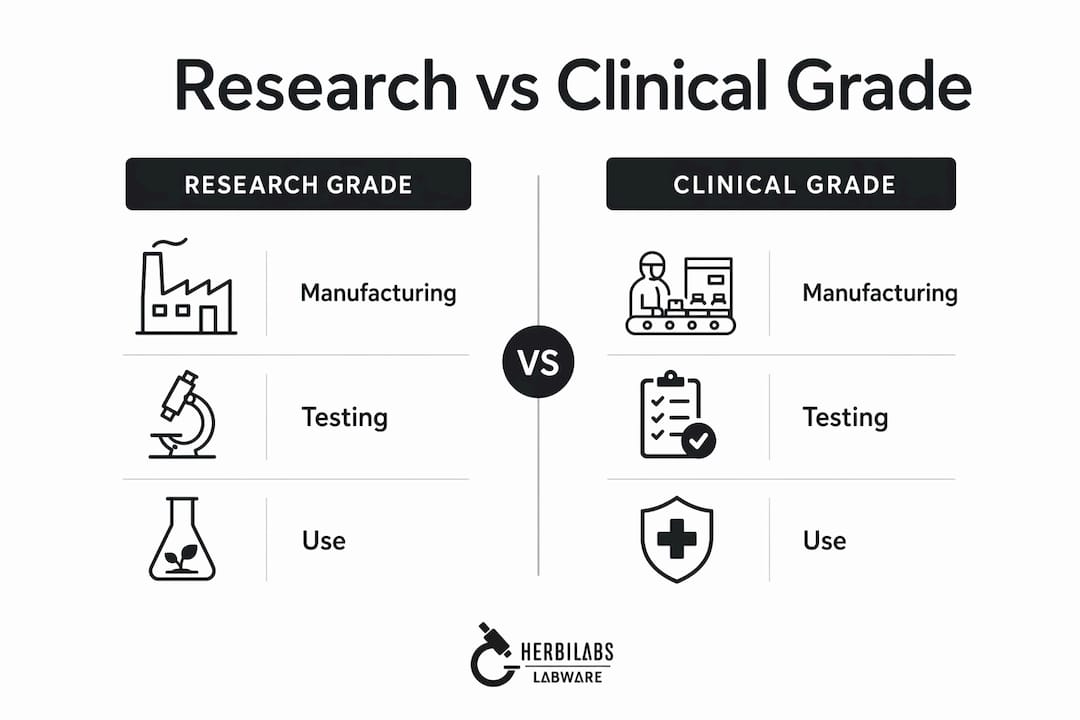
Sterility and endotoxin testing are the clearest dividing line. Clinical-grade products require batch-by-batch sterility certification and verified endotoxin levels. Research-grade products often skip both. For in vitro work, that gap rarely matters. For any study modeling human physiology or feeding into a regulatory submission, it matters enormously.
Clinical-grade monoclonal antibodies commonly reach concentrations of 5–180 mg/mL with predictable glycosylation and verified excipients. Research-grade reagents are often formulated below 1 mg/mL in phosphate-buffered saline with unknown endotoxin profiles. That formulation difference directly affects dose-response relationships and immunological assay results.
Pro Tip: Request the full Certificate of Analysis before ordering any material intended for translational studies. A single-page CoA listing only purity is a research-grade document. A clinical-grade CoA includes sterility, endotoxin, residual solvent, and heavy metal results with method validation references.
How do regulatory and legal categories affect research vs clinical grade use?
Research-grade materials carry a “For Research Use Only” (RUO) label. That designation is a legal restriction, not a suggestion. RUO-labeled products are legally prohibited from human or veterinary administration regardless of their measured purity. Using an RUO material in a human subject study violates FDA regulations and can invalidate an entire clinical program.
Clinical-grade materials follow defined regulatory pathways. In the United States, they require Investigational New Drug (IND) or Biologics License Application (BLA) filings with the FDA. In Europe, the equivalent process runs through the EMA. These filings require manufacturing data, stability studies, and clinical trial protocols. The regulatory burden is substantial, which is why clinical-grade materials cost significantly more than their research-grade counterparts.
The phrase “clinical grade” itself has no formal FDA or federal regulatory definition for non-drug products. Terms like “medical grade” and “hospital grade” carry the same problem. A supplier can print “clinical grade” on a label without any regulatory obligation to back it up. The only term with a defined pharmacopeial standard for human-use materials is pharmaceutical grade.
Key risks of using research-grade materials outside their intended scope:
- Regulatory invalidation: Data generated with RUO materials cannot support IND or BLA submissions without re-testing under cGMP conditions.
- Safety liability: Unknown endotoxin levels and unverified sterility create direct harm risk in human or animal studies.
- Data artifacts: Variable excipients and buffer compositions produce results that cannot be reproduced with clinical-grade formulations.
- Labeling violations: Administering RUO materials to humans constitutes a regulatory offense in both FDA and EMA jurisdictions.
“Clinical-grade labeling is often unregulated and used as a marketing tool. True quality must be confirmed through GMP certification, regulatory filings, and validated documentation.” — Material Truths
What practical implications do grade differences have for research and clinical development?
Grade selection directly determines whether preclinical findings translate to clinical outcomes. Research-grade materials are the correct choice for exploratory studies, early-stage method development, and in vitro assays where the goal is mechanistic understanding rather than regulatory submission. Using clinical-grade materials for every experiment is neither practical nor necessary at that stage.
The problems start when researchers use research-grade materials in studies designed to model human clinical outcomes. Excipient variability and unknown endotoxin profiles can invalidate translational studies entirely. A cytokine response measured in a research-grade assay may reflect buffer contamination rather than the compound’s actual activity. That artifact does not appear until the study is repeated with clinical-grade reference material, often after significant time and funding have been spent.
The most common grade-related research errors follow a predictable pattern:
- Assay development with research-grade reagents, then transition to clinical-grade for validation. The assay fails because the reference material has a different concentration, glycosylation pattern, or excipient profile. The development work must be repeated.
- Preclinical toxicology studies using RUO peptides. Endotoxin contamination triggers inflammatory responses that are attributed to the compound, producing false safety signals.
- Regulatory submission with data generated from research-grade materials. The FDA or EMA requests re-testing under cGMP conditions, delaying the program by months.
- Cost-cutting on reference standards. Researchers substitute research-grade antibodies for clinical-grade reference materials in biomarker assays, producing results that cannot be compared across sites or time points.
The global peptide therapeutics market exceeded $50 billion in 2025. That scale reflects the regulatory and testing investment required to bring clinical-grade materials to market. The cost differential between grades is not arbitrary pricing. It represents the documentation, inspection, and validation burden that clinical-grade production requires.
Pro Tip: For any study with a translational endpoint, use clinical-grade reference materials from the assay development stage. Retrofitting clinical-grade validation onto research-grade data is always more expensive than starting correctly.
How can researchers verify grade claims and evaluate suppliers?
Supplier verification is the practical skill that separates researchers who get reliable results from those who spend months troubleshooting unexplained variability. Most grade-related problems originate at the procurement stage, not the bench.
A genuine clinical-grade supplier provides the following without being asked:
- Full Certificate of Analysis with results for purity, sterility, endotoxin, residual solvents, and heavy metals, each with the analytical method cited.
- GMP certification from a recognized regulatory authority, such as the FDA, EMA, or MHRA, with a current inspection date.
- Batch records showing manufacturing date, lot number, and chain of custody from synthesis to final packaging.
- Stability data demonstrating that the material meets specifications throughout its stated shelf life.
ISO 17025 accreditation for the testing laboratory is a strong indicator of analytical method validity. An ISO 17025 accredited lab operates under a quality management system that is independently audited. Results from accredited labs carry weight in regulatory submissions in a way that in-house testing alone does not.
Fabricated or incomplete certificates are a documented problem in research-grade supply chains. A certificate that lists only purity by HPLC, with no method reference, no lot number, and no testing date, is not a reliable quality document. Cross-referencing the lot number with the supplier’s quality team and requesting the raw analytical data are standard verification steps for any material entering a critical study.
| Verification step | Research grade | Clinical grade |
|---|---|---|
| CoA content | Purity only | Full panel including endotoxin, sterility |
| GMP certification | Not required | Required, inspected |
| ISO 17025 testing | Optional | Strongly recommended |
| Stability data | Rarely provided | Required |
| Regulatory filing | None | IND, BLA, or equivalent |
The RUO designation on a product label is the fastest way to confirm that a material is not cleared for human use. If a supplier cannot provide a GMP certificate and a full CoA on request, the material does not meet clinical-grade standards regardless of how it is labeled.
Key Takeaways
Research-grade and clinical-grade materials differ fundamentally in manufacturing standards, regulatory compliance, and documentation requirements, making grade selection a direct determinant of data validity and regulatory defensibility.
| Point | Details |
|---|---|
| Manufacturing standard | Clinical-grade requires full cGMP with regulatory inspections; research-grade does not. |
| Purity and testing | Research-grade verifies purity at 95–99% by HPLC; clinical-grade adds sterility, endotoxin, and extended panels. |
| Legal restrictions | RUO-labeled materials are legally prohibited from human or veterinary use in any jurisdiction. |
| “Clinical grade” as a term | The phrase has no formal FDA regulatory definition; pharmaceutical grade is the recognized standard. |
| Supplier verification | Demand a full CoA, GMP certification, and ISO 17025 accredited test results before using any material in translational studies. |
Grade confusion costs more than you think
The most persistent problem I see is not researchers who knowingly cut corners. It is researchers who genuinely believe their research-grade material is “good enough” because the purity number looks right. A 98% purity figure on a CoA tells you almost nothing about endotoxin load, excipient identity, or sterility. Those are the variables that wreck translational studies.
I have watched programs lose six months because a preclinical toxicology dataset had to be repeated after the FDA flagged that the test article was sourced from an RUO supplier. The compound was fine. The documentation was not. That is an entirely avoidable outcome, and it happens because researchers treat grade selection as a procurement detail rather than a scientific decision.
The other issue is the “clinical grade” label itself. Suppliers use it freely because it has no legal teeth outside pharmaceutical manufacturing. I have seen products labeled clinical grade that came with a one-page CoA listing a single HPLC purity value. That is a research-grade document with a marketing headline. The only way to verify a grade claim is to ask for the GMP certificate, the full CoA, and the batch records. If any of those are missing, the label is irrelevant.
Budget pressure is real, and I am not suggesting every exploratory experiment needs clinical-grade reagents. The rule is simpler than that. If the data will ever appear in a regulatory submission, or if the study is designed to model human outcomes, use clinical-grade materials from day one. The cost of doing it right is always lower than the cost of doing it twice.
— Ragnar
Herbilabs research-grade reagents for demanding lab work
Researchers who need documented, purity-verified reagents for peptide reconstitution and in vitro work will find Herbilabs’ catalog built around exactly those requirements. Every product ships with a Certificate of Analysis, and the manufacturing process follows strict purity standards designed for demanding research environments.

Herbilabs supplies bacteriostatic water and sterile reconstitution solutions manufactured in a dedicated facility with rigorous quality controls. Products are clearly labeled RUO and are not positioned as clinical-grade replacements. That transparency matters when you are selecting materials for studies where documentation integrity is non-negotiable. Browse the full catalog at the Herbilabs shop or contact the team directly for wholesale and institutional pricing.
FAQ
What is the main difference between research and clinical grade?
Research-grade materials are manufactured for laboratory use only, without full cGMP compliance or mandatory sterility testing. Clinical-grade materials meet cGMP standards, pass extended safety testing including endotoxin and sterility, and are the only legal option for human therapeutic applications.
Is clinical grade the same as pharmaceutical grade?
No. Pharmaceutical grade is a defined regulatory standard referencing USP or NF monographs. “Clinical grade” has no formal FDA regulatory definition and is often used as a marketing term without a required documentation standard behind it.
Can research-grade materials be used in clinical trials?
No. Research-grade materials carry an RUO designation that legally prohibits their use in human or veterinary studies. Clinical trials require materials manufactured under full cGMP with documented regulatory filings such as an IND or BLA.
How do I verify that a supplier’s clinical-grade claim is genuine?
Request a full Certificate of Analysis covering purity, sterility, endotoxin, residual solvents, and heavy metals, along with a current GMP certification from a recognized regulatory authority. ISO 17025 accreditation for the testing laboratory adds further verification.
When is research grade sufficient for scientific work?
Research-grade materials are appropriate for exploratory studies, in vitro assays, and early-stage method development where the goal is mechanistic understanding rather than regulatory submission. Any study with a translational endpoint or intended to support a regulatory filing requires clinical-grade or pharmaceutical-grade materials.