Private Label, White Label, Wholesale partnerships available - EU, USA and UK - Free shipping from €75

USP Grade Reagent: What It Means for Pharmaceutical Labs
Discover what is USP grade reagent and its importance in pharmaceutical labs. Learn about its standards and regulatory significance.
What is a USP grade reagent?
A USP grade reagent is a chemical that meets the identity, assay, and impurity standards specified in the United States Pharmacopeia–National Formulary (USP–NF). That designation is not a marketing claim. When a manufacturer labels a chemical as USP grade, it is asserting that the substance conforms to an official monograph, and the FDA enforces that assertion under 21 CFR 211 regulations.
The United States Pharmacopeia is an independent scientific organization that publishes the USP–NF compendium, which covers over 5,000 standards for drugs, excipients, dietary supplements, and related chemicals. Each monograph specifies what the substance must be, how pure it must be, which impurities are allowed and at what limits, and exactly how to test for all of it. That level of specificity is what separates USP grade from every other chemical grade you will encounter in a lab setting.
Key characteristics of a USP grade reagent:
- Identity testing: The substance must be confirmed as the correct compound using prescribed analytical methods.
- Assay limits: Purity must fall within the range the monograph defines, not simply above a generic threshold.
- Impurity limits: Specific contaminants are capped at defined concentrations, not left to general judgment.
- Manufacturing under cGMP: Production must follow current Good Manufacturing Practices, which govern facility conditions, documentation, and batch traceability.
- Regulatory enforceability: Claiming USP grade without monograph compliance is a regulatory violation in the United States.
The grade is designed for pharmaceutical manufacturing and regulated drug product use, not for general bench chemistry. That distinction shapes every decision downstream.
How USP grade compares to other chemical grades
Not all chemical grades serve the same purpose, and confusing them creates real compliance and quality problems. USP grade prioritizes regulatory safety for pharmaceutical use. ACS and Reagent grades prioritize analytical precision and often require purity of 95% or higher, but they carry no regulatory mandate for pharmaceutical applications.

| Grade | Purity standards | Intended application | Regulatory compliance | Manufacturing practices |
|---|---|---|---|---|
| USP grade | Monograph-defined identity, assay, and impurity limits | Pharmaceutical manufacturing, drug compounding, regulated drug products | FDA-enforced under 21 CFR 211; USP–NF mandatory | cGMP required |
| ACS grade | ≥95% purity; American Chemical Society specifications | Analytical laboratory work, research | No pharmaceutical regulatory mandate | Standard lab manufacturing |
| Reagent grade | High purity, often comparable to ACS | General laboratory use, analytical methods | No regulatory mandate | Standard lab manufacturing |
| Pharmaceutical grade | Meets pharmacopeial standards (USP, BP, EP) | Drug products, clinical use | Regulatory enforcement varies by pharmacopeia | cGMP typically required |
| Lab grade | Variable purity, no formal specification | Teaching labs, non-critical research | No regulatory mandate | No formal requirement |
A few things worth noting about this table. First, “pharmaceutical grade” and “USP grade” are often used interchangeably, but pharmaceutical grade is the broader category. A chemical can meet European Pharmacopoeia (EP) or British Pharmacopoeia (BP) standards and be pharmaceutical grade without being USP grade specifically. Second, lab grade sits at the bottom of the hierarchy for a reason: its purity is unverified against any published standard, making it unsuitable for any regulated application.
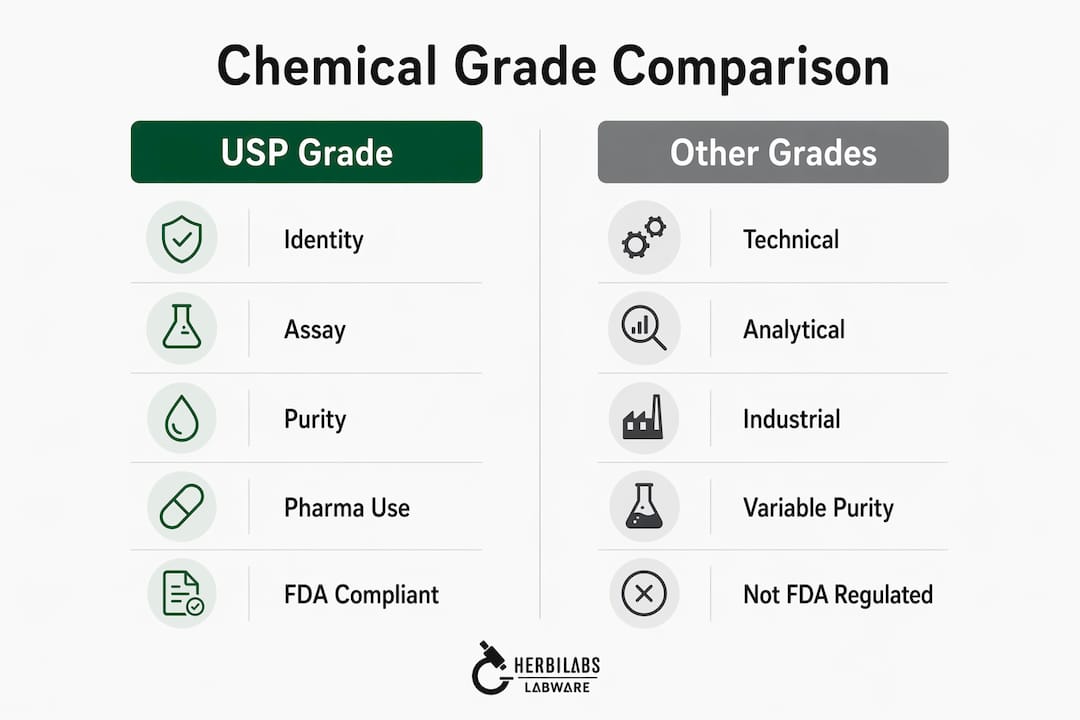
The practical takeaway for lab reagent selection is this: USP grade is the floor for pharmaceutical work, not the ceiling for analytical work. For high-performance liquid chromatography or mass spectrometry, you typically need HPLC grade or LC–MS grade, which are optimized for low UV absorbance and trace-level sensitivity rather than regulatory compliance.
Purity standards and regulatory compliance in USP monographs
Every USP monograph follows a consistent structure that covers identity, assay, impurity limits, and performance attributes. The testing protocols are prescribed in detail, including conductivity testing under USP General Chapter <64> and microbial action limits under USP <1231>. Certificates of Analysis from compliant manufacturers must align with these monograph requirements, test by test.
The FDA’s role here is active, not passive. When a product claims USP grade status, the agency can inspect manufacturing facilities, review batch records, and take enforcement action if the claim is not substantiated. This is what makes USP grade a regulatory designation rather than a voluntary quality label.
Key compliance points for quality assurance professionals:
- Residual solvents: Monographs specify limits for solvents used in synthesis, tested per USP <467>.
- Endotoxin testing: Required for certain USP grade materials, particularly water grades intended for injectable use.
- Microbial limits: USP <1231> sets action limits, though these are trend indicators rather than absolute pass/fail criteria. Exceeding them triggers formal investigations that can halt production.
- Validated alternative methods: Manufacturers may use alternative validated analytical methods in place of the monograph’s prescribed method, provided the alternative is properly validated.
One point that surprises many researchers: USP grade does not automatically mean highest purity for analytical applications. The grade is regulatory-focused, built around safety and pharmaceutical suitability. An ACS reagent grade chemical might actually have a tighter purity specification for a given analyte than its USP grade counterpart, because ACS specifications are designed for analytical detectability rather than patient safety.
USP–NF covers over 5,000 standards, and compliance with the USP designation is mandatory in the United States when that label is applied to a product.
Where USP grade reagents are actually used
The clearest use case is pharmaceutical manufacturing. Any drug product made in the United States that uses a chemical with an existing USP monograph must use the USP grade version of that chemical. This applies to active pharmaceutical ingredients, excipients, and processing aids alike.

Drug compounding pharmacies operate under the same requirement. A compounding pharmacist preparing a custom formulation must source USP grade chemicals for any ingredient covered by a monograph. USP grade chemicals also appear in consumer personal care products and over-the-counter medicines where regulatory compliance is required.
Typical applications where USP grade is required or strongly preferred:
- Finished oral, topical, and parenteral drug products
- Compounded medications prepared in licensed pharmacies
- Clinical trial materials subject to FDA oversight
- Over-the-counter drug formulations
- Pharmaceutical water systems, including USP Purified Water for non-sterile oral and topical products
USP grade water deserves specific attention. The FDA distinguishes between potable water, USP Purified Water, and Water for Injection (WFI). Potable water cannot be used to prepare USP dosage form drug products or laboratory reagent test solutions. USP Purified Water is the minimum standard for wet granulations, aqueous liquid preparations, and laboratory use in pharmaceutical facilities.
One limitation that catches labs off guard: USP grade alone does not guarantee sterility or pyrogen-free status. USP Purified Water, for example, is non-sterile. If your application requires a sterile or endotoxin-controlled material, you need a product explicitly labeled and tested for those attributes, such as Water for Injection, which carries a strict endotoxin limit of ≤0.25 EU/mL.
How to choose the right chemical grade for your lab
Grade selection should follow the application, not the other way around. The most common mistake in pharmaceutical facility design and lab procurement is defaulting to the highest available grade on the assumption that “better is safer.” It often is not, and it is always more expensive.
Formal risk-based assessments should drive every grade decision. That means documenting the intended use, the regulatory requirements that apply, the manufacturing origin of the chemical, and the testing requirements for your specific process. Over-specifying water grade alone can add substantial capital costs to a pharmaceutical facility, according to pharmaceutical facility planning guidance.
Factors to weigh when selecting a chemical grade:
- Regulatory requirement: Is there a USP monograph for this substance? If yes, and the application is pharmaceutical, USP grade is mandatory.
- Intended use: Clinical or drug product use demands USP grade. Analytical method development may call for HPLC or LC–MS grade instead.
- Sterility and endotoxin requirements: USP grade alone does not cover these. Specify WFI or sterile-labeled products when needed.
- Cost and supply chain: Higher grades cost more and may have longer lead times. Match the grade to the need, not to a general preference for “pharmaceutical quality.”
- Documentation: Your supplier must provide a Certificate of Analysis that maps to the monograph. No CoA, no compliance.
Pro Tip: When auditing your reagent inventory, flag every chemical that has a USP monograph and verify that your current supplier’s CoA explicitly references USP–NF compliance. A chemical labeled “high purity” or “analytical grade” is not a substitute for USP grade in a regulated pharmaceutical process, regardless of the purity percentage listed.
For researchers working outside regulated pharmaceutical contexts, understanding reagent quality requirements for your specific methods will save both money and compliance headaches.
Safety, handling, and storage of USP grade reagents
USP grade chemicals follow the same fundamental safety and storage principles as other high-purity laboratory chemicals, but the regulatory context adds documentation requirements that purely research-grade materials do not carry.
Storage conditions must match the monograph’s requirements. Many USP grade chemicals specify temperature ranges, light protection, or inert atmosphere storage to maintain compliance through the shelf life. Deviating from these conditions does not just degrade the chemical. It potentially invalidates the USP grade claim for that batch, which is a compliance issue in a regulated facility.
Handling practices for USP grade reagents in pharmaceutical settings:
- Store in original, sealed containers with intact labeling until point of use.
- Log receipt dates, lot numbers, and CoA references in your materials management system.
- Segregate USP grade materials from research-grade or lab-grade chemicals to prevent cross-contamination or mislabeling.
- Follow the Safety Data Sheet (SDS) for personal protective equipment, ventilation, and spill response, just as you would for any chemical.
- Observe expiration or retest dates. A USP grade chemical past its retest date requires retesting against the monograph before use in a regulated process.
Water-based USP grade reagents, including USP Purified Water, require particular attention to microbial control. Purified Water systems must be monitored regularly, and USP <1231> action limits serve as the trigger for investigation, not as a pass/fail boundary. Storing purified water in open containers or for extended periods without a validated hold-time study is a common source of microbial excursions in pharmaceutical labs. For guidance on safe storage practices, Herbilabs covers reagent storage best practices in detail.
Key Takeaways
USP grade reagents are defined by mandatory monograph compliance enforced by the FDA, making them the required standard for pharmaceutical manufacturing and drug compounding in the United States.
| Point | Details |
|---|---|
| USP grade is regulatory, not just analytical | Compliance with USP–NF monographs is FDA-enforced under 21 CFR 211 for any product claiming the designation. |
| The USP–NF compendium includes over 5,000 standards for drugs, excipients, dietary supplements, and related chemicals, each defined by identity, assay, and impurity limits with exact testing protocols. | |
| Sterility is not automatic | USP grade does not guarantee sterility or pyrogen-free status; WFI with its strict endotoxin limit is required for injectable applications. |
| Grade selection should follow risk assessment | Defaulting to the highest grade without documented justification can add substantial unnecessary facility costs. |
| ACS and HPLC grades serve different needs | Analytical grades optimize for sensitivity and reproducibility, not regulatory compliance; they are not substitutes for USP grade in pharmaceutical processes. |