Private Label, White Label, Wholesale partnerships available - EU, USA and UK - Free shipping from €75

Bacteriostatic Water Standards in 2026: What Researchers Need to Know
Discover the critical bacteriostatic water standards in 2026. Ensure compliance and stay informed on regulations affecting researchers and suppliers.
TL;DR:
- Bacteriostatic water for injection must meet USP composition standards, pass three mandatory tests, and be handled properly under USP <797>.
- Regulatory enforcement in 2026 classifies products sold with injectable drugs as unapproved drugs, creating sourcing risks.
Bacteriostatic water for injection is defined as a USP-grade sterile aqueous solution containing 0.9% benzyl alcohol (9 mg/mL) as a preservative, regulated under both USP compendial monographs and FDA intended use doctrine. The bacteriostatic water standards in 2026 combine precise chemical composition requirements with active FDA enforcement that directly affects how researchers, suppliers, and compounding facilities source, label, and handle this product. Understanding both layers of regulation is not optional for pharmaceutical and biotechnology professionals. Getting either one wrong creates compliance exposure that no Certificate of Analysis can fix after the fact.
What are the official USP standards for bacteriostatic water in 2026?
The USP monograph for Bacteriostatic Water for Injection sets the composition baseline that all compliant products must meet. The USP-defined composition specifies sterile water with 0.9% benzyl alcohol as the sole preservative, with a pH range of 4.5–7.0 and a typical measured value near 5.7. That pH range is not arbitrary. It reflects the stability window for benzyl alcohol as a preservative while remaining compatible with a broad range of injectable drug substances used in reconstitution.
Beyond composition, the monograph requires compliance with three core USP testing chapters:
- USP <71> Sterility Testing: Confirms the absence of viable microorganisms in the final product.
- USP <85> Bacterial Endotoxins: Sets limits on endotoxin contamination, which sterility testing alone does not detect.
- USP <788> Particulate Matter: Defines acceptable limits for visible and subvisible particles in injectable preparations.
These three USP test chapters form the quality floor for any product claiming USP compliance. A product that passes sterility but fails endotoxin limits is not compliant. Researchers should treat all three as non-negotiable, not as a menu of optional tests.
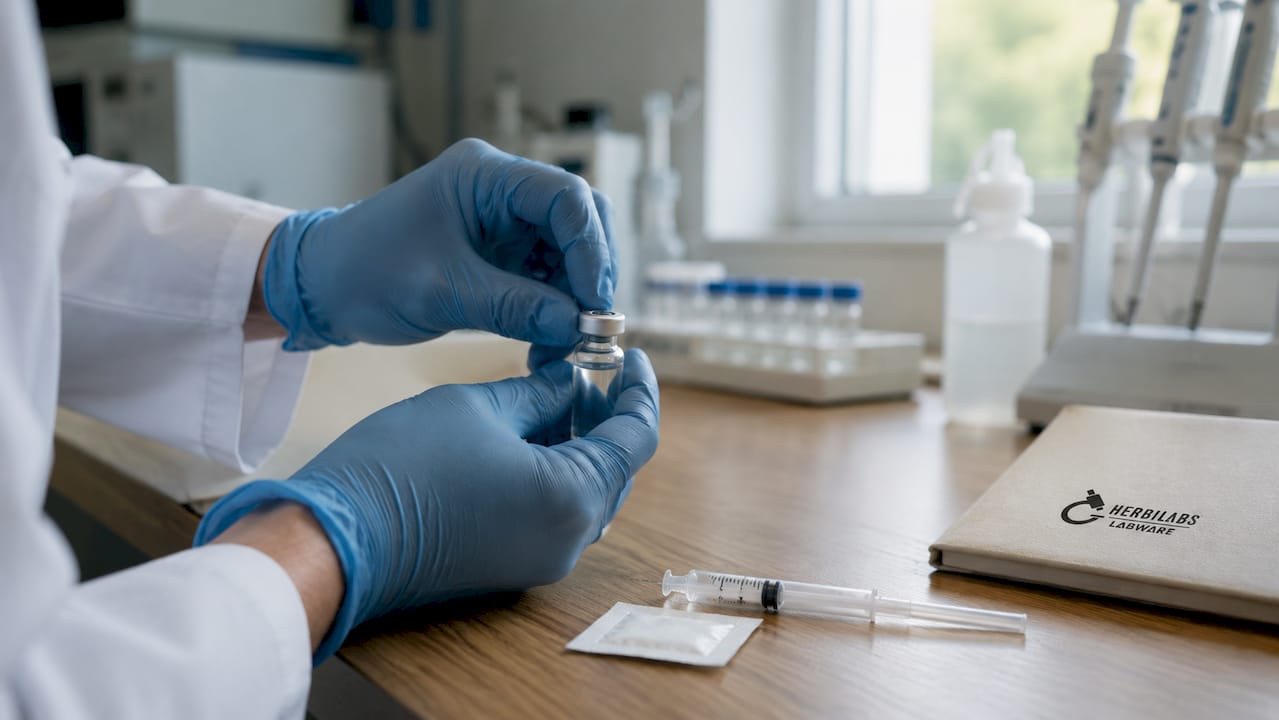
Container and closure requirements also apply. Bacteriostatic water must be packaged in multi-dose vials with closures that maintain sterility across repeated punctures. Single-dose vials are not the appropriate container type for this product. The multi-dose format is precisely what distinguishes bacteriostatic water from sterile water for injection, and the container specification reflects that functional difference.
| USP Test Chapter | Parameter Tested | Why It Matters |
|---|---|---|
| USP <71> | Sterility | Confirms no viable microbial contamination |
| USP <85> | Bacterial endotoxins | Detects pyrogens not caught by sterility testing |
| USP <788> | Particulate matter | Limits visible and subvisible particles |
| Assay | Benzyl alcohol content (0.9%) | Verifies preservative concentration is within spec |
How do 2026 FDA regulations affect bacteriostatic water compliance?
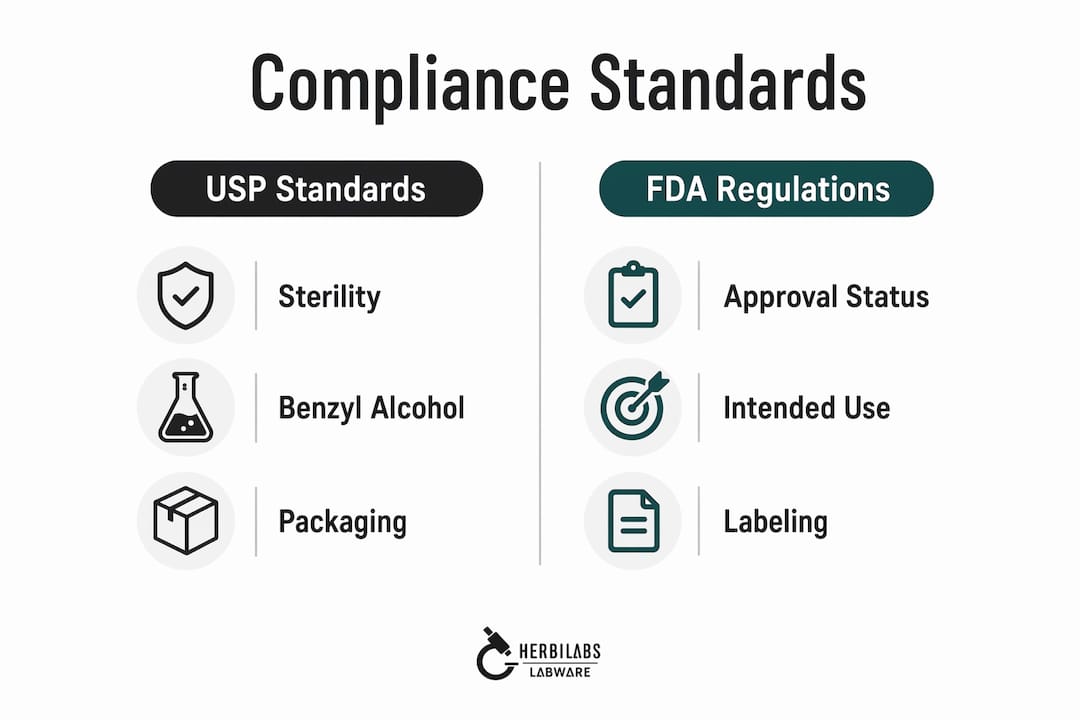
The FDA’s regulatory position on bacteriostatic water is defined by intended use, not composition alone. Compendial monograph compliance covers manufacturing quality. FDA drug regulation covers what the product is marketed to do. These are two separate frameworks, and conflating them is the most common compliance mistake in this space.
The critical 2026 enforcement principle: bacteriostatic water marketed or sold in combination with injectable drugs is regulated as a drug based on intended use. The FDA issued warning letters in 2026 targeting companies that bundled bacteriostatic water with injectable drugs, treating the combination as an unapproved drug product. This enforcement action directly affects suppliers, compounders, and any researcher who sources bacteriostatic water from vendors operating in that gray zone.
“Bacteriostatic water sold with injectable drugs is a drug due to intended use.” — FDA Warning Letter, march 2026
The practical implications for researchers and procurement teams are significant:
- Sourcing risk: Purchasing bacteriostatic water from a vendor who also sells injectable peptides or weight loss compounds creates regulatory exposure for both parties.
- Labeling scrutiny: Any marketing language suggesting the product is intended for use with a specific injectable drug can trigger FDA classification as an unapproved drug.
- Documentation trail: Researchers should verify that their supplier’s labeling and marketing language does not create an implied intended use that conflicts with FDA guidance.
USP compliance does not grant FDA drug approval. A product can meet every USP monograph requirement and still be an unapproved drug if its marketing implies a specific therapeutic or injectable application. Researchers sourcing bacteriostatic water for peptide research need suppliers whose labeling is clean and whose marketing does not bundle the product with injectable compounds.
What are the best practices for multi-dose vial handling under USP <797>?
USP <797> sets the practical handling standard that labs implement daily. The 28-day beyond-use date applies to multi-dose vials of bacteriostatic water after the first puncture, assuming aseptic technique is maintained throughout. This is the standard that most research facilities use as their discard rule, and it is the right one to follow.
The 28-day limit exists because benzyl alcohol inhibits bacterial growth but does not sterilize a vial that has been compromised by poor technique. The preservative manages contamination risk within a defined window. It does not eliminate the need for sterile practice.
Correct multi-dose vial handling requires:
- Use a sterile needle and syringe for every withdrawal. Reusing needles or syringes introduces contamination that benzyl alcohol cannot fully neutralize.
- Disinfect the septum with 70% isopropyl alcohol before each puncture. Allow it to dry before inserting the needle.
- Label the vial with the date of first puncture. Discard at 28 days regardless of remaining volume.
- Store according to manufacturer specifications. Improper storage conditions can degrade benzyl alcohol concentration and compromise preservative effectiveness before the 28-day window closes.
Pro Tip: Write the discard date directly on the vial label at the time of first puncture, not the open date. That single habit eliminates the most common source of beyond-use dating errors in multi-dose vial management.
Preservative presence does not replace sterility requirements. Researchers who treat the benzyl alcohol as a safety net for sloppy technique will eventually see contamination events that a clean vial would have prevented. The preservative and the aseptic technique work together. Neither substitutes for the other.
For comparison, sterile water for injection carries no preservative and is intended for single-dose use only. Once opened, it must be discarded. Bacteriostatic water’s multi-dose utility is entirely dependent on maintaining the aseptic conditions that keep the preservative effective. Researchers who want a detailed comparison of bacteriostatic vs. sterile water handling protocols will find the distinctions matter significantly in high-throughput research workflows.
How do you verify compliance with bacteriostatic water quality standards?
Label claims are not evidence of compliance. Lot-specific Certificates of Analysis are the only reliable way to verify that a batch of bacteriostatic water meets USP standards for sterility, endotoxin limits, and benzyl alcohol content. Researchers who accept a product on the basis of brand reputation or marketing language alone are accepting unverified risk into their workflows.
A compliant Certificate of Analysis for bacteriostatic water should include:
- Sterility result from USP <71>, confirming no microbial growth detected.
- Endotoxin result from USP <85>, with the measured value and the specification limit clearly stated.
- Benzyl alcohol assay result, confirming the preservative concentration falls within the 0.9% specification.
- Particulate matter result from USP <788>, with values for both visible and subvisible particles.
- Lot number and expiration date, traceable to the specific batch being used.
| COA Parameter | Acceptable Result | Red Flag |
|---|---|---|
| Sterility (USP <71>) | No growth detected | Any positive result |
| Endotoxin (USP <85>) | Within stated limit | No limit specified or result missing |
| Benzyl alcohol assay | 0.9% ± specification range | Result absent or out of range |
| Particulate matter (USP <788>) | Within USP limits | No data provided |
Researchers should request lot-specific COAs, not generic product COAs. A COA issued for a product line rather than a specific lot number provides no meaningful quality assurance for the batch in hand. Suppliers who cannot provide lot-specific documentation should not be sourcing bacteriostatic water for research environments.
How does bacteriostatic water compare to other injectable waters in research?
Bacteriostatic water and sterile water for injection are both USP-grade products, but they serve different functions and carry different handling requirements. The key differences matter for peptide reconstitution and any sterile research workflow.
Bacteriostatic water contains 0.9% benzyl alcohol, supports multi-dose use, and carries a 28-day beyond-use date after first puncture. It is the preferred diluent for peptide reconstitution in research settings where a single vial will be accessed multiple times. The composition details directly determine its suitability for specific research applications.
Sterile water for injection contains no preservative and is intended for single-dose use only. It meets USP <71>, USP <85>, and USP <788> requirements but cannot be stored after opening. It is appropriate when a single reconstitution event uses the entire volume, or when the research protocol requires a preservative-free diluent.
Non-USP water sources present unacceptable risk in sterile research workflows. Distilled water, deionized water, or water purified by reverse osmosis does not meet USP injectable standards unless it has been processed, tested, and certified to those specifications. Using non-USP water in peptide reconstitution introduces endotoxin, particulate, and microbial contamination risks that invalidate research results and create safety concerns. Researchers evaluating alternative injectable diluents should apply the same COA verification standard to every option they consider.
Key Takeaways
Bacteriostatic water compliance in 2026 requires meeting USP monograph composition standards, passing lot-specific quality tests, following USP <797> multi-dose handling rules, and sourcing from suppliers whose marketing does not trigger FDA intended use classification.
| Point | Details |
|---|---|
| USP composition standard | Bacteriostatic water must contain 0.9% benzyl alcohol with pH 4.5–7.0 per USP monograph. |
| Three mandatory USP tests | USP <71>, <85>, and <788> are all required; passing one does not substitute for the others. |
| 28-day beyond-use date | Discard multi-dose vials 28 days after first puncture under USP <797>, regardless of remaining volume. |
| FDA intended use enforcement | Suppliers who bundle bacteriostatic water with injectable drugs face FDA drug classification and warning letters. |
| COA verification is mandatory | Lot-specific Certificates of Analysis are the only valid evidence of batch compliance. |
The part of 2026 bacteriostatic water standards most researchers overlook
The FDA intended use doctrine is the piece of the 2026 regulatory picture that catches researchers off guard. Most professionals understand USP composition requirements. Fewer realize that their supplier’s marketing language can reclassify a USP-compliant product as an unapproved drug, creating downstream compliance risk for the research institution procuring it.
I have seen this play out in practice. A lab sources bacteriostatic water from a vendor who also sells injectable peptides. The vendor’s website implies the water is intended for use with those compounds. The FDA’s position is clear: that combination is a drug product, and neither party has an approved NDA. The lab did nothing wrong in terms of handling or testing, but the sourcing decision created exposure.
The practical fix is straightforward. Verify that your supplier’s labeling and marketing language describes bacteriostatic water as a research reagent or compendial product, not as a diluent for a specific injectable compound. Request lot-specific COAs for every batch. Apply the 28-day discard rule without exception. These are not bureaucratic formalities. They are the actual mechanisms that keep your research defensible and your supply chain clean.
The researchers who navigate 2026 standards well are not the ones who know the most regulations. They are the ones who ask the right questions of their suppliers before the order ships.
— Ragnar
Herbilabs bacteriostatic water: built for 2026 research standards
Researchers who need USP-grade bacteriostatic water that meets 2026 compendial and regulatory standards will find Herbilabs supplies products manufactured to strict purity specifications with full quality documentation. Every batch is supported by lot-specific testing data covering sterility, endotoxin limits, and benzyl alcohol content.
Herbilabs serves research institutions, universities, and independent researchers across the UK and Europe with a supply chain built around quality control and reliable delivery. The professional researcher FAQ addresses the most common compliance and sourcing questions in detail. For researchers who need a complete overview of composition and standards, the bacteriostatic water guide covers the full picture. Wholesale pricing and dedicated support are available for institutional and reseller accounts.
FAQ
What is the USP benzyl alcohol concentration for bacteriostatic water?
The USP monograph specifies 0.9% benzyl alcohol (9 mg/mL) as the preservative concentration. The accepted pH range is 4.5–7.0, with a typical measured value near 5.7.
How long can a multi-dose bacteriostatic water vial be used after opening?
USP <797> sets a 28-day beyond-use date from the date of first puncture for multi-dose vials, provided aseptic technique is maintained throughout.
Does USP compliance mean the FDA has approved bacteriostatic water as a drug?
No. USP compliance covers manufacturing quality and composition. FDA drug approval is a separate pathway. Bacteriostatic water marketed with injectable drugs is classified as an unapproved drug based on intended use, regardless of USP compliance.
What tests should a Certificate of Analysis include for bacteriostatic water?
A compliant COA should include results for USP <71> sterility, USP <85> endotoxin, USP <788> particulate matter, and a benzyl alcohol assay confirming the 0.9% preservative concentration, all tied to a specific lot number.
Can bacteriostatic water be used as a substitute for sterile water for injection?
Not interchangeably. Bacteriostatic water contains benzyl alcohol and is designed for multi-dose use. Sterile water for injection contains no preservative and is for single-dose use only. The correct choice depends on the research protocol and whether a preservative-free diluent is required.
Recommended
- Bacteriostatic Water FAQs: Things professional Researchers Like To Ask in 2025 – Herbilabs Labware
- What is Bacteriostatic Water? Best 2025 Guide for Labs in Europe – Herbilabs Labware
- Is Bacteriostatic Water Safe? #1 hack Labs Need to Know – Herbilabs Labware
- Bacteriostatic Water Shelf Life: The 2025 Best Guide – Herbilabs Labware