Private Label, White Label, Wholesale partnerships available - EU, USA and UK - Free shipping from €75

Lab-Grade Diluents for Researchers: 7 Key Examples
Discover 7 key examples of lab-grade diluents essential for accurate research. Ensure quality results and avoid costly errors in your lab work!
TL;DR:
- Lab-grade diluents like bacteriostatic water, sterile water for injection, isotonic saline, and PBS serve distinct roles based on preservative content and assay compatibility. Selecting the appropriate diluent requires verifying analyte solubility, assay sensitivity, and thorough lot validation to prevent sample loss and data invalidation. Proper documentation, pilot testing, and adherence to protocol-specific needs are essential for high-quality, reproducible laboratory results.
Lab-grade diluents are standardized sterile liquids, including bacteriostatic water, sterile water for injection, isotonic saline, and specialized buffer solutions, used to reconstitute or dilute analytes while preserving sample integrity and assay reproducibility. Choosing the wrong diluent is one of the most common and costly errors in peptide and laboratory research. This guide covers the most practical examples of lab-grade diluents, with specific compatibility notes, use cases, and selection criteria drawn from current best practices. Whether you are preparing a multi-dose peptide vial or running a mass spectrometry assay, the diluent you choose directly determines the quality of your data.
1. Examples of lab-grade diluents: the core four
The four most widely used examples of lab-grade diluents in research settings are bacteriostatic water, sterile water for injection, isotonic saline (0.9% NaCl), and phosphate-buffered saline (PBS). Each occupies a distinct niche based on sterility requirements, preservative content, and downstream assay compatibility. Understanding where each one fits prevents both sample loss and data invalidation. These four form the foundation of any practical sterile diluent checklist for peptide and analytical research.
2. Bacteriostatic water: the go-to for multi-dose peptide work
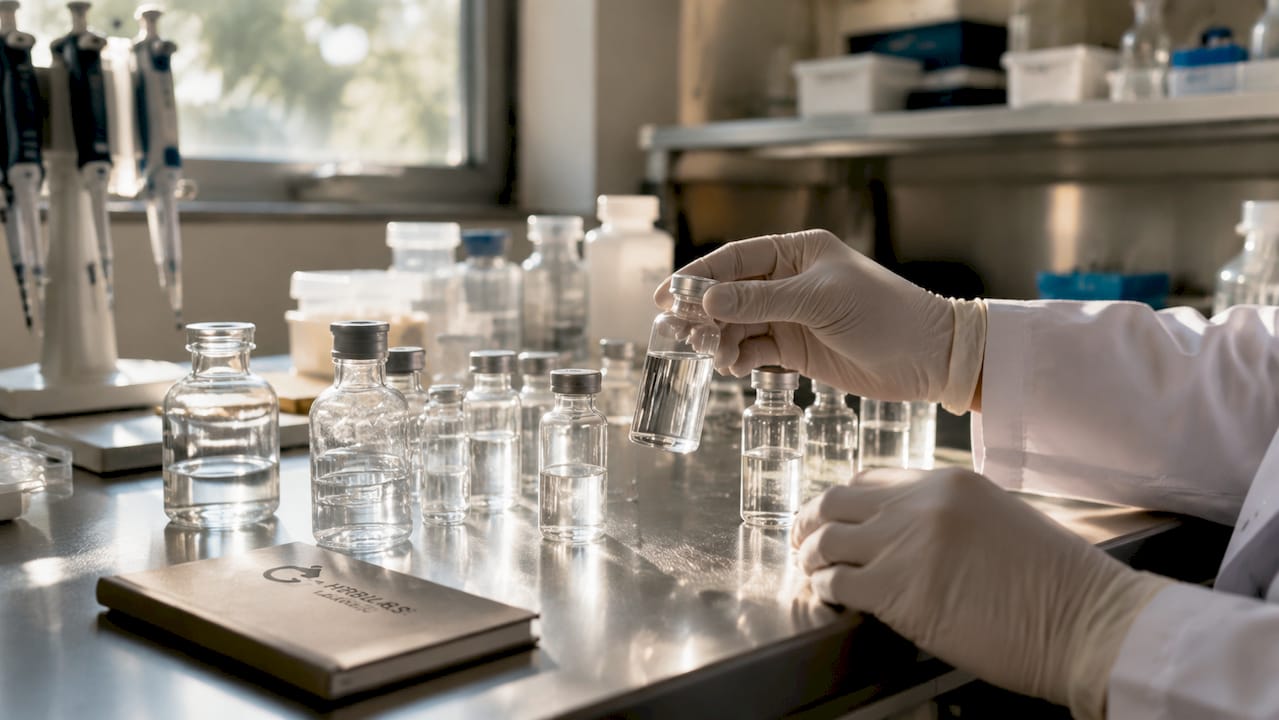
Bacteriostatic water is the most widely used diluent in peptide reconstitution workflows because it contains 0.9% benzyl alcohol, which inhibits microbial growth and supports repeated vial withdrawals without contamination risk. That preservative action is what separates it from every other sterile diluent on this list. For researchers running multi-dose protocols over days or weeks, bacteriostatic water is the only option that maintains sterility between uses without requiring a fresh vial each time.
Key properties that make bacteriostatic water a reliable choice:
- Preservative: 0.9% benzyl alcohol provides sustained antimicrobial protection
- Multi-use compatibility: Supports repeated syringe withdrawals from the same vial
- Peptide stability: Maintains reconstituted peptide integrity across standard storage temperatures
- Regulatory status: Manufactured to USP standards for research-grade applications
The critical limitation is that benzyl alcohol can interfere with sensitive cell-based assays and viability studies. Labs running cytotoxicity screens or live-cell imaging should confirm preservative tolerance before adopting bacteriostatic water as their default diluent. Pilot testing on a small sample set is the standard approach before broad protocol adoption.
Pro Tip: Always verify that your peptide’s solubility profile explicitly lists benzyl alcohol as compatible before reconstituting with bacteriostatic water. Some hydrophobic peptides aggregate in the presence of alcohol-based preservatives.
3. Sterile water for injection: the preservative-free baseline
Sterile water for injection is purified and sterile at packaging but contains no antimicrobial agents, making it the preferred choice for single-use preparations and assays where preservative interference is a concern. It is the cleanest baseline diluent available. Any researcher running a sensitive immunoassay, ELISA, or structural biology experiment where even trace preservatives could alter results should default to sterile water.
Typical applications where sterile water outperforms alternatives:
- Single-use reconstitution: Ideal when the entire vial will be used in one session
- Sensitive assays: Avoids preservative-related signal interference in ELISA and fluorescence-based assays
- Structural studies: Preservative-free environment prevents conformational changes in proteins or peptides
- Reference standard preparation: Provides a neutral matrix for analytical calibration curves
The trade-off is straightforward. Without antimicrobial protection, an opened vial of sterile water cannot be stored and reused. Any residual volume after a single-use session must be discarded. Researchers who attempt multi-dose use with sterile water risk microbial contamination that invalidates downstream results. For multi-dose workflows, bacteriostatic water is the correct choice.
4. Isotonic saline and buffered solutions: examples and uses
Phosphate-buffered saline (PBS) and isotonic saline (0.9% NaCl) are the two most common buffered and salt-based examples of sterile diluents in biological research. PBS maintains a stable physiological pH of 7.4, which is critical for preserving the structural integrity of proteins, antibodies, and nucleic acids during preparation and storage. Isotonic saline provides osmotic balance without the buffering capacity, making it the preferred matrix for cell-based assays where pH is controlled externally.
| Diluent | pH control | Ionic strength | Best use case |
|---|---|---|---|
| PBS (1x) | Yes (pH 7.4) | Moderate | Protein and antibody dilution, flow cytometry |
| Isotonic saline | No | Low to moderate | Cell-based assays, osmotic balance applications |
| Sterile water | No | None | Single-use reconstitution, reference standards |
| Bacteriostatic water | No | None | Multi-dose peptide reconstitution |
The critical limitation of PBS and high-ionic-strength buffers is their incompatibility with mass spectrometry. Buffered solutions like PBS cause ion suppression and salt adducts that degrade signal quality in LC-MS and MALDI-TOF workflows. For MS-based assays, volatile buffers such as ammonium acetate or ammonium bicarbonate are the standard substitution.
Pro Tip: If your downstream analysis involves mass spectrometry, switch from PBS to 10 mM ammonium bicarbonate. It provides mild buffering, is fully volatile, and leaves no salt residue on the ion source.
5. How to select the right lab-grade diluent for your application
Selecting the correct diluent starts with two questions: Is this a single-use or multi-use protocol? And does the downstream assay have known sensitivity to preservatives, ionic strength, or pH? Answering both eliminates most compatibility errors before they happen. Improper diluent selection due to availability rather than compatibility produces denatured samples, wasted reagents, and invalid data.
Follow this decision sequence for any new analyte-diluent combination:
- Check the solubility data sheet. Confirm the analyte’s recommended reconstitution solvent and any listed incompatibilities with preservatives or salts.
- Determine single-use vs. multi-use. Multi-dose protocols require bacteriostatic water. Single-use preparations can use sterile water or buffers.
- Assess assay constraints. MS-based detection requires low-ionic-strength or volatile buffers. Cell-based assays require isotonic conditions. Immunoassays may require specific pH ranges.
- Request a Certificate of Analysis. Diluent lots must be validated with confirmed sterility, pH, endotoxin levels, and absence of interfering preservatives. HPLC and MALDI-TOF purity reports are the current standard for 2026 lot release documentation.
- Run a pilot study. Before committing an entire sample batch, test the diluent with a small aliquot of your analyte and confirm stability, solubility, and assay signal.
Batch traceability and lot-specific documentation are non-negotiable for maintaining data integrity across multi-site or longitudinal studies. Tamper-evident seals and clear lot numbers on diluent packaging support audit readiness and cross-site consistency. Never use a diluent lot that lacks full documentation, regardless of availability pressure.
Pro Tip: Keep a one-page sterile diluent checklist pinned in your lab that maps each active protocol to its validated diluent, lot number, and storage condition. It takes 20 minutes to build and prevents hours of troubleshooting.
6. Sterile diluents comparison: side-by-side summary
The four major lab-grade diluents each have a defined role, and the most common errors occur when researchers substitute one for another based on convenience rather than compatibility. Experts consistently emphasize verifying solubility data sheets and compound tolerances before any substitution. A quick reference comparison helps reinforce the decision logic.
| Diluent | Preservative | Multi-use | MS compatible | Key limitation |
|---|---|---|---|---|
| Bacteriostatic water | 0.9% benzyl alcohol | Yes | No | Interferes with cell viability assays |
| Sterile water | None | No | Yes | No antimicrobial protection |
| Isotonic saline | None | No | Marginal | Ion suppression at higher concentrations |
| PBS (1x) | None | No | No | Strong ion suppression in MS workflows |
For a more detailed diluents comparison covering edge cases and protocol-specific guidance, the Herbilabs resource library provides protocol-matched recommendations. The key takeaway from this comparison is that no single diluent covers all applications. Stocking all four and selecting based on protocol requirements is the standard practice in well-run research labs.
- Bacteriostatic water: default for peptide reconstitution in multi-dose settings
- Sterile water: default for single-use sensitive assays
- Isotonic saline: default for cell-based and osmotic balance applications
- PBS: default for protein and antibody work outside of MS workflows
Aseptic technique, single-use sterile syringes, and proper aliquoting are required regardless of which diluent you select. Storage conditions vary by analyte and diluent combination, so always confirm whether room temperature, refrigeration, or freezing applies to your specific preparation.
Key takeaways
The most reliable approach to lab-grade diluent selection is matching sterility level, preservative content, and ionic strength to the specific demands of your assay and analyte.
| Point | Details |
|---|---|
| Bacteriostatic water for multi-dose use | Its 0.9% benzyl alcohol preservative makes it the only safe choice for repeated vial withdrawals. |
| Sterile water for sensitive single-use assays | No preservatives means no interference, but the vial must be discarded after one use. |
| PBS and saline for biological matrices | Both maintain physiological conditions, but neither is compatible with mass spectrometry workflows. |
| Always request a Certificate of Analysis | Lot-specific sterility, pH, and endotoxin data are required before any diluent enters a validated protocol. |
| Pilot test every new combination | Confirming analyte stability with a small aliquot prevents batch-level sample loss. |
What I have learned from years of watching diluent choices go wrong
Working closely with researchers across peptide and analytical labs, I have seen the same mistake repeat itself more than any other: choosing a diluent based on what is available on the bench rather than what the protocol actually requires. A researcher reaches for bacteriostatic water because it is already open, uses it for a cell viability assay, and then spends two days troubleshooting signal anomalies before tracing the problem back to benzyl alcohol interference. The fix takes five minutes. The troubleshooting takes two days.
The other pattern I see consistently is undervaluing the Certificate of Analysis. Researchers treat it as administrative paperwork rather than a technical document. The CoA tells you the actual pH of that specific lot, the endotoxin load, and whether the manufacturing run passed sterility testing. Two vials from the same product line can behave differently if they come from different lots with different quality profiles. Requesting and reviewing the CoA before a lot enters your workflow is not excessive caution. It is basic quality practice.
My practical advice: build your reconstitution errors awareness before you need it. The researchers who avoid diluent-related data loss are not the ones with the most experience. They are the ones who built a simple validation habit early and stuck to it.
— Ragnar
Stock your lab with verified diluents from Herbilabs
Herbilabs supplies bacteriostatic water and sterile water manufactured to strict purity standards, with full lot documentation including Certificates of Analysis, sterility testing, and endotoxin data. Every product ships with tamper-evident packaging and clear lot traceability, so your protocols stay audit-ready from day one.
Whether you need a single research vial or wholesale quantities for an institutional lab, Herbilabs provides the documentation and quality assurance your protocols require. The bacteriostatic water guide covers everything from reconstitution ratios to storage conditions, and the researcher FAQ addresses the most common protocol questions directly. For researchers in the UK and Europe, Herbilabs is the supplier built specifically for this work.
FAQ
What are the main examples of lab-grade diluents?
The four primary examples are bacteriostatic water, sterile water for injection, isotonic saline, and phosphate-buffered saline. Each serves a distinct role based on preservative content, ionic strength, and assay compatibility.
When should I use bacteriostatic water instead of sterile water?
Use bacteriostatic water for multi-dose peptide reconstitution where repeated vial withdrawals are required. Use sterile water for single-use preparations or assays where benzyl alcohol preservative would interfere with results.
Is PBS compatible with mass spectrometry?
PBS is not compatible with mass spectrometry because its high ionic strength causes ion suppression and salt adducts. Volatile buffers such as ammonium bicarbonate or ammonium acetate are the standard substitution for MS-based workflows.
What should a sterile diluent checklist include?
A sterile diluent checklist should confirm the lot’s Certificate of Analysis, sterility test results, pH value, endotoxin levels, and absence of preservatives that conflict with the target assay. Lot number and tamper-evident seal status should also be documented.
Can I reuse an opened vial of sterile water?
No. Sterile water contains no antimicrobial agents, so an opened vial is vulnerable to microbial contamination. Any unused volume after a single-use session must be discarded to prevent sample and assay contamination.