Private Label, White Label, Wholesale partnerships available - EU, USA and UK - Free shipping from €75

The Role of Suppliers in Scientific Research
Discover the critical role of suppliers in scientific research. Learn how supplier relationships can enhance your research quality and reproducibility.
TL;DR:
- Suppliers play a critical role in ensuring research reproducibility by providing consistent materials with proper documentation and traceability.
- Switching to domestic suppliers can significantly reduce project timelines, costs, and supply chain risks, especially amid tariffs and delays.
- Building strategic partnerships with suppliers fosters innovation, early problem detection, and improves research outcomes through collaboration.
Suppliers in scientific research are defined as the organizations and companies that provide the materials, reagents, equipment, and services researchers depend on to generate valid, reproducible results. The role of suppliers in scientific research extends far beyond logistics. Suppliers determine whether your experiments succeed or fail before you ever run them. A reagent with inconsistent purity, a vendor who ships without a Certificate of Analysis, or an international supplier whose lead times eat into your grant window can derail months of work. Understanding supplier relationships in science as a strategic scientific decision, not an administrative one, is the single most important shift researchers can make in 2026.
How suppliers impact research quality and reproducibility
Research reproducibility depends directly on material consistency, and material consistency depends on your supplier. Material variability and lack of traceability from unreliable vendors are among the leading contributors to irreproducible experimental results. This is not a peripheral concern. The entire credibility of a published study rests on whether another lab can replicate it using the same materials.
Reliable suppliers provide Certificates of Analysis and advanced characterization data, including HPLC purity profiles and mass spectrometry confirmation, that are non-negotiable for compliance-grade research. Without this documentation, you cannot verify what you are actually working with. A reagent labeled 98% pure without third-party verification is a liability, not an asset.
Compliance frameworks like GLP (Good Laboratory Practice) and ISO/IEC 17025 require documented traceability from raw material to finished product. Suppliers who operate within these frameworks give researchers a defensible audit trail. Those who do not create gaps that reviewers, regulators, and collaborators will eventually find.
- Batch consistency: Each lot of a reagent must perform identically to the last. Suppliers who provide lot-specific Certificates of Analysis and retain reference samples allow you to investigate anomalies rather than guess at them.
- Cold-chain integrity: Consistent batch records and cold-chain logistics are critical for biologics, peptides, and temperature-sensitive reagents. A single temperature excursion in transit can render a shipment scientifically useless.
- Third-party certification: Suppliers holding ISO/IEC 17025 accreditation or equivalent have their testing methods independently validated. This matters when your data will face peer review or regulatory scrutiny.
- Documentation depth: Beyond a basic spec sheet, top-tier suppliers provide method validation reports, stability data, and impurity profiles. This depth of documentation is what separates a scientific supplier from a commodity vendor.
Pro Tip: Before placing any order for research-critical materials, request the lot-specific Certificate of Analysis and cross-reference the purity data against your protocol’s minimum specifications. If a supplier cannot provide this within 24 hours, treat that as a disqualifying signal.
How does supply chain timing affect research budgets?
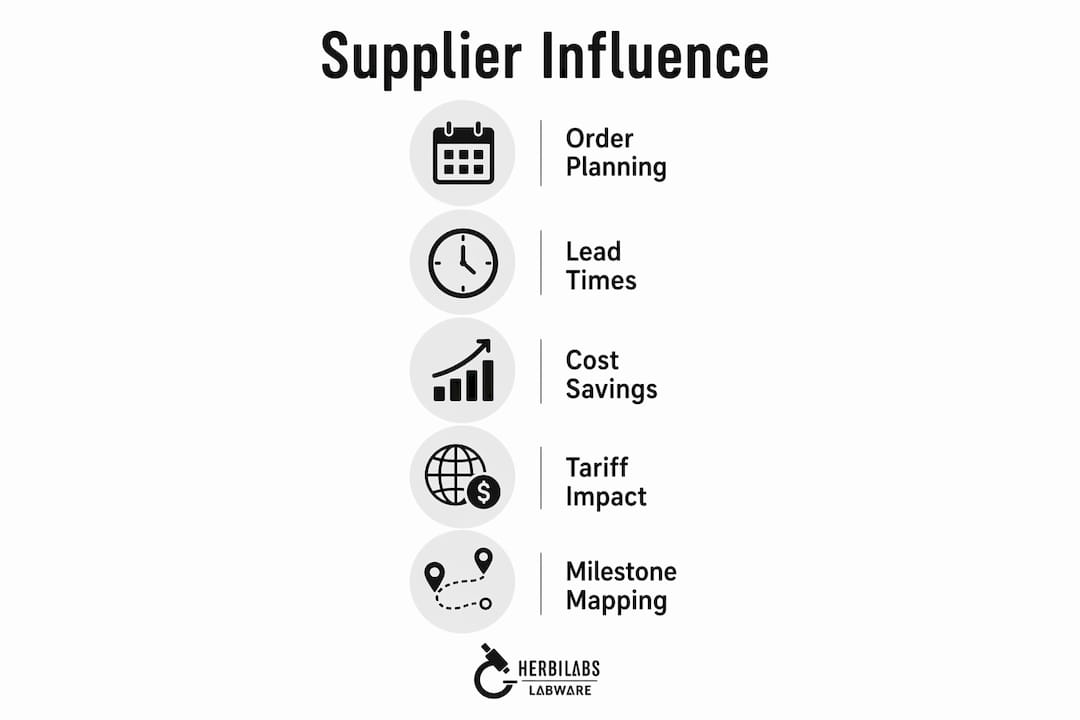
The influence of supply chain dynamics on research timelines is quantifiable and severe. Switching from international to domestic suppliers can reduce project timelines by up to 70%, increase grant utilization efficiency by 300%, and improve publication velocity by 400%. Those numbers reflect real projects where eight-week international shipping windows consumed grant periods and forced researchers to restart experiments with expired materials.

The financial dimension is equally stark. Total project cost savings of $448,000 were realized in one documented case by switching to domestic suppliers with same-day shipping, reducing personnel costs, facility overhead, and grant risk simultaneously. The real cost of procurement delays is never just the purchase price. It includes every hour of researcher salary spent waiting, every day of facility overhead accrued on idle equipment, and the compounding risk of missing grant milestones.
Tariffs add another layer of pressure. Import duties as high as 54% on lab equipment and consumables in 2026 are forcing institutions to defer non-essential purchases and restructure procurement budgets. This is not a temporary disruption. It is a structural shift that demands a new approach to grant planning.
| Factor | International suppliers | Domestic suppliers |
|---|---|---|
| Lead time | 4 to 8 weeks or more | Same day to 3 days |
| Tariff exposure | Up to 54% on select items | Minimal to none |
| Grant risk | High, especially near period end | Low |
| Documentation speed | Variable, often delayed | Typically faster |
| Cold-chain reliability | Higher failure risk | More controllable |
To manage these risks effectively, researchers and procurement teams should follow a structured approach:
- Conduct a total cost analysis before selecting any supplier. Factor in shipping time, tariff exposure, personnel costs during wait periods, and the probability of grant milestone slippage.
- Build contingency budgets of 15% to 25% on all imported consumables. Tariffs have reduced grant purchasing power by that margin, and failing to account for this will leave projects underfunded mid-cycle.
- Identify domestic alternatives for your top ten most-used consumables. Even if domestic options cost slightly more per unit, the timeline and risk savings typically outweigh the price difference.
- Establish backup supplier relationships before you need them. Qualifying a second supplier during a stable period costs far less than scrambling during a supply disruption.
Pro Tip: Map your grant milestones against your supplier lead times at the start of every project. If any critical material has a lead time longer than your buffer window, switch suppliers or pre-order before the grant period begins.
What does a strategic supplier partnership look like?
The shift from transactional vendor relationships to strategic supplier partnerships is the defining trend in research supply management. Strategic partnerships with CDMOs now involve early scientific engagement, joint risk sharing, and integrated collaboration across the full product life cycle. This is a fundamentally different model from placing orders and waiting for delivery.
Cross-tier supplier collaboration significantly improves innovation efficiency by enabling upstream knowledge sharing and joint development. An analysis of over 2,000 U.S. manufacturing firms found that organizations engaging suppliers at multiple tiers of their supply chain generated faster, cheaper research breakthroughs with less internal R&D spending. The implication for academic and industrial research labs is direct: your supplier network is an untapped innovation resource.
The practical benefits of strategic supplier partnerships include:
- Earlier problem detection: Suppliers embedded in your development process identify material compatibility issues, stability risks, and regulatory gaps before they become expensive failures.
- Joint IP development: Some CDMO and reagent supplier partnerships now include co-development agreements where both parties share intellectual property generated during collaborative projects.
- Regulatory alignment: Suppliers who understand your regulatory pathway can proactively prepare documentation packages that accelerate submissions rather than slow them down.
- Capacity reservation: Strategic partners often provide priority manufacturing slots and reserved inventory, which is critical when global supply chains tighten.
Early integration of suppliers in project planning fosters trust, reduces risks, and aligns expectations in ways that transactional relationships never achieve. The researchers who treat their key suppliers as scientific collaborators consistently outperform those who treat them as commodity vendors.
How to select and manage research suppliers effectively
Supplier selection is a scientific decision that deserves the same rigor as experimental design. Evaluating vendors on price alone is the most common and most costly mistake in research procurement. The criteria that actually predict supplier performance are documentation quality, compliance certification, batch traceability, and responsiveness to technical queries.
A structured evaluation process should include these elements:
- Compliance verification: Confirm that the supplier holds relevant certifications, such as ISO 9001, ISO/IEC 17025, or GMP compliance, depending on your research context. Herbilabs provides detailed guidance on ISO standards for labware that applies directly to supplier qualification decisions.
- Documentation audit: Request sample Certificates of Analysis, stability data, and impurity profiles before placing a first order. A supplier who provides these without hesitation is demonstrating the transparency that quality research requires.
- Reference checks: Contact other research groups who have used the supplier. Ask specifically about lot-to-lot consistency, response time on technical questions, and how the supplier handled a quality complaint.
- Trial order protocol: Place a small initial order and run your standard qualification assays before committing to a large purchase. This is standard practice in pharmaceutical development and should be standard in academic labs too.
- Ongoing monitoring: Track supplier performance across every order using metrics like on-time delivery rate, documentation completeness, and deviation frequency. Review these metrics quarterly.
Researchers should evaluate both product quality and supplier documentation compliance to ensure reliable scientific outcomes. This dual evaluation protects you from suppliers who produce good materials inconsistently and from those who document poorly but occasionally get lucky. Understanding lab compliance standards gives you the framework to ask the right questions during supplier qualification.
Pro Tip: Create a one-page supplier scorecard for every vendor you use regularly. Score them on documentation quality, delivery reliability, technical support, and price competitiveness. Review it before every major reorder decision. This takes 20 minutes per supplier per quarter and prevents the drift toward convenience-based procurement that erodes research quality over time.
Key takeaways
Supplier quality, documentation compliance, and strategic partnership depth are the three variables that most directly determine research reproducibility, timeline adherence, and grant efficiency.
| Point | Details |
|---|---|
| Suppliers determine reproducibility | Material variability from unreliable vendors is a leading cause of irreproducible experimental results. |
| Domestic sourcing reduces risk | Switching to domestic suppliers can cut project timelines by up to 70% and save hundreds of thousands in total project costs. |
| Tariffs require budget contingencies | Import duties up to 54% have reduced grant purchasing power by 15% to 25%, demanding proactive budget planning. |
| Strategic partnerships accelerate innovation | CDMOs and integrated supplier teams engaged early in development reduce risk and generate faster breakthroughs. |
| Evaluation must go beyond price | Supplier selection criteria should include documentation quality, compliance certifications, and batch traceability. |
Why procurement decisions are the most underrated scientific choices
I have watched research groups lose months of work not because their science was wrong, but because their supplier was unreliable. A peptide reconstitution experiment that fails three times in a row is not always a protocol problem. Sometimes it is a purity problem that traces directly back to a supplier who skipped third-party characterization. The frustrating part is that this is entirely preventable.
What I find consistently underappreciated is how much supplier qualification resembles experimental validation. You would not use an unvalidated assay to generate publishable data. You should not use an unqualified supplier to generate the materials that feed that assay. The logic is identical, but the practice rarely is.
The shift toward strategic partnerships with CDMOs and specialized reagent suppliers is the most significant structural change in research supply I have observed in recent years. Labs that treat their key suppliers as scientific collaborators, sharing protocols, discussing failure modes, and co-developing solutions, produce more consistent results and publish faster. This is not anecdotal. The data on cross-tier collaboration confirms it at scale.
My advice to any researcher reading this: get personally involved in supplier qualification. Do not delegate it entirely to procurement. You understand your experimental requirements better than anyone. That knowledge belongs in the supplier evaluation process, not just at the bench.
— Ragnar
How Herbilabs supports your research with compliant, reliable supplies
Herbilabs manufactures bacteriostatic water and sterile reconstitution solutions to strict purity standards, with full documentation including lot-specific Certificates of Analysis available for every product. For researchers working with peptides, biologics, or any compound requiring precise reconstitution, the quality of your diluent is not a secondary concern. It is a primary variable. Herbilabs ships across the UK and Europe with reliable cold-chain logistics, giving you the domestic sourcing advantages this article describes. Explore the bacteriostatic water FAQ for detailed answers on specifications, storage, and research applications, or review the reagent storage guide to protect the integrity of your materials from delivery to use.
FAQ
What is the role of suppliers in scientific research?
Suppliers provide the materials, reagents, equipment, and documentation that researchers depend on to generate valid and reproducible results. Their role extends to quality assurance, compliance support, and increasingly, collaborative innovation in research and development.
How do suppliers affect research reproducibility?
Material variability and missing traceability documentation from unreliable suppliers are direct contributors to irreproducible results. Suppliers who provide lot-specific Certificates of Analysis, validated cold-chain logistics, and third-party characterization data give researchers the foundation for consistent experimental outcomes.
Why does supplier lead time matter for grant-funded research?
Long lead times from international suppliers consume grant periods, increase personnel and facility costs, and raise the risk of missing project milestones. Switching to domestic suppliers with faster delivery has been shown to reduce project timelines by up to 70% and generate total cost savings exceeding $448,000 on a single project.
How should researchers evaluate a new supplier?
Evaluate suppliers on documentation quality, compliance certifications such as ISO 9001 or ISO/IEC 17025, batch traceability, and technical responsiveness. Run a qualification order before committing to large purchases, and track performance metrics across every subsequent order.
What is a strategic supplier partnership in research?
A strategic supplier partnership moves beyond transactional ordering to include early scientific engagement, joint risk sharing, and collaborative problem-solving across the full project life cycle. CDMOs and specialized reagent suppliers operating in this model function as scientific collaborators, not just vendors.