Private Label, White Label, Wholesale partnerships available - EU, USA and UK - Free shipping from €75

Understanding lab product certifications for safe practices
Learn which lab product certifications matter for peptide research, how to verify authenticity, and why proper certification ensures safety and reliable results.
Many independent researchers and peptide users face confusion when selecting lab products, unsure which certifications truly guarantee safety and quality. Using uncertified or improperly certified products can compromise research validity, introduce contamination risks, and undermine months of careful experimental work. This guide clarifies the major lab product certification types, explains what each certification actually means for your research, and provides practical verification methods. You’ll gain the knowledge to confidently select certified products that support safer, more reliable laboratory practices and protect the integrity of your peptide research outcomes.
Table of Contents
- Key takeaways
- What are lab product certifications and why do they matter?
- Common types of lab product certifications and their meanings
- How to verify and interpret lab product certifications authentically
- Applying lab product certification knowledge to safe peptide research
- Explore certified lab products trusted by peptide researchers
- FAQ
Key Takeaways
| Point | Details |
|---|---|
| Certification basics | Certifications from recognized bodies confirm lab products meet safety and quality standards and underpin reliable research. |
| ISO and CE roles | ISO standards and CE markings indicate process quality and EU compliance and should be verified for each product. |
| Verify authenticity | Use packaging marks, documentation, and third party audits to confirm a certification is legitimate before purchase. |
| Impact on reliability | Certified products reduce contamination and variability, supporting valid experiments and safer lab practices. |
| Common certified items | Reagents, sterile diluents, standards, culture media, and dedicated glassware are regularly certified for quality control. |
What are lab product certifications and why do they matter?
Lab product certifications are official attestations from recognized bodies confirming that products meet established safety, quality, and performance standards. These certifications verify that manufacturers follow strict protocols during production, testing, and quality control. In Europe, certification bodies and standard-setting organizations like the International Organization for Standardization (ISO) and European Union regulatory agencies establish benchmarks that lab-grade quality bacteriostatic water and other research products must meet.
Certifications matter because they directly impact research reliability and laboratory safety. Without proper certification, you risk using products with inconsistent purity levels, undisclosed contaminants, or unreliable performance characteristics. These issues can invalidate experimental results, waste valuable research time, and potentially create safety hazards in your lab environment. Certified lab products meet established quality and safety standards crucial for reliable laboratory work, giving you confidence in product consistency.
Common risks when using uncertified products include bacterial contamination in reconstitution solutions, inconsistent pH levels in buffers, particulate matter in supposedly sterile products, and degraded active ingredients. These problems often remain invisible until they compromise your research outcomes. Typical lab products requiring certification include reagents, bacteriostatic water, sterile diluents, analytical standards, culture media, and specialized glassware.
Pro Tip: Always check for ISO and CE marks on product packaging and documentation as initial indicators of recognized certification. These marks signal that manufacturers have undergone third-party audits and meet international quality standards, though you should still verify specifics for your application.
Common types of lab product certifications and their meanings
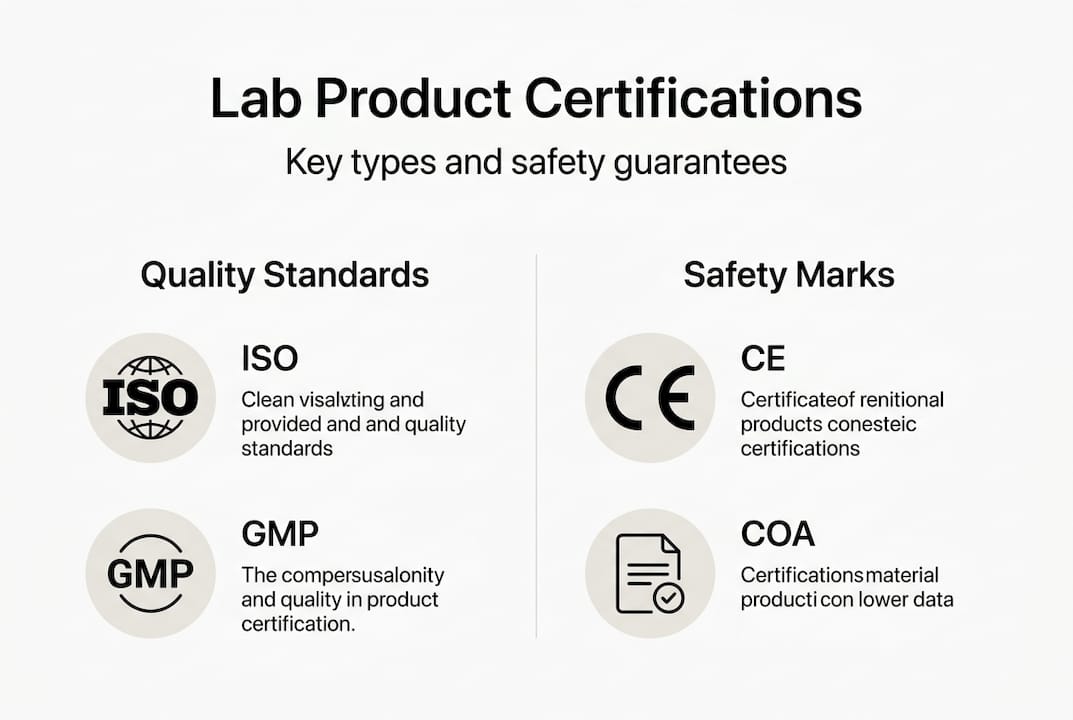
ISO standards represent internationally recognized quality management systems that ensure consistent manufacturing processes and product quality. ISO 9001 covers general quality management, while ISO 13485 specifically addresses medical devices and related products. These certifications require regular audits and demonstrate a manufacturer’s commitment to systematic quality control. ISO certification focuses on process consistency rather than specific product characteristics.
CE marking confirms that a product meets European Union safety, health, and environmental protection requirements. This mark is mandatory for many lab products sold in Europe and indicates compliance with relevant EU directives. CE marking allows free movement of products within the European Economic Area and signals that manufacturers have assessed conformity with applicable regulations. However, CE marking covers broad safety requirements rather than detailed quality specifications.

GMP (Good Manufacturing Practice) certification verifies that products are manufactured in controlled environments following strict protocols for cleanliness, documentation, and quality assurance. GMP standards are particularly important for pharmaceutical-grade products and research reagents where contamination control is critical. This certification ensures proper facility design, equipment maintenance, personnel training, and batch record keeping.
A certificate of analysis (COA) provides detailed, batch-specific quality data including purity percentages, contaminant testing results, pH measurements, and sterility confirmation. Unlike broader certifications, COAs offer concrete verification for each production batch. ISO and CE certifications are primary standards ensuring quality and safety for diverse lab products across Europe, while COAs provide the granular data researchers need for specific applications.
| Certification Type | Issuing Authority | Primary Focus | What It Guarantees |
|---|---|---|---|
| ISO 9001/13485 | ISO-accredited bodies | Quality management systems | Consistent manufacturing processes |
| CE Marking | EU regulatory framework | Safety and health standards | Compliance with EU directives |
| GMP | National health authorities | Manufacturing environment | Controlled production conditions |
| Certificate of Analysis | Manufacturer/third-party labs | Batch-specific quality data | Verified purity and specifications |
Other notable certifications include USP (United States Pharmacopeia) standards for pharmaceutical-grade products, EP (European Pharmacopoeia) specifications, and region-specific marks like the UKCA marking for products in Great Britain post-Brexit. Each certification serves distinct purposes and offers different levels of quality assurance.
How to verify and interpret lab product certifications authentically
Verifying certification authenticity requires systematic checking to avoid counterfeit claims that compromise your research. Follow these steps to authenticate certifications properly:
- Locate the certification number or reference code on product documentation or packaging.
- Visit the official certification body’s website and use their verification database or registry.
- Cross-reference the manufacturer name, product details, and certification dates with official records.
- Verify that certification scope covers the specific product and application you’re purchasing.
- Check expiration dates, as many certifications require periodic renewal and audits.
Reading Certificates of Analysis requires understanding key data points and verification methods. Examine the batch number and confirm it matches your product packaging. Review testing parameters including purity percentages, endotoxin levels, sterility results, and pH measurements. Compare these values against stated specifications to ensure they fall within acceptable ranges. Cross-check testing dates to confirm freshness and verify the testing laboratory’s accreditation status. Certificate of analysis verification involves checking official databases and understanding certification metadata to avoid counterfeit claims.
Red flags indicating fake or invalid certifications include missing official logos or incorrect logo designs, certification numbers that don’t verify on official databases, vague language without specific testing parameters, and suspiciously perfect results showing no variation. Watch for certifications from unknown or unaccredited bodies, documentation with spelling errors or unprofessional formatting, and missing contact information for the certifying organization.
Understanding certification scope limits prevents misplaced confidence in product quality. Certifications guarantee specific tested parameters but don’t cover every possible quality aspect. ISO certification confirms process consistency but doesn’t verify individual batch purity. CE marking ensures basic safety compliance but doesn’t guarantee research-grade quality. Even comprehensive certifications have testing limits and may not detect all potential contaminants.
Pro Tip: Contact manufacturers directly when certification details seem unclear or incomplete. Reputable suppliers readily provide additional documentation, explain testing methodologies, and clarify certification scope. Hesitation or evasive responses signal potential quality concerns.
Parallels exist in other fields where certification authenticity protects end users. Similar to how dental product safety standards ensure consumer protection through verified compliance, lab product certifications safeguard research integrity through documented quality assurance.
Applying lab product certification knowledge to safe peptide research
Peptide research demands exceptional product purity because even trace contaminants can alter experimental outcomes or create safety hazards. Certified lab reagents and solutions provide the consistency necessary for reproducible results and protect researchers from exposure to harmful substances. When working with peptides, you need bacteriostatic water, reconstitution solutions, and handling equipment that meet stringent purity standards to avoid degradation, contamination, or unexpected reactions.
Certified lab products contribute to safer lab environments and higher confidence in research results, essential for peptide experimentation. The difference between certified and uncertified products becomes evident in experimental outcomes and laboratory safety metrics:
| Product Status | Contamination Risk | Result Reproducibility | Regulatory Compliance | Long-term Stability |
|---|---|---|---|---|
| Certified Products | Low (verified sterility) | High (consistent purity) | Documented compliance | Predictable (tested shelf life) |
| Uncertified Products | Unknown/High | Variable (inconsistent batches) | Uncertain/None | Unpredictable |
Best practices for selecting and handling certified products in peptide labs include:
- Verify COAs for every batch of bacteriostatic water and reconstitution solutions before use
- Maintain documentation linking batch numbers to specific experiments for traceability
- Store certified products according to manufacturer specifications to preserve quality
- Use aseptic technique when accessing certified sterile products to prevent contamination
- Monitor expiration dates and rotate stock to ensure optimal product performance
- Source products from suppliers who provide comprehensive certification documentation
- Establish supplier qualification processes that verify certification authenticity
Critical lab products in peptide research requiring certification include bacteriostatic water for reconstitution, sterile diluents for dilution series, analytical-grade solvents for chromatography, buffer solutions with verified pH, and sterile containers for storage. Each product plays a specific role in maintaining peptide integrity and experimental validity.
Benefits of using certified products extend beyond immediate safety concerns. Consistent purity eliminates a major variable in experimental design, allowing you to attribute results to actual experimental factors rather than product inconsistencies. Reduced contamination risk protects both your research investment and personal safety. Regulatory compliance documentation supports publication requirements and satisfies institutional safety protocols. When you understand the safety of bacteriostatic water through proper certification, you can focus on research questions rather than worrying about foundational product quality.
Explore certified lab products trusted by peptide researchers
Now that you understand how certifications protect research integrity and laboratory safety, you can apply this knowledge by sourcing products from suppliers committed to quality documentation. Herbilabs provides certified lab products specifically designed for peptide research, including bacteriostatic water manufactured to strict purity standards with comprehensive certification documentation. Each product comes with verifiable COAs, ensuring you receive the quality assurance your research demands.

Explore our bacteriostatic water FAQs for detailed answers about product specifications, handling procedures, and certification details. Our complete guide to bacteriostatic water explains manufacturing processes, quality control measures, and proper usage protocols. Visit Herbilabs to discover certified lab products that support safer, more reliable peptide research across Europe.
FAQ
What certifications should I look for in lab reagents?
Look for ISO standards, CE marking, GMP certification, and a valid Certificate of Analysis (COA) for batch verification when selecting lab reagents. These certifications confirm compliance with quality and safety protocols established by recognized regulatory bodies. ISO standards ensure consistent manufacturing processes, while CE marking verifies EU safety requirements. GMP certification indicates controlled production environments, and COAs provide specific purity data for each batch you purchase.
How can I verify if a lab product certification is genuine?
Check certifications on official certification body websites and verify batch numbers on COAs against manufacturer records to confirm authenticity. Cross-reference certification numbers in official databases and examine documentation for professional formatting, accurate logos, and complete contact information. Watch for inconsistencies like missing certification details, unverifiable reference numbers, or suspiciously perfect testing results. Contact manufacturers directly for clarification when verifying certificate of analysis documentation, as reputable suppliers readily provide additional verification.
Why are lab product certifications important in peptide research?
Certifications ensure product purity and consistency, minimizing contamination risks that can invalidate experimental results or create safety hazards. Peptides are sensitive to impurities, and uncertified products may contain endotoxins, particulates, or bacterial contamination that alter peptide stability and activity. Certifications support valid and reproducible experimental results by guaranteeing that reconstitution solutions and reagents meet established quality standards. Understanding the importance of certified bacteriostatic water helps you maintain research integrity and protect valuable experimental work.
What best practices should I follow for storing certified lab products?
Store products according to manufacturer instructions, typically in cool, dry places away from direct sunlight and temperature fluctuations. Maintain original packaging until use to preserve sterility and prevent contamination. Avoid contamination by handling products with clean tools, using aseptic technique when accessing sterile solutions, and sealing containers promptly after each use. Label opened products with date and batch number for traceability. Follow specific guidelines for safe storage of bacteriostatic water, including refrigeration requirements and maximum storage durations after opening.
Recommended
- Why Lab-Grade Quality Matters When Buying Bacteriostatic Water in 2025 – Herbilabs Labware
- Bacteriostatic vs Sterile Water: Safe Lab Application Guide 2025 – Herbilabs Labware
- COA – Herbilabs Labware
- Where to Buy Bacteriostatic Water in Europe – #1 Lab Guide – Herbilabs Labware
- Dental Product Safety: Ensuring Science-Backed Choices – Stop Oral Care
- Purification Industry Standards Explained: Impact on Health – Coway Water Purifier