Private Label, White Label, Wholesale partnerships available - EU, USA and UK - Free shipping from €75

The Role of Buffer Solutions in Research Labs
Discover the vital role of buffer solutions in research. Ensure pH stability, protect proteins, and achieve reproducible results in your experiments.
TL;DR:
- Buffer solutions resist pH changes by equilibrating weak acids and conjugate bases, preserving enzyme activity and ensuring reproducibility. Selecting a buffer with a pKa near the target pH and calibrating at the proper temperature are critical for accurate research results. Using high-quality, research-grade reagents and proper preparation practices prevents contamination and experimental failure.
Buffer solutions are defined as aqueous systems that resist pH changes when small amounts of acid or base are added. The role of buffer solutions in research extends far beyond simple pH control. Buffers preserve enzyme activity, protect protein conformation, and make experimental results reproducible across runs. Without them, even a minor pH shift can denature a protein, stall an enzymatic reaction, or invalidate an entire dataset. Phosphate-buffered saline (PBS), Tris, and acetate buffers are the workhorses of biochemical and molecular biology labs worldwide. Understanding how they work and how to use them correctly is not optional for serious researchers. It is the foundation of reliable science.
How do buffer solutions maintain pH stability in research settings?
A buffer solution works through a weak acid and its conjugate base existing in equilibrium. When you add H⁺ ions to the system, the conjugate base absorbs them. When you add OH⁻ ions, the weak acid donates protons to neutralize them. The net result is that pH stays nearly constant despite the addition.
The buffer capacity maximized near pKa is the single most important selection criterion. A buffer performs best within ±1 pH unit of its pKa. Outside that range, the ratio of acid to conjugate base becomes too skewed, and the system loses its ability to resist pH changes.
Buffer capacity and buffer range are not the same thing. A buffer can have high capacity at a given pH but still be useless if that pH is outside the target experimental range. Choosing a buffer with the right pKa is non-negotiable before worrying about concentration.
| Buffer system | pKa | Effective pH range | Common applications |
|---|---|---|---|
| Phosphate (PBS) | 7.21 | 5.8–8.0 | Cell culture, enzyme assays, HPLC |
| Acetate | 4.76 | 3.6–5.6 | Protein crystallization, low-pH assays |
| Tris | 8.10 | 7.0–9.0 | Electrophoresis, PCR, molecular biology |
| Citrate | 3.13 / 4.76 / 6.40 | 3.0–6.2 | Protein purification, food science assays |
| HEPES | 7.55 | 6.8–8.2 | Cell culture, membrane studies |
Pro Tip: Buffers prepared with non-1:1 ratios of acid to conjugate base can still maintain buffering capacity if the resulting pH stays within pKa ±1. This gives you formulation flexibility when you need to fine-tune ionic strength without sacrificing performance.
What are practical considerations for selecting and preparing buffer solutions?
Standard buffer concentrations of 10–100 mM cover the majority of enzymatic assays and cell culture protocols. Lower concentrations reduce ionic strength effects on biomolecules. Higher concentrations provide more capacity but can interfere with sensitive binding interactions.
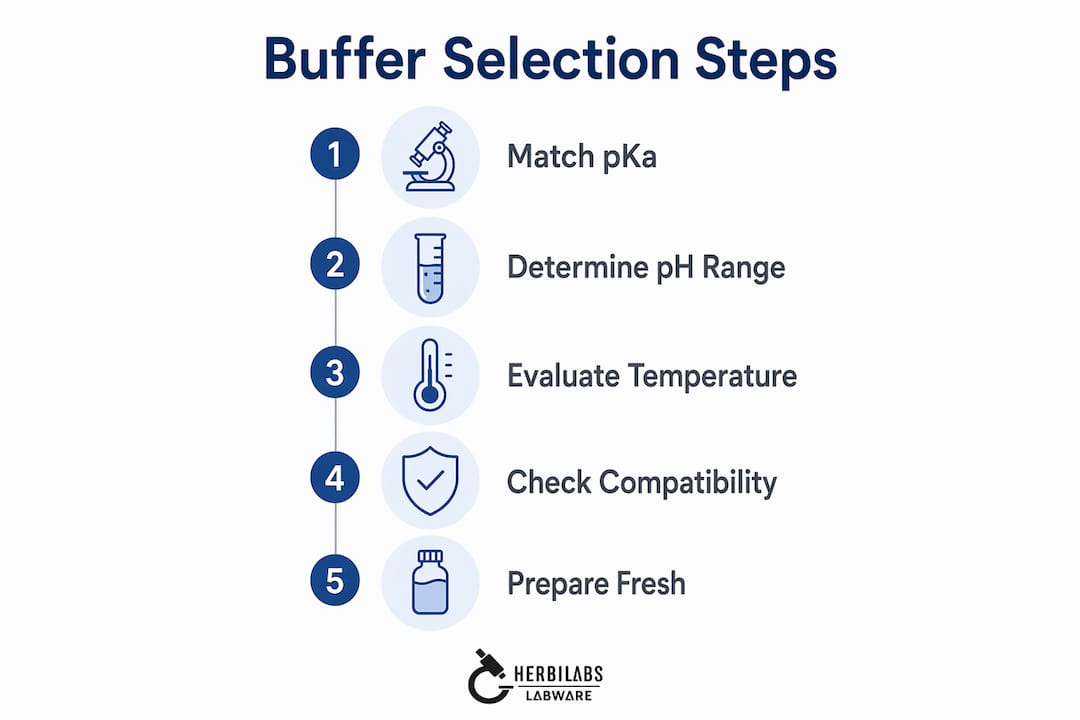
Temperature is a variable that researchers consistently underestimate. Tris buffer pKa decreases approximately 0.03 pH units per °C. A Tris buffer calibrated at room temperature (22°C) and used at 37°C will be roughly 0.45 pH units lower than intended. That shift is enough to alter enzyme kinetics and compromise assay reproducibility.
Chemical compatibility matters as much as pH range. Phosphate buffers can precipitate with Ca²⁺ or Mg²⁺, making them unsuitable for assays that require divalent cations. Tris contains a primary amine group that reacts with aldehydes, ruling it out for any protocol involving glutaraldehyde fixation or aldehyde-based crosslinkers.
Reagent purity directly affects buffer performance in sensitive workflows like chromatography and electrophoresis. Trace metal contaminants can inhibit enzymes. Endotoxin contamination ruins cell-based assays. The quality of your starting materials sets the ceiling for your results. For more on why this matters at the molecular level, the benefits of high purity standards are well documented in biochemical literature.
Best practices for buffer preparation and storage:
- Weigh salts accurately on a calibrated analytical balance before dissolving.
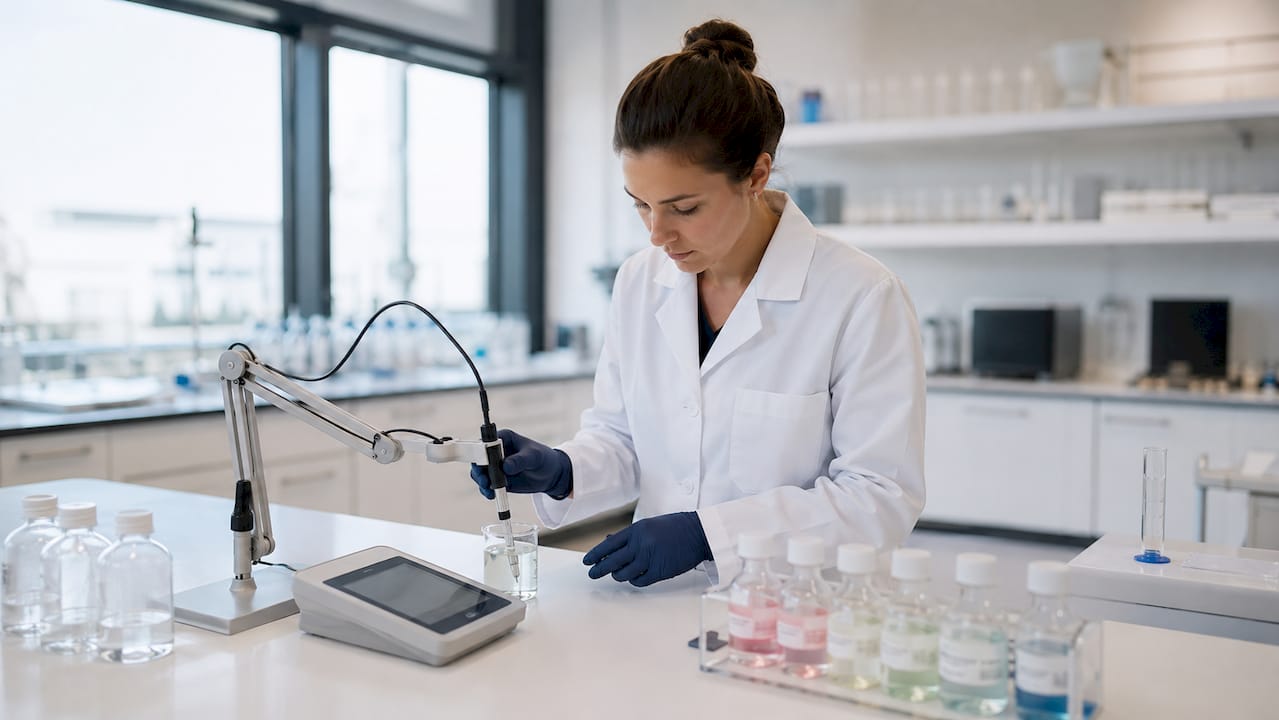
- Adjust pH at the temperature you will use in the experiment, not at room temperature.
- Use water that meets your protocol’s purity requirements (HPLC-grade, ultrapure, or sterile as appropriate).
- Filter through a 0.22 µm membrane before use in cell culture or sterile applications.
- Label every bottle with buffer identity, concentration, pH, preparation date, and storage conditions.
- Store phosphate and acetate buffers at 4°C to minimize microbial growth.
- Discard buffers showing turbidity, precipitation, or pH drift beyond ±0.1 units.
Pro Tip: Always prepare a fresh pH standard curve with your specific electrode before adjusting buffer pH. Electrode drift is common, and a 0.1 unit error in calibration propagates directly into your buffer and your data.
Which buffer solutions are most commonly used across research fields?
The choice of buffer is dictated by the target pH, the biological system, and the downstream analytical method. Phosphate, acetate, and Tris buffers cover the pH range from roughly 3.6 to 9.0 and account for the majority of buffers used in molecular biology and biochemistry labs.
Phosphate-buffered saline is the default for mammalian cell culture and immunoassays because its pH range (5.8–8.0) spans physiological pH and it closely mimics extracellular ion concentrations. Its limitation is incompatibility with divalent cations, which rules it out for any assay requiring Ca²⁺ or Mg²⁺ cofactors.
Tris is the standard buffer for agarose gel electrophoresis, PCR reaction buffers, and many restriction enzyme digests. Its pH range of 7.0–9.0 suits most molecular biology applications. The temperature sensitivity of Tris is a real operational constraint, not a theoretical footnote. Labs running PCR thermocyclers must account for the pH shift across the temperature gradient.
Acetate buffer covers the acidic range (3.6–5.6) and is widely used in protein crystallization, pepsin activity assays, and low-pH chromatography. Citrate buffer, with three ionizable protons, offers a broader effective range (3.0–6.2) and is common in protein purification and some immunohistochemistry antigen retrieval protocols.
| Buffer | pH range | Key advantage | Key limitation |
|---|---|---|---|
| Phosphate (PBS) | 5.8–8.0 | Physiological compatibility | Precipitates with Ca²⁺, Mg²⁺ |
| Tris | 7.0–9.0 | Widely compatible, inexpensive | Temperature-sensitive pKa |
| Acetate | 3.6–5.6 | Stable at low pH | Not suitable above pH 5.6 |
| Citrate | 3.0–6.2 | Broad acidic range | Can chelate metal ions |
| HEPES | 6.8–8.2 | Minimal metal binding | Higher cost than Tris or phosphate |
HEPES has become the preferred buffer for cell culture applications where CO₂ equilibration is not available. Unlike phosphate, HEPES does not bind metal ions significantly, making it compatible with a wider range of cell signaling assays. Its higher cost compared to Tris or phosphate is the primary reason it has not fully displaced PBS in routine culture work.
How do buffers impact experimental outcomes and data interpretation?
Stable buffers allow reproducible enzyme activity, predictable biomolecular behavior, and reliable analytical results. This is not a background condition. It is the active variable that determines whether your data is publishable or needs to be repeated.
Buffers are active components ensuring biomolecules maintain native conformation/01%3A_Unit_I-_Structure_and_Catalysis/02%3A_Water_and_its_Role_in_Life/2.03%3A_Buffering_against_pH_Changes_in_Biological_Systems) at a specific pH. A shift of even 0.3 pH units away from an enzyme’s optimum can reduce its activity by half or more, depending on the enzyme. In kinetic assays, that translates directly to underestimated Vmax values and distorted Km calculations.
Human blood pH is strictly kept between 7.35 and 7.45. Deviations outside that range cause metabolic instability. That biological reality tells you exactly how sensitive pH-dependent systems are. Your in vitro assay is no different.
Common buffer-related experimental failures and how to prevent them:
- pH drift during long incubations: Use higher buffer concentration (50–100 mM) or add a secondary buffer component to extend capacity.
- Enzyme inhibition by buffer components: Test buffer compatibility with a no-substrate control before running full assays.
- Precipitation in the reaction vessel: Check buffer compatibility with all reagents, especially divalent cations, before scaling up.
- Inconsistent results between labs: Standardize buffer preparation protocols, including water source, reagent grade, and pH calibration temperature.
- Electrophoresis band distortion: Verify running buffer pH and ionic strength before loading samples; degraded TAE or TBE buffer is a common cause of smearing.
Ignoring reagent purity or temperature effects causes experimental failure even when buffer composition is technically correct. The formula on paper and the solution in your tube are only equivalent when preparation is executed without shortcuts. Researchers who treat buffer preparation as a routine task rather than a critical step are the ones who spend weeks troubleshooting irreproducible data.
Key Takeaways
Buffer solutions are the single most controllable variable in pH-sensitive research, and getting them right determines whether your experimental data holds up to scrutiny.
| Point | Details |
|---|---|
| Match pKa to target pH | Choose a buffer with pKa within ±1 of your experimental pH for maximum capacity. |
| Account for temperature | Tris pKa shifts ~0.03 units per °C; always calibrate pH at the actual working temperature. |
| Check chemical compatibility | Phosphate precipitates with Ca²⁺ and Mg²⁺; Tris reacts with aldehydes. Match buffer to your system. |
| Use research-grade reagents | Trace contaminants in low-purity salts cause enzyme inhibition and assay artifacts. |
| Standardize preparation | Accurate weighing, proper pH adjustment, and correct storage prevent reproducibility failures. |
Buffers are not background noise
Researchers often treat buffer selection as a checkbox, something you do once and forget. That is the wrong frame. After years of working with biochemical assays and peptide research protocols, I have seen more experiments fail because of buffer issues than almost any other single variable. The failure mode is almost always the same: the buffer was technically correct on paper but wrong for the actual experimental conditions.
The insight that changed how I approach buffer chemistry is this: buffers function beyond stabilizing pH/01%3A_Unit_I-_Structure_and_Catalysis/02%3A_Water_and_its_Step_in_Life/2.03%3A_Buffering_against_pH_Changes_in_Biological_Systems) by actively replicating physiological conditions. When you choose Tris for a mammalian enzyme assay at 37°C without correcting for temperature, you are not just making a minor error. You are running the assay at a pH the enzyme never evolved to function at.
The practical advice I give every researcher I work with is this: prepare your buffer at the temperature you will use it, verify pH with a freshly calibrated electrode, and never assume that a buffer that worked in one protocol will transfer directly to another. The advantages of research-grade solutions become obvious the moment you compare results from lab-grade versus lower-purity reagents. The difference is not subtle.
Attention to buffer chemistry is not perfectionism. It is the minimum standard for data you can defend.
— Ragnar
Research-grade reagents for buffer-dependent protocols
Herbilabs supplies research-grade sterile solutions and reagents built to the purity standards that buffer-sensitive workflows demand. When your protocol depends on consistent pH, ionic strength, and zero contaminant interference, the quality of your starting materials is not negotiable.

Herbilabs products are manufactured under strict quality control and are suited for enzymatic assays, peptide reconstitution, and molecular biology applications across the UK and Europe. Researchers working with bacteriostatic water for buffer preparation will find detailed guidance on product selection, storage, and compatibility in the Herbilabs resource library. For a full catalog of available reagents and sterile solutions, visit the Herbilabs shop directly.
FAQ
What is the primary role of buffer solutions in research?
Buffer solutions maintain stable pH by neutralizing added acids or bases through weak acid and conjugate base equilibria. This stability preserves enzyme activity, protein conformation, and assay reproducibility across experimental runs.
Why does buffer pKa matter for experiment design?
A buffer’s maximum capacity occurs at its pKa, and it performs effectively only within ±1 pH unit of that value. Choosing a buffer whose pKa is far from your target pH leaves your system with little resistance to pH change.
How does temperature affect buffer performance?
Temperature shifts the pKa of many buffers, especially Tris, which changes approximately 0.03 pH units per °C. A Tris buffer calibrated at 22°C will be measurably more acidic at 37°C, which is enough to alter enzyme kinetics.
Can the wrong buffer choice invalidate experimental data?
Yes. Phosphate buffers precipitate with Ca²⁺ and Mg²⁺, and Tris reacts with aldehydes. Either interaction can inhibit enzymes, alter binding kinetics, or introduce artifacts that make data uninterpretable.
What concentration of buffer should researchers use?
Most labs use buffer concentrations between 10 mM and 100 mM. Lower concentrations minimize ionic interference with biomolecules, while higher concentrations provide greater capacity to resist pH drift during long incubations.