Private Label, White Label, Wholesale partnerships available - EU, USA and UK - Free shipping from €75

Why Partner with Research-Grade Suppliers for Labs
Discover why partner with research-grade suppliers. Gain superior quality, enhance reproducibility, and boost your lab's credibility.
TL;DR:
- Research-grade suppliers provide materials with verified 99% purity from independent third-party laboratories. Using such suppliers ensures consistent quality, improves reproducibility, and reduces costs related to failed experiments and validation. Building long-term, reviewed partnerships supports reliable research and regulatory compliance.
Research-grade suppliers are defined as vendors who provide materials meeting at least 99% HPLC-verified purity with batch-specific Certificates of Analysis from independent third-party laboratories. Understanding why partner with research-grade suppliers matters starts here: supplier quality is the single most controllable variable in experimental reproducibility. 57% of businesses identify supplier quality as a direct driver of customer loyalty and brand reputation. For independent researchers and labs, that statistic translates directly into the credibility of published findings and the reliability of every experiment that follows.
Why partner with research-grade suppliers instead of standard vendors?
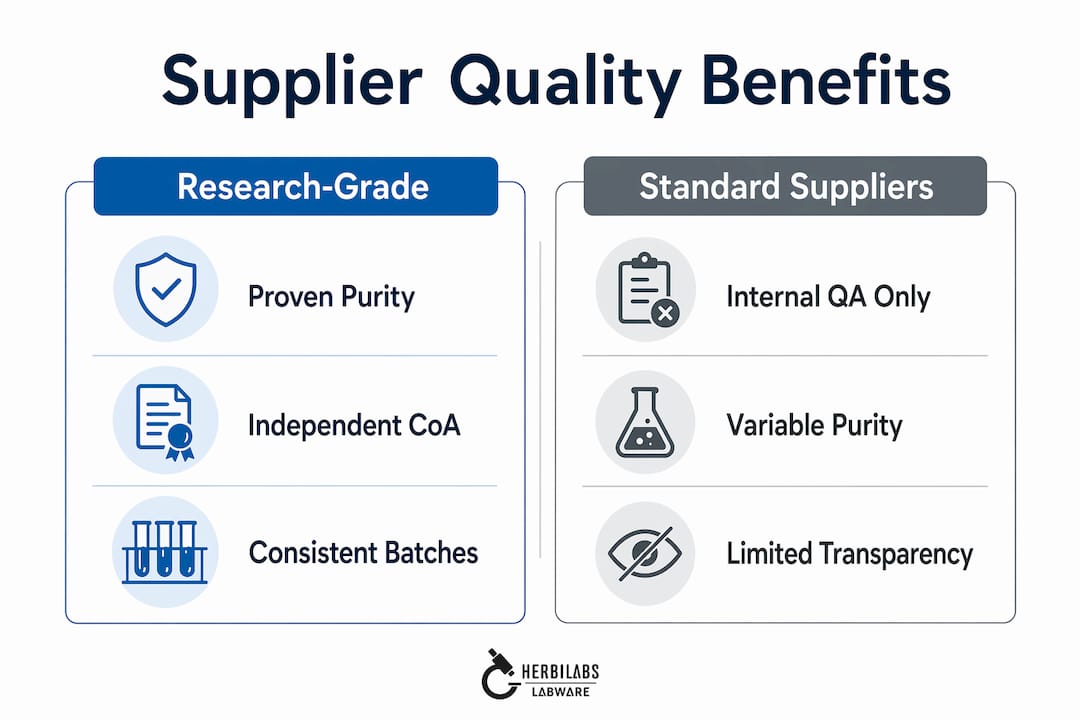
The difference between research-grade and standard suppliers is not a matter of marketing language. It is a matter of verified, documented evidence. Research-grade compounds require at minimum 99% purity confirmed by HPLC analysis, paired with a batch-specific Certificate of Analysis that names the independent laboratory that ran the tests.
Standard suppliers often provide internal QA documents. Those documents carry an inherent conflict of interest because the same organization testing the product also profits from selling it. Independent third-party testing removes that conflict entirely, giving researchers a credible, unbiased quality assurance record.
The term “research-grade” itself is not regulated by a single governing body. That absence of regulation makes independent verification the only reliable differentiator. A supplier claiming research-grade status without a third-party CoA is making a marketing claim, not a scientific one.
| Feature | Research-grade supplier | Standard supplier |
|---|---|---|
| Purity verification | ≥99% HPLC, third-party lab | Internal QC, variable standards |
| Certificate of Analysis | Batch-specific, named third-party lab | Generic or in-house document |
| Traceability | Full lot traceability | Often limited |
| Regulatory alignment | GLP/ISO compatible documentation | Not guaranteed |
Key quality markers to look for in any supplier:
- Batch-specific CoA naming the independent testing laboratory
- HPLC chromatograms available on request
- Full lot traceability from raw material to finished product
- Documented compliance with GLP or ISO quality standards
- Clear contamination testing protocols for endotoxins and heavy metals
Pro Tip: Ask any prospective supplier to send you a sample CoA before placing an order. A credible research-grade supplier will share it without hesitation. A supplier who delays or refuses is telling you something important.
How does partnering with quality suppliers improve research outcomes?
Supplier quality directly determines batch-to-batch consistency. Inconsistent purity between lots forces researchers to repeat validation steps, consuming time and budget that could go toward actual experiments. Transparency and batch documentation are investments in scientific validity, not administrative overhead.
The operational benefits extend beyond the bench. Labs working with verified suppliers spend less time troubleshooting anomalous results caused by reagent variability. They also enter audits with complete, organized documentation rather than scrambling to reconstruct records after the fact.
“Quality decisions start with sourcing. Researchers who treat supplier selection as a scientific decision rather than a purchasing decision protect every experiment that follows.” — Key Advantages of Sourcing Reliable Materials for Labs
The cost argument is equally clear. Quality escapes cost more to remediate than the premium paid to a verified supplier in the first place. A failed experiment traced to a contaminated reagent means lost time, wasted consumables, and potentially invalidated data sets. Paying more upfront for verified materials is not a budget decision. It is a risk management decision.
Concrete advantages of working with research-grade suppliers include:
- Reduced validation cycles due to consistent purity across batches
- Faster compliance with GLP and ISO audit requirements
- Access to technical support from suppliers who understand research applications
- Fewer supply chain disruptions from quality-related holds or recalls
- Stronger data reproducibility supporting peer review and publication
How to choose research partners: criteria that actually matter
Selecting a research-grade supplier requires a structured evaluation, not a quick price comparison. The role of suppliers in scientific research goes beyond product delivery. It includes documentation quality, communication responsiveness, and the ability to support your specific research context.
Use this evaluation sequence when assessing any new supplier:
- Request batch-specific CoAs. Confirm the named testing laboratory is independent and not affiliated with the supplier. Cross-reference the lab if possible.
- Verify quality management system certifications. ISO 9001 or equivalent certification signals that quality processes are audited externally, not self-assessed.
- Review customer references and track records. Ask for references from research institutions with similar applications. Published case studies from academic labs carry more weight than general testimonials.
- Assess communication and technical support. Send a technical question before purchasing. Response quality and speed reveal how the supplier will perform when you have an urgent problem mid-experiment.
- Evaluate flexibility and custom solutions. Research needs change. A supplier who can adjust concentrations, volumes, or packaging formats saves significant time over the course of a project.
- Confirm supply chain transparency. Ask where raw materials originate and how the supplier manages supply disruptions. A supplier with no answer to that question is a supply risk.
Supplier quality management systems improve product quality while reducing costs through ongoing collaboration between buyers and suppliers. That collaboration only works when both parties communicate openly from the start.
Pro Tip: Build a simple supplier scorecard with five criteria: CoA quality, response time, pricing transparency, delivery reliability, and technical support. Score each supplier quarterly. Patterns become visible within two review cycles.

Long-term partnerships vs. transactional supplier relationships
Transactional purchasing treats every order as a standalone event. Long-term supplier partnerships treat the relationship as a research asset. The difference in outcomes is significant.
Trusted supplier partnerships provide collaboration, early access to new materials, and custom solutions that prevent downtime and accelerate research pace. A supplier who knows your research program can flag relevant new compounds, anticipate your volume needs, and prioritize your orders during supply constraints.
| Factor | Long-term partnership | Transactional relationship |
|---|---|---|
| Problem-solving | Collaborative, proactive | Reactive, case-by-case |
| New material access | Early or priority access | Standard catalog availability |
| Pricing | Volume-based, negotiated | List price per order |
| Supply continuity | Managed, planned | Dependent on stock availability |
| Documentation support | Ongoing, tailored | Per-order only |
The advantages of long-term supplier relationships compound over time:
- Suppliers learn your specific quality requirements and flag deviations proactively
- Custom formulations become feasible once the supplier understands your application
- Priority fulfillment during supply shortages protects research continuity
- Shared institutional knowledge reduces onboarding time for new lab members
- High purity standards become easier to maintain when a supplier already knows your benchmarks
The cost-benefit case for long-term partnerships is direct. Vendor qualification takes time and resources upfront. But the cost of qualifying a new supplier after a quality failure, including repeated validation, delayed publications, and potential grant reporting issues, far exceeds the investment in maintaining a trusted relationship.
Key Takeaways
Partnering with research-grade suppliers is the most direct way to protect experimental reproducibility, reduce remediation costs, and maintain compliance across every stage of a research program.
| Point | Details |
|---|---|
| Verify purity independently | Require ≥99% HPLC-verified purity with a CoA from a named third-party lab. |
| Treat documentation as data | Batch-specific CoAs are scientific records, not administrative formalities. |
| Evaluate before you order | Score suppliers on CoA quality, communication, and supply chain transparency before committing. |
| Build long-term relationships | Long-term partnerships provide priority access, custom solutions, and proactive quality support. |
| Calculate the true cost | Quality escapes cost more to fix than verified suppliers cost to use. |
What I’ve learned from watching labs cut corners on supplier selection
Researchers who treat supplier selection as a procurement task rather than a scientific decision pay for it eventually. I have seen labs spend weeks troubleshooting anomalous assay results, only to trace the problem back to a reagent lot with no traceable CoA and a purity level that was never independently verified. The time lost was irreversible. The data was unusable.
The most common mistake is accepting a supplier’s internal QA document as proof of research-grade quality. Internal documents are not independent. They tell you what the supplier wants you to know, not what a neutral laboratory measured. Demanding a third-party CoA is not being difficult. It is doing your job.
The second mistake is treating a good first order as permanent validation. Supplier quality can drift between lots, especially with smaller producers. Continuous assessment matters more than the initial qualification. Review CoAs on every new batch, not just the first one.
The researchers who move fastest are the ones with the most reliable supply chains. They spend less time validating, less time troubleshooting, and more time generating data. That is not a coincidence. It is the direct result of treating supplier partnerships as a core part of research design, not an afterthought.
— Ragnar
Herbilabs: research-grade supplies with full documentation
Independent researchers and labs working across the UK and Europe need a supplier who treats documentation as seriously as purity. Herbilabs supplies bacteriostatic water and research reagents manufactured to strict purity standards, with Certificates of Analysis available for every product.
Herbilabs products are produced in a dedicated facility with rigorous quality control at every stage. The focus is on contaminant-free materials that hold up under demanding research conditions. Researchers who need reliable reagent supply chain management will find transparent documentation, responsive support, and wholesale pricing for labs and resellers at Herbilabs.
FAQ
What does research-grade supplier mean?
A research-grade supplier provides materials with at least 99% HPLC-verified purity and batch-specific Certificates of Analysis from independent third-party laboratories. The term is not regulated, so independent verification is the only reliable proof of quality.
Why does supplier quality affect research reproducibility?
Inconsistent purity between batches forces repeated validation and produces variable experimental results. Verified suppliers deliver consistent lot-to-lot quality, which is the foundation of reproducible data.
How do I verify a supplier is truly research-grade?
Request a batch-specific CoA that names the independent laboratory that ran the analysis. If the CoA only references internal testing, the supplier has not met the standard for research-grade verification.
What is the cost risk of using unverified suppliers?
Quality escapes cost more to remediate than the premium paid to a verified supplier. Failed experiments, repeated validation, and delayed publications all carry costs that exceed any initial savings from cheaper materials.
How often should I reassess my current suppliers?
Reassess suppliers on every new batch by reviewing the CoA, and conduct a formal supplier evaluation at least once per year. Quality can drift between lots, and continuous review catches problems before they affect your data.