Private Label, White Label, Wholesale partnerships available - EU, USA and UK - Free shipping from €75

Compliance Checklist for Research Labs: 2026 Guide
Download our 2026 compliance checklist for research labs. Ensure regulatory compliance, protect staff, and enhance research integrity today!
TL;DR:
- Research labs must follow specific federal regulations, including OSHA’s Chemical Hygiene Plan and EPA waste rules. Regular inspections, updated documentation, and proper training are essential for compliance and safety. Continuous monitoring and a strong safety culture prevent violations and ensure effective research operations.
A compliance checklist for research labs is a structured, facility-specific tool that maps every regulatory obligation a lab must meet to protect personnel, maintain research integrity, and avoid legal liability. The governing framework spans OSHA’s Laboratory Standard 29 CFR 1910.1450, EPA hazardous waste rules under 40 CFR 262, and the mandatory Chemical Hygiene Plan. Lab managers who treat this checklist as a living document rather than a one-time form consistently outperform those who rely on generic templates. This guide gives you the exact structure, regulatory grounding, and implementation steps to build a checklist that holds up under audit.
What regulatory standards must research labs meet?
Research lab regulations come from multiple federal agencies, and each carries distinct documentation and training requirements. Knowing which rules apply to your specific lab type is the first step in building any credible research facility safety checklist.
OSHA Laboratory Standard 29 CFR 1910.1450 is the primary federal rule for labs working with hazardous chemicals. It mandates a written Chemical Hygiene Plan, documented staff training before hazardous work begins, and exposure monitoring with strict communication timelines. Specifically, exposure monitoring results must be provided to affected lab staff within 15 working days. Missing that deadline is one of the most common OSHA citations labs receive.
The Global Harmonized System labeling transition adds another deadline. OSHA requires employers to update all workplace labeling and complete staff training on pure substances by mid-2026. Mixture compliance follows by may 19, 2028. Labs that have not yet updated their GHS labels for pure substances are already in violation.
On the environmental side, the EPA offers a regulatory alternative under 40 CFR 262 Subpart K for hazardous waste management in academic research labs. Subpart K provides more flexibility than standard generator rules, but opting in requires strict internal compliance. Labs that elect Subpart K and then fail to follow its requirements face penalties under both the alternative and the standard rules.
Key regulatory obligations every lab checklist must address:
- Written Chemical Hygiene Plan, facility-specific and annually reviewed
- GHS-compliant labeling for all hazardous chemicals, updated per OSHA deadlines
- Documented training records showing completion before hazardous work starts
- Exposure monitoring records shared with affected staff within 15 working days
- Hazardous waste management plan aligned with EPA Subpart K or standard generator rules
- Department of Transportation compliance for any off-site chemical shipments
What are the critical components of a research lab compliance checklist?
A well-built lab inspection checklist is not a single form. It is a set of interlocking documents covering chemical management, personnel safety, environmental monitoring, emergency preparedness, and waste disposal. Each component feeds the others.
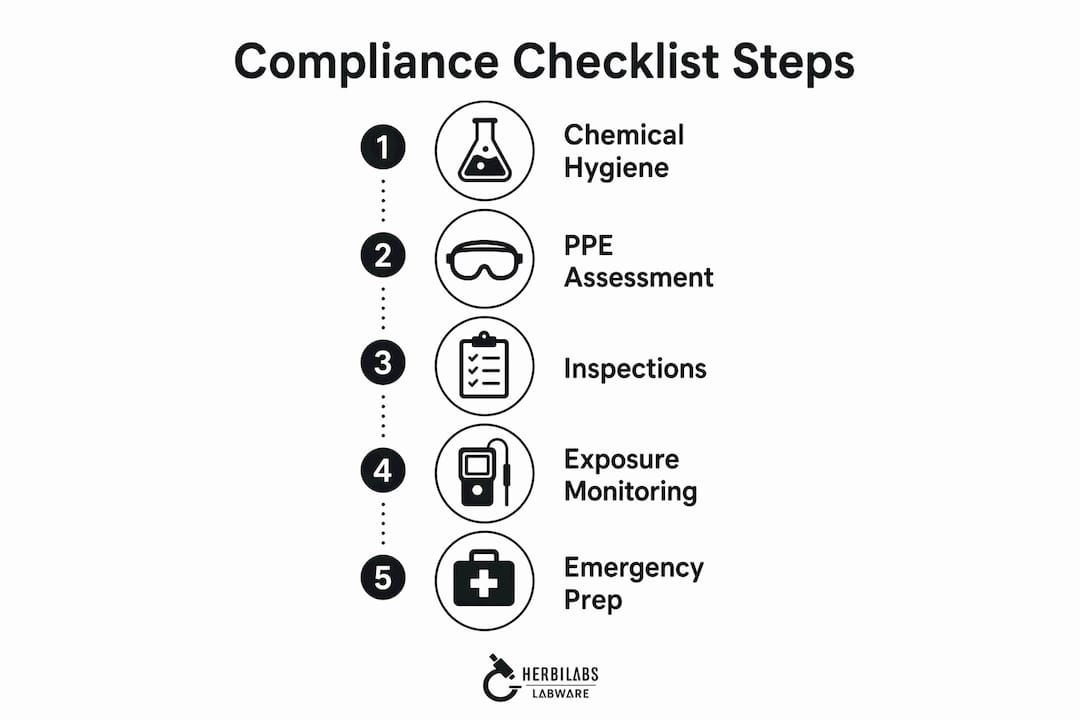
1. Chemical Hygiene Plan
The CHP is the backbone of laboratory safety compliance. A generic Chemical Hygiene Plan is insufficient. OSHA mandates a facility-specific plan tailored to the unique hazards of each lab, reviewed annually or immediately when a new hazard is introduced. The CHP must be physically accessible to every lab staff member, not stored only in a manager’s office or a shared drive folder that requires special access.
2. PPE and hazard assessment documentation
Every lab must conduct a written hazard assessment that identifies the specific PPE required for each task. That assessment must be signed, dated, and kept on file. PPE selection tied to a documented hazard assessment protects both the researcher and the institution in the event of an incident or inspection.
3. Inspection schedule
Formal lab safety inspections should occur quarterly, supplemented by monthly self-inspections conducted by lab personnel. Quarterly audits catch systemic issues. Monthly checks catch the day-to-day drift that accumulates between formal reviews. Both must be documented with dates, findings, and corrective actions.
4. Environmental and exposure monitoring
Monitoring data is mandatory evidence, not optional recordkeeping. Environmental monitoring data must be documented, time-stamped, and shared with affected employees within strict OSHA deadlines. Digital time-stamping systems prevent the most common citation in this category.
5. Emergency preparedness and waste disposal
Emergency procedures must be written, posted, and practiced. Waste disposal records must align with the lab’s chosen EPA framework. Labs using Subpart K must maintain satellite accumulation records and ensure all waste containers are properly labeled and closed.
| Checklist component | Review frequency | Documentation required |
|---|---|---|
| Chemical Hygiene Plan | Annually or upon new hazard | Signed, dated revision log |
| PPE hazard assessment | Per task type or annually | Written assessment with signatures |
| Safety inspections | Monthly (self) and quarterly (formal) | Inspection reports with corrective actions |
| Exposure monitoring | Per OSHA trigger events | Time-stamped records shared within 15 days |
| Waste disposal records | Ongoing | Satellite accumulation logs, manifest copies |
Pro Tip: Assign a named responsible person to each checklist component. Shared ownership means no ownership. One person per item, with a backup designee, prevents gaps during staff turnover.
How to implement and maintain an effective lab compliance checklist
Deploying a checklist is straightforward. Keeping it current as your lab’s hazards and regulations evolve is the harder task. The following steps build a system that survives staff changes, new research projects, and regulatory updates.
Step 1: Audit your current hazards. Walk every bench and storage area. Catalog all chemicals, biological agents, and physical hazards present. This inventory drives every other checklist decision.
Step 2: Map regulations to your specific hazards. Not every OSHA standard applies to every lab. A lab working exclusively with low-hazard reagents has different obligations than one handling carcinogens or reproductive toxins. Match your hazard inventory to the applicable regulatory requirements before building your checklist sections.
Step 3: Assign ownership and set schedules. Every inspection item needs a named owner and a calendar date. Use a shared digital system so records are accessible to all authorized personnel and cannot be lost when a staff member leaves.
Step 4: Train staff before they touch hazardous materials. OSHA requires training completion before hazardous work begins, not within 30 days of hire. Build your onboarding sequence so that safe reagent handling training is completed on day one, before any bench access is granted.
Step 5: Document every finding and corrective action. An inspection that finds no issues and produces no written record is worthless under audit. Document what was checked, what was found, and what was corrected, including the date the correction was completed.
Step 6: Integrate continuous monitoring where possible. Automated environmental monitoring creates immutable, time-stamped records that auditors prefer over manual logs. Real-time systems also catch exceedances before they become incidents.
Step 7: Review and update the checklist quarterly. Tie checklist reviews to your formal inspection cycle. Any new chemical, new procedure, or new regulatory update triggers an immediate checklist revision, not a note to “handle later.”
Pro Tip: Build a simple corrective action tracker in a shared spreadsheet or digital platform. Each finding gets a row: date identified, responsible person, target completion date, and date closed. This single document answers 80% of auditor questions.
What common compliance challenges do research labs face?
Most lab compliance failures are predictable. They fall into a small set of recurring patterns that a well-designed checklist directly prevents.
- Generic Chemical Hygiene Plans. Labs that download a template CHP and file it without customization are already non-compliant. OSHA inspectors check whether the CHP reflects the actual hazards present in that specific facility. A plan that lists chemicals not used in your lab, or omits ones that are, signals that the document is not a working tool.
- Outdated training records. Training is not a one-time event. When a new chemical is introduced or a procedure changes, affected staff need updated training before the change takes effect. Labs that train at hire and never revisit training accumulate silent compliance gaps.
- Missed exposure monitoring deadlines. The 15-working-day window for sharing monitoring results is firm. Labs that collect data but delay sharing it with affected employees face citations even when the monitoring itself was conducted correctly.
- Infrequent self-inspections. Monthly self-inspections involving lab personnel build safety ownership and catch hazards that develop between formal audits. Labs that rely solely on annual or quarterly external inspections miss the day-to-day drift that leads to incidents.
- Static policies that do not reflect current research. Lab compliance policies must be living documents continuously updated to reflect changing hazards and regulations. A policy written for last year’s research project does not cover this year’s new protocols.
“Cultural gaps often cause non-compliance even when knowledge exists.” This finding from the National Institute of General Medical Sciences captures the core problem. A lab can have every document in order and still fail because safety culture does not support near-miss reporting or honest self-inspection. Compliance is a behavior, not a binder.
Key Takeaways
A compliance checklist for research labs works only when it is facility-specific, regularly updated, and backed by a safety culture that treats documentation as a daily practice rather than an audit-time scramble.
| Point | Details |
|---|---|
| Regulatory mapping is mandatory | Match your specific lab hazards to OSHA, EPA, and DOT requirements before building any checklist. |
| CHP must be facility-specific | A generic Chemical Hygiene Plan is an OSHA violation; review and update it annually or when new hazards arise. |
| Inspection frequency matters | Run monthly self-inspections and quarterly formal audits, and document every finding with corrective actions. |
| Training precedes hazardous work | Staff must complete safety training before handling hazardous materials, not within a grace period after hire. |
| Monitoring data has a hard deadline | Share exposure monitoring results with affected staff within 15 working days to avoid citations. |
Why I think most labs are one audit away from a citation
I have reviewed compliance programs across a range of research environments, and the pattern is consistent. Labs with strong documentation often have weak culture, and labs with strong culture often have documentation gaps. The rare lab that passes a rigorous audit without a single finding has both.
The shift toward continuous automated monitoring is the most significant practical change in lab compliance right now. Real-time, time-stamped records remove the human error that plagues manual logs. They also change the dynamic during an inspection because the auditor sees a continuous record rather than a snapshot.
What I find most underused is the monthly self-inspection. When lab personnel conduct their own inspections, they stop seeing hazards as someone else’s problem. That ownership shift is worth more than any software tool. The lab safety compliance standards that govern research environments are complex, but the behavioral change required to meet them is simple: make safety a weekly conversation, not an annual event.
The labs that struggle most are the ones treating their Chemical Hygiene Plan as a filed document rather than a working guide. Pull it out. Read it. If it does not describe what actually happens in your lab today, rewrite it before your next inspection.
— Ragnar
Herbilabs Labware and your lab’s compliance needs
Research labs running compliant operations need reagents and diluents that meet the same standard as their documentation. Herbilabs supplies research-grade bacteriostatic water and sterile reconstitution solutions manufactured to strict purity standards, with rigorous quality control at every production stage.
Every product in the Herbilabs catalog is designed for demanding research environments where contaminant-free materials are non-negotiable. Whether your lab requires bacteriostatic water for peptide reconstitution or sterile diluents for sensitive assays, Herbilabs provides reliable supply with documented quality assurance. Visit the Herbilabs shop to review the full product range and request wholesale pricing for institutional orders.
FAQ
What is a compliance checklist for research labs?
A compliance checklist for research labs is a facility-specific document that tracks every regulatory obligation a lab must meet under OSHA, EPA, and other applicable agencies. It covers chemical hygiene, PPE, training, inspections, monitoring, and waste disposal.
How often should a research lab conduct safety inspections?
Labs should conduct formal safety inspections quarterly and monthly self-inspections involving lab personnel. Both inspection types must be documented with findings and corrective actions.
What must a Chemical Hygiene Plan include?
A Chemical Hygiene Plan must address the specific hazards present in that facility, outline safe handling procedures, define PPE requirements, and be reviewed annually or immediately when a new hazard is introduced.
How quickly must exposure monitoring results be shared with staff?
OSHA requires labs to share exposure monitoring results with affected employees within 15 working days of receiving the data. Failure to meet this deadline is a common and avoidable citation.
What is EPA Subpart K and does it apply to your lab?
EPA Subpart K under 40 CFR 262 is an optional regulatory alternative for hazardous waste management in academic research labs. Labs that opt in gain flexibility but must follow Subpart K requirements strictly or face penalties under both frameworks. Review the lab waste disposal requirements for your institution before electing this option.