Private Label, White Label, Wholesale partnerships available - EU, USA and UK - Free shipping from €75

Safe reagent handling: step-by-step lab safety guide
Follow this step-by-step guide to safe reagent handling, covering PPE, CLP/REACH labeling, spill response, and EU compliance for independent researchers.
Handling research reagents without a structured safety protocol is one of the fastest ways to turn a productive session into a serious incident. Independent researchers working outside institutional settings face a unique challenge: no safety officer looking over your shoulder, no automatic compliance checks, and full personal liability if something goes wrong. EU regulations around chemical handling are strict, and violations can carry real legal consequences. This guide walks you through every stage of safe reagent handling, from the gear you need before you open a bottle to the verification steps you run before closing your session, so you can work confidently and legally.
Table of Contents
- Preparation: What you need for safe reagent handling
- Step-by-step safe reagent handling procedures
- Common mistakes and troubleshooting in reagent handling
- Verification: Ensuring lab safety and regulatory compliance
- Enhancing lab safety with certified solutions from Herbilabs
- Frequently asked questions
Key Takeaways
| Point | Details |
|---|---|
| Always use PPE | Wearing the right protective gear prevents accidents and exposure. |
| Label and store correctly | Proper labeling and storage following EU rules avoids costly legal incidents. |
| Act fast on spills | Immediate cleanup and emergency response are vital for lab safety. |
| Verify compliance | Check all procedures against CLP/REACH to meet European requirements. |
| Avoid working alone | Never handle hazardous reagents solo; always have support and procedures ready. |
Preparation: What you need for safe reagent handling
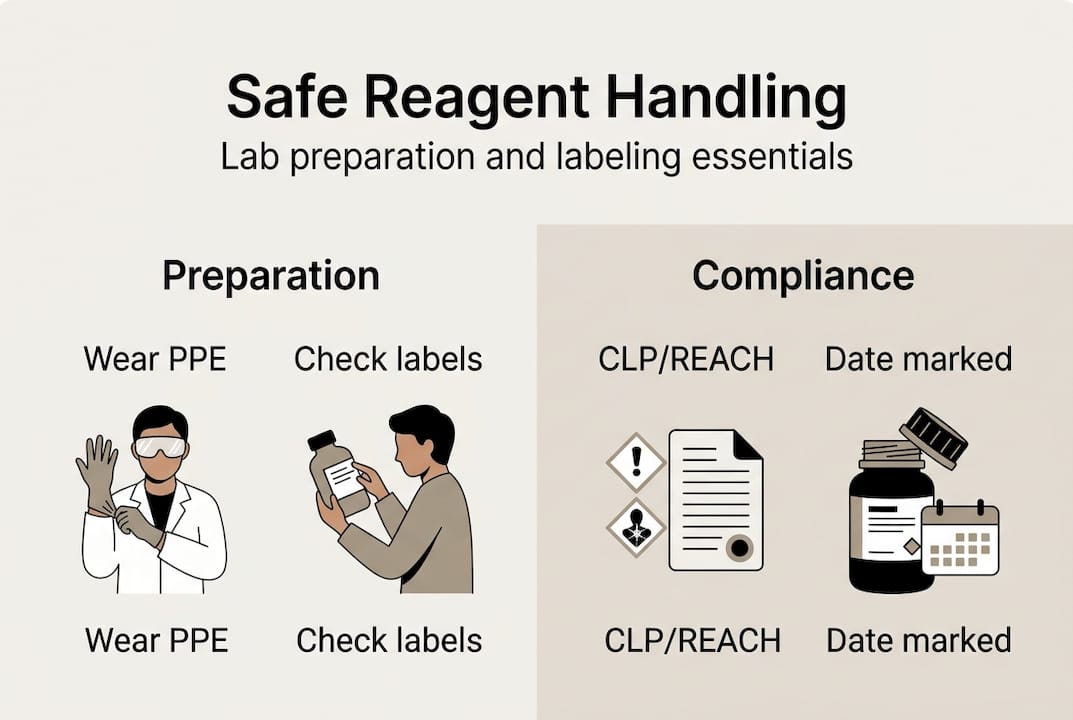
Before you touch a single reagent, your workspace and your body need to be protected. This is not optional. Appropriate PPE includes chemical splash goggles, a lab coat, gloves, and a face shield when splash risk is elevated. Skipping any one of these is not a calculated risk. It is a gap in your defense.
Here is a practical PPE checklist to run through before every session:
- Chemical splash goggles (not standard safety glasses)
- Nitrile or neoprene gloves matched to the chemical class you are handling
- Lab coat made from flame-resistant or chemical-resistant material
- Face shield for any procedure involving open containers or pressurized systems
- Closed-toe shoes and long pants, no exceptions
- Emergency eyewash station within 10 seconds of your work area
- Spill kit stocked with appropriate absorbents for your reagent class
Labeling is equally non-negotiable. Under EU rules, CLP/REACH compliance requires every container to display its contents, associated hazards, and preparation or expiry dates. A Safety Data Sheet (SDS) must be accessible for every substance in your workspace. If you are sourcing reagents for peptide research, understanding lab purity for peptide research is directly tied to how well you document and label what you are working with.
| Requirement | EU standard | Practical action |
|---|---|---|
| Container labeling | CLP/REACH | Name, hazard, date on every vessel |
| SDS availability | REACH Article 31 | Printed or digital copy on hand |
| PPE selection | EN standards | Match glove/goggle type to chemical |
| Emergency equipment | Directive 89/391 | Eyewash and spill kit within reach |
| Research use labeling | EU peptide regulation | No therapeutic claims on label |
Understanding lab product certifications before you purchase reagents also saves you from compliance headaches later.
Pro Tip: Always treat any mixture as more toxic than its individual components. Synergistic effects between reagents are common and often unpredictable. When in doubt, escalate your PPE level rather than downgrade it.
Step-by-step safe reagent handling procedures
Once your workspace is set up and your PPE is on, execution is about discipline and sequence. Rushing any step is where most incidents begin.
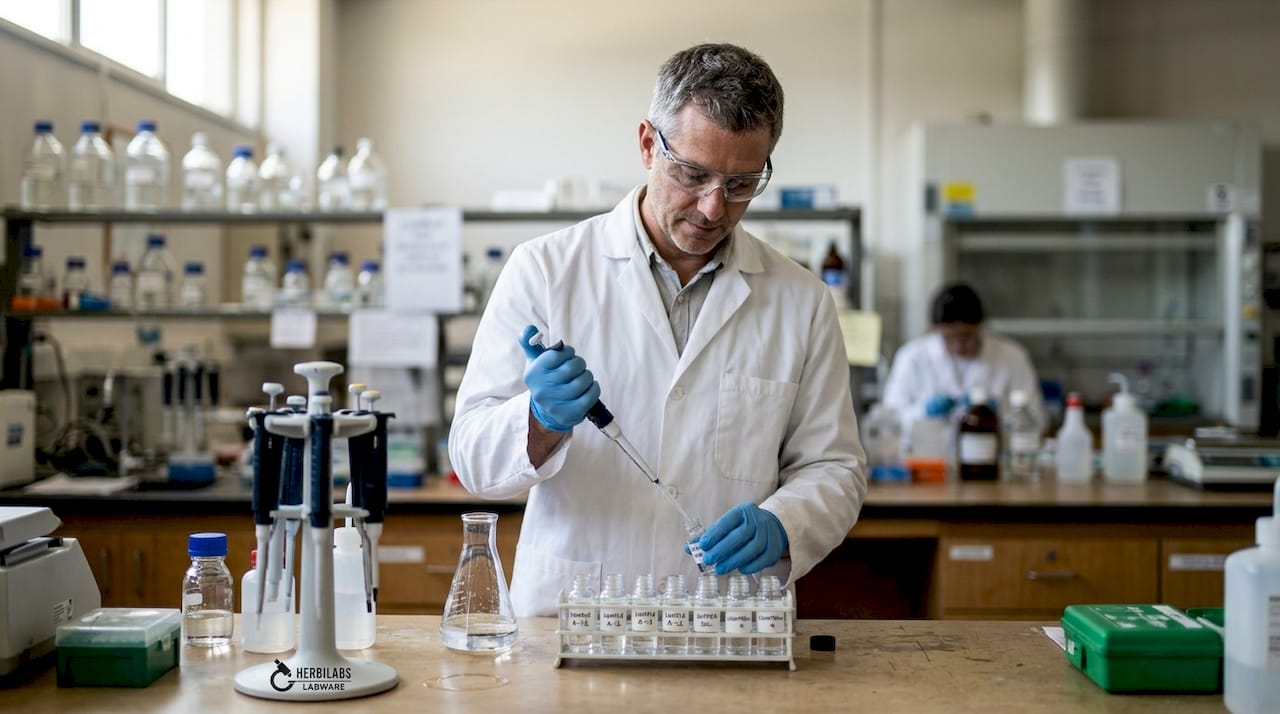
- Don PPE in order. Put on your lab coat first, then gloves, then goggles. If a face shield is needed, it goes on last. Wash hands before gloving.
- Verify labels before opening. Confirm the container matches your SDS. Check for damage, leaks, or discoloration before proceeding.
- Record the substance. Log the reagent name, lot number, quantity used, and time in your lab notebook or digital record system.
- Dispense in a controlled environment. Use a fume hood for volatile compounds. Never pipette by mouth. Use calibrated equipment only.
- Mix with caution. Add reagents to solvents, not the reverse, to control exothermic reactions. Work in small volumes when testing new combinations.
- Store immediately after use. Return reagents to their designated storage area. Segregate incompatible chemicals. Follow temperature requirements for sensitive compounds. Guidance on storing lab reagents safely is especially relevant for aqueous solutions like bacteriostatic water.
- Respond to spills immediately. Clean spills at once using appropriate absorbents. Never work alone with hazardous reagents, and always have emergency procedures posted and rehearsed.
Critical safety warning: Never handle hazardous reagents alone. If an incident occurs and you are incapacitated, a second person must be present to activate emergency protocols. This is both a safety requirement and, in many EU jurisdictions, a legal one.
For researchers working with injectable solutions, lab sterilization tips and understanding comparing water types for reconstitution are practical extensions of these handling steps.
| Step | Key action | Risk if skipped |
|---|---|---|
| PPE donning | Full kit before any contact | Skin/eye exposure |
| Label verification | Match container to SDS | Wrong substance used |
| Dispensing | Fume hood, calibrated tools | Inhalation, measurement error |
| Storage | Segregate incompatibles | Fire, reaction, contamination |
| Spill response | Absorbent, emergency protocol | Exposure escalation |
Common mistakes and troubleshooting in reagent handling
Even experienced researchers fall into patterns that quietly erode safety. Knowing what to look for is half the battle.
The most frequent errors include:
- Illegible or incomplete labels. A faded marker or missing hazard symbol is a compliance failure and a safety risk. Reprint or rewrite labels before they degrade.
- Wrong glove selection. Latex gloves offer almost no protection against many organic solvents. Always cross-reference your glove material against the chemical’s SDS.
- Skipping goggles for “quick” tasks. Splash incidents do not announce themselves. Goggles stay on for the entire session, not just the parts that feel risky.
- Storing incompatible chemicals together. Oxidizers near flammables, acids near bases. These combinations can react violently even through container walls if there is a leak.
- Ignoring volatility. Heating a reagent or working in a warm room dramatically increases vapor concentration. The accident prevention checklist from EU-OSHA specifically flags volatiles and heating as underestimated risks.
Expert note: Engineering controls like fume hoods and ventilation systems should always be your first line of defense. PPE is the last barrier, not the primary one. If you are relying on gloves to protect you from a vapor hazard, your setup is already wrong.
Pro Tip: When you encounter an unknown mixture or an unlabeled container, isolate it immediately. Do not attempt to identify it by smell or appearance. Treat it as hazardous until proven otherwise, and consult your SDS library or a qualified chemist.
For researchers working with peptide solutions, applying sterilization tips consistently reduces both contamination risk and the chance of creating unintended chemical interactions during reconstitution.
Verification: Ensuring lab safety and regulatory compliance
Finishing a session is not the same as closing it safely. Verification is the step most independent researchers skip, and it is where compliance gaps accumulate.
Run through this sequence before you leave your workspace:
- Check all container labels against your CLP/REACH requirements. Every vessel must show contents, hazard classification, and date. Proper labeling is not just good practice. It is a legal obligation under EU chemical law.
- Update your reagent log. Record quantities remaining, any incidents or near-misses, and disposal actions taken.
- Inspect storage areas. Confirm incompatible substances are segregated. Check that temperature-sensitive reagents are within their required range.
- Review emergency equipment. Confirm the eyewash station is functional, the spill kit is restocked, and emergency contact numbers are posted.
- Document training currency. If you work with others, verify that everyone present has completed relevant safety training and that records are current.
| Verification item | What to check | Frequency |
|---|---|---|
| Container labels | Contents, hazard, date visible | Every session |
| Reagent log | Quantities, incidents recorded | Every session |
| Storage segregation | Incompatibles separated | Weekly |
| Emergency equipment | Eyewash, spill kit functional | Weekly |
| Training records | All personnel current | Monthly |
| SDS library | All substances covered | Per new reagent |
For a deeper look at what certifications your reagents and labware should carry, the lab certification checklist is a practical reference. Staying current with regulatory guidance for peptide research in Europe ensures your verification process reflects the latest legal standards.
Enhancing lab safety with certified solutions from Herbilabs
Following a rigorous handling protocol is only as effective as the quality of the reagents you start with. If your bacteriostatic water or reconstitution solution is not manufactured to research-grade purity standards, every safety step downstream is working against a compromised baseline.
At Herbilabs, every product in our labware shop is manufactured under strict quality controls designed for exactly the kind of research environment this guide describes. Our bacteriostatic water guide walks you through proper use and handling, and our resources on lab certifications help you verify that what you are using meets EU research standards. When your reagents are certified and your protocols are solid, you are not just working safely. You are working with confidence.
Frequently asked questions
What PPE is required for handling research peptides?
You should wear splash goggles, a lab coat, gloves, and a face shield if necessary to prevent skin and eye contact during any handling procedure.
How should I label reagent containers in a European lab?
Every container must display its contents, hazard classification, and date, and must meet CLP/REACH labeling requirements with an accessible SDS for each substance.
What is the first step after a reagent spill?
Use appropriate absorbent materials to clean the spill immediately and activate your posted emergency protocol if the spill involves a hazardous substance.
Are ‘research use only’ peptides legal to handle in Europe?
Yes, provided no therapeutic claims are made and labeling is correct. EU peptide rules permit research-labeled peptides under REACH/CLP handling requirements.
What are the signs of unsafe reagent handling?
Missing PPE, poor or incomplete labeling, and no posted emergency procedures are the clearest indicators. Engineering controls being bypassed in favor of PPE alone is another serious warning sign.