Private Label, White Label, Wholesale partnerships available - EU, USA and UK - Free shipping from €75

Bac water for reliable lab workflows: 28-day guide
Learn how bacteriostatic water supports 28-day multi-dose peptide reconstitution, how it compares to sterile water, and best practices for reliable lab workflows.
TL;DR:
- Water choice critically affects peptide stability and reproducibility in research workflows.
- Bacteriostatic water enables multi-dose use due to its antimicrobial preserving properties.
- Proper technique and reagent selection prevent degradation and ensure reliable experimental results.
Water choice is one of the most underestimated variables in peptide research. Most protocol failures get blamed on reagent quality or technique, but the diluent used during reconstitution is frequently the real culprit. Bacteriostatic water, commonly called bac water, contains 0.9% benzyl alcohol and offers a level of stability that plain sterile water simply cannot match for multi-dose applications. In this guide, we cover how bac water works, how it compares to sterile water, the exact steps for safe peptide reconstitution, and how to handle the edge cases that trip up even experienced researchers.
Table of Contents
- Why bac water matters in lab workflows
- Bac water vs sterile water: finding the right fit
- Step-by-step peptide reconstitution with bac water
- Edge cases and best practices: navigating exceptions
- The overlooked truth: reliable workflows start with water choices
- Get trusted bac water and lab solutions for reliable research
- Frequently asked questions
Key Takeaways
| Point | Details |
|---|---|
| Choose the right water | Bac water is optimal for multi-dose peptide vials, while sterile water fits single-dose or sensitive applications. |
| Follow safe reconstitution steps | Proper technique—slow injection and gentle mixing—ensures peptide integrity and reproducibility. |
| Address exceptions smartly | Switch to acetic acid or sterile water for peptides that are poorly soluble or sensitive to benzyl alcohol. |
| Reliable results start with solvents | Managing water selection and handling reduces lab errors and improves workflow consistency. |
Why bac water matters in lab workflows
Bacteriostatic water is sterile water preserved with 0.9% benzyl alcohol, a compound that inhibits bacterial growth without affecting the peptides or reagents dissolved in it. That single addition changes everything about how you can use it in the lab. Unlike plain sterile water, which must be discarded after a single use, bac water maintains its antimicrobial protection for up to 28 days after the vial is first punctured. For researchers running repeated assays or managing multi-dose peptide vials, that difference is enormous.
Understanding what is bac water is the first step toward building a reproducible workflow. The benzyl alcohol acts as a bacteriostatic agent, meaning it halts bacterial replication rather than killing existing organisms outright. This is why sterile technique still matters even when using bac water. The preservative buys you time and reduces contamination risk, but it does not replace proper aseptic handling.
Key benefits of bac water for lab use:
- Multi-dose capability across a 28-day window
- Maintains peptide stability better than unpreserved diluents
- Reduces waste and cost in high-frequency research protocols
- Widely compatible with most standard peptides and growth factors
- Supports reproducibility by eliminating single-use preparation variability
The lab applications of bac water span peptide reconstitution, hormone preparation, and reagent dilution across multiple research disciplines.
| Feature | Bac water | Sterile water |
|---|---|---|
| Preservative | 0.9% benzyl alcohol | None |
| Multi-dose use | Yes, up to 28 days | No, single-dose only |
| Shelf life after opening | 28 days | Discard after use |
| Peptide stability | High for most peptides | Variable |
| Best use case | Multi-dose vials, repeated assays | Single-dose, sensitive peptides |
Bac water’s benzyl alcohol content prevents bacterial growth for up to 28 days after opening, making it the standard choice for multi-dose peptide vials in research environments.
Pro Tip: Always check the expiry date printed on bac water vials before use. Expired vials may have degraded benzyl alcohol concentrations, which compromises both antimicrobial protection and your results.
Before you even draw up your diluent, allow vials to reach room temperature and use 70% IPA to swab stoppers. This step is non-negotiable for maintaining sterility from the start.
Now that we understand the importance of water selection, let’s explore how bac water compares to other lab solutions.
Bac water vs sterile water: finding the right fit
The distinction between bac water and sterile water is not just academic. Choosing the wrong diluent can degrade your peptide, shorten its usable window, or introduce variables that make your data unreliable. Both are sterile at the point of manufacture, but they behave very differently once a vial is opened.
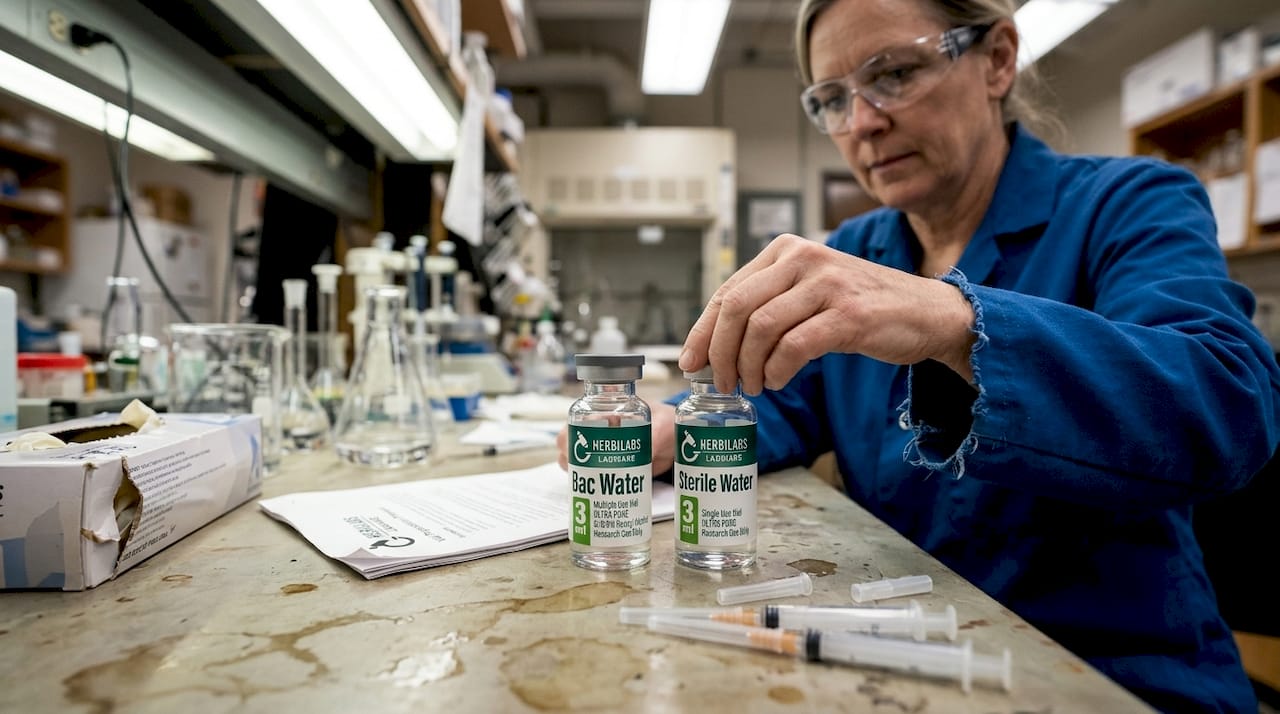
Sterile water contains no preservatives. It is pure, clean, and completely inert, which makes it ideal for specific applications. But the moment you puncture a sterile water vial, the clock starts ticking. Any subsequent draw introduces contamination risk, and there is nothing in the solution to slow bacterial growth if contamination occurs.
Consult a bac vs sterile water guide before finalizing your protocol, especially if you are working with less common peptide sequences.
| Property | Bac water | Sterile water |
|---|---|---|
| Components | Water + 0.9% benzyl alcohol | Water only |
| Applications | Multi-dose peptides, growth factors | Single-dose, sensitive compounds |
| Shelf life after opening | Up to 28 days | Single use |
| Limitations | Not for benzyl alcohol-sensitive peptides | No multi-dose capability |
| Cost efficiency | High for repeated use | Low for repeated use |
When to use each type:
- Use bac water for multi-dose peptide vials, growth hormone, and standard research peptides
- Use sterile water for single-dose applications where the entire vial will be used at once
- Use sterile water when the peptide is known to be sensitive to benzyl alcohol
- Use bac water when reproducibility across multiple draws is critical to your protocol
Researchers sometimes assume that is bac water safe is a simple yes or no question. The real answer depends on the specific peptide and application. For most standard peptides, bac water is the safer choice precisely because it reduces contamination risk over time.
For edge cases in peptide reconstitution, sterile water is the correct choice for single-dose or benzyl alcohol-sensitive applications. Ignoring this can lead to peptide degradation that looks like a dosing error or a bad batch.
Pro Tip: Avoid bac water for hydrophobic peptides that are known to be sensitive to benzyl alcohol. When in doubt, check the peptide manufacturer’s technical data sheet before selecting your diluent.
With these distinctions clarified, it’s vital to implement the right reconstitution steps, especially for peptides.
Step-by-step peptide reconstitution with bac water
Reconstitution sounds simple, but small technique errors compound quickly. A peptide that was stored correctly and reconstituted with the right diluent can still be degraded if the mechanical steps are wrong. Here is the process we recommend for consistent, reproducible results.
Step-by-step reconstitution with bac water:
- Remove both the peptide vial and bac water vial from the refrigerator and allow them to reach room temperature. Cold peptides reconstitute unevenly.
- Swab both vial stoppers with a 70% IPA wipe and allow them to air dry for 30 seconds.
- Calculate the volume of bac water needed based on your target concentration. Use a 1 to 3 mL syringe for precision.
- Draw the calculated volume of bac water slowly into the syringe, avoiding air bubbles.
- Insert the needle into the peptide vial and inject slowly down the vial wall, not directly onto the lyophilized powder.
- Gently roll or swirl the vial to dissolve. Never shake.
- Inspect the solution visually. It should be clear with no particulates before use.
- Label the vial with the date of reconstitution and store according to the peptide’s requirements.
Following using bac water in protocols consistently across your team reduces inter-researcher variability, which is one of the most common sources of unreliable data in independent lab settings.
Bac water allows up to 28 days use for multi-dose vials, which means a single properly handled vial can support an entire research cycle without replacement.
Always dispose of bac water vials that show cloudiness, visible particles, or have exceeded 28 days since first puncture. When in doubt, discard and use a fresh vial.
Pro Tip: Never shake peptide vials during reconstitution. Shaking creates mechanical stress that can break peptide bonds and denature the compound. Swirl gently and give the peptide time to dissolve on its own.
For guidance on temperature and duration, storing bac water safely covers the specific conditions that preserve both the diluent and the reconstituted peptide.
Now let’s explore special cases that can change your approach to reconstitution.
Edge cases and best practices: navigating exceptions
Not every peptide behaves the same way in bac water. Some are hydrophobic, meaning they resist dissolving in aqueous solutions. Others are chemically sensitive to benzyl alcohol. Knowing when to reach for an alternative solvent is what separates a reliable researcher from one who keeps blaming the peptide.
When to use acetic acid or sterile water instead of bac water:
- Use 0.1 to 1% acetic acid for hydrophobic or poorly soluble peptides
- Use sterile water when the peptide sequence is known to degrade in the presence of benzyl alcohol
- Use acetic acid as a first-step solvent, then dilute with bac water or sterile saline if needed
- Always consult the peptide’s technical datasheet before selecting an alternative solvent
For bac water vs other diluents, the comparison goes beyond just bac water and sterile water. Acetic acid, DMSO, and saline each have specific use cases that depend on peptide chemistry.
| Peptide type | Recommended solvent |
|---|---|
| Standard water-soluble peptides | Bac water |
| Hydrophobic or poorly soluble peptides | 0.1 to 1% acetic acid |
| Benzyl alcohol-sensitive peptides | Sterile water |
| IGF-1 LR3 | Acetic acid (preferred) |
| Growth hormone (HGH) | Bac water |
For edge cases in peptide reconstitution, acetic acid at 0.1 to 1% is the standard recommendation for hydrophobic or poorly soluble peptides like IGF-1 LR3, where benzyl alcohol may degrade the compound over time.
Review the bac water faqs if you encounter unexpected solubility issues or cloudiness after reconstitution. Many common problems have straightforward solutions once you understand the chemistry.
Pro Tip: For IGF-1 LR3 specifically, opt for acetic acid rather than bac water as your primary reconstitution solvent. IGF-1 LR3 is sensitive to benzyl alcohol and dissolves more reliably in a mildly acidic environment.
Armed with these advanced principles, let’s address what most guides miss: practical wisdom for researchers.
The overlooked truth: reliable workflows start with water choices
Here is something most protocol guides will not tell you directly. When a researcher reports inconsistent results, the investigation usually starts with reagent purity, assay conditions, or equipment calibration. Water selection is rarely the first suspect. That is a mistake.
We have seen workflows where every variable was tightly controlled except the diluent. Researchers were switching between bac water and sterile water based on availability, not protocol. The result was data that looked almost right but never fully replicated. Once the water variable was locked down, reproducibility improved immediately.
Controlling your solvent selection is the simplest, lowest-cost intervention available to independent researchers. It requires no new equipment and no additional training. It just requires discipline and a clear understanding of what each diluent does.
Building lab quality assurance into your standard operating procedures means documenting which diluent is used for each peptide, from which vial, and on which date. That level of traceability is what separates publishable data from anecdote.
Get trusted bac water and lab solutions for reliable research
For researchers ready to upgrade their lab safety and consistency, having a reliable source for research-grade diluents is not optional. It is foundational.
At Herbilabs, we supply bacteriostatic water and sterile reconstitution solutions manufactured to strict purity standards, with rigorous quality control at every stage. Whether you need a single vial or wholesale quantities for a larger research program, our products are built for the demands of serious scientific work. Check our guidance on bac water safety and safe bac water storage to ensure your workflow meets the highest standards. Browse the full range at our labware shop and find the right solution for your protocol.
Frequently asked questions
How long can bacteriostatic water be used after opening?
Bac water prevents bacterial growth for up to 28 days after opening, thanks to its 0.9% benzyl alcohol content. Discard any vial that has exceeded this window or shows visible changes.
Can I use sterile water instead of bac water for peptide reconstitution?
Sterile water works for single-dose applications or when the peptide is sensitive to benzyl alcohol, but it offers no multi-dose protection. For single-dose or benzyl alcohol-sensitive applications, sterile water is the correct choice.
What should I do if my peptide is poorly soluble in bac water?
Switch to a mild acetic acid solution for IGF-1 LR3 and other hydrophobic peptides. A concentration of 0.1 to 1% acetic acid improves solubility without damaging the peptide.
Should I shake the vial to dissolve peptides?
Never shake. Gently roll or swirl the vial until the lyophilized powder dissolves completely. Shaking introduces mechanical stress that can degrade sensitive peptide bonds.