Private Label, White Label, Wholesale partnerships available - EU, USA and UK - Free shipping from €75

Laboratory water handling guide: ensure purity in research
Learn how to handle, store, and monitor laboratory water for reliable peptide research. Evidence-based steps for researchers across the UK and Europe.
A single contaminated container or a few minutes of improper storage can invalidate hours of peptide preparation work. Handling methodologies directly impact result accuracy, and for researchers working with sensitive compounds, that is not a theoretical risk. It is a practical one that shows up as failed assays, inconsistent reconstitution, and wasted reagents. This guide walks you through every critical stage of laboratory water handling, from workspace setup to purity monitoring, so your results stay reproducible and your samples stay clean.
Table of Contents
- Preparing for proper laboratory water handling
- Step-by-step: Safe handling and dispensing procedures
- Best practices for laboratory water storage
- Maintaining water system performance and monitoring purity
- Resolving issues and special considerations for peptide preparation
- Your next steps: Trusted labware and water solutions
- Frequently asked questions
Key Takeaways
| Point | Details |
|---|---|
| Set up for success | Prepare your environment, materials, and containers before every use to ensure purity. |
| Follow proper handling | Flush, minimize storage, and use glass to prevent contamination and preserve water quality. |
| Monitor and maintain | Regularly check water purity and maintain systems to catch issues before they affect results. |
| Special case awareness | Adapt protocols for peptide handling and resolve issues rapidly for consistent research quality. |
| Partner with trusted suppliers | Reliable labware and water sources underpin robust and reproducible scientific research. |
Preparing for proper laboratory water handling
Before you touch a single vial or pipette, your environment and equipment need to meet a defined standard. Contamination does not always come from the water itself. It comes from the containers, the airflow in the room, and the habits built into your daily workflow.
Location matters more than most researchers expect. Store water away from HVAC vents, high-traffic corridors, and any area where airborne particulates are likely. Even brief exposure to unfiltered air during dispensing can introduce contaminants that compromise downstream results.
For containers, avoid plastics, store in borosilicate glass exclusively. Plastic vessels leach extractables into ultrapure water within hours, and those trace compounds interfere with peptide stability and assay sensitivity. Borosilicate glass is chemically inert and the only acceptable choice for research-grade water storage. You can find practical safe storage tips that align with these standards.
Cleaning your containers properly is non-negotiable. Follow established cleaning protocols that include acid or acetone washing followed by thorough rinsing with the same grade of water you plan to store. Never assume a visually clean container is chemically clean.
Key preparation checklist:
- Store water in a low-traffic, vent-free area
- Use only borosilicate glass containers
- Wash containers with acid or acetone, then rinse thoroughly
- Discard the first 1 to 2 liters after any idle period before use
- Label every container with date, water grade, and intended use
| Preparation factor | Recommended standard | Common mistake |
|---|---|---|
| Container material | Borosilicate glass | Using polypropylene or PET plastic |
| Cleaning method | Acid or acetone wash plus rinse | Rinsing with tap water only |
| Storage location | Away from vents and traffic | Near HVAC units or open windows |
| Pre-use flushing | Discard 1 to 2 liters after idle | Using first draw without flushing |
Pro Tip: Build a weekly container sterilization schedule into your lab maintenance log. Rotating containers on a fixed cycle prevents biofilm buildup that visual inspection alone will never catch.
Step-by-step: Safe handling and dispensing procedures
With your workspace and materials ready, the actual handling sequence needs to be precise and consistent. Variability in technique is one of the most common sources of contamination that researchers overlook.
Standard handling sequence:
- Flush the system or container by discarding the first draw before collecting your working volume.
- Transfer water using dedicated, pre-cleaned borosilicate glassware. Never reuse containers across different water grades.
- Dispense directly into your working vessel. Minimize the number of transfer steps.
- Cap or seal immediately after dispensing. Do not leave containers open on the bench.
- Use immediately; minimize storage to reduce contamination risk from airborne particles and bacterial growth.
For peptide applications specifically, bubble formation during transfer is a real problem. Bubbles introduce air interfaces that can denature sensitive peptide structures. Pour slowly along the vessel wall and avoid vigorous mixing. If you are working with hydrophobic peptides, note that 0.1% acetic acid or DMSO is often required for initial solubilization before aqueous dilution. Skipping this step leads to incomplete dissolution and inaccurate concentration calculations.
Understanding which water type you are working with also shapes your handling approach. Review the bacteriostatic water overview and the comparison of sterile vs bacteriostatic options before selecting your diluent. For detailed protocol integration, the lab protocol steps resource covers application-specific guidance.
| Water type | Handling priority | Multi-use suitability |
|---|---|---|
| Sterile water | Single-use, immediate transfer | No |
| Bacteriostatic water | Controlled multi-draw with aseptic technique | Yes |
| Deionized water | Minimize storage, use borosilicate glass | Limited |
Critical warning: Plastic containers release extractables into ultrapure and sterile water within hours of contact. Even brief storage in polypropylene vials can introduce compounds that interfere with peptide assays and invalidate your results. Always use glass.
Pro Tip: When reconstituting hydrophobic peptides, add a small volume of DMSO or 0.1% acetic acid first, swirl gently, then add your aqueous diluent. This two-step approach dramatically improves dissolution without denaturing the peptide.
Best practices for laboratory water storage
Proper handling is only effective if storage also meets strict laboratory standards. Water that is handled correctly but stored poorly will degrade before it reaches your experiment.
Glass is always the preferred storage material. Store minimally in clean borosilicate glass and keep volumes small. Large stored volumes are a liability, not a convenience. The more water you store, the greater the surface area exposed to potential contamination over time.
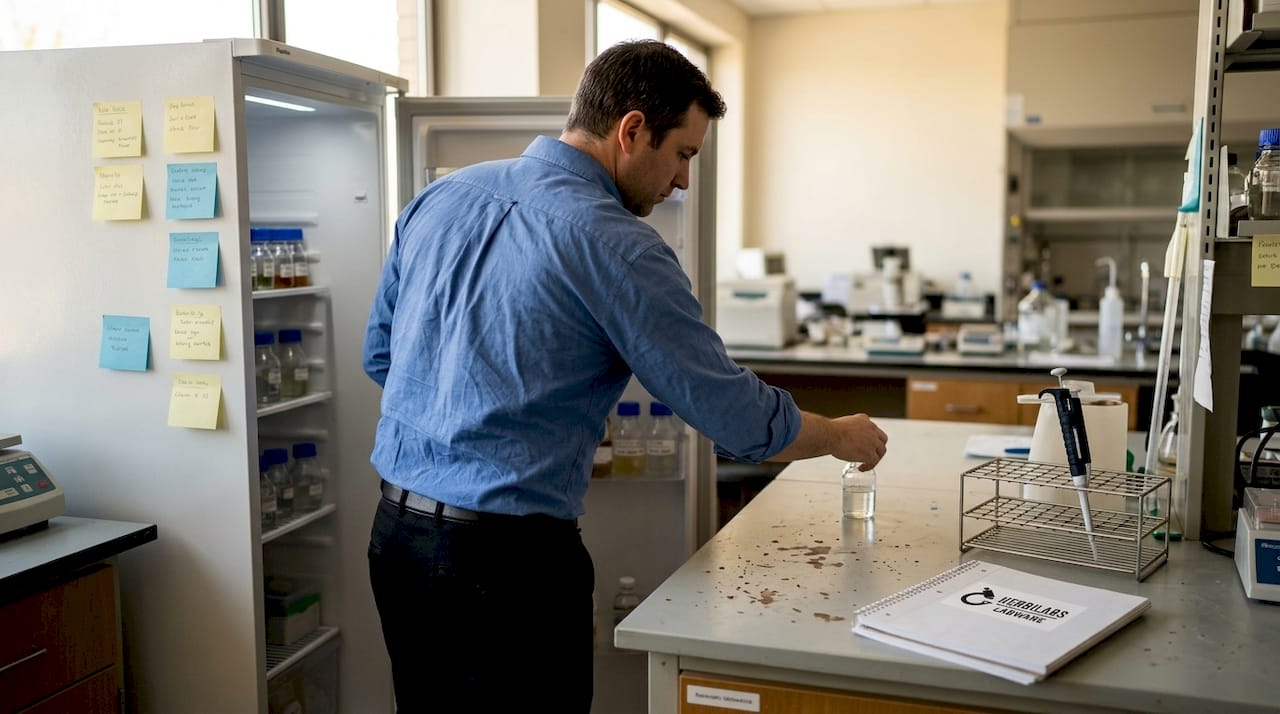
Protect your stored water from airborne contamination. Keep containers sealed at all times except during active dispensing. Store them away from vents, open windows, and high-traffic areas where particulates are disturbed regularly. Review the safe water storage guidelines and cross-reference with your lab’s quality assurance criteria to ensure your storage practices align with research-grade standards. Proper instrument cleaning training principles also apply to water storage vessel maintenance.
Actionable storage tips:
- Label every container with the date of collection and water grade
- Conduct routine visual and purity checks before each use
- Dispose of any stored water that has been open or unused for more than 24 hours
- Never top off old water with fresh water. Empty, clean, and refill completely
- Store at controlled room temperature away from direct light
Safety note: Bacteria risk increases with storage times exceeding 24 hours in unprotected or improperly sealed containers. Even ultrapure water becomes a growth medium once exposed to ambient air. Treat storage duration as a critical variable, not an afterthought.
Maintaining water system performance and monitoring purity
No water handling protocol is complete without ongoing maintenance and impurity monitoring. Your purification system is only as reliable as the attention you give it between uses.
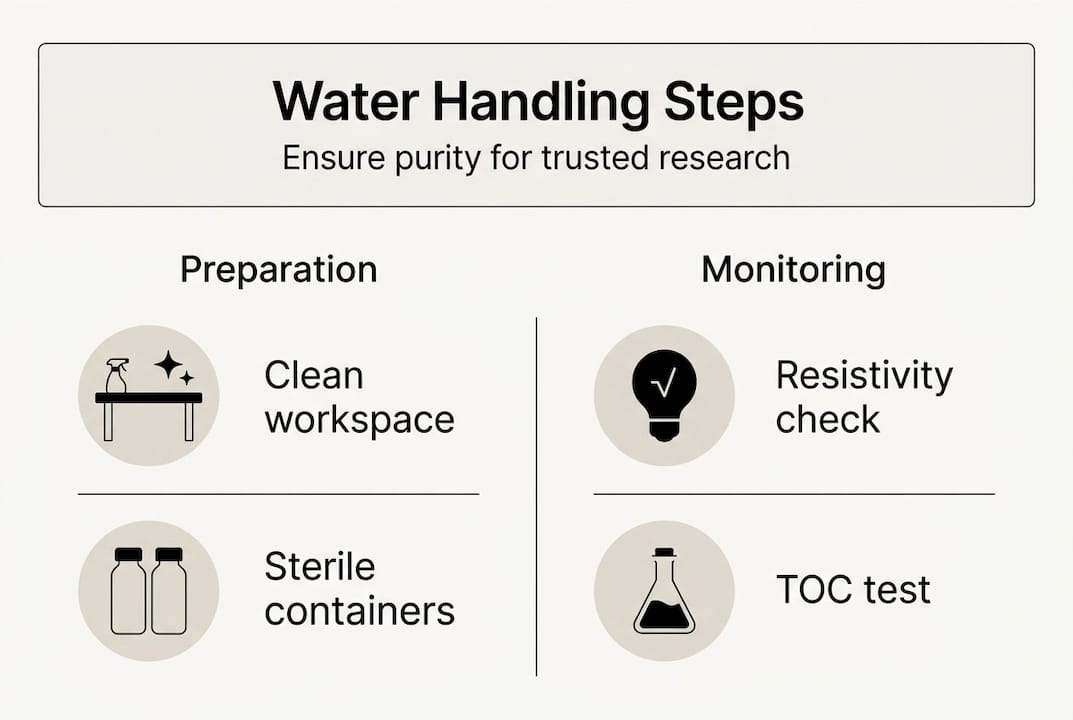
Daily checks are the foundation of system reliability. Monitor water resistivity and total organic carbon (TOC) every day your system is in use. A drop in resistivity is often the first signal that something has changed upstream, whether that is a failing cartridge, a contaminated feed line, or a system leak.
Daily and periodic maintenance steps:
- Check resistivity and TOC readings at the start of each session and log the values.
- Compare readings against your baseline. Flag any deviation greater than 5% for investigation.
- Replace DI resin cartridges at least annually, or sooner if resistivity drops below specification.
- Replace final filters every three months, or per manufacturer guidance.
- Sanitize RO and EDI (electrodeionization) systems periodically using manufacturer-approved methods.
- Inspect all fittings, tubing, and connections for leaks or discoloration during each maintenance cycle.
Feedwater quality is a variable that many researchers underestimate. Daily resistivity and TOC checks, cartridge replacement, and feedwater quality minima are all essential components of a functioning system. Feedwater should contain less than 0.05 ppm chlorine and maintain a fouling index below 1 to protect downstream purification stages. Exceeding these thresholds accelerates membrane and resin degradation. Your lab water quality checks should include feedwater parameters alongside output measurements. A maintenance refresher on system upkeep can also help reinforce good habits.
Stat callout: Feedwater with chlorine above 0.05 ppm and a fouling index above 1 will degrade RO membranes significantly faster, increasing system failure risk and output contamination.
Resolving issues and special considerations for peptide preparation
Despite best practices, issues can arise. The ability to diagnose problems quickly and respond correctly separates reliable labs from inconsistent ones.
Common troubleshooting scenarios:
- Rapid purity drop: Signals fouled resin, EDI failure, or a system leak. Isolate the stage, check resistivity at each point, and replace the affected component.
- Resin fouling: Often caused by chlorine breakthrough or organic loading in feedwater. Check feedwater quality and replace resin.
- EDI failure: Usually indicated by a sudden drop in output resistivity. Check electrode connections and flow rates before replacing the module.
- Leaks: Inspect all fittings and tubing connections. Even minor leaks introduce contamination and reduce system pressure, affecting output quality.
For peptide-specific work, rapid purity drops signal fouled resin or EDI failure, and hydrophobic peptides require initial solubilization before aqueous dilution. This is not optional. Skipping the pre-solubilization step with DMSO or 0.1% acetic acid results in aggregation, not dissolution, and your concentration data will be wrong from the start.
The choice between bacteriostatic and sterile water also matters here. BAC water is preferred for multi-use stability, making it the practical choice for peptide researchers who draw from the same vial across multiple sessions. Sterile water, by contrast, is a single-use product. Using it across multiple draws introduces contamination risk that bacteriostatic water’s benzyl alcohol content actively suppresses. For a full breakdown, the peptide research purity guide and the water diluent options comparison are both worth reviewing before you finalize your protocol.
Pro Tip: Keep a running log of your water system’s daily resistivity and TOC readings. Trend analysis over weeks reveals gradual degradation patterns that point-in-time checks will miss entirely.
Your next steps: Trusted labware and water solutions
Strong protocols need equally strong products behind them. At Herbilabs, we supply research-grade bacteriostatic water and sterile diluents manufactured to strict purity standards, with rigorous quality control at every stage. Whether you are setting up a new peptide research workflow or tightening an existing one, having a reliable supplier removes one major variable from your results.
Start with our safe storage guide to align your storage practices with lab-grade standards. If you have questions about product selection or application, the Bacteriostatic Water FAQs covers the most common researcher queries in detail. When you are ready to order, shop lab water solutions directly from our catalog, with secure ordering and delivery across the UK and Europe.
Frequently asked questions
What is the best way to clean laboratory water containers?
Clean containers with acid or acetone, rinse thoroughly with the same grade of water you plan to store, and always use borosilicate glass. Avoid plastics entirely since they leach extractables that compromise water purity.
How long can ultrapure water be stored before use?
Use laboratory water immediately whenever possible, and never exceed 24 hours of storage in open or unsealed conditions. Bacteria risk increases beyond 24 hours even in clean containers.
How often should water system cartridges be replaced?
Replace DI resin cartridges at least annually and final filters every three months, or sooner if output quality drops. Replace cartridges per manufacturer guidance and track replacement dates in your maintenance log.
What is the difference between bacteriostatic and sterile water for peptide use?
Bacteriostatic water contains benzyl alcohol, which suppresses bacterial growth and makes it suitable for multi-draw use across research sessions. BAC is preferred for multi-use stability, while sterile water is a single-use product.
What action should be taken if water purity drops rapidly?
A rapid purity drop typically points to fouled resin, EDI failure, or a system leak. Rapid purity drop signals fouled resin or EDI failure, so isolate each system stage and test resistivity at each point before replacing components.
Recommended
- Bacteriostatic vs Sterile Water: Safe Lab Application Guide 2025 – Herbilabs Labware
- How to Use Bacteriostatic Water in Lab Protocols? Valuable skills in 2025 – Herbilabs Labware
- How to ensure lab purity for peptide research success
- How to Store Bacteriostatic Water Safely in the Lab – Herbilabs Labware