Private Label, White Label, Wholesale partnerships available - EU, USA and UK - Free shipping from €75

Cold Storage Options for UK Labs: 2026 Guide
Discover essential cold storage options for UK labs in 2026. Ensure sample integrity, meet regulations, and optimize energy costs with our expert guide.
TL;DR:
- UK laboratory cold storage ranges from -196°C liquid nitrogen dewars to 5°C refrigeration units, each suited for different sample types. Proper selection, regulation compliance, and maintenance are crucial to prevent sample loss and ensure quality preservation. High-access labs benefit from horizontal freezers, modular systems improve repair speed, and energy efficiency reduces long-term costs.
Cold storage in UK laboratories is defined as any temperature-controlled system maintaining conditions between 5°C and -196°C to preserve the integrity of biological samples, reagents, and research materials. Choosing the right laboratory cold storage system is not a matter of preference. It directly determines whether your samples survive long-term storage or degrade beyond use. UK labs face a layered challenge: matching equipment to sample type, meeting regulatory requirements from bodies like the HTA and HSE, and managing energy costs over years of continuous operation. This guide covers every major cold storage option available to UK labs in 2026, with practical guidance on selection, compliance, and performance.
1. Cold storage options in UK labs: the four main categories
UK laboratory cold storage options span a wide range, from compact liquid nitrogen dewars to large enterprise-grade biorepositories supporting temperatures from 5°C to -196°C in cGMP-compliant environments. Each category serves a distinct preservation need, and selecting the wrong one risks sample loss that cannot be undone.
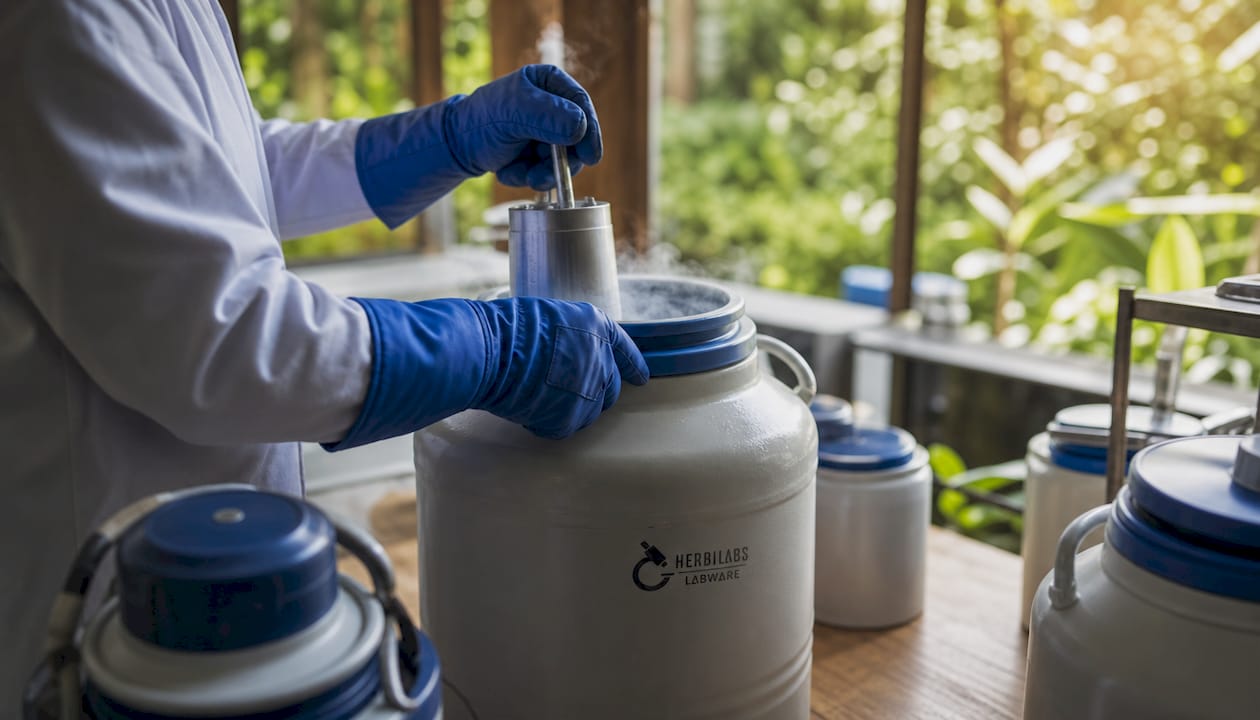
Liquid nitrogen dewars store biological material at -196°C using passive insulation rather than active refrigeration. A standard 20-liter dewar holds nitrogen for 60–90 days with minimal top-ups, making it the most cost-effective option for long-term cryogenic storage of cell lines, sperm, embryos, and tissue samples. Labs working with cryopreservation techniques rely on dewars precisely because they require no electrical connection and continue working during power outages.
Ultra-low temperature (ULT) freezers maintain temperatures around -80°C and are the standard for storing RNA, enzymes, viral stocks, and long-term protein samples. They require active refrigeration and a reliable power supply, but they offer precise electronic temperature control and alarm systems that dewars cannot match.
Standard laboratory refrigerators and freezers cover the 5°C to -20°C range. These are the workhorses of daily lab operations, used for reagents, antibodies, culture media, and short-term sample storage. Under-counter models fit into tight spaces, while upright units offer higher capacity for busier labs.
Walk-in modular cold rooms serve large-scale operations where bulk storage across multiple temperature zones is required. Pharmaceutical production facilities, biobanks, and university research centers rely on these for storing thousands of samples simultaneously.
Pro Tip: Never store cryogenic samples and standard reagents in the same dewar or freezer. Cross-contamination risk aside, the temperature requirements are incompatible and will compromise both.
2. ULT freezer performance: what the specs actually mean
ULT freezer performance is measured by three metrics that matter most in practice: temperature recovery time, energy consumption, and noise output. Leading ULT freezers achieve steady-state recovery in 26 minutes and consume as little as 6.6 kWh per day. That recovery figure is critical. Every time a freezer door opens, internal temperature rises. A slow recovery means samples spend more time outside their target range.
Energy consumption at 6.6 kWh per day translates to meaningful cost differences over a freezer’s operational lifespan, which typically runs 10–15 years. Labs running multiple ULT units should factor energy costs into procurement decisions, not just purchase price.
Noise levels in ULT freezers range from under 42 dB(A) to 55 dB(A). That difference matters in open-plan lab environments where researchers work for extended periods. A quieter unit reduces fatigue and supports concentration during precision work.
Pro Tip: Request the energy consumption figure in kWh per day, not just the annual estimate. Daily figures are easier to compare across models and more useful for calculating running costs.
| Feature | What to look for | Why it matters |
|---|---|---|
| Temperature recovery | Under 30 minutes | Protects samples during frequent access |
| Energy consumption | Under 8 kWh per day | Reduces long-term operating costs |
| Noise level | Under 45 dB(A) | Supports a productive lab environment |
| Alarm system | Audible and remote alert | Catches excursions before damage occurs |
| Compressor design | Modular or bolt-on | Enables fast repair without full unit replacement |
3. Modular refrigeration and maintenance advantages
ULT freezers with modular bolt-on refrigeration systems enable component replacement in under one hour. That speed is the difference between a minor inconvenience and a catastrophic sample loss event. Traditional single-compressor freezers require full unit shutdown for any major repair, exposing every stored sample to temperature excursion risk.
Modular designs allow a technician to swap a failed refrigeration module while the secondary system maintains temperature. Labs storing irreplaceable biological material, such as patient-derived cell lines or decade-long longitudinal study samples, should treat modular refrigeration as a non-negotiable requirement rather than a premium feature.
Maintenance contracts and spare parts availability also affect total cost of ownership. A freezer with a five-year parts guarantee from a UK-based distributor is worth more in practice than a cheaper unit with a six-week international shipping lead time for components.
4. Regulatory compliance for laboratory cold storage in the UK
UK labs must hold appropriate regulatory certifications before storing certain categories of biological material. Key UK regulators include the HTA, APHA, HSE, and HFEA, each governing different sample types and storage conditions. Failing to meet these requirements does not just risk fines. It can invalidate research data and trigger facility shutdowns.
The specific compliance requirements most UK labs encounter include:
- HTA license: Required for storing human tissue, organs, and cells for research or transplantation purposes.
- Home Office license: Mandatory for controlled drugs and Schedule 1 substances stored in research settings.
- MHRA compliance: Applies to labs storing investigational medicinal products, requiring validated temperature mapping and continuous monitoring.
- HSE regulations: Cover general laboratory safety, including safe storage of hazardous biological agents at low temperatures.
- cGMP compliance: Required for clinical-grade sample storage, demanding documented temperature logs, calibrated equipment, and validated storage environments.
Compliance with MHRA and WHO storage standards requires validated temperature mapping and continuous monitoring. Temperature mapping is not a one-time exercise. It must be repeated after any significant change to the storage environment, including equipment relocation or facility renovation.
Choosing a storage equipment supplier that provides validation documentation and calibration certificates alongside the hardware saves significant time during regulatory audits. Labs that treat certification as an afterthought consistently face delays when inspectors arrive.
5. Horizontal vs. vertical freezers: access frequency changes everything
Horizontal freezers outperform vertical models in temperature uniformity and stability when the door is opened frequently. Cold air is denser than warm air and sinks. In a chest-style horizontal freezer, opening the lid does not cause the cold air mass to fall out. In an upright vertical model, every door opening allows cold air to spill onto the floor and warm air to rush in.
Labs with high sample retrieval rates, such as biobanks processing dozens of requests per day, should default to horizontal ULT freezers for their most accessed inventory. The thermal protection during frequent access directly reduces sample degradation risk over time.
Vertical upright freezers remain the better choice for labs with limited floor space and lower access frequency. Their footprint is smaller, and their internal organization with shelves and drawers makes inventory management easier for large sample collections accessed infrequently.
Pro Tip: If your lab accesses the same freezer more than 10 times per day, measure the internal temperature recovery after each opening. If recovery takes longer than 30 minutes, you need a horizontal model or a second unit to distribute access load.
6. Walk-in cold rooms: when scale demands a different approach
Modern modular cold rooms now run on standard single-phase 13-amp power, removing the need for costly three-phase electrical upgrades. That single change makes walk-in cold room installation practical for smaller university labs and veterinary facilities that previously could not justify the infrastructure investment.
Modular cold rooms offer multi-zone temperature control, allowing a single installation to maintain separate areas at 4°C for reagents and -20°C for frozen samples. This flexibility reduces the number of separate units a lab needs to purchase, maintain, and monitor.
Large-scale cold room installations benefit from single-point-of-contact project management. Disjointed communication between contractors, electricians, and equipment suppliers is a leading cause of infrastructure project delays. Labs planning a walk-in installation should contract a supplier who manages the full project rather than coordinating multiple vendors independently.
7. Matching cold storage to lab size and sample type
Small labs and independent research units have different needs than large biorepositories, and the equipment selection should reflect that gap directly.
For small labs and veterinary units:
- Compact 20-liter liquid nitrogen dewars cover cryogenic needs without requiring dedicated nitrogen supply infrastructure.
- Under-counter ULT freezers at -80°C fit into existing bench layouts and require no special flooring.
- Standard 4°C refrigerators handle daily reagent storage for antibodies, enzymes, and culture media.
For large biorepositories and pharmaceutical facilities:
- Enterprise-grade ULT freezers with modular refrigeration and remote monitoring cover high-volume frozen storage.
- Walk-in cold rooms with multi-zone capability handle bulk reagent and sample storage across temperature ranges.
- Automated sample management systems integrated with cold storage reduce retrieval errors and improve audit trails.
Proper selection and certification of storage vessels is pivotal in preventing costly sample loss. Technical validation goes beyond hardware specifications. It includes documented performance testing, alarm response protocols, and staff training on temperature excursion procedures.
Budget constraints are real, but the cost of a failed storage system always exceeds the cost of buying the right equipment initially. Labs that cut corners on cold storage capacity consistently face sample losses that set research timelines back by months.
Key takeaways
The most effective laboratory cold storage strategy matches equipment type to sample temperature requirements, access frequency, and UK regulatory obligations from the outset.
| Point | Details |
|---|---|
| Match equipment to temperature range | Dewars cover -196°C; ULT freezers cover -80°C; standard units cover 5°C to -20°C. |
| Prioritize modular refrigeration | Bolt-on compressor designs allow sub-one-hour repairs and protect irreplaceable samples. |
| Verify regulatory certifications | HTA, MHRA, and HSE requirements must be met before storing regulated biological material. |
| Choose horizontal freezers for high access | Chest-style designs preserve temperature stability during frequent door openings. |
| Plan for scale from the start | Modular cold rooms on single-phase power reduce infrastructure costs for growing labs. |
What I’ve learned about cold storage decisions UK labs get wrong
The most common mistake I see UK lab teams make is treating cold storage as a procurement decision rather than a systems decision. They buy a freezer, plug it in, and assume the job is done. Temperature monitoring, alarm response protocols, and maintenance contracts are afterthoughts, if they are considered at all.
The second mistake is underestimating energy costs. A ULT freezer running at 15 kWh per day costs significantly more to operate over a decade than one running at 6.6 kWh per day. That difference funds reagents, staff hours, or additional equipment. Labs that factor running costs into procurement decisions consistently get better value from their cold storage infrastructure.
The third mistake is ignoring supplier support quality. A freezer with excellent specs but a supplier who cannot provide calibration certificates, validation documentation, or a UK-based service engineer is a liability during regulatory audits. I always recommend labs ask for a sample maintenance report and a list of UK service contacts before signing any purchase order.
The overlooked advantage of energy-efficient ULT models is that they also tend to run quieter and recover temperature faster. Those three benefits, lower energy cost, less noise, and faster recovery, come from the same underlying engineering quality. When you find a freezer that excels on energy efficiency, it almost always excels on the other two metrics as well.
For labs storing research reagents safely alongside biological samples, the storage environment for each material type must be documented separately. Mixing reagent storage logs with biological sample logs creates audit confusion and increases the risk of a compliance finding during inspection.
— Ragnar
Herbilabs and the reagents that depend on proper cold storage
Bacteriostatic water and sterile reconstitution solutions require the same temperature discipline as any other research reagent. Storing them incorrectly, even briefly, compromises their purity and defeats the purpose of using lab-grade materials in the first place.
Herbilabs supplies research-grade bacteriostatic water and reconstitution solutions manufactured to strict purity standards for UK and European research labs. Every product is designed to work within the cold storage environments described in this guide. If you are building or upgrading your lab’s cold storage setup, the bacteriostatic water storage guide covers the specific temperature and handling requirements for Herbilabs reagents. For a broader look at lab supply best practices that support reliable research results, Herbilabs’ resource library is a practical starting point.
FAQ
What temperature range do UK lab cold storage systems cover?
UK laboratory cold storage systems cover temperatures from 5°C in standard refrigerators down to -196°C in liquid nitrogen dewars. The specific range required depends on sample type and preservation duration.
Do UK labs need regulatory approval for cold storage?
Yes. Labs storing human tissue require an HTA license, controlled drugs require a Home Office license, and clinical-grade samples require MHRA-compliant validated storage with continuous temperature monitoring.
What is the best freezer type for labs with frequent sample access?
Horizontal ultra-low temperature freezers are the best choice for high-access labs. Their chest-style design prevents cold air loss during door openings, maintaining temperature stability better than upright vertical models.
How often should temperature mapping be performed in a UK lab?
Temperature mapping must be repeated after any significant change to the storage environment, including equipment relocation, facility renovation, or changes to HVAC systems. It is not a one-time compliance exercise.
Can a small UK lab install a walk-in cold room without major electrical upgrades?
Yes. Modern modular cold rooms run on standard single-phase 13-amp power, making installation practical for smaller labs without the need for three-phase electrical infrastructure upgrades.