Private Label, White Label, Wholesale partnerships available - EU, USA and UK - Free shipping from €75

UK-sourced labware: quality, speed & research benefits
Discover why UK-sourced labware outperforms global imports on quality standards, delivery speed, traceability, and true research cost for peptide researchers.
TL;DR:
- UK labware offers higher quality standards, accreditation, and verified traceability for research reliability.
- Domestic UK sourcing ensures faster delivery, avoids customs delays, and reduces shipping costs.
- Investing in UK-sourced labware minimizes hidden costs from failed experiments and supply chain disruptions.
When researchers weigh up labware sourcing options, the instinct is often to chase the lowest price. But for anyone running peptide experiments or precision assays, that instinct can quietly undermine months of work. UK-sourced labware operates under accreditation frameworks and supply chain conditions that most overseas alternatives simply cannot match. This guide breaks down exactly why origin matters, covering the quality standards, delivery reliability, verification processes, and real cost comparisons that should inform every sourcing decision you make.
Table of Contents
- The quality advantage: UK labware standards and accreditation
- Delivery speed and supply reliability after Brexit
- Unmatched verification: Third-party testing, CoAs, and traceability
- The reality of cost vs. quality: UK vs. international labware options
- Our take: Why ‘good enough’ labware is rarely good enough
- Find the right UK-sourced labware for your research
- Frequently asked questions
Key Takeaways
| Point | Details |
|---|---|
| Stringent UK standards | UK labware is certified to world-class ISO, GMP, and quality systems ensuring precise, reproducible research. |
| Fast, hassle-free delivery | UK sourcing means next-day dispatch and avoids post-Brexit customs delays or VAT for GB-based researchers. |
| Verified batch traceability | Every batch undergoes third-party testing and comes with CoAs for full transparency and safety in peptide studies. |
| True cost vs. reliability | Lower upfront cost of imports can be outweighed by increased project delays, reruns, or lost confidence in research. |
The quality advantage: UK labware standards and accreditation
With the context set, it’s critical to understand why standards matter and what specific quality frameworks UK labware providers actually follow.
UK-sourced labware and supplies benefit from stringent quality management systems including ISO 9001:2015, ISO 14001, ISO 45001, and ISO/IEC 17025 accreditations, ensuring precision, consistency, and reproducibility for research. These aren’t just certificates on a wall. Each one represents a documented, audited system that governs how products are made, tested, stored, and shipped.
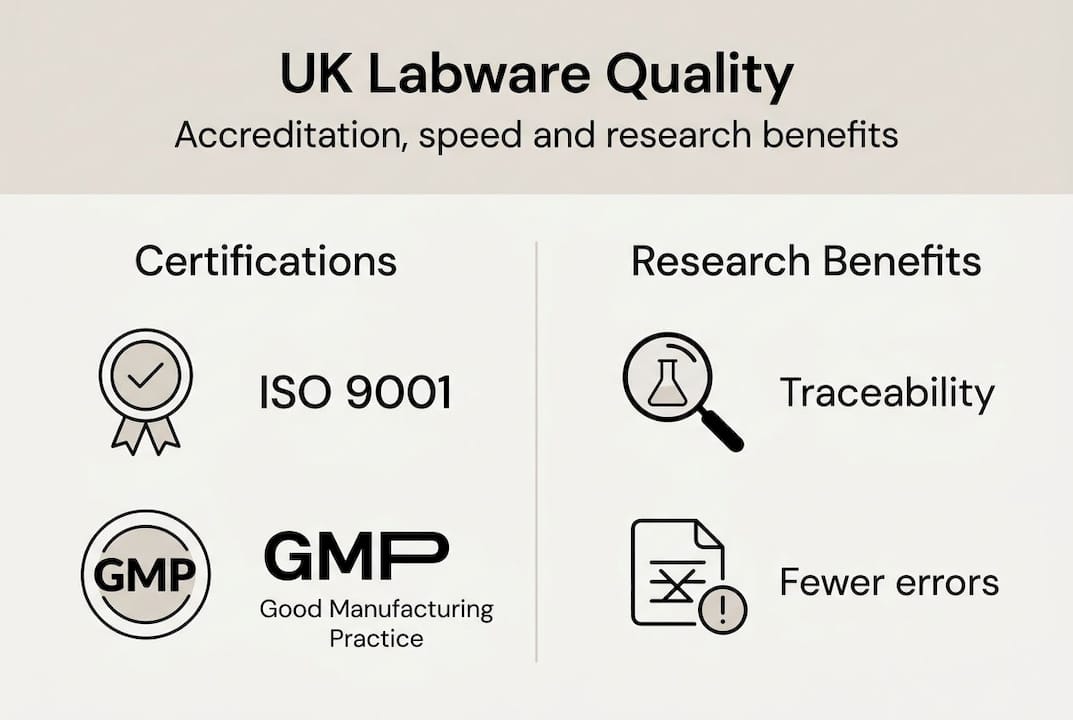
ISO 9001:2015 covers the overall quality management system, ensuring processes are consistent and continuously improved. ISO/IEC 17025 is the gold standard for testing and calibration laboratories, meaning any supplier holding this accreditation has proven their measurement results are technically valid. For researchers running sensitive assays, that distinction matters enormously.
In-process controls are where these frameworks show their real value. Reputable UK suppliers use techniques like gel electrophoresis to verify molecular integrity and chromatography methods to confirm purity at each production stage. These aren’t optional extras. They’re built into the workflow because UK certificates and accreditations require documented evidence at every step.
Here’s a quick comparison of what these accreditations actually cover:
| Accreditation | What it governs | Why it matters for research |
|---|---|---|
| ISO 9001:2015 | Quality management systems | Consistent production processes |
| ISO 14001 | Environmental management | Responsible manufacturing practices |
| ISO 45001 | Occupational health and safety | Safe, controlled production environments |
| ISO/IEC 17025 | Testing and calibration labs | Validated, trustworthy measurement results |
The practical outcome of all this? Fewer failed experiments. When your labware comes from a supplier operating under these systems, you’re not gambling on batch-to-batch consistency. You’re working with materials that have been verified against defined specifications before they ever reach your bench.
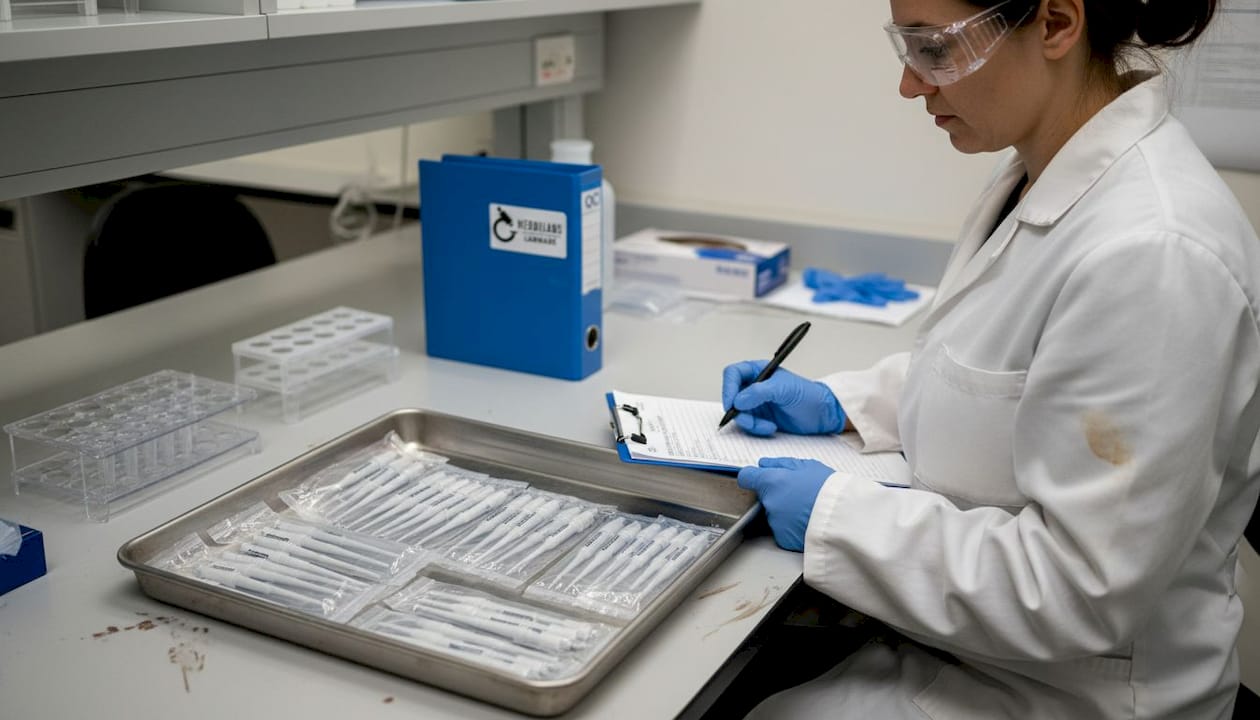
Pro Tip: Always request a supplier’s current Certificates of Analysis and ask which accreditations their facility holds. A credible UK supplier will provide both without hesitation. If they can’t, that’s a red flag worth taking seriously.
For researchers who rely on lab-grade quality standards for reconstitution work, the accreditation chain is what separates a reliable result from an expensive guess. Understanding the importance of lab quality control is the first step toward protecting your data.
Delivery speed and supply reliability after Brexit
Quality alone isn’t enough. A reliable supply chain can make or break research deadlines, and this is where UK-sourced labware has a structural advantage that’s easy to underestimate.
For GB-based researchers, UK-sourced products offer fast next-day delivery with no post-Brexit customs delays or duties when shipping domestically, avoiding EU import complications entirely. That speed difference is not marginal. Compare it to ordering from an EU supplier, where a standard shipment can take anywhere from five to twenty-one days once customs processing, VAT documentation, and carrier handoffs are factored in.
Here’s what actually happens when you import labware from the EU post-Brexit:
- Supplier prepares export documentation including commodity codes and proof of origin.
- Shipment enters UK border, triggering a customs declaration requirement.
- UK import VAT is assessed and must be paid or deferred.
- Goods may be held for inspection, adding unpredictable delays.
- Final delivery occurs after clearance, often days after the original estimated arrival.
For cold-chain-dependent peptide materials, every extra day in transit is a risk. Domestic UK logistics networks are far better equipped to maintain temperature-controlled conditions end-to-end, with shorter routes and fewer handling points.
The tariff picture also matters. Non-UK imports can attract tariffs up to 23%, depending on product classification. That’s a cost that compounds quickly across multiple orders.
| Factor | UK-sourced | EU or international import |
|---|---|---|
| Delivery time | Next day (GB) | 5 to 21+ days |
| Customs paperwork | None for GB | Required for every shipment |
| Import VAT | Not applicable | Assessed at border |
| Tariff risk | None | Up to 23% |
| Cold-chain reliability | High (shorter route) | Variable |
For researchers managing tight project timelines, reliable labware delivery isn’t a luxury. It’s a prerequisite for keeping experiments on schedule and avoiding the cascade of delays that one late shipment can trigger.
Unmatched verification: Third-party testing, CoAs, and traceability
Delivery speed is vital, but equally essential is knowing exactly what’s in your labware. This is where UK suppliers consistently outperform global alternatives.
Leading UK peptide and labware suppliers emphasize third-party testing beyond purity, covering endotoxins, heavy metals, and mass spectrometry confirmation, with CoAs issued for full traceability and research reproducibility. This goes well beyond a simple purity percentage printed on a label.
The testing methods used by top UK suppliers include:
- HPLC (High-Performance Liquid Chromatography): Confirms compound identity and purity with high precision.
- Mass spectrometry: Verifies molecular weight and detects unexpected contaminants or degradation products.
- LAL (Limulus Amebocyte Lysate) testing: Detects bacterial endotoxins that could invalidate biological assays.
- ICP-MS (Inductively Coupled Plasma Mass Spectrometry): Screens for heavy metal contamination at parts-per-billion levels.
Each of these methods targets a different failure mode. A product that passes HPLC but fails LAL testing is still dangerous for cell-based research. UK suppliers running all four categories give you a complete picture, not just the most flattering one.
“Traceability isn’t just a compliance checkbox. It’s the mechanism that lets you pinpoint exactly where a batch failure originated and prevent it from recurring.”
For peptide researchers, the real-world implication is stark. A single batch of poorly traced reconstitution solution can invalidate weeks of downstream data. When you can follow a product from raw material sourcing through every production step to your bench, you have the foundation to defend your results. For safe peptide research sourcing, traceability is non-negotiable. Understanding sterility for peptides and reviewing product certifications explained will help you ask the right questions before you order.
The reality of cost vs. quality: UK vs. international labware options
Traceability and testing aren’t the whole story. Most researchers face a genuine dilemma: save upfront or invest for reliability. Here’s how the numbers and risks actually stack up.
Global imports, particularly from China, offer lower unit costs but face quality consistency concerns and tariff exposure, while UK standards prioritize regulatory alignment over low cost. That framing is useful, but it understates the hidden costs of choosing cheap.
The true cost of selecting the lowest-price international supplier often includes:
- Rerun costs: Failed experiments due to inconsistent labware quality require repeat reagent use, staff time, and instrument time.
- Customs delays: Missed project milestones when shipments are held at the border.
- Compliance risk: Using non-accredited materials in regulated research environments can invalidate entire study datasets.
- Reship costs: Damaged or non-conforming goods from overseas suppliers often involve lengthy return and replacement processes.
- Lost data: In peptide research, a single contaminated batch can corrupt results that took months to generate.
| Factor | UK-sourced | International (e.g., China, non-EU) |
|---|---|---|
| Upfront cost | Moderate | Lower |
| Compliance alignment | High (ISO, GMP) | Variable |
| Lead time | 1 to 2 days | 2 to 6 weeks |
| Traceability | Full CoA chain | Often limited |
| Tariff exposure | None (GB) | Up to 23% |
| Rerun risk | Low | Higher |
Pro Tip: When calculating supplier value, always include the cost of one failed experiment in your comparison. For most researchers, that single event erases any upfront savings from cheaper imports.
For labs that have already experienced supply chain disruptions, the case for reliability in scientific supplies is intuitive. For those still weighing options, reviewing alternatives to global suppliers is a practical starting point.
Our take: Why ‘good enough’ labware is rarely good enough
Seeing the numbers makes the dilemma clear, but what does lived experience with labs making the switch to UK-sourced labware actually reveal?
Quality failures are almost never visible upfront. They surface three weeks into a project when a batch behaves unexpectedly, or six weeks in when reproducibility falls apart and nobody can pinpoint why. By then, the cheap upfront decision has cost far more than the premium alternative ever would have.
Labs that switch to UK-sourced supplies consistently report something that’s hard to quantify but immediately felt: project confidence. Fewer disruptions. Fewer unexplained anomalies. More time spent on actual science rather than troubleshooting sourcing problems.
Most researchers underestimate how much inconsistent labware accumulates as a hidden tax on their work. It’s not one dramatic failure. It’s dozens of small inefficiencies that compound over months. UK sourcing solves problems before they appear, because the quality systems are designed to catch failures before the product ever ships. Serious science doesn’t just need labware that won’t fail catastrophically. It needs labware that supports why reliability matters at every step, every batch, every time.
Find the right UK-sourced labware for your research
If you’re ready to avoid common labware sourcing pitfalls and streamline your research, here’s where to start.
Herbilabs offers a curated range of UK-sourced labware with full traceability, verified purity, and express UK delivery built in from the start. Every product is manufactured to strict research-grade standards, with CoAs available on request.
Browse the Herbilabs labware shop to find bacteriostatic water, sterile diluents, and reconstitution solutions suited to your specific protocols. If you’re focused on peptide work, the peptide research labware section covers the specialized options most relevant to your needs. Not sure where to start? Reach out directly and we’ll point you toward the right products for your research setup.
Frequently asked questions
What are the key certifications to look for in UK-sourced labware?
Seek ISO 9001:2015, ISO 14001, ISO/IEC 17025, and GMP accreditations for highest quality assurance. These accreditations ensure precision and reproducibility across every production batch.
How does UK-sourced labware impact research delivery timelines?
UK sourcing enables next-day delivery within GB and eliminates the customs delays and VAT complications that EU imports trigger. Next-day delivery within UK keeps research timelines intact without customs-related disruptions.
Why do Certificates of Analysis (CoAs) matter for peptides?
CoAs confirm that every batch has been independently tested for purity, endotoxins, and heavy metals, giving you a verifiable record for each experiment. UK suppliers providing CoAs for traceability make reproducibility far easier to defend.
Is UK-sourced labware more expensive than global imports?
Upfront unit costs can be slightly higher, but UK sourcing eliminates tariffs up to 23%, avoids rerun costs from inconsistent batches, and removes customs delays. UK standards prioritize regulatory alignment over low cost, which pays off across a full project lifecycle.