Private Label, White Label, Wholesale partnerships available - EU, USA and UK - Free shipping from €75

Why lab quality control is essential for reliable results
Learn why lab quality control is critical for peptide research and bacteriostatic water workflows, covering ISO 17025, USP standards, and practical QC methods.
Around 70-75% of medical decisions depend on laboratory data, which means a single quality control failure can invalidate months of peptide research or compromise an entire batch of reconstitution work. For independent researchers working with sensitive compounds, that is not an abstract risk. It is a real operational threat. This guide breaks down what lab quality control actually involves, how it applies to bacteriostatic water and peptide workflows, and what you can do right now to protect your data and your results.
Table of Contents
- Demystifying lab quality control: What it really means
- Core QC methodologies: Standards, tools, and error prevention
- QC in action: From bacteriostatic water to peptide research
- The cost of neglecting QC: Data, outcomes, and reputation
- Take lab reliability to the next level with Herbilabs
- Frequently asked questions
Key Takeaways
| Point | Details |
|---|---|
| QC underpins reliable results | Lab quality control is vital for ensuring that research results are accurate and actionable. |
| Standards prevent errors | Applying methodologies like ISO 17025 and USP standards minimizes risks from sample handling to data reporting. |
| Practical QC protects reputation | Consistent quality control saves time, money, and ensures labs maintain their credibility in scientific communities. |
| Bacteriostatic water needs special QC | Multi-dose use and reconstitution solutions require careful QC to avoid contamination and ensure safety. |
| Neglecting QC costs dearly | Ignoring lab quality control can result in wasted resources, invalid research, and severe reputational damage. |
Demystifying lab quality control: What it really means
Quality control (QC) in a laboratory setting is not just about checking a box before you publish. It is a structured system that runs through every phase of your workflow. QC is essential across pre-analytical, analytical, and post-analytical stages to catch errors before they compound into bigger problems. Pre-analytical errors include sample mishandling, incorrect labeling, or improper storage. Analytical errors involve instrument drift, reagent degradation, or calibration failures. Post-analytical errors show up in data transcription, reporting, or interpretation.
“70-75% of medical decisions rely on lab QC data, making quality control one of the most consequential yet underinvested areas in research infrastructure.”
Many independent researchers focus heavily on the analytical phase and overlook the other two. That is where most errors actually originate. Understanding quality assurance in labs as a continuous process rather than a final checkpoint changes how you approach every experiment.
When QC is neglected, the consequences are not always obvious immediately. Here is what you are actually risking:
- Invalid research data that cannot be reproduced or published
- Misdiagnosis or incorrect dosing in applied research contexts
- Regulatory noncompliance leading to audit failures or product recalls
- Wasted reagents and compounds, including expensive peptides and bacteriostatic vs sterile water products
- Loss of lab credibility with collaborators, institutions, or funding bodies
These are not edge cases. They are predictable outcomes of skipping structured QC. The good news is that most of them are entirely preventable.
Core QC methodologies: Standards, tools, and error prevention
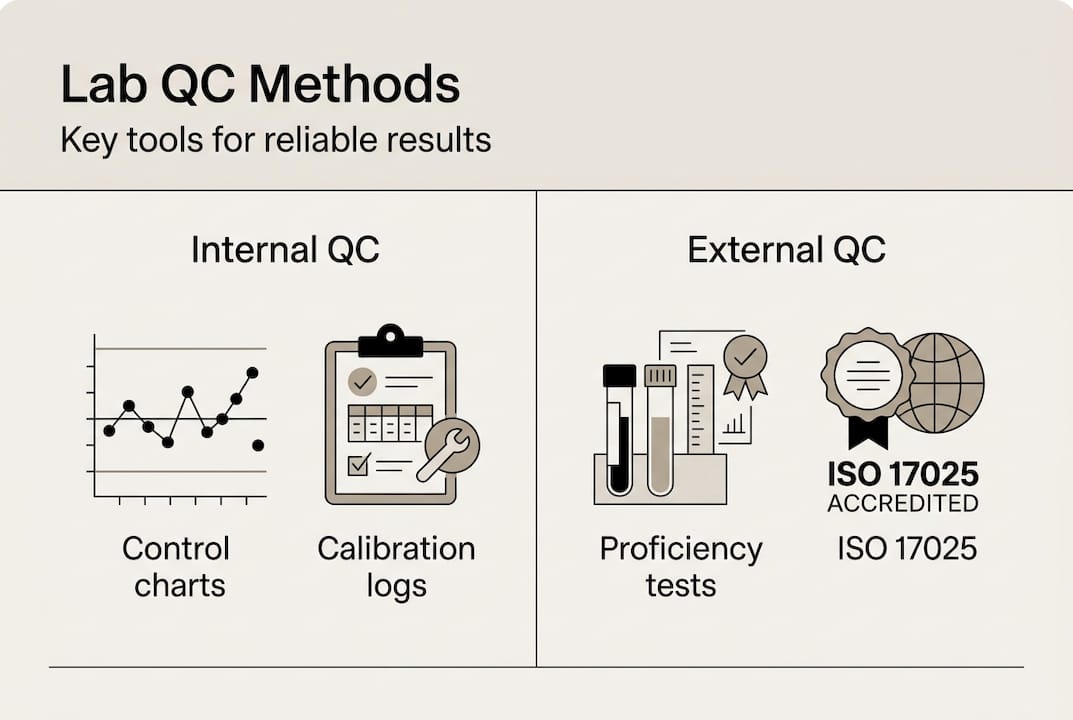
Once you understand what QC covers, the next step is knowing which tools and standards actually enforce it. Key methodologies include internal QC (IQC), control charts, calibration, SOPs, and ISO 17025 accreditation as the backbone of any reliable lab operation. Each serves a distinct function, and together they create a system that catches errors before they reach your results.
| Approach | Internal QC (IQC) | External QC (EQC) |
|---|---|---|
| Who runs it | Your own lab team | Third-party proficiency programs |
| Purpose | Detect day-to-day instrument or process drift | Benchmark your results against peer labs |
| Frequency | Every run or batch | Periodic, often quarterly |
| Tools used | Control charts, reference standards | Proficiency testing schemes |
| Limitation | Cannot detect systemic lab bias | Delayed feedback loop |
Both approaches are necessary. IQC catches real-time errors. EQC reveals whether your entire system is calibrated correctly relative to the broader scientific community.
For labs pursuing or maintaining ISO 17025 lab standards compliance, the critical steps are:
- Document all calibration records with traceability to national or international standards
- Establish written standard operating procedures (SOPs) for every analytical method
- Run control samples with every batch and record results on control charts
- Conduct regular internal audits and management reviews
- Participate in external proficiency testing at least once per year
- Train all personnel on QC procedures and document that training
Digital tools and lab automation have significantly improved QC reliability. ISO 17025 ensures valid results through a risk-based approach that integrates data traceability at every step, which is much harder to achieve manually. Automated pipetting systems, digital logbooks, and LIMS (laboratory information management systems) reduce transcription errors and flag anomalies in real time.
For QC for bacteriostatic water and similar reagents, digital batch tracking is especially valuable because it links every vial to its production record, sterility test, and shelf-life data.
Pro Tip: The most overlooked QC step is not calibration itself but the interpretation of control charts. Many labs run the charts but never act on trending data until a failure occurs. Set alert thresholds at two standard deviations and investigate before you hit three.
A solid water quality checklist for your reconstitution workflow is one of the fastest ways to close common QC gaps without overhauling your entire system.
QC in action: From bacteriostatic water to peptide research
Theory only takes you so far. Let us look at how QC plays out in the specific workflows most relevant to peptide researchers and independent labs.
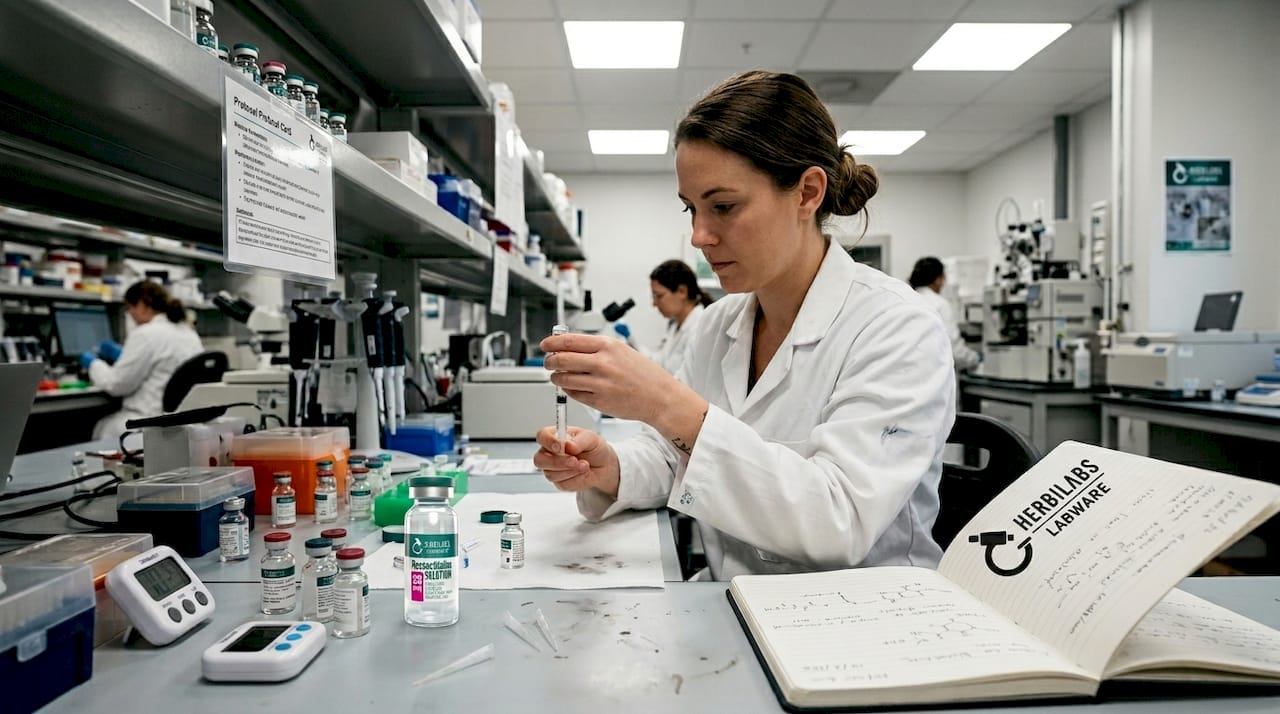
Bacteriostatic water is one of the most commonly used reconstitution vehicles in peptide research, and it has its own strict QC requirements. Bacteriostatic water requires USP standards for sterility, pH, and benzyl alcohol concentration to ensure safe multi-dose use. Here is what that looks like in practice:
| QC parameter | Acceptable range | Why it matters |
|---|---|---|
| Sterility | No microbial growth | Prevents contamination of peptide solutions |
| pH | 4.5 to 7.0 | Affects peptide stability and solubility |
| Benzyl alcohol | 0.9% w/v | Antimicrobial preservative; toxic above threshold |
| Shelf life (opened) | 28 days maximum | Preservative efficacy degrades over time |
| Particulate matter | Visually clear | Indicates contamination or degradation |
For a deeper look at how to work with this product correctly, the guide to bacteriostatic water covers reconstitution protocols in detail.
On the peptide side, batch-to-batch variability in peptide purity directly affects dosing accuracy and experimental outcomes. This is one of the most underappreciated QC risks in independent research. A peptide that tests at 95% purity in one batch may come in at 88% in the next, and if you are not accounting for that, your dose calculations are off from the start.
Common QC failures in peptide synthesis and reconstitution include:
- Incomplete dissolution due to incorrect solvent choice or temperature
- Oxidation of methionine or cysteine residues from improper storage or handling
- Aggregation caused by high concentration or incompatible pH
- Cross-contamination from shared equipment without proper cleaning validation
- Inaccurate weighing of lyophilized peptide due to moisture absorption
Proper safe storage in labs is not optional. Temperature excursions, even brief ones, can degrade both the peptide and the reconstitution vehicle.
Pro Tip: Multi-dose vials of bacteriostatic water should be discarded after 28 days once opened, regardless of how much remains. The benzyl alcohol preservative does not maintain full antimicrobial efficacy indefinitely after the seal is broken. Date every vial on first use.
The cost of neglecting QC: Data, outcomes, and reputation
Let us be direct about what poor QC actually costs you. Inadequate QC leads to invalid research data and, in applied contexts, to misdiagnoses or incorrect treatment decisions. For independent researchers, the consequences are more immediate: wasted compounds, failed experiments, and results that cannot be defended.
Here is what neglecting QC typically produces:
- Irreproducible results that block publication or peer review
- Regulatory penalties if your lab operates under any compliance framework
- Wasted budget on reagents, peptides, and instrument time that produced unusable data
- Damaged collaborations when partners cannot replicate your findings
- Loss of grant funding if QC failures are identified during audits
The flip side is equally compelling. Peptide QC yields 96% purity via optimized methods, which translates directly into more consistent dosing, more reliable data, and results that hold up under scrutiny. That is not a marginal improvement. It is the difference between publishable science and a failed experiment.
“Optimized QC methods in peptide research consistently achieve 96% purity, demonstrating that structured quality control is not overhead but a direct driver of research output quality.”
For labs working on lab applications of bacteriostatic water across multiple projects, QC also protects your institutional reputation. Reviewers, collaborators, and funding bodies increasingly scrutinize QC documentation as part of their evaluation process. A well-maintained QC record is not just good science. It is a competitive advantage.
The lab research insights available from experienced suppliers can also help you benchmark your current practices against what is working in comparable research environments. You do not need to build your QC system from scratch. You need to learn from what already works and apply it consistently.
Safeguards worth implementing immediately include: running control samples with every batch, maintaining a calibration log with dates and results, and reviewing your SOP documents at least every six months. Small, consistent habits prevent the large, expensive failures.
Take lab reliability to the next level with Herbilabs
Understanding QC is one thing. Having access to products that are already built to meet those standards is another. At Herbilabs, every batch of bacteriostatic water and reconstitution solution is manufactured to strict purity specifications, with full traceability and documented QC at every production stage.
If you are sourcing reagents for peptide research or reconstitution workflows, the labware shop offers research-grade products designed for exactly the kind of demanding, reproducible work this article describes. For researchers who want to go deeper on reagent-specific quality practices, the QC for reagents resource covers what to look for when evaluating any supplier. And if you need a reliable, QC-verified reconstitution solution for your current project, Herbilabs has you covered with products built for precision research.
Frequently asked questions
What are the main stages of lab quality control?
Lab QC covers three stages: pre-analytical, analytical, and post-analytical, each designed to catch a different category of error before it affects your results.
Which QC standards apply to bacteriostatic water?
Bacteriostatic water must meet USP standards for sterility, pH, and benzyl alcohol concentration, and proper QC ensures it remains safe for multi-dose use throughout its shelf life.
How do ISO 17025 standards improve lab reliability?
ISO 17025 uses a risk-based approach with full data traceability to ensure that lab results are valid, reproducible, and defensible under external review.
What is the main consequence of poor QC in peptide research?
Batch-to-batch variability in peptide purity is the primary consequence, leading to inaccurate dosing and results that cannot be reliably reproduced across experiments.
How does lab QC impact overall research integrity?
Effective QC safeguards data accuracy at every stage of the workflow, protecting both the validity of your findings and the long-term credibility of your research program.