Private Label, White Label, Wholesale partnerships available - EU, USA and UK - Free shipping from €75

Quality control for reagents: ensure reliable results
Learn how to apply quality control practices for reagents in peptide research, including COA verification, EMA standards, and supplier selection for European labs.
Most researchers don’t question their reagents until something goes wrong. A peptide reconstitution fails, a dose response curve looks nothing like expected, or a batch of results simply can’t be reproduced. Quality control failures can lead to unreliable results, wasted resources, and serious setbacks in your research timeline. The good news is that most of these failures are preventable, and this guide walks you through exactly how to build quality control practices that hold up under scrutiny.
Table of Contents
- Why quality control in reagents is critical for reliable research
- Core components of quality control in laboratory reagents
- Special considerations for peptides and bacteriostatic water
- How to verify reagent quality: Certificates, testing, and supplier selection
- Herbilabs: research-grade reagents built for serious science
- Frequently asked questions
Key Takeaways
| Point | Details |
|---|---|
| Quality control basics | Routine checks and standardized tests ensure your reagents deliver reliable lab performance. |
| Peptide reagent standards | European labs should demand ≥99% purity and validated COAs for all peptide reagents. |
| Supplier selection tips | Choose suppliers with GMP-like practices, third-party testing, and transparent documentation. |
| Bacteriostatic water care | Use bacteriostatic water with preservative for peptide work and follow safe handling guidelines. |
| Verification process | Always review certificates of analysis and validate your supplier’s compliance for every batch. |
Why quality control in reagents is critical for reliable research
Reagent quality is not just a formality. It is the foundation on which every data point in your study rests. When you use a reagent with unknown purity, undisclosed impurities, or inconsistent batch composition, you are not just risking one experiment. You are risking the credibility of every result that follows.
Poor-quality reagents cause real, measurable damage in research settings. Failed syntheses, inconsistent assay results, and irreproducible data are the most common outcomes. In peptide research specifically, even trace contaminants can alter biological activity, skew binding assays, or produce false positives that send your investigation in entirely the wrong direction.
Quality assurance is not simply a matter of trusting your supplier. It requires systematic procedures that you apply consistently. Assuring lab reliability means building a framework around every reagent you use, not just the ones that seem most critical.
Here is what poor reagent quality actually costs you:
- Wasted time running repeat experiments to explain anomalous results
- Wasted materials reconstituting peptides with substandard diluents
- Compromised data that cannot be published or peer-reviewed with confidence
- Regulatory risk if your work feeds into any compliance-sensitive pipeline
- Reputational damage when results cannot be replicated by other labs
“Quality control for laboratory reagents involves QA/QC programs including calibration, blanks, fortified samples, precision and recovery checks, and control charts to ensure data accuracy and precision.” This is not optional infrastructure. It is the minimum standard for credible science.
Proper QA leads directly to reproducible and publishable results. When your reagents are verified, your methods are validated, and your controls are in place, you can defend every number in your dataset.
Core components of quality control in laboratory reagents
Knowing that QC matters is one thing. Knowing exactly what it involves is another. Quality control for reagents is built from several interlocking components, each serving a specific function in confirming that your materials are what they claim to be.
QC programs rely on calibration, blanks, fortified samples, precision and recovery checks, and control charts. The Eurachem validation guide adds selectivity, limit of detection (LOD), limit of quantification (LOQ), and systematic QC design as essential elements of method validation.
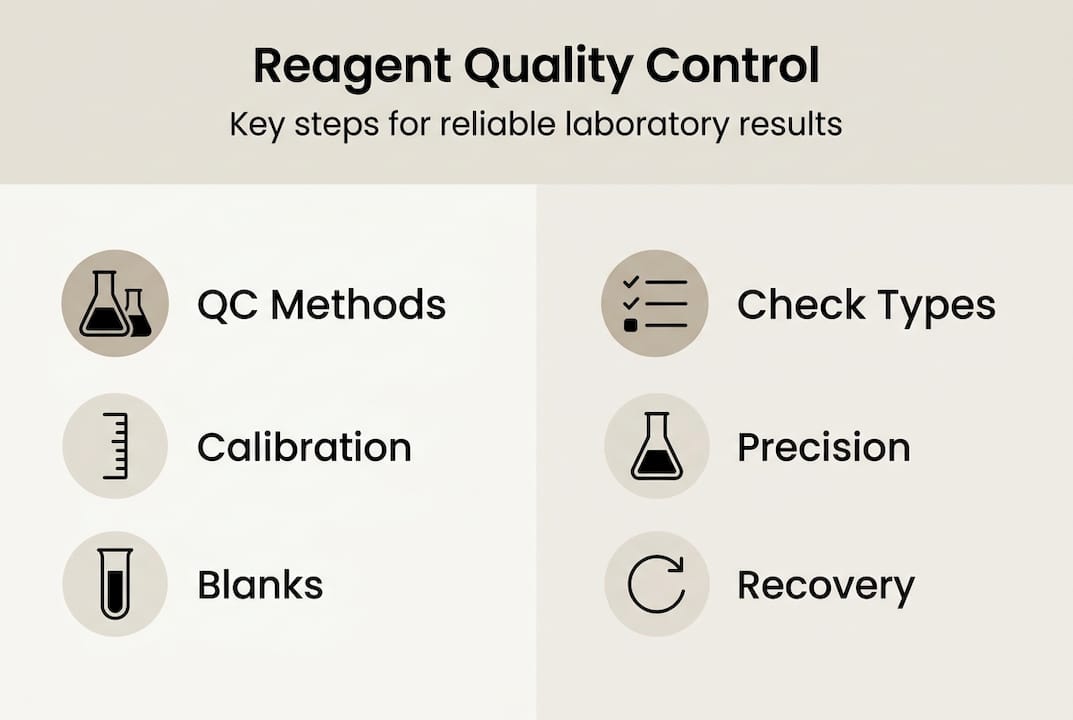
Here is a breakdown of the core QC components and what each one does:
| QC Component | Purpose | Practical example |
|---|---|---|
| Calibration standards | Confirm instrument accuracy | Run known concentration standards before each assay |
| Reagent blanks | Detect background contamination | Run solvent-only control alongside samples |
| Fortified (spiked) samples | Verify recovery and matrix effects | Add known analyte to sample matrix, measure recovery |
| Precision checks | Assess repeatability | Run same sample in triplicate, calculate %RSD |
| Control charts | Track performance over time | Plot QC results across batches to spot drift |
| Reference materials | Validate against certified standards | Use certified peptide reference standards for HPLC |
To implement these in your lab, follow this sequence for each new reagent batch:
- Request the certificate of analysis (COA) before accepting any shipment. Cross-check the certificate of analysis against your required specifications.
- Run a reagent blank to confirm the solvent or diluent introduces no interfering signal.
- Prepare a spiked sample using your reagent matrix and a certified reference standard to verify recovery.
- Perform precision testing by running replicate analyses and calculating the relative standard deviation.
- Update your control chart with the new batch data to track any drift from historical performance.
- Document everything, including lot numbers, test dates, instrument IDs, and analyst initials.
This is not a one-time exercise. Batch-to-batch consistency is only visible when you track results systematically over time. Reviewing peptide research purity standards gives you a solid benchmark for what acceptable performance actually looks like in practice.
Special considerations for peptides and bacteriostatic water
Generic QC frameworks apply across all reagent types, but peptides and bacteriostatic water carry specific requirements that go beyond standard laboratory practice. If you work with synthetic peptides in a European research context, you need to understand both EMA and ICH standards.
EMA guidelines specify control of starting materials including amino acid derivatives, critical steps in solid-phase peptide synthesis (SPPS), impurity profiling, and validated analytical procedures using HPLC and mass spectrometry. For research-grade peptides, purity of 99% or above is the accepted benchmark, and any COA you receive should reflect this with chromatographic data to back it up.
Bacteriostatic water adds another layer of complexity. It is not interchangeable with sterile water, and the distinction matters enormously for multi-dose peptide reconstitution.
| Feature | Bacteriostatic water | Sterile water |
|---|---|---|
| Preservative | 0.9% benzyl alcohol | None |
| Use type | Multi-dose | Single use |
| Shelf life after opening | 28 days | Use immediately |
| Peptide compatibility | Most synthetic peptides | Sensitive peptides only |
| Risk if misused | Degraded peptide, contamination | Microbial growth in multi-dose use |
Understanding the bacteriostatic vs sterile water distinction is not just academic. Using the wrong diluent can degrade your peptide before you even begin your experiment. If you are new to this, the complete guide to bacteriostatic water covers everything you need to know about composition, handling, and storage.
Statistic callout: Bacteriostatic water for injection (USP) contains 0.9% benzyl alcohol as a preservative and must be discarded within 28 days of opening, regardless of remaining volume.
Pro Tip: Always store bacteriostatic water at room temperature away from direct light, and never freeze it. Freezing can cause benzyl alcohol to precipitate, compromising both the preservative function and the sterility of the solution.
For European researchers, here is a quick compliance checklist when sourcing peptides and bacteriostatic water:
- Supplier provides COA with HPLC and MS data
- Peptide purity confirmed at 99% or above
- Impurity profile documented and within acceptable limits
- Bacteriostatic water manufactured under sterile processing conditions
- Lot numbers traceable to manufacturing batch records
- Supplier operates under GMP-like or equivalent quality standards
How to verify reagent quality: Certificates, testing, and supplier selection
Knowing what quality looks like on paper is only useful if you can actually verify it. Here is how to put that knowledge into practice every time you source a new reagent.
Reading a COA correctly
A COA is your primary verification document. But not all COAs are created equal. A credible COA for a research-grade peptide should include the following:
- Peptide name, sequence, and molecular weight
- Lot or batch number with manufacturing date
- Purity result expressed as a percentage, with HPLC chromatogram attached
- Mass spectrometry data confirming molecular identity
- Impurity profile with individual impurities listed
- Storage conditions and expiry date
- Analyst signature or quality department authorization
If a supplier cannot provide all of these, that is a red flag. Understanding COAs in detail will help you spot gaps that less experienced researchers might miss.
Key testing parameters to request
EMA guidelines are clear that HPLC and MS are the minimum analytical standards for synthetic peptide characterization. Beyond these, you should also ask about:
- Water content (Karl Fischer titration)
- Residual solvents from synthesis
- Endotoxin levels if your research involves cell-based assays
- Counterion content for salt form peptides
Selecting a supplier that meets EU standards
For European researchers, Eurachem validation standards and EMA/ICH compliance are the benchmarks to apply when evaluating suppliers. Prioritize EU-based suppliers where possible. They offer faster shipping, easier compliance documentation, and accountability under European regulatory frameworks.
Here is a practical supplier evaluation checklist:
- Confirm the supplier provides full COAs with every order, not just on request.
- Verify that third-party testing is used, not just in-house QC.
- Ask whether the facility operates under GMP or GMP-like conditions.
- Check whether the supplier can provide batch traceability documentation.
- Confirm that bacteriostatic water products are manufactured in a dedicated sterile facility.
- Review customer support responsiveness before placing a large order.
Pro Tip: Request a sample COA before your first order. A supplier confident in their quality will send one without hesitation. If they stall or offer vague documentation, look elsewhere.
For independent verification, reagent testing services can provide third-party analysis of your materials before you commit to a full batch. This is especially valuable when working with novel peptide sequences or switching suppliers.
Aseptic handling is the final piece of the puzzle. Even a perfectly manufactured reagent can be compromised at the point of use. Always work in a clean environment, use sterile syringes and needles, and never return unused solution to the original vial. Reviewing lab product certifications will give you a clearer picture of how handling standards connect to product integrity.
Herbilabs: research-grade reagents built for serious science
If you are sourcing bacteriostatic water or research reagents for peptide studies in Europe, the quality of your supplier directly determines the quality of your science.
At Herbilabs, every product is manufactured to strict purity standards in a dedicated sterile facility, with full COA documentation and batch traceability available on request. We supply independent researchers, universities, and private customers across the UK and Europe with injectable bacteriostatic water and research-grade diluents that meet the quality benchmarks described in this guide. Whether you need a single vial or wholesale quantities, our products are built for researchers who cannot afford to compromise on purity. Explore our full range at herbilabs.co.uk and order with confidence.
Frequently asked questions
What is a certificate of analysis (COA) and why is it important for reagents?
A COA is an official document listing verified test results for purity, identity, and contaminants, confirming that a reagent meets required quality specifications. Researchers should demand COAs with HPLC and MS data showing 99% or greater purity for peptides.
How often should I run quality checks on my lab reagents?
Run quality checks for every new batch received, and perform periodic checks during storage to confirm the reagent has not degraded. QC programs involve ongoing checks, not a single verification at the point of purchase.
What are the differences between bacteriostatic and sterile water for peptide use?
Bacteriostatic water contains 0.9% benzyl alcohol as a preservative, making it suitable for multi-dose use, while sterile water has no preservative and is intended for single use only. Opened vials should be discarded within 28 days regardless of remaining volume.
What are the key European guidelines for peptide reagent quality?
Peptide reagents in Europe must meet EMA and ICH standards covering starting material control, impurity profiling, and validated analytical procedures including HPLC and mass spectrometry.