Private Label, White Label, Wholesale partnerships available - EU, USA and UK - Free shipping from €75

Why reliability matters in scientific supplies: 63% fewer failures
Unreliable scientific supplies cost US labs $28B/year. Learn how EU researchers can source reliable bacteriostatic water and reagents with the right certifications and documentation.
TL;DR:
- Reliable scientific supplies ensure consistent purity, full traceability, and regulatory compliance.
- Unreliable reagents and water increase experiment failure, costs, and compromise data integrity.
- EU-based suppliers with verified documentation and standards are crucial for trustworthy research.
Imagine spending three weeks preparing a peptide reconstitution experiment, only to discover your bacteriostatic water introduced contamination that invalidated every data point. This is not a rare edge case. A Brazilian reproducibility project replicated fewer than 50% of 47 experiments, with original effect sizes running 60% larger than reproduced ones. For independent researchers in Europe, the stakes are immediate: unreliable supplies waste time, money, and credibility. This guide breaks down what reliability actually means in the lab context, how EU regulations support it, and how to source bacteriostatic water and reagents you can genuinely trust.
Table of Contents
- Reliability in scientific supplies: What is it and why does it matter?
- Consequences of unreliable supplies: Data and real-world impact
- Regulatory standards and quality control in Europe
- How to source reliable bacteriostatic water and reagents in the EU
- Why reliability is non-negotiable: Lessons and hard truths for independent researchers
- Find reliable scientific supplies in Europe with Herbilabs
- Frequently asked questions
Key Takeaways
| Point | Details |
|---|---|
| Reliability boosts accuracy | Using reliable scientific supplies ensures accurate, reproducible research outcomes every time. |
| Compliance prevents setbacks | Sourcing EU-certified lab materials helps avoid costly compliance and customs issues. |
| Invest in quality | Cheap, unreliable supplies often cost more due to experiment failures and wasted efforts. |
| Batch traceability is vital | Always confirm batch and quality documents to secure consistent and safe laboratory results. |
Reliability in scientific supplies: What is it and why does it matter?
Reliability in scientific supplies is not just about a product arriving on time. It means every batch performs identically, every vial meets the same purity threshold, and every lot comes with full traceability documentation. When a supply is reliable, you can rule it out as a variable. When it is not, your entire dataset becomes suspect.
Reliability in scientific supplies ensures experiment accuracy, reproducibility, and minimizes downtime by providing consistent performance, purity, and traceability. That definition matters because it ties reliability directly to the scientific method itself. You cannot control what you cannot measure, and you cannot measure accurately with inconsistent inputs.
For independent researchers across the EU, this problem is amplified. You often lack the institutional safety nets that university labs enjoy, such as dedicated procurement teams, in-house quality assurance staff, and bulk purchasing agreements with vetted suppliers. One bad batch of bacteriostatic water can derail a months-long peptide study with no backup stock waiting on a shelf.
Here is what reliable scientific supplies actually deliver:
- Consistent purity: Each batch meets the same specification, so your baseline does not shift between experiments.
- Full batch traceability: You can trace any anomaly back to a specific lot, isolating the source of error quickly.
- Accurate labeling: Regulatory codes like RUO (Research Use Only) or GMP tell you exactly how a product was manufactured and tested.
- Predictable delivery: Reliable suppliers ship on schedule, so your experiment timeline stays intact.
- Supporting documentation: Certificates of Analysis (CoA), safety data sheets, and batch records are provided without you having to chase them.
As one procurement specialist put it:
“Choosing a cheaper supplier to save 15% upfront often costs far more in failed assays, repeat orders, and delayed timelines. The true cost of unreliability is invisible until it hits you.”
This is the core tension every independent researcher faces. Budget pressure is real, especially outside institutional funding. But the lab quality control importance argument is not abstract. It shows up in ruined samples, wasted reagents, and experiments you have to run twice.
Consequences of unreliable supplies: Data and real-world impact
The data on unreliable scientific supplies is striking. Over 50% of neuroscience antibodies tested by YCharOS failed to perform as labeled, and poor reagents account for 36% of irreproducibility cases in research, costing an estimated $28 billion per year in the US alone. These are not abstract figures. They represent thousands of experiments that produced invalid results because the inputs were wrong.

For EU peptide researchers working with reconstitution solutions, the risks are specific. Bacteriostatic water that contains trace endotoxins, microbial contamination, or inconsistent benzyl alcohol concentrations can alter peptide stability, skew bioactivity readings, and introduce variables you cannot account for in your analysis.
The hidden costs stack up fast:
- Repeat experiments: A failed run means re-preparing samples, re-ordering supplies, and re-allocating time.
- Lost reagents: Peptides are expensive. If contaminated water degrades your compound, that cost is unrecoverable.
- Delayed timelines: A single unreliable batch can push a project back by weeks, especially if you need to source a replacement from a new supplier.
- Credibility damage: If you share data with collaborators or submit findings for peer review, reproducibility issues reflect directly on your methodology.
| Impact area | Reliable supplier | Unreliable supplier |
|---|---|---|
| Assay failure rate | Up to 63% lower | Baseline or higher |
| Batch documentation | Full CoA and traceability | Often incomplete |
| Experiment timeline | Predictable | Frequently disrupted |
| Long-term cost | Lower total cost of ownership | Higher due to repeat runs |
| Regulatory compliance | Meets EU standards | Often unverified |
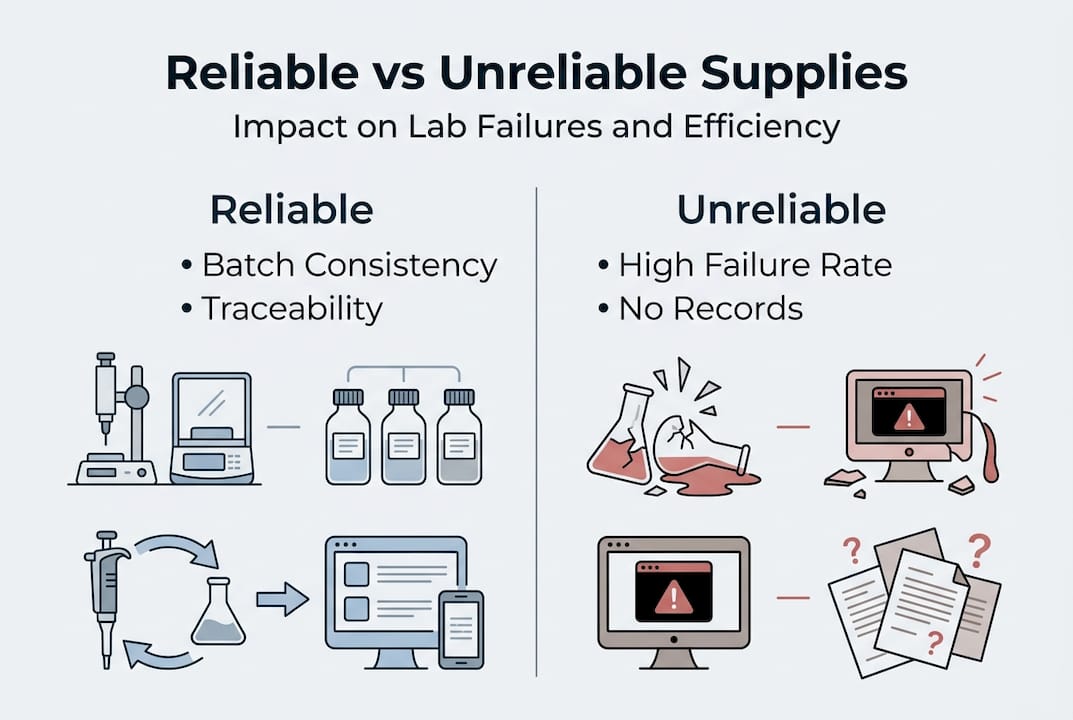
Switching to a reliable labware delivery model is not just about convenience. Suppliers with proven track records reduce assay failures by 63% compared to cheaper alternatives, while the 15% upfront savings from discount suppliers routinely lead to delays and rework that cost far more over time.
Pro Tip: Always request a Certificate of Analysis and batch traceability records before placing any order. If a supplier cannot provide these immediately, treat that as a hard red flag. A trustworthy reagent quality control guide will walk you through exactly what to look for in those documents.
Regulatory standards and quality control in Europe
Europe has a well-developed framework for scientific supply quality, but it only protects you if you know what to look for. The two most relevant standards for reagents and reconstitution solutions are ISO 17025 and ISO 17034. ISO 17025 covers the competence of testing and calibration laboratories, while ISO 17034 specifically governs reference material producers. If a supplier claims ISO certification, ask which standard applies and request the certificate number.
For nanomaterials and specialty compounds, the EU’s Joint Research Centre issues certified reference materials that ensure reliable testing under REACH regulations. External quality assurance schemes like SPMD-RfB and NML add another layer of precision verification, particularly for labs involved in cross-border research or regulatory submissions.
Here is what documentation you should always request from any EU supplier:
- Certificate of Analysis (CoA): Confirms the product meets its stated specification for that specific batch.
- Batch records: Allows you to trace the manufacturing history of a specific lot.
- Regulatory label codes: RUO, GMP, ISO, and REACH compliance labels tell you how the product was made and tested.
- Safety Data Sheet (SDS): Required under EU regulations for any chemical or biological solution.
| Supply type | Certified | Non-certified |
|---|---|---|
| Traceability | Full lot and batch records | Often absent |
| Regulatory standing | ISO/REACH/JRC compliant | Unverified |
| Customs clearance (EU) | Straightforward | Potential delays |
| Experiment validity | Defensible | Questionable |
| Supplier accountability | High | Low |
For contamination control in peptide research, certified supplies are not optional. They are the baseline. Non-certified products may look identical on paper but carry unknown risk profiles that only surface when your experiment fails. When sourcing safe peptide products in Europe, always verify that your supplier can demonstrate compliance with at least one recognized standard before you order.
How to source reliable bacteriostatic water and reagents in the EU
Knowing what standards exist is only half the work. The other half is applying that knowledge when you are actually evaluating a supplier online at 11pm before placing an order. Here is a practical checklist.
- Verify documentation upfront: Does the supplier provide a CoA and batch records for each product? If this information is not on the product page or available on request within 24 hours, move on.
- Check for EU-based manufacturing: EU-based suppliers are subject to REACH and local quality regulations. Non-EU suppliers may not meet the same standards, and their products can face customs delays or regulatory scrutiny on arrival.
- Look for recognized label codes: RUO, GMP, and ISO labels on product pages indicate the manufacturing standard applied. These are not marketing terms. They have specific regulatory meanings.
- Confirm batch traceability: Can you tie your order to a specific production lot? This matters if you ever need to investigate an anomaly or file a complaint.
- Test before scaling: For any new supplier, order a small quantity first. Validate the documentation, check the product against your existing baseline, and only scale up once you are satisfied.
For lab-grade bacteriostatic water, prioritize suppliers who emphasize batch documentation and RUO labeling. This is especially important for EU peptide users who need to avoid customs complications and ensure their reconstitution solutions meet research-grade purity standards.
Pro Tip: When evaluating a new supplier’s bacteriostatic water, cross-check the benzyl alcohol concentration listed on the CoA against the standard 0.9% specification. Deviations from this range are a direct indicator of quality control gaps. Proper lab water handling and purity practices start with knowing exactly what is in your vial.
Red flags to watch for include: no CoA available, vague manufacturing location, no response to documentation requests, pricing significantly below market rate, and no clear regulatory labeling on product pages.
Why reliability is non-negotiable: Lessons and hard truths for independent researchers
Here is something most sourcing guides will not tell you directly: the researchers who cut corners on supply quality are not doing it because they do not care about science. They do it because the upfront cost difference feels real and the downstream risk feels abstract. Until it is not.
One contaminated batch does not just ruin an experiment. It can set a project back by months, force you to question every result you collected before the failure, and damage your credibility with collaborators who trusted your methodology. No 15% discount is worth that.
Reliability is not a product attribute. It is an investment in your own scientific credibility. Treating lab quality control as a routine step, as integral as pipetting or data logging, is what separates researchers who produce defensible results from those who spend half their time chasing ghosts in their own data.
The uncomfortable truth is that independent researchers face more risk from unreliable supplies than institutional labs do, precisely because they have fewer redundancies. That makes rigorous sourcing more important, not less.
Find reliable scientific supplies in Europe with Herbilabs
If this guide has made one thing clear, it is that your research is only as strong as the supplies behind it. Verified documentation, EU-based manufacturing, and consistent batch quality are not nice-to-haves. They are the foundation of reproducible science.
Herbilabs supplies research-grade bacteriostatic water and reagents manufactured to strict purity standards, with full batch documentation and EU-compliant labeling included as standard. Browse the bacteriostatic water FAQs for answers to the most common sourcing questions, or read the complete bacteriostatic water guide to understand exactly what you should be ordering. When you are ready to source, the Herbilabs shop has everything you need with the documentation to back it up.
Frequently asked questions
What makes a scientific supply ‘reliable’ for laboratory research?
Reliable supplies deliver proven consistency, verified purity, full batch traceability, and compliance with recognized standards like ISO, so every experiment starts from a controlled, defensible baseline.
Which certifications should EU researchers check for when sourcing reagents or bacteriostatic water?
Look for ISO 17025 or 17034 certification, REACH compliance, and where applicable, certified reference materials issued by the EU’s Joint Research Centre.
How does unreliable bacteriostatic water affect peptide research?
Contaminated or inconsistent solutions introduce uncontrolled variables that cause irreproducibility and data invalidation. Fewer than 50% of experiments in major reproducibility studies were successfully replicated, with poor reagents identified as a leading cause.
What practical steps help ensure reliable supply sourcing in Europe?
Always demand a CoA and batch records upfront, buy from EU-based suppliers with verified regulatory labeling, and validate small orders before committing to larger quantities.