Private Label, White Label, Wholesale partnerships available - EU, USA and UK - Free shipping from €75

How quality control ensures reliable reagent production
Learn how quality control in reagent production protects your research data, prevents lab failures, and keeps European labs compliant with ISO and GLP standards.
TL;DR:
- Reagent quality control ensures consistency and prevents costly experimental failures.
- QC involves raw material testing, in-process controls, and final batch verification.
- Strong QC culture and documentation are essential for reliable, reproducible research results.
Reagent quality is not a background detail. It is the variable that determines whether your experimental data holds up or falls apart. A single batch of improperly characterized bacteriostatic water or a mislabeled reconstitution solution can cascade into weeks of failed assays, wasted peptides, and inconclusive results. QC in reagent production_and_Quality_Control_(QC)) covers purity, identity, strength, and microbial limits from raw material intake through final batch release. This guide breaks down what QC actually encompasses in reagent manufacturing, which components matter most, and how European labs can build systems that prevent failure before it reaches the bench.
Table of Contents
- What is quality control in reagent production?
- Core components of QC in reagent manufacturing
- How QC prevents reagent-related lab failures
- Best practices and standards for QC in Europe
- Why most reagent QC efforts fall short—and what labs should do differently
- Ensure reliable results with trusted reagent QC resources
- Frequently asked questions
Key Takeaways
| Point | Details |
|---|---|
| QC prevents lab errors | Rigorous QC in reagent production stops contamination, mislabeling, and unstable batches before they reach your bench. |
| Standards enable compliance | Following ISO and GLP standards helps European labs maintain reliable documentation and scientific reputation. |
| Documentation is crucial | Careful record-keeping of QC checkpoints safeguards reproducibility and ensures quick auditing. |
| Culture drives results | A proactive QC culture and continuous feedback in labs lead to more consistent, validated research outcomes. |
What is quality control in reagent production?
Quality control in reagent production is the set of systematic, documented processes used to verify that every batch of a reagent meets predefined specifications before it is released for use. It is not a single test at the end of a manufacturing run. It is a layered system of checks that runs from the moment raw materials arrive at a facility to the moment a labeled vial leaves it.
A common confusion worth clearing up: QC and quality assurance (QA) are not the same thing. QA is the broader management framework that defines how quality will be built into a process. QC is the hands-on, measurement-based activity that confirms quality was actually achieved. You need both, but confusing them leads to gaps. Labs that invest heavily in QA documentation but underinvest in actual testing are the ones that get surprised by batch failures.
For quality control for reagents, the scope typically includes three major phases:
- Raw material testing: Every input, including water, excipients, and active compounds, is tested for identity, purity, and microbial load before it enters production.
- In-process controls: Measurements taken during manufacturing to catch deviations before they propagate into the final product.
- Batch release: Final verification that the finished reagent meets all specifications, including potency, pH, sterility, and labeling accuracy.
As outlined in chromatography-based QC frameworks, QC covers raw material testing, in-process controls, and batch release as interconnected checkpoints, not isolated events.
“A QC system is only as strong as its weakest checkpoint. Skipping in-process controls because raw materials passed testing is how contamination enters undetected.”
Understanding why QC is essential goes beyond compliance. Reproducible data requires that every reagent behaves identically across batches. Without that consistency, you are not running controlled experiments. You are running variables.
Core components of QC in reagent manufacturing
Once you understand what QC covers, the next question is: what does it actually test? The answer depends on the reagent, but the core attributes are consistent across most research-grade products.
According to established QC attribute standards_and_Quality_Control_(QC)), QC ensures key attributes such as identity, purity, and microbial limits are met for reagents. Here is how those translate into actual lab operations:
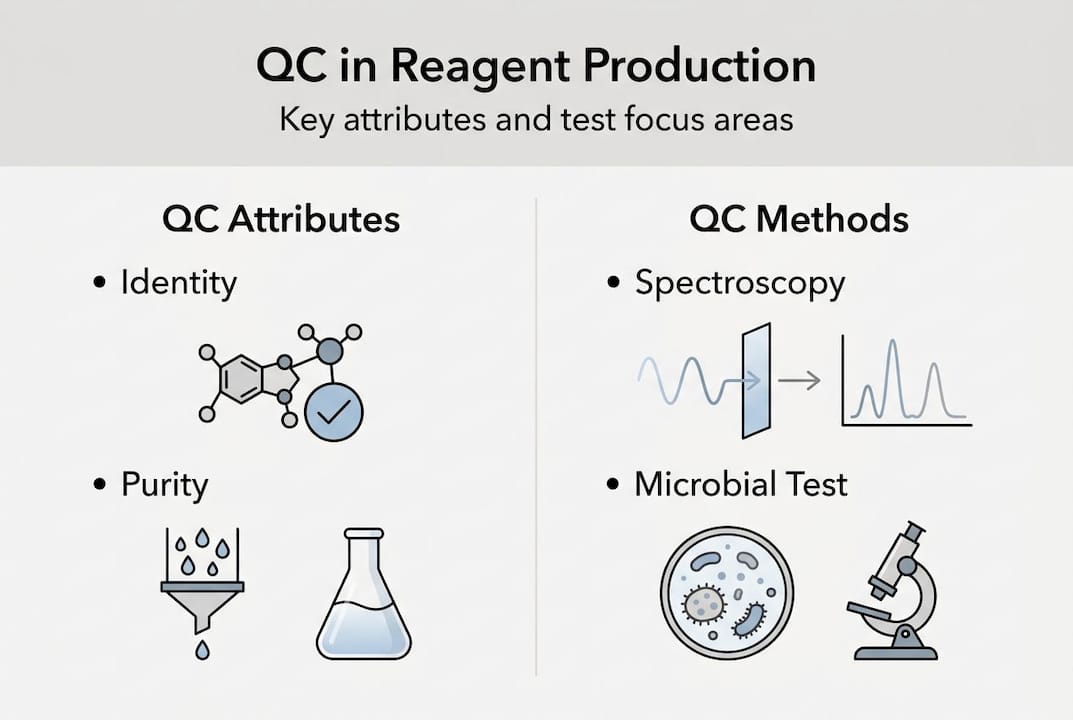
| QC attribute | Common test method | Acceptable outcome |
|---|---|---|
| Identity | Spectroscopy, HPLC | Matches reference standard |
| Purity | Chromatography, titration | Above specified threshold |
| Microbial limits | Sterility assay, bioburden test | Below colony-forming unit limit |
| pH | Potentiometry | Within defined range |
| Labeling accuracy | Visual and data audit | Matches batch record exactly |
Beyond the tests themselves, documentation and traceability are what make QC defensible. Every test result, instrument calibration record, and analyst signature needs to be stored in a way that allows full reconstruction of a batch’s history. This is not bureaucracy for its own sake. It is what allows you to isolate the source of a problem when something goes wrong.

For safe reagent handling in practice, traceability also means knowing exactly which lot of raw material went into which final product. Lot-level traceability is the difference between recalling one batch and recalling everything.
Understanding the full functions of reagents in experimental workflows also helps you prioritize which QC attributes matter most for your specific application. Bacteriostatic water used for peptide reconstitution, for example, demands tighter microbial and pH controls than a general-purpose buffer.
Pro Tip: Keep a dedicated QC logbook that cross-references batch numbers, test dates, analyst IDs, and instrument calibration records. During audits, this single document can save hours of evidence gathering.
How QC prevents reagent-related lab failures
The consequences of poor QC are not abstract. They show up as irreproducible assay results, contaminated cultures, degraded peptides, and data that cannot be published or defended. Understanding the failure modes makes QC feel less like overhead and more like insurance.
The three most common sources of reagent-related failure are:
- Contamination: Microbial or chemical contamination introduced during manufacturing or storage that is not caught before release.
- Mislabeling: Incorrect concentration, pH, or identity information on the label, leading to dosing errors in experiments.
- Instability: Reagents that degrade faster than expected due to improper formulation or storage conditions not validated during QC.
Consider two scenarios. In the first, a lab receives a batch of bacteriostatic water with no certificate of analysis and no microbial testing data. The water looks clear. It passes a basic visual check. Three weeks into a peptide stability study, cultures show unexpected contamination. The source takes two weeks to identify. In the second scenario, the same water arrives with full QC documentation, a confirmed endotoxin level, and a sterility certificate. The study runs cleanly.
“Reagent confidence across research and clinical applications starts with documented, verified QC at every production stage.”
Strong QC and reliability practices also reduce the downstream cost of failure. Repeating a four-week assay because of a reagent issue is not just a time loss. It is a budget loss, a personnel morale issue, and potentially a missed publication window.
For labs focused on lab purity techniques, the preventive actions QC enforces include controlled environmental monitoring, validated storage conditions, and mandatory hold-time studies that confirm reagent stability over the product’s claimed shelf life.
Best practices and standards for QC in Europe
European researchers operate within a well-defined regulatory environment, but navigating it consistently requires more than awareness. It requires systems.
The two most relevant frameworks for lab-based QC in Europe are ISO standards (particularly ISO/IEC 17025 for testing and calibration laboratories) and Good Laboratory Practice (GLP), which governs non-clinical safety studies. As regional QC compliance_and_Quality_Control_(QC)) frameworks make clear, QC protocols must align with these requirements to ensure both laboratory safety and scientific reliability.
For independent researchers and smaller labs, full GLP compliance may not be mandatory, but adopting its documentation principles is still valuable. Here is a practical checklist for building a defensible QC system:
- Establish written specifications for every reagent you use or produce, including acceptable ranges for all critical attributes.
- Implement a supplier qualification process that requires certificates of analysis and, where possible, third-party testing data.
- Maintain calibrated, logged instruments and schedule regular verification checks.
- Record every deviation from specifications and document the investigation and resolution.
- Conduct periodic internal audits, at least annually, to identify gaps before external reviewers do.
Using a structured reagent QC guide helps smaller labs apply these principles without needing a dedicated QA department. The goal is proportionate rigor, not bureaucratic overload.
For a broader view of how laboratory reagents overview principles connect to QC decisions, understanding reagent function informs which specifications to prioritize.
Pro Tip: Schedule a quarterly internal audit focused specifically on your reagent documentation chain. Review supplier COAs, cross-check lot numbers in your logbooks, and verify that storage conditions match validated parameters. This 90-minute exercise catches most compliance gaps before they become problems.
Why most reagent QC efforts fall short—and what labs should do differently
Here is the uncomfortable reality: most QC failures in European research labs are not caused by missing tests. They are caused by a culture that treats QC as a final checkpoint rather than an embedded practice.
Labs invest in SOPs, purchase compliant reagents, and train staff on documentation. Then, under deadline pressure, someone skips the in-process check. A mislabeled vial gets used because the visual inspection felt redundant. These are not equipment failures. They are culture failures.
The labs that maintain the most reliable data are the ones where every team member understands why each QC step exists, not just what to do. Process ownership matters. When a junior researcher knows that their in-process pH check is the last line of defense before a batch is used in a six-week study, they do not skip it.
Adopting QC best practices as a cultural standard rather than a compliance exercise is what separates labs that publish reproducible results from labs that spend months troubleshooting. Seek feedback from your team on where QC feels like friction. That friction is usually where the gaps are.
Ensure reliable results with trusted reagent QC resources
Applying rigorous QC to your reagent workflow is only as effective as the quality of the products you start with. At Herbilabs, every batch of bacteriostatic water and research reagent is manufactured to strict purity standards, with full documentation available to support your compliance requirements.
If you are building or refining your lab’s QC framework, our reagent QC resources provide detailed guidance on specifications, testing methods, and documentation practices. For a broader view of QC importance in research settings, we have covered the full case for why this investment pays off. When you are ready to source reagents that arrive with verified QC data, visit the Herbilabs shop and review our product documentation before your next order.
Frequently asked questions
What are the main stages of quality control in reagent production?
QC in reagent production starts with raw material testing and ends with final batch release, with in-process controls bridging the two. Each stage verifies a different set of critical properties to ensure the finished reagent performs as specified.
Why is microbial testing essential for lab reagents?
Microbial limits_and_Quality_Control_(QC)) must be verified in lab reagents because even low-level contamination can invalidate cell-based assays, corrupt cultures, and create safety risks for lab personnel. Sterility testing is non-negotiable for injectable or reconstitution-grade products.
What happens if labs skip QC in reagent production?
Skipping QC creates undetected variability in reagent performance, which leads directly to failed experiments, irreproducible data, and potentially unsafe working conditions. The cost of a single failed study almost always exceeds the cost of the QC that would have prevented it.
Which QC standards are most relevant in Europe?
ISO and GLP requirements_and_Quality_Control_(QC)) are the most widely applied QC frameworks across European research and testing laboratories. ISO/IEC 17025 is particularly relevant for labs performing their own reagent testing and calibration.