Private Label, White Label, Wholesale partnerships available - EU, USA and UK - Free shipping from €75

Laboratory reagents: Functions, types, and practical use
Learn what laboratory reagents are, how they are classified, how to source them legally in the UK and Europe, and why bacteriostatic water matters in research.
Most researchers working independently assume that if a substance triggers a reaction, it will do the job. That assumption has quietly ruined more experiments than any equipment failure ever could. The difference between a research-grade reagent and a generic substitute is not always visible, but it shows up in your data every single time. This article breaks down what laboratory reagents actually are, how they are classified, how to source them legally in the UK and Europe, and why bacteriostatic water deserves its own category in any serious research setup.
Table of Contents
- What are laboratory reagents? Definition and role in science
- Types of laboratory reagents and their functions
- Regulations and sourcing laboratory reagents in the UK and Europe
- Bacteriostatic water: A special reagent for peptide and protein studies
- Why reagent quality and validation outpace common lab shortcuts
- Explore trusted lab reagents and practical solutions with Herbilabs
- Frequently asked questions
Key Takeaways
| Point | Details |
|---|---|
| Role of reagents | Laboratory reagents are essential for driving controlled chemical reactions and analyses. |
| Types and functions | Reagents are categorized as analytical, synthetic, or catalytic, each serving a distinct scientific purpose. |
| Sourcing safely | Reliable suppliers and legal compliance are key for both hobbyists and professional labs in the UK/EU. |
| Bacteriostatic water use | Bacteriostatic water allows sterile, multi-dose research with proper handling for up to 28 days. |
| Importance of quality | High purity and validated methods ensure trustworthy, reproducible lab results. |
What are laboratory reagents? Definition and role in science
Laboratory reagents are substances or compounds used in chemical analysis, experiments, or to cause specific reactions in laboratory settings. That definition sounds simple, but the practical implications are enormous. A reagent is not just any chemical you add to a reaction. It is a precisely formulated substance with a defined purity, concentration, and purpose.
The reagent definition from Oxford Reference reinforces this: reagents are selected for their specific chemical properties, not their general availability. Substituting one reagent for another, even a chemically similar one, can shift reaction kinetics, alter detection thresholds, or introduce contaminants that skew your results entirely.
In practice, reagents serve three core functions in research:
- Initiating reactions: Reagents provide the chemical trigger that starts a controlled process, from simple acid-base titrations to complex enzymatic assays.
- Detecting or measuring analytes: In analytical work, a reagent reacts with a target compound to produce a measurable signal, color change, or precipitate.
- Maintaining reaction conditions: Some reagents act as buffers or stabilizers, keeping pH, ionic strength, or temperature within the range your experiment requires.
Purity is not just a label on the bottle. It directly determines whether your results are reproducible. A reagent with 98% purity sounds acceptable until you realize that 2% impurity can interfere with a fluorescence assay or destabilize a protein reconstitution. Independent researchers often underestimate this because they are not running clinical assays where regulatory bodies enforce purity standards.
“Reagent quality is not a premium feature. It is the baseline requirement for any result worth trusting.”
For researchers working with reconstitution solutions, understanding what a reagent actually does is the foundation. If you are new to this, our bacteriostatic water guide is a practical starting point for understanding how specialized reagents function in peptide and protein research.
A common mistake among hobbyists is treating water as a neutral carrier with no reagent properties. Water, depending on its formulation, ionic content, and preservative profile, is itself a reagent with measurable effects on your experiment.
Types of laboratory reagents and their functions
Reagents are classified by function: analytical (for detection and measurement), synthetic (for creating molecules), and catalytic (to accelerate reactions). Each type serves a fundamentally different purpose, and choosing the wrong category for your goal is one of the most common errors in independent research.
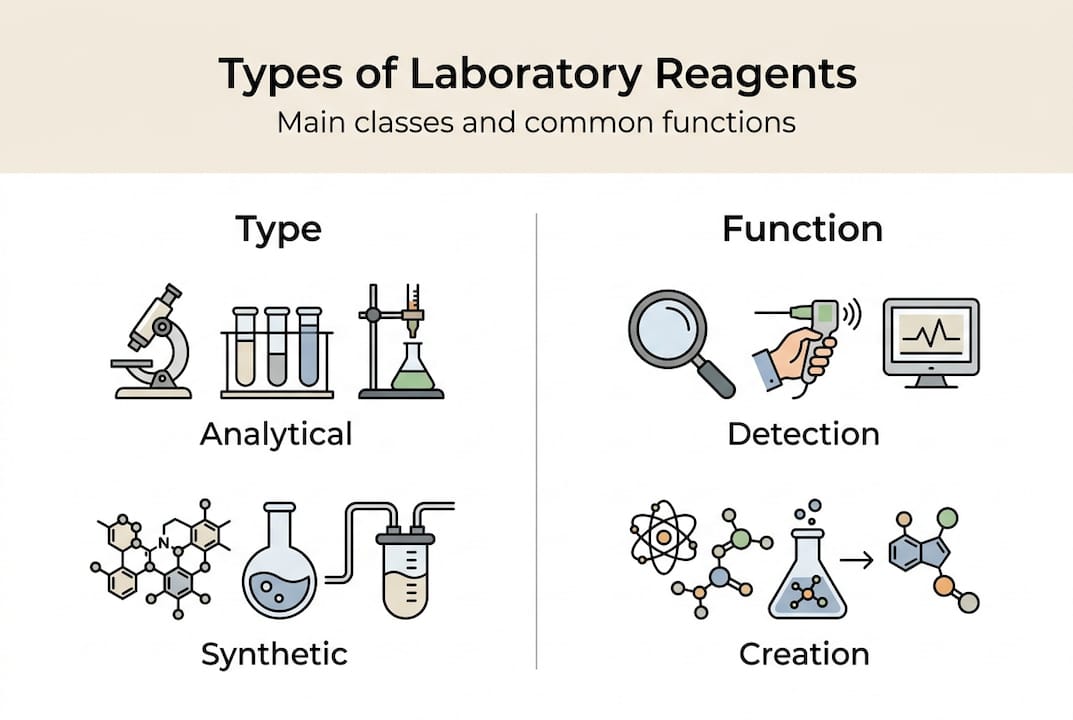
Here is a comparison of the three main types:
| Type | Primary function | Common examples |
|---|---|---|
| Analytical | Detect or quantify a target compound | pH indicators, titration reagents, staining agents |
| Synthetic | Build or modify molecular structures | Coupling agents, reducing agents, protecting groups |
| Catalytic | Speed up reactions without being consumed | Enzymes, metal catalysts, acid catalysts |
Common examples include acids like sulfuric acid, hydrochloric acid, and sodium hydroxide, which appear across all three categories depending on concentration and application. The same compound can be an analytical reagent in one protocol and a synthetic reagent in another.
The most frequently used reagents in typical independent and small-scale labs include:
- Sodium chloride (NaCl): Used in buffer preparation and as a tonicity agent in reconstitution.
- Hydrochloric acid (HCl): pH adjustment and protein denaturation studies.
- Sodium hydroxide (NaOH): Saponification reactions and pH calibration.
- Ethanol: Precipitation, sterilization, and extraction.
- Benzyl alcohol: Bacteriostatic preservative in multi-use injectable solutions.
Before you buy, check our water purity checklist to understand how solvent-grade water fits into your reagent selection. Also, if you are deciding between diluents, the water vs other diluents comparison covers the practical trade-offs clearly.
Pro Tip: Select your reagent type based on your experimental goal, not on what is easiest to source. Using an analytical-grade reagent in a synthetic protocol, or vice versa, can produce results that look valid but are not reproducible across labs or conditions.
One detail that surprises many researchers: catalytic reagents are not consumed in reactions, but they do degrade over time. Enzyme activity drops with improper storage, and a catalyst that has lost 30% of its activity will give you data that looks plausible but is systematically off.
Regulations and sourcing laboratory reagents in the UK and Europe
Once you know the types of reagents, sourcing them safely and legally is a vital step for independent researchers. The regulatory landscape in the UK and Europe is more nuanced than most guides acknowledge.
Reagents for blood grouping or IVD must comply with UK MDR 2002, while general lab reagents are available commercially without special licenses for research. This distinction matters enormously. If you are running a diagnostic assay, you are operating under a completely different compliance framework than someone reconstituting a peptide for a controlled study.
Here is a quick overview of requirements by use case:
| Use case | Regulatory framework | License required? |
|---|---|---|
| Clinical/IVD testing | UK MDR 2002, EU IVDR | Yes |
| Academic/institutional research | GLP guidelines | Institutional approval |
| Independent/hobby research | General chemical safety | No, but GLP recommended |
No special license is needed for non-regulated reagents in hobby or independent research, but GLP is strongly recommended for safety and result validity. GLP, or Good Laboratory Practice, is a quality framework that covers documentation, equipment calibration, and reagent traceability. You do not need to be audited to follow it.
Best practices for sourcing reagents as an independent researcher:
- Verify supplier credentials: Look for ISO-certified manufacturers or suppliers who publish certificates of analysis (CoA).
- Check lot-specific purity data: A CoA should include purity percentage, heavy metal content, and microbial limits where relevant.
- Avoid unverified online marketplaces: Reagents sold without documentation are a liability, not a bargain.
- Store according to SDS instructions: Improper storage degrades reagents faster than any other factor.
For a detailed breakdown of how to evaluate suppliers, our lab product sourcing guide covers the key criteria. If you are handling reagents for the first time, the reagent safety guide walks through step-by-step safety protocols.
The UK’s exit from the EU has created some divergence in chemical regulations, particularly around REACH compliance. For most research reagents, this has minimal practical impact, but it is worth confirming with your supplier whether their products are compliant with both UK REACH and EU REACH if you are shipping across borders.
Bacteriostatic water: A special reagent for peptide and protein studies
Moving from general reagents, let’s zoom into bacteriostatic water, a key reagent in modern research. It is one of the most misunderstood substances in independent lab work, often treated as just “water with something in it.” That framing misses what makes it genuinely useful.
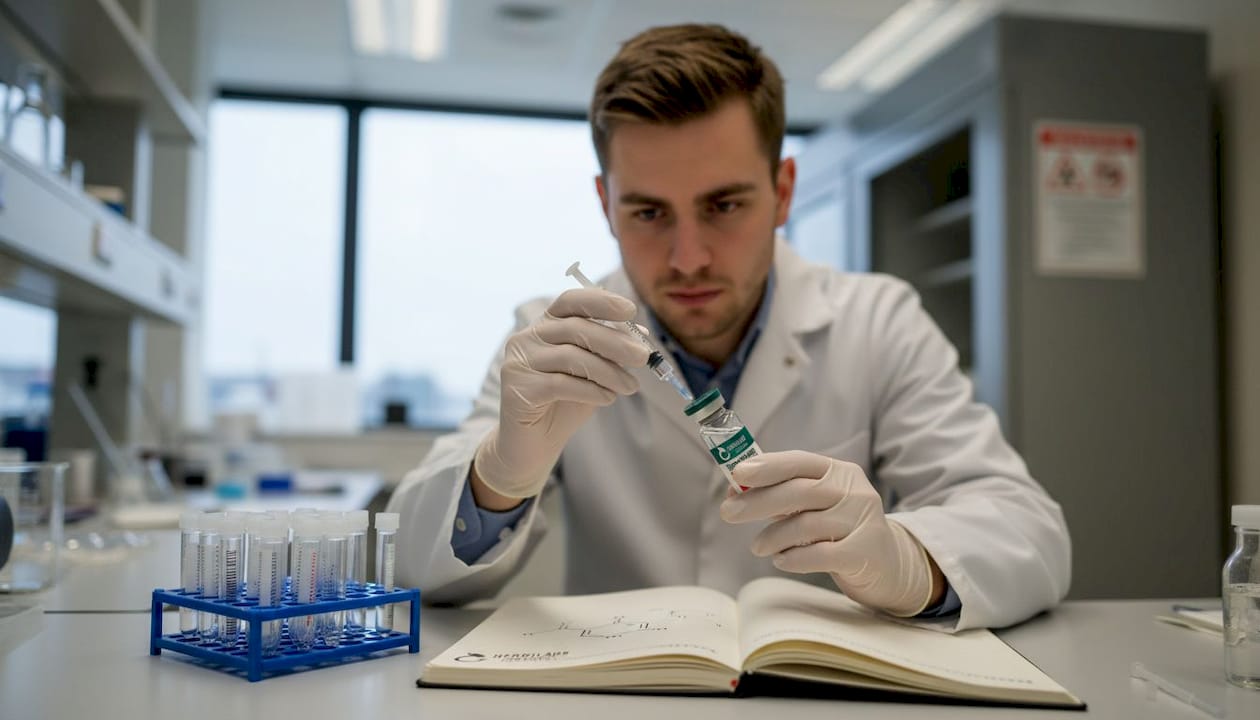
Bacteriostatic water is sterile water with 0.9% benzyl alcohol preservative to inhibit bacterial growth, used for multi-dose reconstitution of lyophilized peptides and proteins in research. The benzyl alcohol does not sterilize. It inhibits bacterial growth, which is a meaningful distinction. Sterilization kills microorganisms; bacteriostasis prevents them from multiplying to levels that would compromise your sample.
Key properties that make it a research-grade reagent:
- 0.9% benzyl alcohol: Provides bacteriostatic action without denaturing most peptides at research concentrations.
- pH range of 4.5 to 7.0: Suitable for a wide range of peptide stability profiles.
- Multi-use capability: Unlike sterile water, it can be accessed multiple times from the same vial without compromising integrity.
- Low ionic strength: Minimal interference with peptide solubility or activity.
Bacteriostatic water has a pH of 4.5 to 7.0 and can be used for up to 28 days post-opening under aseptic conditions. That 28-day window is not a suggestion. It is the validated limit beyond which benzyl alcohol concentration may drop below effective bacteriostatic levels.
Pro Tip: Always use a new, sterile needle each time you access a bacteriostatic water vial. Reusing needles introduces particulates and potential contaminants that the benzyl alcohol cannot fully neutralize at low bacterial loads.
For a full breakdown of how this reagent behaves across different research scenarios, the bacteriostatic water FAQs page covers the most common questions in detail. If storage is a concern, storing bacteriostatic water outlines the conditions that preserve its integrity. For applied use cases, applications of bacteriostatic water shows how it performs across five common research contexts.
One practical note: bacteriostatic water is not appropriate for all reconstitution tasks. Some proteins are sensitive to benzyl alcohol at even low concentrations. Always verify compatibility with your specific compound before committing to a full reconstitution batch.
Why reagent quality and validation outpace common lab shortcuts
Most guides on laboratory reagents stop at definitions and sourcing tips. They rarely address what happens when researchers cut corners on quality or skip method validation entirely. That gap is where most independent research quietly fails.
The Eurachem method validation guide recommends validating methods for selectivity, trueness, and precision, parameters that only matter if your reagents are consistent and documented. Cheap, off-label reagents create a compounding problem: your method validation is only as good as the reagents you validated with. Swap in a different batch from an unverified supplier, and your validated method is no longer validated.
This is the uncomfortable reality that budget-focused sourcing ignores. A reagent that costs 40% less but lacks a lot-specific CoA introduces uncertainty that no amount of statistical analysis can fully correct. You are not saving money. You are borrowing against your data’s credibility.
Our quality control for reagents resource outlines what rigorous QC looks like in practice, including what documentation to request from suppliers before you place an order.
Pro Tip: Document every reagent lot number, supplier, and CoA alongside your experimental records. Reproducibility is only possible when someone else can source the exact same reagent and replicate your conditions.
The researchers who produce the most reliable data are not necessarily the ones with the best equipment. They are the ones who treat reagent selection and documentation as non-negotiable parts of the scientific process.
Explore trusted lab reagents and practical solutions with Herbilabs
If this article has clarified how much reagent quality shapes your research outcomes, the next step is knowing where to source products that meet those standards consistently.
At Herbilabs, we supply research-grade bacteriostatic water and reconstitution solutions manufactured to strict purity standards, with full documentation for every batch. Whether you are reconstituting peptides for the first time or scaling up a repeat study, our bacteriostatic water complete guide gives you the technical foundation you need. For specific questions, the bacteriostatic water FAQs page addresses the most common handling and compatibility queries. Ready to order? Browse the full range at our lab reagents shop and find the right solution for your research setup.
Frequently asked questions
Are laboratory reagents regulated differently for clinical and hobby research in the UK/EU?
Yes, clinical reagents face stricter regulations under UK MDR 2002, while most general reagents for research and hobby use can be purchased without a license.
How long can bacteriostatic water be used after opening?
Bacteriostatic water is usable for up to 28 days post-opening, provided it is handled aseptically and stored correctly throughout that period.
Why is reagent purity crucial in experiments?
Impurities can shift detection limits and interfere with reaction specificity; purity affects sensitivity and the limit of detection in any validated analytical method.
Can hobbyists safely purchase lab reagents online?
Yes, most non-regulated reagents are available without a license, but GLP is recommended and sourcing from verified suppliers with published certificates of analysis is essential.
What’s the difference between bacteriostatic and sterile water for lab use?
Bacteriostatic water contains 0.9% benzyl alcohol to inhibit bacterial growth across multiple uses, while sterile water lacks this preservative and is suitable for single-dose applications only.