Private Label, White Label, Wholesale partnerships available - EU, USA and UK - Free shipping from €75

Lab product sourcing: Safe, reliable peptide research in EU
Discover how European researchers can safely source bacteriostatic water and reconstitution solutions for peptide research, with GMP, COA, and EU warehousing tips.
Sourcing bacteriostatic water and reconstitution solutions in Europe sounds straightforward until you actually try it. Independent researchers and home users quickly discover a maze of regulatory restrictions, inconsistent supplier quality, and purity risks that can quietly undermine months of peptide research. The products you choose as solvents and diluents are not passive ingredients. They directly shape your results. This guide walks you through the real obstacles, the standards that matter, and the practical steps that protect your research from the ground up.
Table of Contents
- Understanding lab product sourcing challenges in Europe
- Risks of poor sourcing: Impurities and unreliable results
- GMP, COA, and EU warehousing: The sourcing gold standard
- Practical tips for safe home and independent lab sourcing
- Reliable sourcing solutions with Herbilabs
- Frequently asked questions
Key Takeaways
| Point | Details |
|---|---|
| Check EU regulations | Always verify that your lab products comply with EU rules to avoid legal and customs issues. |
| Demand GMP and COA | Insist on GMP-certified products with a Certificate of Analysis for true purity and safety. |
| Smart handling practices | Apply aseptic techniques and label everything to protect your peptide research from contamination. |
| Avoid non-EU imports | Choosing EU-based suppliers reduces risk of customs seizures and ensures faster delivery. |
Understanding lab product sourcing challenges in Europe
Europe is not a single, unified market when it comes to lab reagents. Each country applies its own interpretation of EU pharmaceutical directives, and bacteriostatic water sits in a particularly awkward regulatory position. In many EU member states, bacteriostatic water is classified as a prescription medicinal product, which means standard retail channels simply cannot supply it to independent buyers or home users.
This forces most researchers into the Research Use Only (RUO) supplier category. RUO products are not subject to the same clinical-grade oversight, which creates its own set of concerns around consistency and documentation. You need to know exactly what you are buying and from whom.
Here are the core sourcing obstacles you will encounter:
- Prescription classification: Many EU countries restrict bacteriostatic water to licensed medical or pharmacy channels
- RUO gray zones: Research-grade suppliers vary widely in quality controls and batch documentation
- Cross-border shipping: Importing from outside the EU introduces customs delays, temperature excursion risks, and potential legal complications
- Lack of transparency: Many online vendors do not publish batch-specific purity data or manufacturing credentials
“Sourcing bacteriostatic water as a non-professional in Europe is genuinely difficult because of how regulations classify it. Knowing what bacteriostatic water actually is and what standards it should meet is the first step toward making a safe choice.”
Understanding these barriers is not just academic. It directly determines whether your reconstituted peptides are stable, pure, and research-ready.
Risks of poor sourcing: Impurities and unreliable results
Let’s be direct: a subpar solvent does not just produce slightly messier data. It can invalidate your entire experiment or introduce genuine safety risks. The chemistry here is unforgiving.
Common impurities found in low-quality peptide solvents and reconstitution solutions include:
- Dimers: Form when cysteine residues cross-link, creating false molecular weight readings
- Pyroglutamate: An N-terminal modification that alters peptide behavior in assays
- Deamidation: Converts asparagine or glutamine residues, changing charge and activity
- Oxidation products: Particularly damaging to methionine and tryptophan-containing peptides
These are not theoretical concerns. Peptide impurities such as dimers, pyroglutamate, deamidation, and oxidation can produce false results or outright toxicity in research settings. When dimers are present, purity is routinely overestimated, meaning you may believe you are working with a 98% pure compound when the actual active fraction is significantly lower.
| Impurity type | Source | Research impact |
|---|---|---|
| Dimers | Cysteine cross-linking | False MW readings, skewed dose-response |
| Deamidation | Asparagine/glutamine modification | Altered charge, reduced activity |
| Oxidation | Methionine/tryptophan degradation | Loss of bioactivity, toxicity risk |
| Pyroglutamate | N-terminal cyclization | Changed binding behavior |
Key stat: Result skew from undetected impurities can reach 18% or higher in peptide activity assays, which is enough to misclassify a compound as inactive.
Poor solvents also worsen peptide aggregation. When your reconstitution water contains trace contaminants or incorrect pH, peptides clump rather than dissolve. This is a major reason why ensuring peptide purity starts with the solvent, not just the peptide itself. Choosing verified, research-grade bacteriostatic water is one of the most impactful decisions you can make for lab reliability.
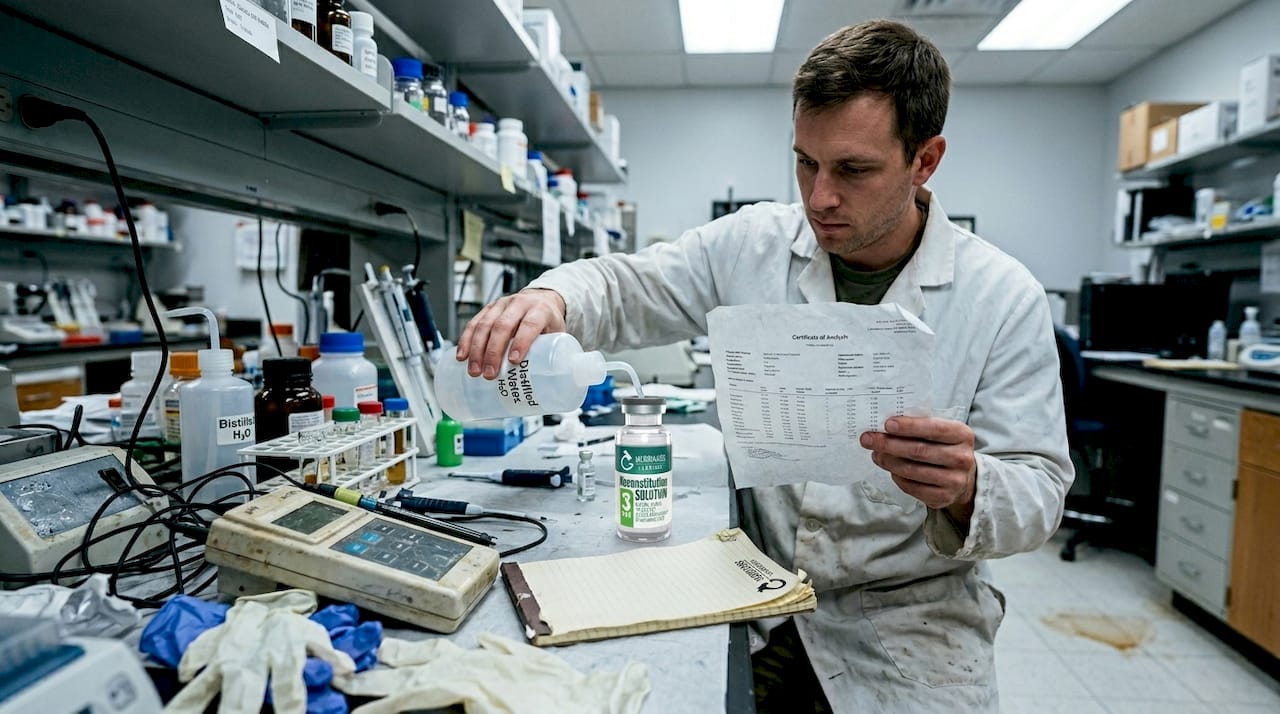
GMP, COA, and EU warehousing: The sourcing gold standard
Once you understand what can go wrong, the solution becomes clearer. Three criteria separate trustworthy suppliers from risky ones: GMP certification, a Certificate of Analysis, and EU-based warehousing.
GMP (Good Manufacturing Practice) is a regulatory framework that governs how products are manufactured, tested, and documented. A GMP-certified facility follows strict protocols for contamination control, equipment calibration, and batch traceability. When a supplier claims GMP compliance, it means every vial of bacteriostatic water was produced under audited, reproducible conditions.
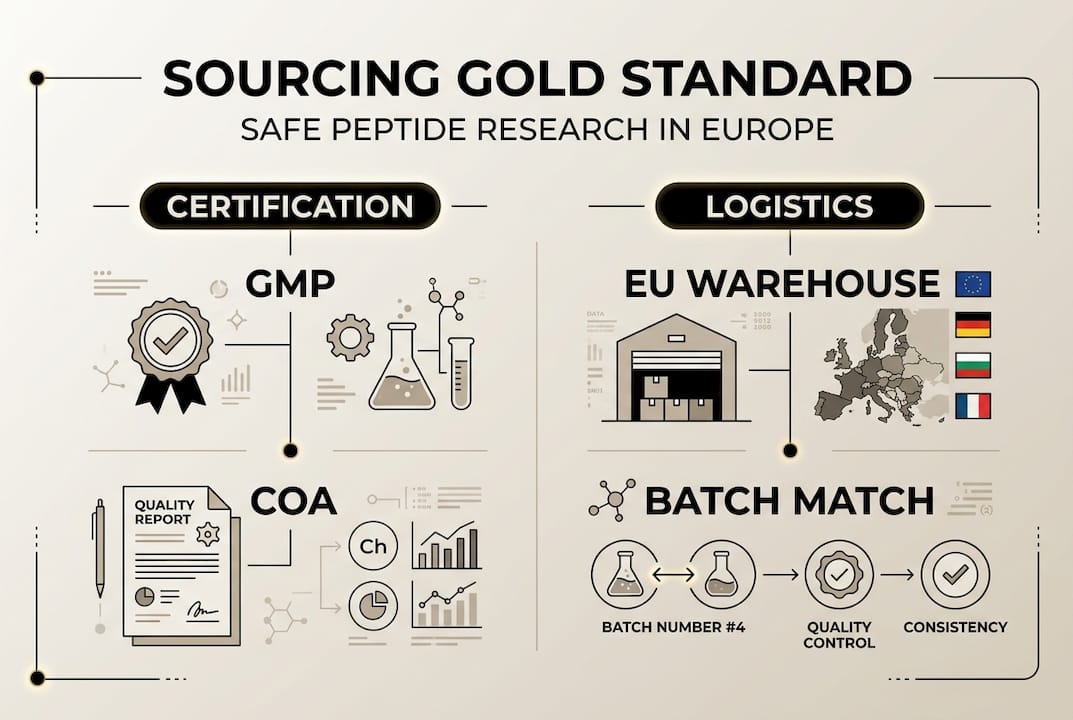
COA (Certificate of Analysis) is the document that proves it. A proper COA lists the specific batch number, test methods used, results for key parameters like pH, endotoxin levels, and benzyl alcohol concentration, and the release date. If a supplier cannot provide a batch-specific COA, that is a red flag.
EU warehousing matters more than most buyers realize. GMP-sourced solvents with COA documentation combined with EU-based stock means faster delivery, no customs interference, and products that have not been exposed to uncontrolled temperature conditions during long international transit.
| Criterion | What it means | Why it matters |
|---|---|---|
| GMP certification | Audited manufacturing process | Consistent quality, batch traceability |
| Certificate of Analysis | Batch-specific test results | Verified purity and safety parameters |
| EU warehousing | Stock held within EU borders | Fast delivery, no customs risk |
| Benzyl alcohol content | 0.9% preservative standard | Bacteriostatic efficacy confirmed |
Some researchers prefer sterile water or PBS (phosphate-buffered saline) over bacteriostatic water for certain applications. The comparison between BAC and sterile water comes down to multi-use stability. Bacteriostatic water allows repeated needle entries without contamination risk, while sterile water is single-use. For most peptide reconstitution work, bacteriostatic water is the practical choice, but only when it meets the standards above.
Pro Tip: Always cross-reference the COA batch number with the vial label before use. A mismatch means the documentation does not apply to your product, and you have no verified quality data for what you are actually using. Check the bacteriostatic water FAQ for a full breakdown of what to look for on a COA.
Practical tips for safe home and independent lab sourcing
Knowing the standards is one thing. Applying them consistently in a home or small independent lab is another. Here is a step-by-step approach that minimizes risk from purchase to reconstitution.
- Verify the supplier before ordering: Confirm GMP certification, a published EU warehouse address, and the ability to provide a batch-specific COA. If any of these are missing, move on.
- Check the product label on arrival: Confirm benzyl alcohol concentration (0.9% is standard), expiry date, and batch number. Match the batch number to the COA.
- Prepare your workspace: Clean your work surface, use a laminar flow hood if available, and have fresh alcohol wipes ready before opening any vials.
- Apply aseptic technique throughout: Aseptic reconstitution means wiping vial tops with alcohol, adding solvent slowly down the vial wall, and swirling gently rather than shaking. Shaking creates bubbles and can denature sensitive peptides.
- Refrigerate immediately: Store reconstituted solutions at 2 to 8°C. Do not leave them at room temperature, even briefly.
- Label every vial: Write the peptide name, concentration, solvent used, date of reconstitution, and your initials. This is non-negotiable for reproducibility.
- Avoid non-EU imports: Customs delays expose products to temperature fluctuations. Stick to EU-warehoused suppliers to protect product integrity.
Pro Tip: Use a dedicated notebook or digital log for every reconstitution. Record the supplier, batch number, COA reference, and any observations about solubility. If results become inconsistent, this log is your first diagnostic tool. Proper storage of bacteriostatic water before reconstitution is equally important. Unopened vials should be kept away from light and temperature extremes. Review whether BAC water is safe for your specific application before starting any new protocol.
These steps are not bureaucratic overhead. They are the difference between data you can trust and data you have to throw out.
Reliable sourcing solutions with Herbilabs
You now have a clear picture of what safe, compliant sourcing looks like for peptide research in Europe. The next step is finding a supplier that actually meets those standards without making you dig for documentation.
Herbilabs stocks bacteriostatic water and reconstitution solutions from an EU warehouse, with GMP manufacturing credentials and batch-specific COA available for every product. Whether you are working through the Bacteriostatic Water FAQs to confirm product suitability or reading the complete BAC water guide before your first order, the information you need is there. When you are ready to order, the Herbilabs labware shop offers secure checkout, fast EU delivery, and support for both individual researchers and wholesale buyers.
Frequently asked questions
Why is bacteriostatic water so hard to buy in Europe?
In many EU countries, bacteriostatic water is regulated as a prescription medicinal product, which limits who can legally supply it. Only select research-grade suppliers operating within the correct regulatory framework can ship it to independent buyers.
What risks come from poor-quality solvents or water?
Low-quality solvents introduce impurities like dimers, oxidation products, and deamidation byproducts that can skew results or cause toxicity. Peptide purity is routinely overestimated when these contaminants are present, making your data unreliable.
How can I verify the quality of lab products?
Request a batch-specific Certificate of Analysis, confirm GMP certification, and check that the supplier holds EU-warehoused stock. All three together give you a solid quality baseline before you commit to a purchase.
What practical steps can prevent contamination during reconstitution?
Wipe vial tops with alcohol, add solvent slowly down the vial wall, swirl gently without shaking, and refrigerate at 2 to 8°C immediately after reconstitution. Always label with the date and batch reference.