Private Label, White Label, Wholesale partnerships available - EU, USA and UK - Free shipping from €75

Essential Labware Types for Reliable Peptide Research
Discover the essential labware types for peptide research and bacteriostatic water in Europe. Compare glass vs. plastic, filtration tools, and trusted EU suppliers.
TL;DR:
- Selecting certified Class A glassware ensures accuracy and chemical inertness in peptide research.
- EU-certified sterile vials with rubber stoppers are essential for maintaining sterility in BAC water usage.
- Standardized, high-quality labware and supplier reliability are key to consistent and reproducible results.
Choosing the wrong labware is not just inconvenient. It can compromise sterility, skew results, and invalidate months of careful research. For independent researchers and peptide users across Europe, the stakes are especially high when working with bacteriostatic water (BAC water), which requires sterile vials and aseptic technique to remain stable for up to 28 days refrigerated. The labware you select directly affects purity, reproducibility, and compliance. This article breaks down the most important labware types, what to look for in each, and how to build a reliable setup that holds up under real research conditions.
Table of Contents
- Key criteria for selecting labware in peptide and reagent applications
- Sterile vials and bottles: Gold standard for bacteriostatic water
- Syringes, pipettes, and filtration: Supporting tools for purity
- Test tubes, racks, and auxiliary labware: Organization and workflow
- Making the right choice: Matching labware to your research goals
- Our unique take: Practical labware choices that stand up in real research
- Find trusted labware and expert support for your research
- Frequently asked questions
Key Takeaways
| Point | Details |
|---|---|
| Class A glass is ideal | Class A borosilicate glass vials offer the best accuracy and safety for most peptide and BAC water applications. |
| Sterile technique matters | Using sterile labware and aseptic handling minimizes contamination risks and supports reliable research outcomes. |
| Filtration ensures purity | 0.22µm filters are essential for removing bacteria when preparing BAC water for research use. |
| Choose reliable suppliers | EU-based suppliers like Herbilabs, Labbox, and Greiner Bio-One provide labware that meets strict quality standards. |
Key criteria for selecting labware in peptide and reagent applications
Before you buy anything, you need a clear framework. The wrong material or an uncertified supplier can introduce contamination or regulatory headaches that cost far more than the savings on cheap equipment.
Here are the core criteria every researcher should evaluate:
- Material compatibility: Glass (Class A borosilicate) offers superior chemical resistance and volume accuracy. Plastics are lighter and less prone to breakage, but plastic may leach compounds into sensitive solutions. For precise volumes and peptide work, certified Class A glass is the stronger choice.
- Sterility assurance: Any labware touching BAC water or reconstituted peptides must be sterile from the start. Pre-sterilized, sealed packaging is non-negotiable.
- Supplier certification: Within the EU, look for suppliers who document ISO compliance, manufacturing standards, and traceability. A vague product listing is a red flag.
- Single-use vs. reusable: Single-use plasticware eliminates cross-contamination risk but adds waste. Reusable glass requires validated cleaning and sterilization protocols.
- Regulatory fit: EU labs and clinics must align with relevant directives. Sourcing from certified European distributors simplifies this considerably.
“Certified Class A glassware is indispensable for precise volumes in any research setting where accuracy and chemical inertness are required.”
Pro Tip: Before ordering in bulk, request a certificate of conformity or batch test report from your supplier. Reputable vendors provide these without hesitation. Reviewing your lab safety checklist before sourcing new labware is a practical first step that many researchers skip.
The goal is not to find the cheapest option. It is to find the most reliable one for your specific protocol. A small investment in quality upfront prevents costly errors downstream.
Sterile vials and bottles: Gold standard for bacteriostatic water
Sterile vials are the cornerstone of any peptide reconstitution workflow. Get this piece wrong and nothing else matters.
For BAC water specifically, glass vials with benzyl alcohol are the standard because they minimize leaching, support multi-dose use, and maintain sterility over time. Type I borosilicate glass is the preferred material. It is chemically inert, resistant to thermal shock, and does not interact with the benzyl alcohol preservative in BAC water.
Key considerations when selecting vials:
- Volume: Common sizes for peptide work are 2 ml, 10 ml, and 30 ml. Match the vial volume to your typical reconstitution batch to minimize headspace and contamination risk.
- Closure type: Rubber stoppers with aluminum crimp seals offer the best sterility assurance for multi-dose vials. Flip-off caps allow repeated needle access without compromising the seal.
- Pre-sterilization: Always source vials that are gamma-irradiated or autoclaved and individually sealed. Never assume a vial is sterile based on appearance alone.
- Plastic alternatives: HDPE (high-density polyethylene) vials are sometimes used for short-term storage, but they are generally less suitable for repeated needle puncture and long-term stability.
Understanding the difference between your diluent options also matters. Reviewing resources on bacteriostatic vs sterile water helps clarify when each is appropriate for your protocol. For a deeper background on preparation and handling, the bacteriostatic water guide covers the essentials in detail.
Pro Tip: When swirling a reconstituted peptide in a vial, rotate gently rather than shaking. Vigorous agitation can degrade sensitive peptide bonds. Gentle swirling preserves molecular integrity while ensuring even mixing.
Store sealed vials upright, away from direct light, and at the recommended temperature. Label every vial with the date of reconstitution, concentration, and contents. This is basic practice, but it is also the step most commonly skipped under time pressure.
Syringes, pipettes, and filtration: Supporting tools for purity
Sterile vials do not work in isolation. The tools you use to transfer, measure, and filter your solutions are just as critical to maintaining purity.
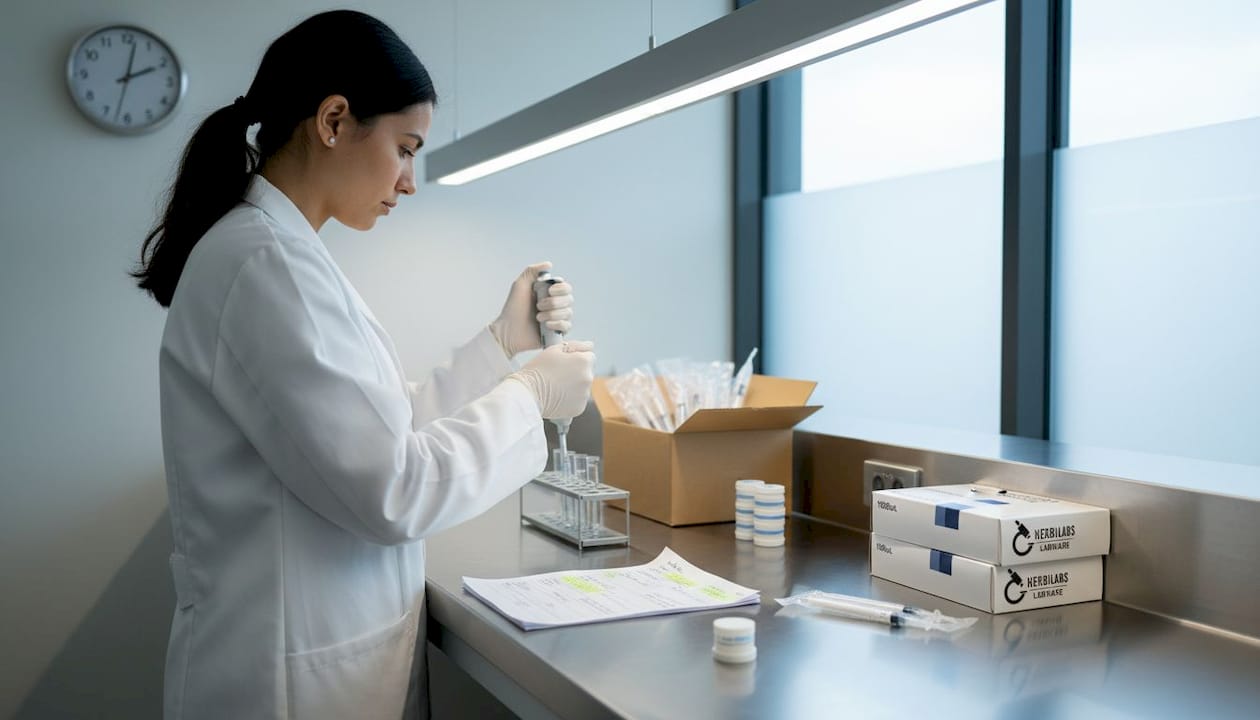
Syringes: Disposable, single-use syringes are the standard for peptide work. They eliminate cross-contamination between samples and remove the need for validated cleaning protocols. Use low dead-volume syringes when working with expensive peptides to minimize waste. Insulin syringes (typically 0.3 ml to 1 ml) are popular for small-volume transfers.
Micropipettes: For precise volume transfers in the microliter range, calibrated micropipettes are essential. Check calibration regularly, especially if your pipette is shared across multiple users. Always use certified, filter-tipped pipette tips to prevent aerosol contamination of the pipette shaft.
Filtration: 0.22µm filters are the critical final step in BAC water preparation. They remove bacteria and particulates that could compromise sterility. Syringe filters with PES (polyethersulfone) membranes are widely used because they have low protein binding and high flow rates.
| Labware item | Typical size or precision | Primary use in peptide research |
|---|---|---|
| Disposable syringe | 0.3 ml to 10 ml | Transferring BAC water and peptide solutions |
| Micropipette | 0.1 µl to 1000 µl | Precise volume measurement |
| 0.22µm syringe filter | 13 mm to 33 mm diameter | Sterile filtration of solutions |
| Filter-tipped pipette tip | Various | Contamination-free liquid transfer |
For complete guidance on handling these tools correctly, the water handling guide outlines best practices in a clear, protocol-ready format.
Pro Tip: Always use separate syringes and pipette tips for each stock solution. Never reuse a tip between different peptide vials, even if you believe the solution is the same. Cross-contamination is cumulative and often invisible until it is too late.
Test tubes, racks, and auxiliary labware: Organization and workflow
Beyond vials and syringes, the supporting infrastructure of your workspace shapes how efficiently and safely you work.
Test tubes serve as intermediate containers for mixing, diluting, and short-term storage. For peptide applications, European suppliers like Labbox (Spain), Greiner Bio-One (Austria and Germany), and Gentaur (Belgium) offer a wide range of certified glass and plastic options. Herbilabs (UK and EU) specializes in BAC water in glass vials and is a practical first stop for researchers in the region.
Glass vs. plastic test tubes for peptide work:
| Feature | Glass test tubes | Plastic test tubes |
|---|---|---|
| Chemical inertness | High | Moderate (material-dependent) |
| Breakage risk | Higher | Lower |
| Reusability | Yes, with sterilization | Limited or single-use |
| Cost per unit | Higher | Lower |
| Best for | Precise volumes, reagent prep | Short-term mixing, disposable use |
“Certified Class A glassware is indispensable for precise volumes in any research setting where accuracy and chemical inertness are required.”
Setting up an organized workstation reduces error and speeds up your workflow. Here is a practical sequence:
- Clear and wipe down your work surface with 70% isopropyl alcohol before starting.
- Lay out all labware in order of use: vials, syringes, filters, tubes, and racks.
- Label all containers before filling them, not after.
- Keep a dedicated rack for completed vials, separate from empty or in-progress ones.
- Dispose of sharps and single-use plastics immediately after use to avoid accidental reuse.
For longer-term storage considerations, the peptide storage guide covers temperature, light exposure, and container selection in depth.
Making the right choice: Matching labware to your research goals
With all the options laid out, the real skill is matching labware to your specific protocol rather than buying a generic “lab kit” and hoping it works.
Here is a quick decision checklist:
- Material: Does your protocol involve organic solvents or acids? Use glass. Standard aqueous peptide solutions? Certified plastics may be acceptable for short-term use.
- Sterility: Are you working with multi-dose solutions? Prioritize pre-sterilized glass vials with rubber stoppers.
- Supplier: Is your supplier EU-certified with traceable batch documentation? If not, keep looking.
- Storage needs: BAC water stays stable for 28 days refrigerated in glass vials, making it the preferred diluent for multi-use peptide protocols over plain sterile water.
- Budget: Single-use plasticware lowers upfront cost but increases ongoing spend. Reusable glass requires sterilization infrastructure but pays off at scale.
Stat callout: BAC water in sealed glass vials remains stable for up to 28 days when refrigerated, making it significantly more practical than sterile water for repeated dosing protocols.
For researchers exploring specific applications, the use cases for BAC water page provides a clear breakdown by research context.
Pro Tip: Build your labware list around your most demanding protocol first. If your most sensitive application requires Class A glass and 0.22µm filtration, standardize on that across your workflow. Mixing quality levels between protocols is where errors creep in.
Long-term reliability also means building a supplier relationship, not just making one-off purchases. Suppliers who know your volume and application can flag backorders early and help you maintain continuity.
Our unique take: Practical labware choices that stand up in real research
Here is something most labware guides will not tell you: the biggest source of research failure is not equipment failure. It is inconsistency in sourcing.
Researchers who switch suppliers frequently to save a few euros often end up with vials from three different manufacturers, filters with inconsistent membrane ratings, and pipette tips that do not fit their pipettes. The cumulative effect is subtle but real: variable results, contamination events, and wasted reagents.
The labs and independent researchers who get consistent results are the ones who standardize early. They pick certified EU suppliers, they follow lab protocols for BAC water consistently, and they do not deviate from their validated setup without good reason.
Class A certification and supplier traceability are not bureaucratic formalities. They are the practical foundation of reproducible research. Skimping on vial quality or ignoring supplier credentials is the most common and most avoidable mistake we see. The accessories that consistently improve outcomes are often the simplest: labeled racks, filter-tipped tips, and pre-sterilized vials from a supplier you trust.
Find trusted labware and expert support for your research
If you are ready to build a reliable labware setup for peptide research and BAC water handling, Herbilabs offers EU-compliant sterile vials and bottles manufactured to strict purity standards, with full documentation available on request.
Start with the BAC water FAQs for quick answers to the most common sourcing and handling questions, or read the bacteriostatic water complete guide for a thorough protocol-level overview. When you are ready to order, the shop labware products page lists current inventory with secure checkout and wholesale pricing for resellers and professionals across the UK and Europe.
Frequently asked questions
Which labware material is best for peptide research: glass or plastic?
Class A glass is typically preferred for peptides due to volume accuracy and low leaching risk, though certified plastics are acceptable for short-term, low-sensitivity applications.
How long can bacteriostatic water remain stable once opened?
BAC water in glass vials stays stable for up to 28 days refrigerated, thanks to the 0.9% benzyl alcohol preservative that inhibits microbial growth.
Are there reliable European suppliers for sterile labware?
Yes. Leading options include Herbilabs (UK and EU), Labbox (Spain), Greiner Bio-One (Austria and Germany), and Gentaur (Belgium), all offering EU-compliant certified products.
Why use 0.22µm filters during bacteriostatic water preparation?
0.22µm filters remove bacteria and particulates from solution, providing the sterile filtration step that is essential before BAC water is used in any peptide reconstitution protocol.