Private Label, White Label, Wholesale partnerships available - EU, USA and UK - Free shipping from €75

Contaminant-Free Water for Research: 2026 Lab Guide
Discover the importance of contaminant-free water for research in our 2026 lab guide. Learn standards, benefits, and ensure accurate results!
TL;DR:
- Ultrapure water for research has a resistivity of 18.2 MΩ·cm and endotoxin levels below 0.001 EU/mL, making it essential for molecular biology and cell culture. Achieving this standard requires multi-stage purification, continuous monitoring, and proper system maintenance, as water quality degrades silently over time. Using proper materials and proactive filtration ensures water integrity, preventing assay failures caused by hidden contaminants.
Contaminant-free water for research is ultrapure water defined by a resistivity of 18.2 MΩ·cm at 25°C and endotoxin levels below 0.001 EU/mL, making it the benchmark standard for molecular biology, HPLC, and cell culture work. The industry term is Type I ultrapure water, and it differs from deionized water for labs or filtered drinking water in ways that matter enormously to your results. Bacteria counts must stay below 1 CFU/mL, and RNase and DNase levels must fall under 0.01 ng/mL. If your water misses any of these targets, your assay does not just underperform. It fails silently, and you may not know until you have wasted weeks of work.
What standards define contaminant-free water for research?
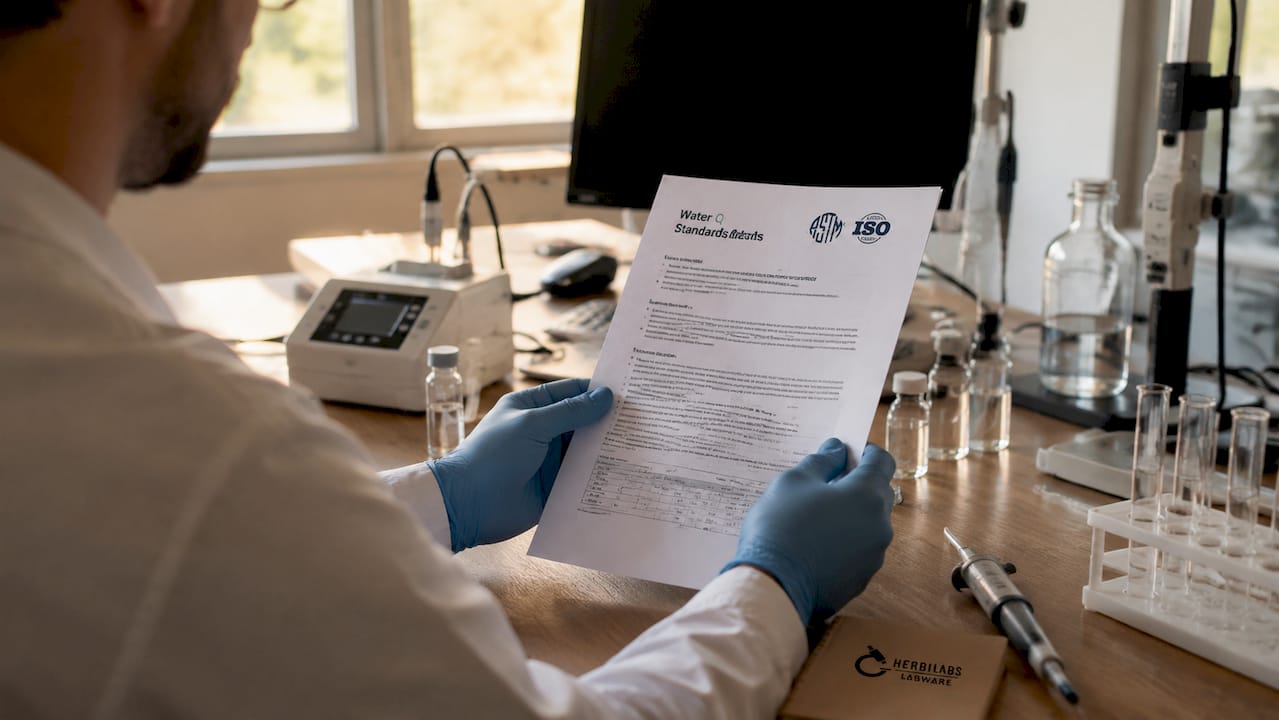
Three frameworks govern water quality for scientific studies: ASTM D1193-06, ISO 3696:1987, and CLSI EP21-A. Each defines acceptable limits for resistivity, total organic carbon (TOC), conductivity, bacteria, and endotoxins across water grades. Type I is the most stringent grade under all three systems, and it is the only grade suitable for LC-MS, trace metal analysis, and mammalian cell culture.
The table below summarizes the key parameters for Type I ultrapure water under ASTM and ISO standards:
| Parameter | Type I Specification |
|---|---|
| Resistivity | 18.2 MΩ·cm at 25°C |
| TOC | <5 ppb |
| Bacteria | <1 CFU/mL |
| Endotoxins | <0.001 EU/mL |
| RNase / DNase | <0.01 ng/mL |
Real-time monitoring of TOC and resistivity is not optional for critical applications. A system that only tests water at startup gives you a snapshot, not a guarantee. Continuous inline sensors catch purity drops before they reach your bench. This distinction separates a compliant system from one that merely claims compliance.
One common error is treating deionized water for labs as equivalent to Type I ultrapure water. Deionization removes ions but leaves organics, endotoxins, and nucleases intact. Potable water standards do not require removal of trace enzymes or nucleases, which means tap-derived or lightly filtered water carries biological contaminants that will interfere with PCR, RNA work, and protein assays.
Which purification methods produce ultrapure water?
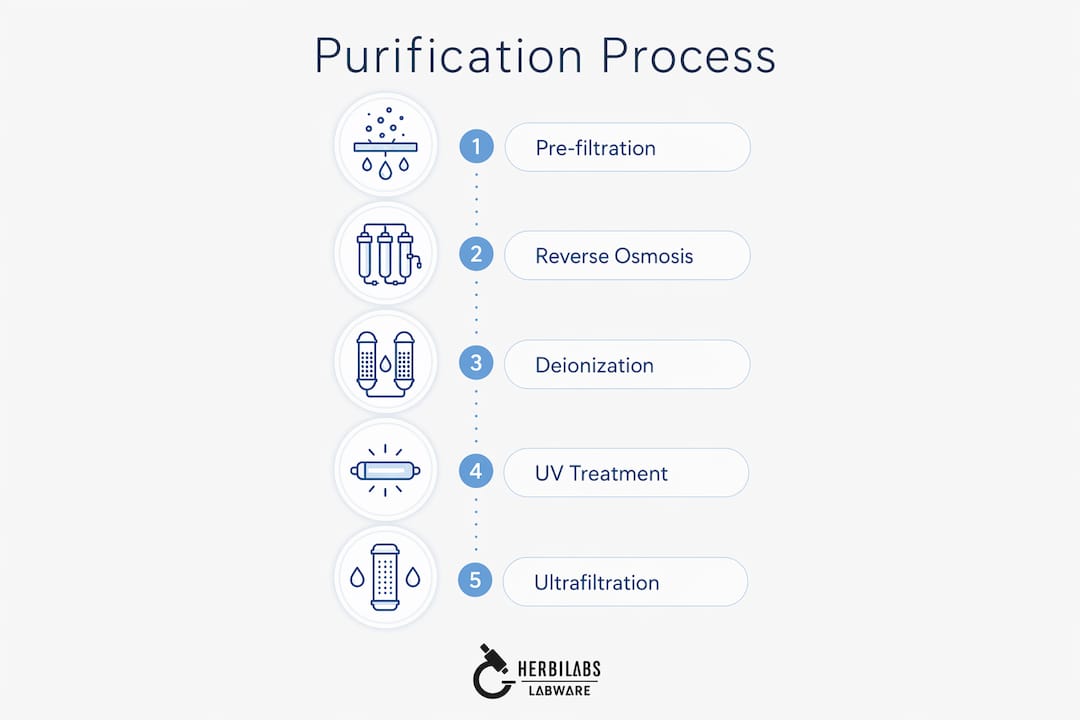
No single technology produces research grade purified water on its own. Different contaminants require distinct removal methods, so a series of physical and chemical stages is mandatory. Here is how each stage contributes:
- Reverse osmosis (RO): Removes 95–99% of dissolved ions and most organics in the first pass. RO is the workhorse of the system, reducing the load on every downstream stage.
- Electrodeionization (EDI) and mixed-bed ion exchange: Polish the water after RO, driving resistivity up to 18.2 MΩ·cm. EDI uses electrical current to continuously regenerate resin, eliminating the need for chemical regeneration cycles.
- Ultrafiltration (UF) membranes: Remove endotoxins, nucleases, and particulates that RO and ion exchange cannot capture. UF is the stage that makes water safe for cell culture and RNA work.
- UV sterilization and UV oxidation: UV at 254 nm kills microorganisms; UV at 185 nm breaks down organic compounds, driving TOC below 5 ppb. Both wavelengths are often combined in a single lamp unit.
- Final 0.2 µm filter at the point of use: Catches any particulates or microorganisms that enter the distribution loop after purification.
The logic is sequential. Each stage targets what the previous one cannot remove. Skipping any stage leaves a specific contaminant class unaddressed, and that gap will show up in your data.
Pro Tip: If your system lacks a UV oxidizer, TOC levels will creep upward over time even with intact ion exchange resin. Check whether your unit includes both 185 nm and 254 nm UV output before purchasing.
How do you maintain purity at the point of use?
Producing pure water for experiments inside the purification unit is only half the problem. Getting that water to your bench without picking up contaminants is the other half. System design determines whether you succeed.
- Use a closed-loop recirculation architecture. Water that sits in a distribution line grows biofilm within days. Continuous recirculation keeps water moving and prevents microbial colonization. Integrated closed-loop systems outperform open or add-on configurations because they eliminate stagnant zones entirely.
- Specify the right piping materials. Ultrapure water is chemically aggressive and leaches contaminants from standard plastics and metals. Acceptable materials are PFA (perfluoroalkoxy), PVDF (polyvinylidene fluoride), and electro-polished stainless steel with orbital-welded joints. Standard PVC or copper piping will introduce ions and organics immediately.
- Eliminate dead-legs in the distribution loop. A dead-leg is any section of pipe where water does not circulate. Dead-legs accumulate biofilm and become a continuous contamination source. Every branch in your loop should be as short as possible, ideally under six pipe diameters in length.
- Schedule proactive filter replacement. Maintenance failures cause water quality degradation that is invisible until it affects experiments. Do not wait for resistivity to drop before replacing cartridges. Follow the manufacturer’s replacement schedule and log every service event.
- Monitor continuously with online sensors. Inline TOC and resistivity sensors give you real-time data. A sudden resistivity drop below 17 MΩ·cm signals resin exhaustion. A TOC spike above 10 ppb signals UV lamp failure or biofilm intrusion. Both are actionable before they compromise a run.
Pro Tip: Keep a lab water quality checklist that logs resistivity and TOC readings daily. Trends matter more than single readings. A slow resistivity decline over two weeks tells you the resin is approaching exhaustion before it actually fails.
How do ultrapure water systems compare for independent labs?
Independent researchers and small lab teams face a specific challenge: they need Type I water quality without the infrastructure budget of a university core facility. The table below compares representative systems across the specifications that matter most for bench-scale molecular biology work.
| System | Flow Rate | Resistivity | TOC | UV Oxidizer | UF Membrane |
|---|---|---|---|---|---|
| AQUA SOLUTIONS 2035BL | 1.5 L/min | 18.2 MΩ·cm | <5 ppb | Yes | Yes |
| AQUA SOLUTIONS 2121B | 2.0 L/min | 18.2 MΩ·cm | <5 ppb | Yes | Yes |
| ELGA Chorus 1 | 1.0 L/min | 18.2 MΩ·cm | <5 ppb | Yes | Yes |
| Basic DI polisher (generic) | Varies | Up to 18.2 MΩ·cm | Not controlled | No | No |
The AQUA SOLUTIONS 2035BL and 2121B both meet Type I ultrapure water specifications with built-in UV oxidizers and ultrafiltration, making them suitable for RNA work and cell culture without add-on modules. The ELGA Chorus 1 targets life science and trace analysis applications with similar specifications. A basic DI polisher, by contrast, controls resistivity but leaves TOC, endotoxins, and nucleases unaddressed. That gap is the difference between water that passes a resistivity check and water that is actually safe for sensitive assays.
Flow rate matters more than most researchers realize. A 1.0 L/min system works for a single bench but creates bottlenecks in a shared lab environment. Match the system’s output to your peak daily demand, not your average demand.
Key takeaways
Reliable ultrapure water for research requires integrated multi-stage purification, compliant system materials, continuous monitoring, and proactive maintenance working together without exception.
| Point | Details |
|---|---|
| Type I is the standard | Research-grade water requires 18.2 MΩ·cm resistivity and endotoxins below 0.001 EU/mL. |
| No single technology is enough | RO, EDI, UV, and UF must work in series to remove all contaminant classes. |
| System materials matter | Use PFA, PVDF, or electro-polished stainless steel to prevent leaching into ultrapure water. |
| Monitor continuously | Inline TOC and resistivity sensors catch purity failures before they reach your experiments. |
| Maintenance prevents silent failures | Proactive filter replacement and sanitization schedules protect water quality between readings. |
What i have learned about water purity the hard way
The biggest mistake I see independent researchers make is treating water purity as a procurement decision rather than an ongoing practice. You buy a good system, verify the spec sheet, and assume the problem is solved. It is not.
Water quality degrades silently. Resin exhausts gradually. UV lamps lose output over months. Biofilm establishes itself in a dead-leg you forgot about during installation. None of these failures announce themselves with an alarm. They show up as irreproducible results, failed Western blots, or RNA degradation you cannot explain. By the time you suspect the water, you have already lost significant time.
The second misconception I encounter constantly is that “contaminant-free” is a binary state. It is not. Contaminant-free is a relative term. Water that is perfectly acceptable for HPLC may be completely unsuitable for RNA extraction. The contaminant profile you need to eliminate depends entirely on your assay. A researcher running trace metal analysis needs different water than one running cell culture, even if both systems show 18.2 MΩ·cm on the display.
My practical advice: define your contaminant requirements before you select a system, not after. List the assays you run, identify the contaminants that would interfere with each, and then verify that your chosen system removes those specific contaminants. Do not rely on a single resistivity reading as your quality gate. Pair it with TOC monitoring and periodic microbiological testing. That combination gives you an actual picture of what is in your water, not just what is not conducting electricity.
The laboratory water handling guide from Herbilabs covers this assay-specific approach in practical detail, and it is worth reading before you finalize any system purchase.
— Ragnar
Research-grade water and reagents from Herbilabs
When your purification system produces Type I water, the next question is whether your reconstitution solutions and diluents meet the same standard. Herbilabs supplies bacteriostatic water and sterile reconstitution solutions manufactured to strict purity specifications, designed for peptide research and molecular biology applications across the UK and Europe. Every product is produced in a dedicated facility with rigorous quality control, so the purity you need at the bench is the purity you receive.
Visit the Herbilabs shop to browse research-grade bacteriostatic water and reagents. If you have questions about product specifications or storage requirements, the bacteriostatic water FAQs page covers the practical details researchers ask most often.
FAQ
What is type i ultrapure water?
Type I ultrapure water is the highest purity grade defined by ASTM D1193-06 and ISO 3696:1987, characterized by 18.2 MΩ·cm resistivity, TOC below 5 ppb, and endotoxins below 0.001 EU/mL. It is the required standard for HPLC, LC-MS, cell culture, and RNA-based assays.
Is deionized water the same as ultrapure water?
Deionized water removes ions but does not remove organics, endotoxins, or nucleases. Ultrapure Type I water requires additional stages including UV oxidation and ultrafiltration to meet research-grade specifications.
How often should purification filters be replaced?
Filter replacement intervals depend on feed water quality and system throughput, but most manufacturers recommend cartridge replacement every 6–12 months regardless of resistivity readings. Proactive replacement prevents the silent purity degradation that reactive schedules miss.
Can i use bacteriostatic water instead of ultrapure water?
Bacteriostatic water serves a specific purpose: it contains 0.9% benzyl alcohol to inhibit microbial growth and is used for reconstituting peptides and proteins for research use. It is not a substitute for Type I ultrapure water in HPLC or molecular biology applications, but it is the correct choice for peptide reconstitution and storage.
What happens if water purity drops during an experiment?
A drop in resistivity or a TOC spike mid-experiment introduces ionic and organic contaminants that can inhibit enzymes, degrade nucleic acids, or skew spectrophotometric readings. The safest response is to halt the run, identify the source of the purity failure, and restart with verified water rather than attempt to correct results from compromised samples.