Private Label, White Label, Wholesale partnerships available - EU, USA and UK - Free shipping from €75

How to safely reuse BAC water vials for best results
Discover how many times you can use a BAC water vial safely. Learn to maximize your resources while ensuring sterility and effectiveness.
TL;DR:
- Properly handled BAC water can be reused for up to 28 days with aseptic technique.
- Benzyl alcohol in BAC water inhibits bacterial growth, enabling multiple draws.
- Visual inspection and strict protocols are essential to ensure safety and avoid contamination.
Many researchers and peptide users treat bacteriostatic water vials as single-use containers, tossing them after the first draw and moving on. That’s wasteful, expensive, and completely unnecessary. A properly handled BAC water vial can support multiple reconstitutions over nearly a month, provided you understand the science behind it and follow the right protocols. This guide covers everything you need to know: how BAC water works, how many times you can realistically use a single vial, what aseptic technique actually looks like in practice, and how to recognize contamination before it becomes a problem.
Table of Contents
- Understanding bacteriostatic water: What makes it unique?
- How many times can you use a BAC water vial safely?
- Essential safety practices for reusing BAC water vials
- Recognizing contamination and when to discard your BAC water vial
- Applying the guidelines: Example scenarios and decision framework
- What most guides miss about BAC water vial reuse
- Your trusted partner for safe BAC water and labware
- Frequently asked questions
Key Takeaways
| Point | Details |
|---|---|
| 28-day safe window | You can reuse a BAC water vial for up to 28 days after the first puncture if it’s handled aseptically. |
| Watch for contamination | Discard the vial immediately if you see cloudiness, discoloration, or particles. |
| Multiple uses allowed | A single vial can reconstitute several peptides, provided you use sterile technique for every draw. |
| Proper storage matters | Store your vial as directed by the manufacturer, often under refrigeration, and always note the opening date. |
Understanding bacteriostatic water: What makes it unique?
Before you can confidently reuse a vial, you need to understand exactly why BAC water is built differently from other diluents. The answer comes down to one ingredient: benzyl alcohol.
Bacteriostatic water is sterile water that contains 0.9% benzyl alcohol as a preservative. This concentration is carefully selected because it inhibits the growth of bacteria without introducing levels of benzyl alcohol that would compromise the integrity of your reconstituted compounds. You can learn more about what is BAC water and its formulation in detail, but the core point is this: benzyl alcohol creates a hostile environment for microbial growth, which is exactly what allows you to puncture the vial stopper more than once without immediately introducing contamination risk.
This is the fundamental difference when you compare BAC vs sterile water. Regular sterile water contains no preservative whatsoever. The moment you puncture the rubber stopper and expose that solution to the atmosphere, microorganisms can begin colonizing it. Even under good technique, sterile water should not be reused. BAC water, on the other hand, suppresses bacterial growth precisely because of its benzyl alcohol content, which is why it tolerates repeated punctures safely within a defined window.
Here’s a quick comparison to put this in perspective:
| Feature | BAC water | Sterile water |
|---|---|---|
| Contains benzyl alcohol | Yes (0.9%) | No |
| Multiple-use vial | Yes, within 28 days | No, single use only |
| Supports peptide reconstitution | Yes | Limited (no repeat draws) |
| Refrigeration after opening | Recommended | N/A (discard after use) |
| Visible shelf life post-opening | 28 days | Immediate discard |
Beyond its preservative properties, BAC water is specifically favored in peptide reconstitution for several practical reasons:
- pH compatibility: BAC water’s pH is close to neutral, which is suitable for most peptide structures.
- Isotonicity considerations: For research-grade reconstitution, the low benzyl alcohol concentration avoids destabilizing many peptide bonds.
- Volume consistency: The clear, colorless appearance makes it easy to verify the solution’s integrity visually at every draw.
- Wide compatibility: Most peptide protocols in academic and independent research settings specify BAC water explicitly, rather than sterile saline or plain water.
Pro Tip: If you’re working with particularly sensitive peptides or compounds, always cross-check the peptide manufacturer’s reconstitution recommendations. Some rare compounds may call for a different diluent, but for the vast majority of common research peptides, BAC water is the standard choice.
How many times can you use a BAC water vial safely?
Now that you understand why BAC water allows for multiple uses, let’s get into the specifics of how many draws are actually safe and what conditions have to be met.
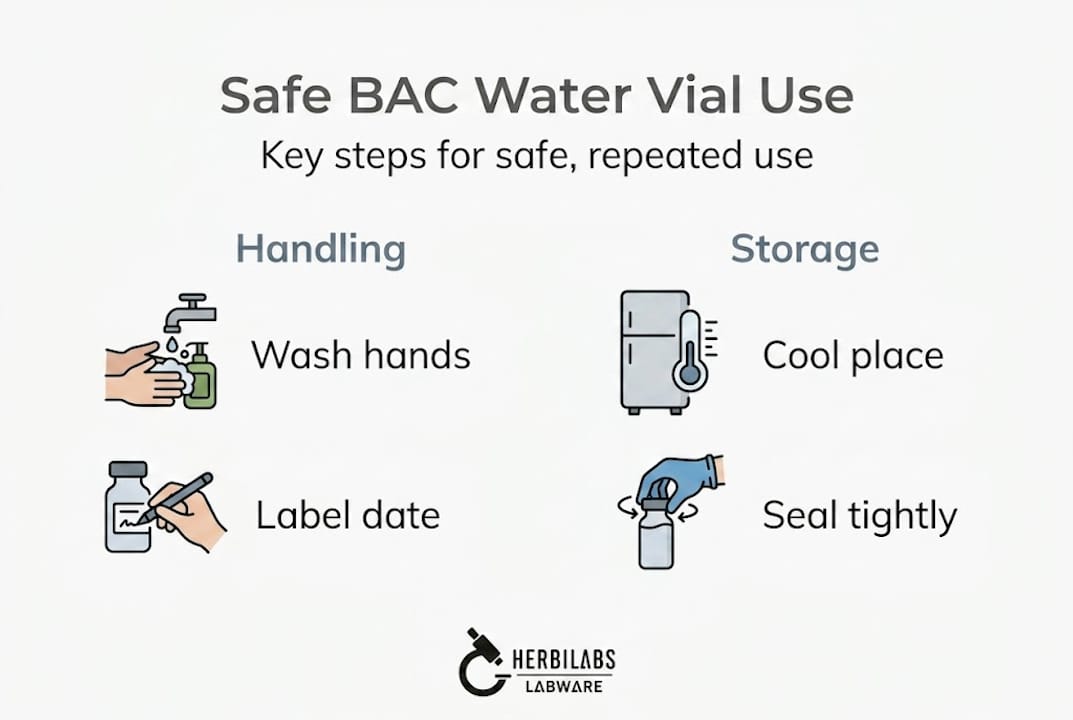
The short answer: there is no fixed maximum number of punctures. What governs safe reuse is time, not needle count. The 28-day BAC water rule is the governing principle here. Once you first puncture the stopper, you start a clock. Within those 28 days, you can draw from that vial as many times as needed, as long as you maintain aseptic technique every single time.
This is a major point that many guides gloss over. Researchers reuse BAC water vials multiple times per week without issue in professional settings, and so can you at home, provided you respect both the time window and the handling standards.
Here’s how this works in practical terms. A standard 10mL BAC water vial is one of the most common sizes used in peptide research. If your typical reconstitution protocol calls for 2mL per peptide vial, one BAC vial gives you:
| BAC vial size | Volume per reconstitution | Reconstitutions possible |
|---|---|---|
| 10mL | 1mL | Up to 10 |
| 10mL | 2mL | Up to 5 |
| 10mL | 2.5mL | Up to 4 |
| 30mL | 2mL | Up to 15 |
As the data shows, a single 10mL vial can cover 3 to 5 peptide reconstitutions at 2mL each, which makes it highly economical when managed correctly. The key is tracking your puncture date from day one.
Here’s the core decision-making sequence for every draw you take:
- Check the opening date written on the vial label. If it’s been 28 days or more, discard regardless of how much liquid remains.
- Inspect the solution visually. Hold it up to light. It should be completely clear and colorless. Any cloudiness, discoloration, or floating particles is an automatic discard.
- Verify your syringe and needle are fresh, sterile, and unopened. Never reuse needles or syringes between draws.
- Swab the stopper with a fresh 70% isopropyl alcohol wipe and allow it to dry completely before inserting the needle.
- Draw your required volume using smooth, controlled technique. Avoid touching the syringe plunger tip or needle shaft at any point.
Pro Tip: Write the date of first puncture directly on the vial label with a permanent marker the moment you open it. In a home setting especially, it’s easy to forget when a vial was first used, and even a day’s uncertainty can affect your safety calculations. A simple “Opened: DD/MM/YYYY” label takes five seconds and eliminates all guesswork.
Essential safety practices for reusing BAC water vials
Safe reuse is only possible when you follow strict handling and storage protocols. Technique is not just a box to check. It’s the active mechanism keeping your solution sterile between uses.
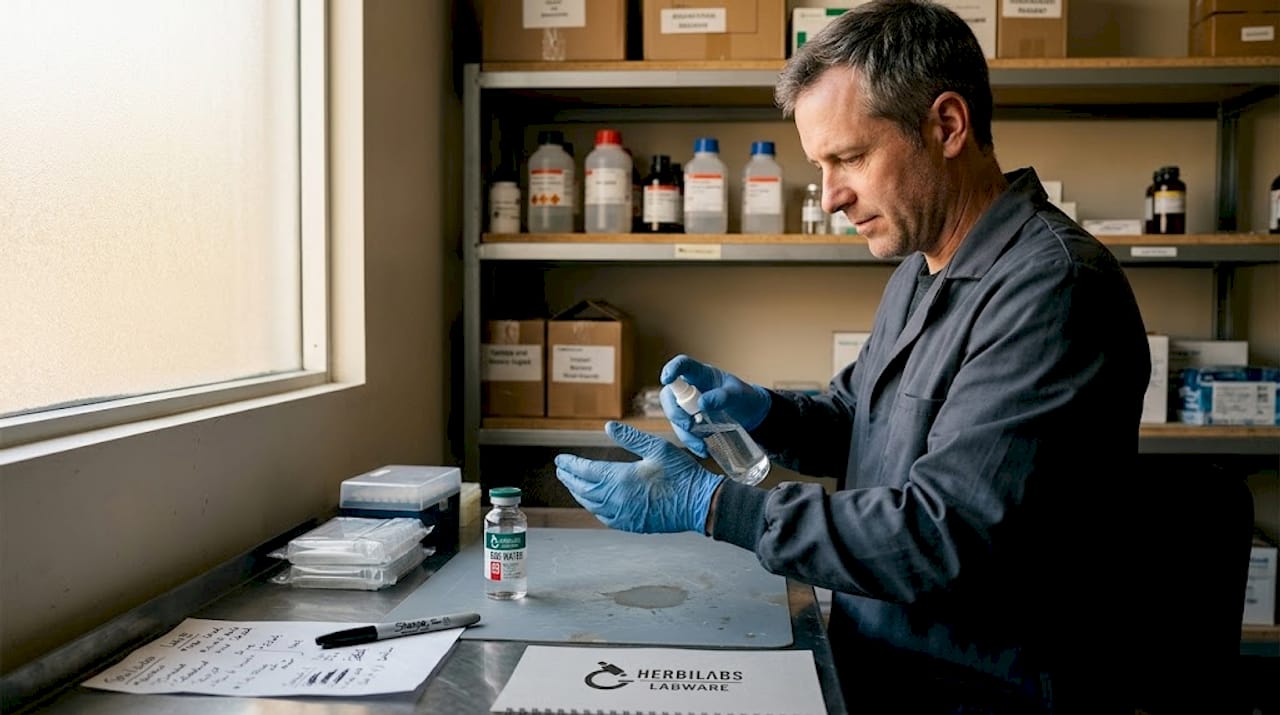
Aseptic handling and proper storage are the two pillars of safe BAC water reuse. Neither can substitute for the other. Great storage without aseptic technique still exposes the vial to contamination on every draw. Perfect technique with poor storage, such as leaving a vial in direct sunlight or at room temperature for extended periods, degrades the benzyl alcohol and reduces its preservative effectiveness over time.
Here’s what a non-negotiable checklist for every single use looks like:
- Fresh needle and syringe for every draw, no exceptions. Even rinsing a used syringe with alcohol is not sufficient. Sterility is binary in this context.
- 70% isopropyl alcohol swab on the rubber stopper before each puncture. Let it air-dry for 10 to 15 seconds before inserting the needle. Inserting while wet can push alcohol into the solution.
- Label the vial with the opening date immediately after first puncture. Include lot number if possible for traceability.
- Refrigerate at 2 to 8 degrees Celsius after opening unless the manufacturer’s instructions specify otherwise.
- Minimize the time the vial is outside of refrigeration. Draw your required volume, recap the vial, and return it promptly.
- Never leave a syringe inserted in the stopper between uses. Each puncture is its own isolated, aseptic event.
“Aseptic technique is not a suggestion. It’s the difference between a vial that remains safe for 28 days and one that becomes a contamination risk after the first draw.” Store it correctly, handle it correctly, and BAC water will perform exactly as designed.
It’s also worth noting that the BAC water safety tips for home users are not fundamentally different from those used in formal laboratory settings. The same principles apply. If anything, home environments require extra vigilance because they typically lack the controlled conditions of a dedicated lab, such as laminar flow hoods or dedicated clean areas. Setting up a consistent, clean workspace before any draw significantly reduces risk.
Recognizing contamination and when to discard your BAC water vial
No technique is foolproof. Understanding the signs of contamination means you can make a discard decision before a compromised vial causes harm to your research or, in a home setting, to yourself.
The starting point for contamination detection is always visual inspection. A contaminated vial should show visible changes in the solution that are distinguishable from its baseline appearance of clear, colorless liquid. Here’s what to look for and act on immediately:
- Cloudiness or turbidity: Any haziness in the solution that wasn’t there before is a strong indicator of microbial contamination. Bacterial colonies alter the optical clarity of the solution as they multiply.
- Discoloration: BAC water should be completely colorless. Yellow, brown, or any other tint signals degradation or contamination.
- Visible particles: Floating or settled particles, regardless of size, indicate contamination or particulate matter introduction from poor technique.
- Unusual odor: In a home setting, smelling the solution after drawing a small amount is a reasonable check. BAC water has a mild, faint odor from benzyl alcohol. A sharp, sour, or unusual smell can indicate bacterial activity.
- Compromised stopper: If the rubber stopper is cracked, cored (meaning pieces of rubber have been extracted by a blunt needle), or shows obvious physical damage, discard the vial regardless of visual solution appearance.
Beyond visual signs, there are circumstantial grounds for immediate discard:
- You accidentally touched the stopper with an ungloved hand or unsterile surface.
- You inserted a previously used needle.
- The vial was left uncapped, even briefly.
- The vial was dropped and the seal integrity is uncertain.
Do not rationalize these events. The cost of a new vial is trivial compared to the research cost of contamination or, more seriously, a safety incident. The 28-day limit applies even if the solution looks perfect at day 28. Benzyl alcohol’s bacteriostatic effect diminishes over time, and the conservative standard for safe use does not extend beyond that window under any circumstance.
Applying the guidelines: Example scenarios and decision framework
With all guidelines in place, here’s how to make confident, real-life decisions about BAC water reuse in practice.
Scenario 1: Peptide researcher conducting multiple reconstitutions
A researcher is working through five peptide vials over three weeks. They open a 10mL BAC water vial on day one, mark the date, and draw 2mL for the first peptide. On day 7, they draw another 2mL for a second peptide, following full aseptic protocol each time. By day 21, they’ve completed four reconstitutions. They inspect the vial before the fifth draw. The solution is clear, the stopper looks intact, and it has been properly refrigerated the entire time. The draw proceeds safely, and the vial is discarded on day 28 per protocol. This is exactly how single vials covering three to five reconstitutions are intended to work.
Scenario 2: Home user managing a research protocol
A home user opens a BAC water vial and writes the opening date immediately. They keep it in the back of a dedicated refrigerator shelf. Each time they need it, they take it out, inspect it, swab the stopper, draw with a fresh syringe, and return it within minutes. On day 22, they notice a faint cloudiness they hadn’t seen before. They discard it immediately, without hesitation, even though six days remain in the 28-day window.
Here’s a simple decision framework for every vial access event:
- Is the vial within 28 days of first puncture? If no, discard.
- Does the solution appear completely clear and colorless? If no, discard.
- Is the stopper intact with no physical damage? If no, discard.
- Was aseptic technique followed perfectly on this and all previous draws? If no, discard.
- Are you using a fresh, sterile syringe and needle? If no, do not proceed until you have one.
You can also reference BAC water lab protocols for more formalized standard operating procedure formats that slot directly into existing lab workflows.
What most guides miss about BAC water vial reuse
Most protocol documents give you the rules. What they rarely give you is the intuition that comes from repeated, careful practice.
Experienced researchers build what amounts to a pattern-recognition instinct for contamination risk. They notice when something feels off before it becomes visible. That sixth sense is built from a habit of detailed observation and, critically, from keeping written records of every vial manipulation. A simple log noting the date, volume drawn, and condition of the vial at each use catches patterns that memory alone would miss.
The uncomfortable truth is that overconfidence is the most common source of contamination in home and informal lab settings. Users who have successfully reused BAC water vials twenty times without incident tend to become less meticulous over time. They skip the stopper swab once. They reuse a needle “just this once.” The bacteriostatic properties of BAC water are robust, but they are not a substitute for discipline. Following BAC water safety expert tips consistently, on every single draw, is what actually keeps the 28-day window safe. Vigilance is not a one-time effort. It’s a protocol that has to hold every time.
Your trusted partner for safe BAC water and labware
If this guide has made one thing clear, it’s that quality matters at every level: the quality of your handling, your technique, and your starting material. A BAC water vial that doesn’t meet strict manufacturing and purity standards undermines every protocol step you follow correctly.
At Herbilabs Labware, we supply research-grade buy BAC water vials manufactured to strict purity standards, alongside thorough resources to support your work. Whether you’re a first-time reconstituter or running a multi-vial research protocol, our BAC water FAQ resource and complete BAC water guide give you the depth you need to work confidently. Explore our range and order securely, knowing you have expert-backed protocols and a reliable supply chain behind every vial.
Frequently asked questions
Can I use the same BAC water vial for multiple peptide vials?
Yes, one BAC water vial can reconstitute several peptides within a 28-day window if aseptic technique is strictly maintained on every draw. A standard 10mL vial covers 3 to 5 reconstitutions at 2mL each.
What is the maximum time a BAC water vial can be used after first opening?
Discard the vial at 28 days from first puncture, regardless of how much solution remains. The 28-day clock starts the moment the stopper is first pierced, not from the manufacturer’s production date.
What signs show that a BAC water vial is contaminated?
Cloudiness, discoloration, or visible particles are all immediate grounds for disposal. Any change in clarity or color means the vial should be discarded without exception.
Should BAC water be refrigerated after opening?
Refrigeration between 2 and 8 degrees Celsius is strongly recommended after opening if directed by the manufacturer. Aseptic handling and storage, including refrigeration, are both essential for maintaining safe use throughout the 28-day window.