Private Label, White Label, Wholesale partnerships available - EU, USA and UK - Free shipping from €75

Sterile Solution Storage Tips for Lab Researchers
Discover essential sterile solution storage tips to protect your research. Control temperature and ensure purity for optimal results!
TL;DR:
- Proper sterile solution storage requires strict environmental controls, aseptic access, and timely discard procedures to ensure product integrity. Continuous monitoring of temperature, humidity, and environmental conditions, combined with thorough record-keeping, reduces contamination risks and maintains experimental reproducibility. Investing in automated systems and adhering to SOPs minimizes invisible failures that compromise research outcomes.
Sterile solution storage is defined as the controlled preservation of solutions free from microbial, chemical, and particulate contamination across their entire storage period. For researchers working with bacteriostatic water, reconstituted peptides, and other sterile diluents, a single lapse in temperature control or aseptic technique can invalidate weeks of work. The protocols governing this practice, including USP <797> and Joint Commission standards, set specific thresholds for temperature, humidity, container integrity, and handling frequency. These sterile solution storage tips cover every variable that matters, from refrigerator settings to vial puncture limits, so your solutions stay exactly as pure as the day they were prepared.
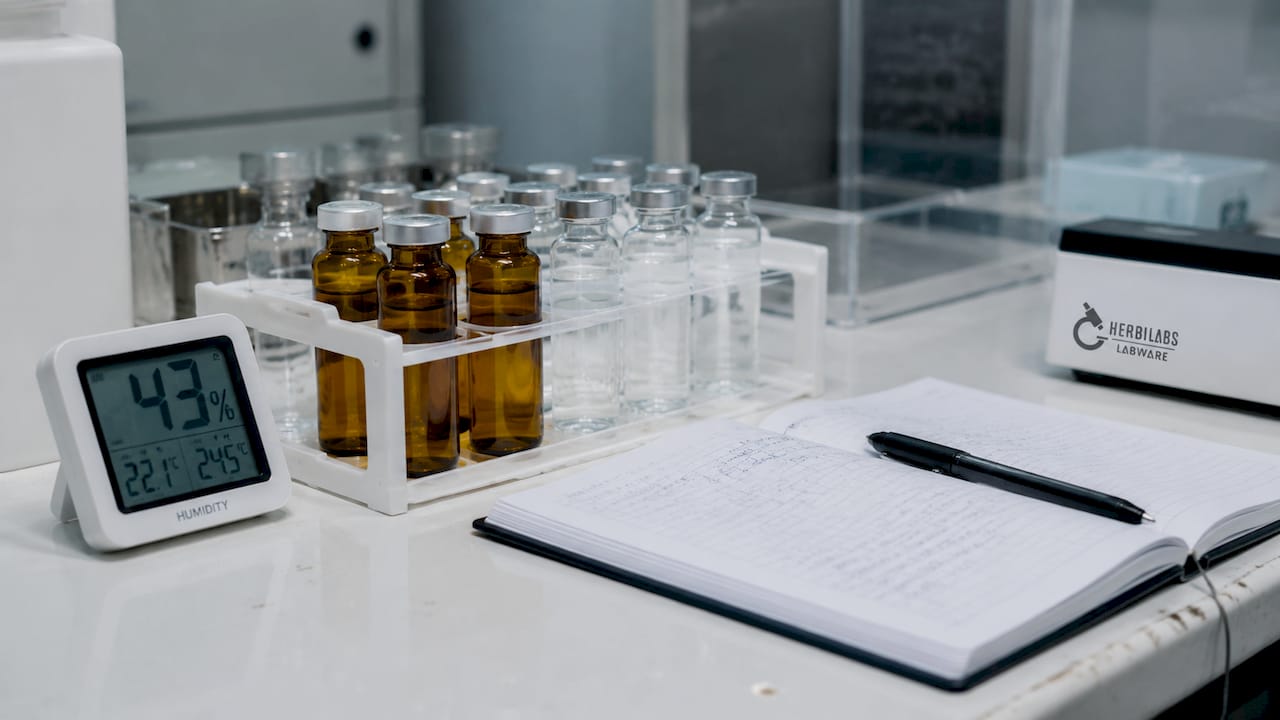
1. Control temperature as your first line of defense
Temperature is the single most controllable variable in sterile solution storage, and deviations cause both microbial proliferation and chemical degradation simultaneously. USP <797> requires sterile compounding areas to maintain temperatures at or below 20°C, while refrigerated solutions such as bacteriostatic water must be stored at 2 to 8°C. Exceeding these thresholds accelerates preservative breakdown and creates conditions where residual microorganisms can multiply. A calibrated pharmaceutical-grade refrigerator, not a standard lab fridge shared with food or reagents, is the correct tool for this job.
Refrigerators used for sterile solutions should have a validated temperature range, a built-in alarm for excursions, and a continuous data logger. Placing solutions on the door shelf exposes them to repeated temperature swings every time the door opens. Store vials on interior shelves, away from the cooling coil, where temperature is most stable.
2. Maintain humidity below 60% in all storage areas
Relative humidity above 60% promotes microbial growth on surfaces and accelerates label degradation, stopper swelling, and chemical instability in hygroscopic solutions. Joint Commission accreditation explicitly requires continuous temperature and humidity monitoring in sterile supply storage areas. This means a standalone hygrometer is not sufficient. You need a validated sensor connected to a logging system with alert thresholds.
Humidity control is particularly critical in storage rooms adjacent to sinks, autoclaves, or water baths, where ambient moisture is consistently elevated. Dehumidifiers or HVAC systems with humidity setpoints are standard solutions in compliant facilities. If your storage area lacks HVAC control, a pharmaceutical-grade dehumidifier with a continuous readout is a practical minimum.
Pro Tip: Place humidity sensors at bench height, not ceiling height. Moisture stratifies in rooms, and ceiling readings routinely underestimate the humidity level where your vials actually sit.
3. Prioritize air quality and particulate control
GMP storage compliance treats environmental factors as an integrated system, meaning air quality, particulate matter, vibration, and pest pressure all affect sterile product quality in parallel. Sterile solution storage areas should be clean, dust-free, and ideally maintained under positive pressure relative to adjacent corridors to prevent unfiltered air ingress. HEPA-filtered supply air is the standard in dedicated sterile storage rooms.
Avoid storing sterile solutions in open shelving near HVAC return vents, which pull particulates across exposed surfaces. Enclosed cabinets or laminar flow storage units provide a secondary barrier. Routine surface sampling, as required under USP <797> surface monitoring, confirms whether your air quality controls are actually working or just assumed to be working.
4. Apply strict aseptic technique at every access event
Sterile solution storage failures predominantly occur during container interface events such as stopper puncture or cap reconnection, not during passive storage. This means your environmental controls can be perfect, but a single lapse in aseptic technique at the moment of access will compromise the entire vial. Wipe every vial stopper with 70% isopropyl alcohol and allow it to dry completely before each puncture. Never blow on the stopper or touch it after disinfection.
Use a new sterile needle and syringe for every draw without exception. Reusing needles introduces both particulate contamination and mechanical stopper damage that creates pathways for microbial ingress. Limit punctures per vial to approximately 20 to prevent stopper coring, where small rubber fragments enter the solution. After each access, recap the vial immediately and return it to the correct storage temperature.
Pro Tip: Keep a dedicated puncture log taped to each multi-dose vial. A simple tally mark system takes three seconds and prevents the guesswork that leads to over-punctured stoppers being used in critical experiments.
5. Enforce the 28-day discard rule for opened vials
Multi-dose bacteriostatic water vials must be refrigerated at 2 to 8°C after first puncture and discarded within 28 days. This limit exists because preservative efficacy, typically benzyl alcohol in bacteriostatic water, declines over time even when the vial appears visually unchanged. Using a vial beyond 28 days from first puncture is not a minor protocol deviation. It is a direct contamination risk that invalidates any downstream result.
Storage SOPs must define discard timelines tied to the first puncture date, not the manufacturing expiry date. A vial with a two-year shelf life opened today must still be discarded in 28 days. Label every opened vial with the date and time of first puncture, the discard date, and the researcher’s initials. This labeling practice takes under 10 seconds and eliminates the most common source of expired vial use in busy labs.
6. Manage freeze-thaw cycles with documented limits
Freeze-thaw cycle limits differ sharply by solution type: small-molecule standards tolerate 3 to 5 cycles, while proteins tolerate only 1. Exceeding these limits causes irreversible aggregation, denaturation, and loss of biological activity that no visual inspection can detect. Reconstituted peptide solutions are particularly vulnerable, and a single unauthorized freeze-thaw event can render an entire batch analytically useless.
The correct mitigation is aliquoting. Divide reconstituted solutions into single-use volumes before freezing so that each thaw event consumes one aliquot rather than exposing the entire stock. Maintain a freeze-thaw log for every vial that records each cycle with date, time, and researcher name. This log is not bureaucratic overhead. It is the only way to enforce limits reliably across a multi-person lab.
For a detailed breakdown of safe reconstitution practices that complement these storage protocols, Herbilabs provides a focused guide covering solution selection and preparation.
7. Choose the right container for each solution type
Container selection directly determines whether a sterile solution maintains its chemical and biological integrity across its storage period. Borosilicate glass vials are the standard for inert, moisture-resistant storage of aqueous sterile solutions. They do not leach plasticizers, do not absorb proteins, and provide a reliable seal when fitted with bromobutyl or chlorobutyl stoppers. Plastic containers are acceptable for some buffers but are inappropriate for hygroscopic biologics or solutions sensitive to trace extractables.
Photosensitive solutions, including certain peptides and vitamin-based reagents, require amber glass vials or aluminum foil wrapping to prevent UV-induced degradation. Storing a light-sensitive solution in a clear vial inside a lit refrigerator is a common error that produces gradual potency loss with no visible indicator. The following table summarizes container selection by solution type:
| Solution type | Recommended container | Key reason |
|---|---|---|
| Aqueous sterile diluents | Borosilicate glass, clear | Inert, moisture-resistant |
| Photosensitive solutions | Amber borosilicate glass | UV protection |
| Reconstituted proteins | Borosilicate glass, single-use aliquots | Prevents freeze-thaw damage |
| Hygroscopic reagents | Sealed glass with desiccant | Moisture exclusion |
| Buffered solutions | Glass or Type I plastic | Chemical compatibility |
8. Organize storage to prevent physical damage and cross-contamination
Vial organization is a practical sterile solution handling tip that most protocols underemphasize. Vials stored loosely in a refrigerator drawer collide during door opening, which risks stopper damage, label loss, and cap loosening. Use labeled vial racks or trays that hold each vial upright and separated. Upright storage also prevents stopper contact with the solution, which can accelerate leaching from certain stopper formulations.
Segregate sterile solutions from non-sterile reagents, biological samples, and food in shared refrigerators. Cross-contamination from aerosols or spills in a mixed-use refrigerator is a documented source of solution compromise. If a dedicated sterile solution refrigerator is not available, assign a sealed, labeled bin within a shared unit and treat it as a controlled zone.
9. Implement automated monitoring and audit-ready documentation
Automated environmental monitoring systems provide audit-ready reports, real-time alerts, and continuous data logs that manual systems cannot replicate. Manual temperature checks create inspection gaps between readings, and a two-hour excursion at 3 a.m. will never appear in a paper log. Automated systems from validated vendors capture every deviation with a timestamp, which is the standard Joint Commission expects during accreditation review.
Documentation must cover vial receipt, first puncture date, each access event, freeze-thaw cycles, and final discard. A chain-of-custody style log for multi-dose vials protects both the researcher and the institution in the event of a contamination investigation. Define corrective action procedures in your SOP before an excursion occurs, not after. When an alarm triggers, the response sequence should be automatic, not improvised.
For a practical overview of aseptic handling workflows that integrate with these monitoring requirements, Herbilabs has published a step-by-step guide for laboratory teams.
10. Avoid the most common storage mistakes
The following errors account for the majority of sterile solution integrity failures in research labs:
- Storing vials near moisture sources such as sinks, autoclaves, or exposed pipes, where localized humidity exceeds safe thresholds
- Failing to label opened vials with first puncture date and discard date, leading to expired vial use
- Repeated freeze-thaw cycling of reconstituted solutions without aliquoting or documented limits
- Skipping stopper disinfection before access, particularly during high-throughput workflows where steps get compressed
- Ignoring temperature or humidity alarm events and resuming use without documented corrective action
- Pooling leftover solution volumes from multiple vials into a single container, which introduces cross-contamination risk
- Transferring solutions from original manufacturer vials into secondary containers without validating container compatibility
The most dangerous storage mistake is not a dramatic failure. It is the slow accumulation of small protocol shortcuts that individually seem harmless but collectively destroy solution integrity over weeks.
Reviewing your storage and handling practices against GMP-based environmental standards is a useful calibration exercise, particularly for labs that have grown rapidly and added personnel without updating SOPs.
Key takeaways
Sterile solution storage requires continuous environmental control, strict aseptic access technique, and documented discard timelines to maintain product integrity across the full storage period.
| Point | Details |
|---|---|
| Temperature control | Store refrigerated sterile solutions at 2 to 8°C in a validated, dedicated refrigerator with continuous logging. |
| Humidity threshold | Maintain relative humidity below 60% with validated sensors at bench height, not ceiling level. |
| Aseptic access | Disinfect stoppers with 70% isopropyl alcohol, use a new needle per draw, and log every puncture. |
| 28-day discard rule | Label first puncture date on every opened vial and discard within 28 days regardless of manufacturing expiry. |
| Freeze-thaw limits | Aliquot reconstituted solutions before freezing and document every cycle; proteins tolerate only one freeze-thaw event. |
What I’ve learned from watching storage protocols break down
The labs I’ve seen struggle most with sterile solution integrity are not the ones with bad equipment. They are the ones with good equipment and inconsistent people. A calibrated refrigerator with a continuous data logger means nothing if the researcher who opened a vial at 11 p.m. did not write down the puncture date because the label tape was across the room.
The real challenge in maintaining sterility during storage is that most failures are invisible until they matter. A vial that was over-punctured, stored at 9°C instead of 7°C for three days, and accessed without stopper disinfection will look identical to a perfectly stored vial. The contamination shows up in your assay results, or worse, it does not show up at all and you publish data built on a compromised solution.
My honest recommendation is to treat your storage SOP as a living document that gets reviewed every time a new person joins the lab, not once a year during an audit. The 28-day discard rule, the freeze-thaw log, the humidity sensor placement. These are not compliance theater. They are the difference between reproducible research and results you cannot explain.
Investing in automated monitoring is worth the cost even for small labs. The first time an automated alert catches a refrigerator compressor failure at 2 a.m. and saves a month of reconstituted samples, the system pays for itself. Manual logs do not catch what happens between checks.
— Ragnar
Store with confidence using Herbilabs research-grade solutions

Herbilabs supplies bacteriostatic water and sterile diluents manufactured to strict purity standards in a dedicated facility, giving researchers a reliable foundation for every reconstitution and storage workflow. Every product ships with documented quality controls, so you know exactly what you are storing before the first vial is opened. For researchers who need answers fast, the bacteriostatic water FAQs cover storage duration, puncture limits, and handling protocols in depth. If you are setting up or auditing your current storage setup, the Herbilabs guide on storing bacteriostatic water safely is a practical starting point built specifically for lab professionals.
FAQ
What temperature should sterile solutions be stored at?
Refrigerated sterile solutions, including bacteriostatic water, require storage at 2 to 8°C after opening. Room-temperature sterile solutions should be maintained between 20 and 25°C in a controlled, monitored environment per USP <797> guidelines.
How long can an opened multi-dose sterile vial be used?
Opened multi-dose vials must be discarded within 28 days of first puncture, regardless of the printed manufacturing expiry date. This limit reflects preservative efficacy decline and cumulative contamination risk from repeated access events.
How many times can you puncture a sterile vial stopper?
Approximately 20 punctures is the accepted practical limit before stopper coring risk becomes significant. Each puncture must use a new sterile needle, and the stopper must be disinfected with 70% isopropyl alcohol before every access.
Does humidity affect sterile solution storage?
Relative humidity above 60% promotes microbial growth on storage surfaces and can compromise stopper integrity and label adhesion. USP <797> and Joint Commission standards both require continuous humidity monitoring with documented corrective action for excursions.
How do you prevent freeze-thaw damage to reconstituted solutions?
Aliquot reconstituted solutions into single-use volumes before freezing to limit each thaw event to one aliquot. Proteins tolerate only one freeze-thaw cycle, so aliquoting is not optional for biological solutions. Document every cycle in a vial-level log.