Private Label, White Label, Wholesale partnerships available - EU, USA and UK - Free shipping from €75

Endotoxin Testing Explained: Methods, Standards, and Safety
Discover what is endotoxin testing, its importance, and methods used. Ensure product safety in pharmaceuticals and medical devices.
What is endotoxin testing and why does it matter?
Endotoxin testing is the detection and quantification of lipopolysaccharides (LPS) from the outer membrane of Gram-negative bacteria. These fragments are not living organisms. They are structural components that survive sterilization, resist heat, and remain biologically active long after the bacteria that produced them are dead.
That last point is what makes endotoxin testing distinct from sterility testing. A product can pass a sterility test, confirming no viable microbes are present, and still carry enough endotoxin to trigger a severe immune response. When LPS enters the bloodstream or spinal fluid, the immune reaction can range from fever and chills to septic shock. For parenteral drugs, implantable devices, and Water for Injection, that risk is not theoretical.
Three pharmacopeial and regulatory frameworks govern how manufacturers control this risk in the United States:
- USP <85> Bacterial Endotoxins Test sets the compendial methods, acceptance criteria, and assay validation requirements for drugs and biologics.
- EP 2.6.14 is the European Pharmacopoeia equivalent, harmonized with USP <85> for international submissions.
- ANSI/AAMI ST72 covers endotoxin test methodologies and routine monitoring specifically for medical devices.
Endotoxin testing sits inside the broader current Good Manufacturing Practice (cGMP) framework. Regulatory agencies treat a failed endotoxin test as a serious quality event, not a procedural footnote.
Primary endotoxin test methods used in the industry
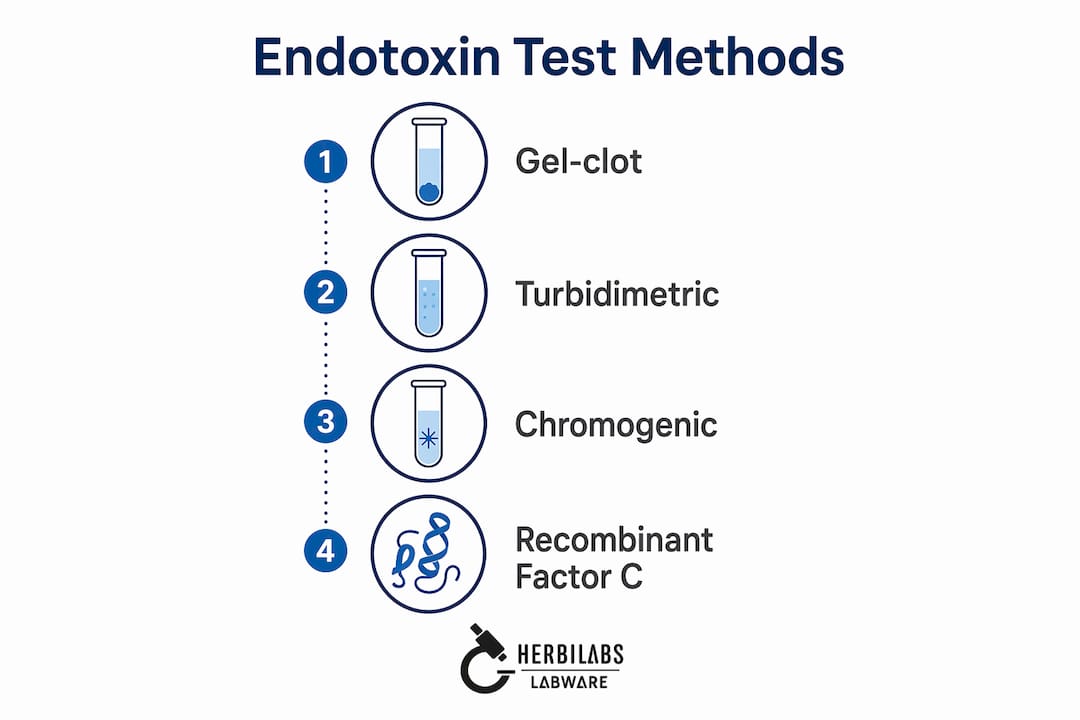
All three compendial methods recognized by USP <85> and EP 2.6.14 exploit the same biological reaction: endotoxin activates a clotting cascade in Limulus Amebocyte Lysate (LAL), a reagent derived from the blood of horseshoe crabs. What differs is how each method reads the result.
1. Gel-clot assay
The gel-clot method is the oldest and simplest. LAL reagent is mixed with the sample and incubated; if endotoxin is present above the lysate’s labeled sensitivity, a firm gel clot forms. The result is pass/fail, not a concentration. USP <85> designates the gel-clot as the final arbiter when results from different methods conflict, which reflects its status as the reference technique.
Advantages: low equipment cost, straightforward interpretation, no calibration curve required.
Limitations: qualitative only, labor-intensive at scale, poor throughput for high-volume labs.
2. Turbidimetric assay
The turbidimetric method measures how cloudy the reaction mixture becomes as the clotting cascade proceeds. Turbidity increases proportionally to endotoxin concentration, and a photometer tracks the change over time. This is a quantitative method, capable of reporting results in Endotoxin Units per milliliter (EU/mL).

Advantages: quantitative, amenable to automation, suitable for high-throughput water testing.
Limitations: colored or turbid samples can interfere with the optical reading.
3. Chromogenic assay
The chromogenic method uses a synthetic peptide-chromogen substrate. When endotoxin activates the LAL cascade, an enzyme cleaves the substrate and releases a yellow color. Absorbance is read at 405 nm and compared against a standard curve. Both endpoint and kinetic formats exist.
Advantages: highly sensitive, quantitative, widely used for parenteral drugs and biologics.
Limitations: sample color or matrix components can cause false readings; requires careful validation.
Kits like the Pierce Chromogenic Endotoxin Quant Kit and the Pierce Rapid Gel Clot Endotoxin Assay Kit bring these methods into a ready-to-use format for research labs, reducing setup time without departing from compendial principles.
4. Recombinant Factor C (rFC) assay
The rFC assay replaces horseshoe crab-derived LAL with a recombinant form of Factor C, the protein that LPS activates first in the clotting cascade. Products like ENDOZYME II GO use a fluorescent endpoint readout. In comparative studies, rFC showed better accuracy, repeatability, and resistance to matrix interference than conventional LAL-based kinetic assays, particularly in cleaning validation water samples. The method also delivers shorter time-to-results.

| Method | Format | Quantitative? | Key strength |
|---|---|---|---|
| Gel-clot | Pass/fail | No | Reference standard, low cost |
| Turbidimetric | Kinetic or endpoint | Yes | High throughput, automation-ready |
| Chromogenic | Kinetic or endpoint | Yes | High sensitivity, widely validated |
| rFC assay | Fluorescent endpoint | Yes | No horseshoe crab dependency, low interference |
Regulatory standards and acceptance criteria you need to know
The FDA’s guidance on pyrogen and endotoxin testing consolidates the agency’s current thinking on USP <85>, USP <161> for medical devices, and ANSI/AAMI ST72. Together, these documents define the permissible test methods, the validation requirements, and the endotoxin limits that manufacturers must meet before releasing product.
USP <85> specifies that spike recovery must fall within an approved range for a test to be considered valid. Many quality labs apply a tighter internal range to reduce the risk of false negatives and false positives, which regulatory reviewers increasingly expect to see documented.
Key regulatory requirements at a glance:
- Spike recovery: 50–200% per USP <85>; many laboratories apply a stricter internal range of 75–150% to enhance reliability.
- Maximum Valid Dilution (MVD): each product has a calculated MVD that limits how far you can dilute a sample to overcome interference while still detecting endotoxin at the specification limit.
- ANSI/AAMI ST72: applies specifically to medical devices, covering routine monitoring, batch release, and alternatives to batch testing.
- ISO 10993-11: addresses biological evaluation of medical devices, including endotoxin limits for systemic toxicity assessment.
- FDA enforcement: a failed BET or an unvalidated method can trigger a 483 observation or a warning letter; the agency treats endotoxin control as a cGMP obligation, not an optional quality check.
Acceptance criteria vary by product type. Parenteral drugs for non-intrathecal use carry a limit of 5 EU/kg/hour for most applications, while intrathecal products face a far stricter threshold. Medical devices have limits expressed per device surface area or per unit depending on the contact type defined in ANSI/AAMI ST72.
Which products require endotoxin testing?
The short answer: anything that contacts blood, cerebrospinal fluid, or compromised tissue. The product categories subject to endotoxin testing requirements include:
- Parenteral drugs and biologics: intravenous solutions, vaccines, blood products, and reconstitution diluents. Every batch must meet the endotoxin limit before release.
- Implantable medical devices: orthopedic implants, cardiac stents, and neurostimulators. Surface contact with tissue creates a direct route for endotoxin exposure.
- Blood-contacting devices: dialysis equipment, extracorporeal circuits, and infusion sets.
- Ophthalmic products: intraocular injectables and irrigating solutions, which contact highly sensitive tissue.
- Water for Injection (WFI) and purified water systems: WFI carries a limit of 0.25 EU/mL per USP standards; routine monitoring of water systems is a cGMP requirement. Understanding injectable water endotoxin limits is foundational for any pharmaceutical manufacturing site.
- Compounding materials and research reagents: any reagent used in the preparation of injectable formulations must be verified as endotoxin-free or tested at the final product stage.
The relationship between endotoxin testing and sterility testing is complementary, not redundant. Sterility testing confirms the absence of viable organisms; endotoxin testing confirms the absence of toxic bacterial residues. Both are required for a complete microbiological safety profile of injectable products.
Advanced quality control: rFC assays, bioburden testing, and emerging technology
Endotoxin testing and bioburden testing address different risks. Bioburden testing counts viable microorganisms on a product or surface before sterilization; endotoxin testing detects the toxic LPS fragments that persist after sterilization. Running both gives you a complete picture of microbial quality, and most device manufacturers are required to do exactly that.
The shift toward rFC assays is accelerating for two reasons: sustainability and performance. Horseshoe crab populations face pressure from LAL harvesting, and regulatory agencies in several markets have signaled openness to rFC as a compendial alternative. On the performance side, rFC assays show lower susceptibility to matrix interference, which matters when you are testing complex biological samples or cleaning validation rinse waters.
Microfluidic platforms represent the next step in throughput. These systems reduce manual pipetting steps by up to 89% and cut setup time to under 10 minutes, which addresses one of the oldest complaints about traditional BET: it is slow and operator-dependent. Automated platforms also improve reproducibility, a factor that matters when you are running thousands of water samples annually.
Pro Tip: Always use certified endotoxin-free consumables, including pipette tips, tubes, and glassware. Endotoxins adsorb strongly to plastics and glass surfaces, which can cause your assay to underestimate the true endotoxin load in a sample. Switching to depyrogenated glassware and low-binding plastics is one of the simplest ways to improve assay accuracy without changing your method.
How to prepare samples for endotoxin testing
Sample preparation is where most endotoxin testing failures originate. The goal is to present the sample to the LAL reagent in a form that neither inhibits nor enhances the reaction, while keeping the endotoxin concentration within the assay’s detection range.
The core steps follow a consistent logic regardless of which method you use:
- Use Water for BET as your diluent. This is water tested to contain less than 0.005 EU/mL. Using any other water introduces background endotoxin that corrupts your baseline.
- Calculate the Maximum Valid Dilution before you start. MVD is derived from the endotoxin limit for your product, the labeled lysate sensitivity, and the sample concentration. Diluting beyond the MVD invalidates the test.
- Adjust pH to 6.0–8.0. The LAL reaction requires this range. Acidic or alkaline samples must be neutralized with a buffer that does not itself introduce endotoxin.
- Run a spike recovery control with every sample set. Add a known quantity of reference endotoxin to a portion of your sample and confirm recovery falls within the validated range. This is your proof that the matrix is not interfering.
- Avoid vortexing aggressively. Endotoxin aggregates at high concentrations; aggressive mixing can break aggregates and artificially elevate readings, while insufficient mixing can leave them intact and suppress results.
For endotoxin-free solutions used as reconstitution diluents or research reagents, the same preparation discipline applies. Any reagent introduced into the test system is a potential endotoxin source.
How to interpret endotoxin test results and understand EU
Endotoxin concentration is expressed in Endotoxin Units per milliliter (EU/mL) or per unit of product (EU/device, EU/dose). One EU is defined by reference to the FDA’s Reference Standard Endotoxin (RSE), which is derived from Escherichia coli O113:H10. The unit is a biological activity measure, not a mass measure, which is why endotoxin potency can vary between preparations even at the same protein concentration.
For a gel-clot test, interpretation is binary: a firm gel that withstands inversion means the endotoxin concentration is at or above the lysate’s labeled sensitivity (λ). No gel means the concentration is below λ. To bracket a concentration, you run a dilution series and identify the highest dilution that still clots.
For quantitative methods (turbidimetric and chromogenic), results come from a standard curve built with serial dilutions of reference endotoxin. The curve typically spans at least three concentrations bracketing the expected sample range. Your sample result is valid only if the spike recovery falls within the accepted range and the standard curve meets the correlation coefficient requirement specified in your method validation.
A result above the specification limit means the batch fails release. A result that is technically valid but close to the limit warrants investigation into the contamination source before the next batch is run. Healthcare water systems, for example, require endotoxin risk assessment as part of routine monitoring programs, precisely because trending toward the limit is an early warning sign.
Where endotoxin contamination comes from and how to prevent it
Endotoxins are everywhere Gram-negative bacteria have been. The most common sources in a pharmaceutical or device manufacturing environment are:
- Raw water and process water: municipal water contains Gram-negative bacteria; without proper purification and monitoring, endotoxins accumulate in distribution loops.
- Raw materials and excipients: sugars, amino acids, and other fermentation-derived ingredients carry endotoxin loads that must be controlled at the supplier qualification stage.
- Labware and equipment surfaces: glass and plastic surfaces adsorb endotoxin; depyrogenation at 250°C for at least 30 minutes destroys endotoxin on heat-stable materials.
- Personnel and environment: skin flora includes Gram-negative organisms; open processing in non-classified environments is a direct contamination route.
- Cross-contamination from previous batches: endotoxin is not removed by standard cleaning agents; dedicated cleaning validation with endotoxin-specific rinse testing is required.
Prevention centers on controlling the bioburden of incoming materials and process water, using depyrogenated or certified endotoxin-free contact materials, and maintaining environmental controls that limit Gram-negative colonization of surfaces and equipment.
Limitations and challenges of endotoxin testing methods
No single endotoxin test method is perfect, and understanding the failure modes is as important as knowing the methods themselves.
Matrix interference is the most common problem. Samples containing proteins, lipids, detergents, or chelating agents can inhibit the LAL cascade, producing false negatives. Conversely, beta-glucans from fungal contamination can activate the cascade independently of endotoxin, producing false positives. The gel-clot and chromogenic methods are both susceptible; rFC assays are inherently resistant to beta-glucan interference because Factor C is specific to LPS.
Endotoxin masking occurs when endotoxin binds to proteins or lipids in the sample matrix and becomes unavailable to activate LAL. Dilution helps, but only up to the MVD. Some matrices require specialized extraction or treatment before testing.
Assay variability between lots of LAL reagent is real. Each lot must be confirmed for labeled sensitivity before use, and inter-lot variability means that a method validated with one lot requires reconfirmation when a new lot is introduced.
Endotoxin persistence after sterilization is a fundamental challenge. Autoclaving kills bacteria but does not destroy LPS. A contaminated surface that is subsequently sterilized still carries its endotoxin load, which is why sample dilution validation and endotoxin-specific cleaning procedures are distinct requirements from sterility assurance.
Finally, the LAL test detects endotoxins from Gram-negative bacteria but does not detect pyrogens from other sources, such as Gram-positive bacterial cell wall components or synthetic pyrogens. The Monocyte Activation Test (MAT) covers a broader pyrogen spectrum and is increasingly referenced in European regulatory guidance as a complement to BET.
Key Takeaways
Endotoxin testing is a mandatory quality control step for any product that contacts blood or spinal fluid, governed by USP <85>, EP 2.6.14, and ANSI/AAMI ST72, with spike recovery validated at 50–200% per pharmacopeial requirements; most quality labs aim for a stricter internal range of 75–150% for improved reliability.
| Point | Details |
|---|---|
| Three compendial methods | Gel-clot, turbidimetric, and chromogenic are all recognized under USP <85> and EP 2.6.14; gel-clot is the reference if results conflict. |
| rFC as a modern alternative | Recombinant Factor C assays offer lower matrix interference and no horseshoe crab dependency compared to LAL-based methods. |
| Spike recovery range | USP <85> requires 50–200% recovery; many labs apply a stricter range of 75–150% to improve reliability and meet regulatory expectations. |
| Products requiring testing | Parenteral drugs, implantable devices, blood-contacting equipment, ophthalmic injectables, and Water for Injection all carry mandatory endotoxin limits. |
| Contamination prevention | Depyrogenation at 250°C, certified endotoxin-free consumables, and validated cleaning procedures are the primary controls against endotoxin carryover. |