Private Label, White Label, Wholesale partnerships available - EU, USA and UK - Free shipping from €75

Why Endotoxin-Free Solutions Matter for Lab Research
Discover the significance of endotoxin-free solutions in lab research. Ensure accurate results and improve your experiments. Learn more today!
TL;DR:
- Endotoxin-free solutions contain LPS below active thresholds and are verified by specialized assays, not just sterility tests. Contamination activates inflammatory pathways, invalidating sensitive experiments and causing reproducibility issues in life sciences. Prevention with certified reagents and batch-level testing ensures reliable data and reduces the need for costly removal methods.
Endotoxin-free solutions are defined as preparations confirmed to contain lipopolysaccharide (LPS) below biologically active thresholds, typically verified by Limulus Amebocyte Lysate (LAL) or recombinant Factor C assays. The significance of endotoxin-free solutions extends far beyond simple cleanliness. Endotoxins, the heat-stable outer membrane fragments shed by Gram-negative bacteria, activate the Toll-like receptor 4 (TLR4) pathway at picogram concentrations, triggering inflammatory cascades that corrupt cytokine readouts, cell viability data, and gene expression profiles. For researchers running immune cell assays, protein therapeutics, or peptide reconstitution studies, a contaminated reagent does not just add noise. It invalidates the experiment entirely.
What is the significance of endotoxin-free solutions in research?
Endotoxin contamination is one of the most underestimated threats to experimental reproducibility in cell biology and immunology. High HPLC purity does not measure endotoxin content. A peptide or protein can read 99% pure by chromatographic analysis and still carry enough LPS to trigger a full inflammatory response in sensitive cell models.
The biological mechanism is the problem. TLR4 sits on the surface of macrophages, dendritic cells, and many primary cell lines. When LPS binds TLR4, it initiates NF-κB signaling and drives cytokine release, including TNF-α, IL-1β, and IL-6. This happens at concentrations so low that standard quality checks miss them entirely. Researchers who rely on sterility certificates alone are working with an incomplete picture of their reagent quality.
The importance of endotoxin-free products becomes clearest in three contexts: immune cell assays where cytokine output is the primary readout, in vivo peptide administration where systemic inflammation is a safety concern, and protein binding studies where LPS can alter protein conformation and receptor interactions. In each case, undetected endotoxin does not just add a variable. It creates a false signal that looks like real biology.
Endotoxin contamination is also a documented contributor to the reproducibility crisis in life sciences research. When different labs use reagents with different endotoxin burdens, their results diverge even when every other variable is controlled. Standardizing on certified endotoxin-free solutions is one of the most direct ways to close that gap.
How does endotoxin contamination enter the lab and affect results?
Contamination enters through more routes than most researchers expect. The most common sources are water used in buffer preparation, plastic consumables that have not been depyrogenated, recombinant proteins produced in E. coli expression systems, and environmental dust settling on open reagent containers. Each of these carries LPS that persists long after any bacterial cells are gone.
Sterility testing confirms the absence of live bacteria. Endotoxins remain biologically active after sterilization. These are two entirely separate quality parameters, and confusing them is the most common mistake in reagent quality assessment.
LPS survives autoclaving at 121°C without degradation. Dry heat above 250°C is required to destroy it. This means a glassware item that passes standard sterilization can still deliver a full endotoxin load into your next experiment. Researchers who assume “sterile equals clean” are operating on a false premise.
The downstream effects vary by cell type and assay design:
- Immune cell assays: Even sub-nanogram LPS levels produce false-positive cytokine signals, making it impossible to distinguish treatment effects from contamination artifacts.
- Primary cell cultures: Endotoxin alters proliferation rates, surface receptor expression, and apoptosis pathways in ways that mimic the very biology being studied.
- Protein binding and enzyme assays: LPS binds hydrophobically to many proteins, changing their conformation and producing artifactual shifts in binding affinity or catalytic rate.
- In vivo peptide studies: Cumulative LPS exposure across chronic dosing protocols drives systemic inflammation, confounding pharmacological readouts and raising safety concerns.
Batch-level endotoxin data is especially critical for chronic dosing or immune-responsive experiments, where cumulative inflammatory effects compound over time. A single contaminated lot can corrupt months of data before the source is identified.
What are the main endotoxin removal techniques and their trade-offs?
No single removal method works for every protein or reagent type. The choice depends on protein size, charge, hydrophobicity, and the endotoxin level that needs to be achieved.
| Method | Mechanism | Removal Efficiency | Key Trade-off |
|---|---|---|---|
| Polymyxin B affinity chromatography | Binds LPS lipid A domain | 90–99% per pass | Can bind basic proteins; reduces yield |
| Triton X-114 phase separation | Partitions LPS into detergent phase | ~1,000-fold per cycle | Protein loss; detergent sensitivity |
| Anion exchange chromatography | Exploits LPS negative charge | High for acidic proteins | Poor for negatively charged proteins |
| Multi-mode commercial kits | Combines ionic and hydrophobic binding | High with minimal protein loss | Cost; kit-specific compatibility |
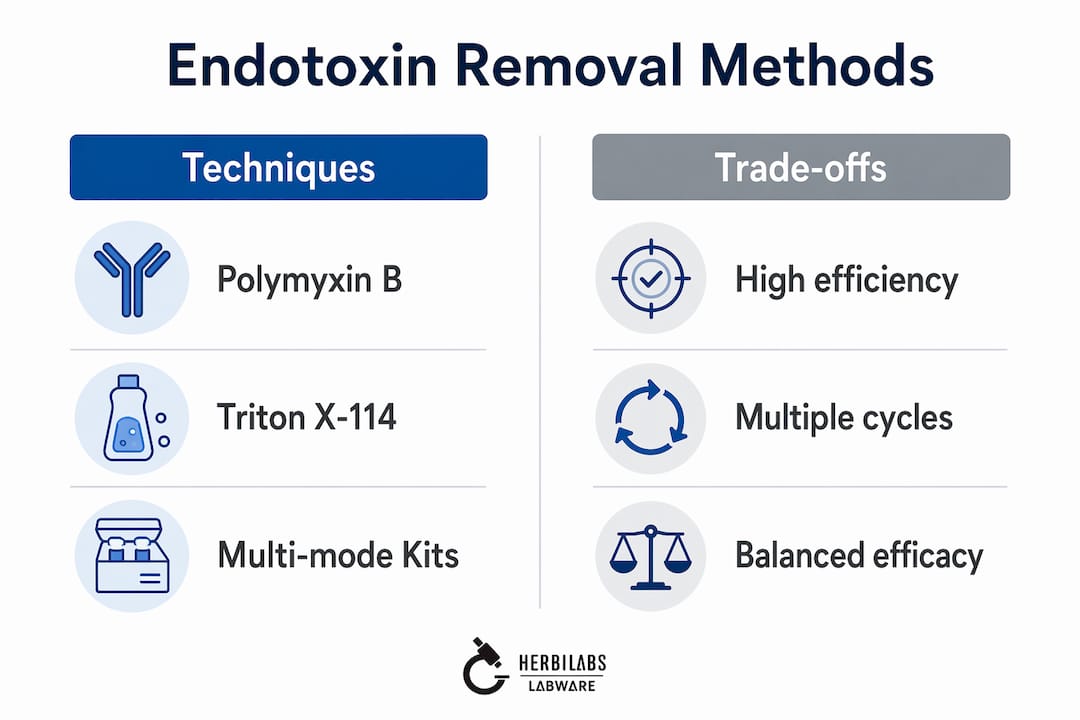
Polymyxin B affinity chromatography is the most widely used method for recombinant proteins. It achieves 90–99% endotoxin removal in a single pass. The limitation is that polymyxin B itself carries a positive charge, which means it can co-purify with basic proteins and reduce final yield.
Triton X-114 phase separation reduces endotoxin approximately 1,000-fold per cycle. Multiple rounds are needed to reach very low endotoxin levels, and some proteins denature in the process. It works well for small, stable proteins but is poorly suited to glycoproteins or anything sensitive to detergent exposure.
Advanced multi-mode removal kits combine ionic and hydrophobic binding modes in a single resin. They simplify workflows and maintain protein integrity better than single-mode methods. The trade-off is cost per preparation and the need to validate kit compatibility with each specific protein.
Pro Tip: Always run a protein activity assay after endotoxin removal, not just an endotoxin test. Removal methods can reduce biological activity even when protein concentration appears unchanged.
The balance between removal efficacy and protein integrity is the central challenge. Pushing for the lowest possible endotoxin level often means accepting some protein loss. Defining your target endotoxin threshold before choosing a method prevents over-processing and unnecessary yield reduction.
How do you prevent endotoxin contamination in the lab?
Prevention is more effective than removal, and significantly less expensive. Endotoxins adhere readily to lab surfaces and equipment, making post-contamination cleanup difficult and often incomplete. Building endotoxin control into standard operating procedures from the start is the correct approach.
- Source certified endotoxin-free reagents and water. Use water that carries a documented endotoxin specification, not just a sterility certificate. Certified endotoxin-free reagents reduce contamination more effectively than any downstream removal step.
- Depyrogenate all glassware. Dry heat at 250°C for 30 minutes destroys LPS on glass surfaces. Plastic consumables cannot be depyrogenated this way and must be sourced pre-certified.
- Maintain dedicated equipment. Pipettes, tubes, and containers used for endotoxin-sensitive work should not be shared with general lab use. Cross-contamination from shared equipment is a common and underappreciated source.
- Integrate endotoxin control into Quality by Design (QbD) frameworks. QbD-based endotoxin control builds prevention into process design rather than relying on end-point testing to catch failures.
- Verify every batch with a Certificate of Analysis (COA). A COA that includes batch-specific endotoxin data is a non-negotiable requirement for any reagent used in immune-responsive or parenteral research. Supplier-level endotoxin data is not sufficient. Batch-level data is.
Pro Tip: When evaluating a new reagent supplier, request the actual LAL assay result from the specific production lot, not a generic specification sheet. Generic specs describe what a product should contain. Batch data describes what it actually contains.
Cleanroom maintenance also matters. Endotoxin levels in ambient air and on bench surfaces vary significantly by environment. Researchers working in open lab settings with high foot traffic face higher baseline contamination risk than those using laminar flow hoods. Pairing water hygiene risk controls with dedicated endotoxin-free consumables addresses both environmental and reagent-level risk simultaneously.
How do you apply endotoxin-free standards in cell culture and therapeutic research?
Applying endotoxin control in practice requires knowing your threshold, choosing the right test, and interpreting results in biological context.
The regulatory ceiling for parenteral products is 5 EU/kg/hour for non-intrathecal administration. Cell culture models are often more sensitive than this regulatory limit suggests. Primary macrophages and dendritic cells respond to endotoxin levels well below 1 EU/mL, which means a reagent that passes regulatory thresholds can still confound a cell-based assay.
Endotoxin testing methods differ in sensitivity and applicability:
- LAL (Limulus Amebocyte Lysate) assay: The gold standard for endotoxin detection. Available in gel-clot, turbidimetric, and chromogenic formats. Highly sensitive but derived from horseshoe crab blood.
- Recombinant Factor C (rFC) assay: A synthetic alternative to LAL with equivalent sensitivity. Preferred when animal-derived reagents are a concern. Increasingly accepted by regulatory agencies.
- Kinetic turbidimetric LAL: Provides quantitative endotoxin data across a wide dynamic range. The preferred format for batch release testing in biopharmaceutical production.
Selecting the right test depends on the matrix. Colored or turbid samples interfere with optical LAL formats and require gel-clot or rFC methods instead. Tailoring endotoxin testing to the specific product and exposure route improves risk assessment accuracy and prevents both false negatives and unnecessary product rejection.
Integrating endotoxin management into reagent sourcing is the most practical step most labs can take immediately. Reviewing peptide research standards for batch-level endotoxin certification requirements gives researchers a concrete framework for supplier evaluation. Understanding the distinction between sterility and endotoxin-free status in lab products is the prerequisite for making that evaluation correctly.
Key Takeaways
Endotoxin-free solutions are a distinct quality category from sterile solutions, and treating them as equivalent is the single most common source of contamination-driven data failure in immunology and cell biology research.
| Point | Details |
|---|---|
| Sterility does not equal endotoxin-free | LPS survives autoclaving; dry heat above 250°C is required for destruction. |
| TLR4 activates at picogram levels | Trace contamination produces real inflammatory signals that corrupt assay readouts. |
| Removal has trade-offs | Polymyxin B and Triton X-114 methods reduce yield or risk protein denaturation. |
| Prevention outperforms remediation | Certified endotoxin-free reagents and QbD frameworks cost less than post-hoc removal. |
| Batch-level COA data is mandatory | Supplier-level specs do not replace lot-specific endotoxin test results for sensitive work. |
Why I think most labs underestimate the endotoxin problem
After years of working with researchers across immunology and peptide biology, the pattern I see most often is this: a lab invests heavily in experimental design, statistical power, and expensive instrumentation, then sources reagents based on price and HPLC purity alone. The endotoxin question gets asked only after results become inexplicably variable.
Researchers frequently equate high HPLC purity with endotoxin absence. This is a category error. Chromatographic purity measures chemical composition. Endotoxin is a biological contaminant that sits in an entirely different quality dimension. A 99% pure peptide with 10 EU/mg of LPS is not a high-quality research reagent. It is a source of false data.
The other misconception I encounter regularly is that endotoxin removal is a reliable safety net. It is not. Every removal method carries trade-offs in protein yield, activity, and compatibility. Prevention through certified sourcing is always the better investment. The cost of a batch-level COA with endotoxin data is trivial compared to the cost of repeating three months of cell culture experiments.
My practical advice: build endotoxin specification into your reagent purchasing criteria the same way you specify purity grade or storage temperature. Treat it as a non-negotiable column on your supplier evaluation form, not an afterthought. The labs that do this consistently produce more reproducible data and spend less time troubleshooting unexplained variability.
— Ragnar
Herbilabs endotoxin-free solutions for reliable research
Researchers who need verified purity at every stage of their workflow will find that Herbilabs manufactures its reconstitution solutions and bacteriostatic water to strict endotoxin control standards, with batch-level quality documentation available for every product. Each lot is produced in a dedicated facility designed to minimize LPS ingress from the start, not remediated after the fact.
Herbilabs supplies endotoxin-free water for injection specifically formulated for peptide reconstitution and sensitive biological research. For researchers evaluating reconstitution options, the lab-grade reagent advantages page details the quality standards applied across the full Herbilabs product range. Every product ships with documentation that supports your own QC process, not just a generic specification. Browse the full Herbilabs shop to find the right solution for your research requirements.
FAQ
What makes a solution endotoxin-free?
A solution is classified as endotoxin-free when its LPS content falls below a defined biological threshold, confirmed by LAL or recombinant Factor C assay. The threshold varies by application, with parenteral products regulated at 5 EU/kg/hour.
Why does sterile water still need endotoxin testing?
Sterilization kills bacteria but does not destroy LPS, which is heat-stable and survives autoclaving at 121°C. Sterility and endotoxin-free status are two separate quality parameters that require separate verification.
Which endotoxin removal method is most effective?
Polymyxin B affinity chromatography removes 90–99% of endotoxin per pass and is the most widely used method for recombinant proteins. Multi-mode commercial kits offer comparable efficiency with better protein yield preservation for sensitive proteins.
How low must endotoxin levels be for cell culture work?
Regulatory limits for parenteral products set a ceiling of 5 EU/kg/hour, but primary immune cells such as macrophages respond to concentrations well below 1 EU/mL. Cell culture thresholds must be determined based on the specific cell type and assay sensitivity.
Can HPLC purity data confirm a product is endotoxin-free?
HPLC purity measures chemical composition and does not detect endotoxin. Batch-specific LAL or rFC assay data is required to confirm endotoxin-free status, regardless of how high the chromatographic purity reads.