Private Label, White Label, Wholesale partnerships available - EU, USA and UK - Free shipping from €75

Why High-Quality Solvents Matter for Research Results
Discover why high-quality solvents matter for research results. Ensure accuracy and reliability in your experiments with the right solvent choice.
TL;DR:
- High-quality solvents with validated purity profiles are essential for accurate, reproducible scientific research.
- Researchers should review impurity profiles and batch consistency, not just purity percentages, to avoid data corruption and equipment damage.
High-quality solvents are chemical compounds with verified purity profiles and minimal impurities that directly determine the accuracy, reproducibility, and safety of scientific research. Solvent purity grade, the recognized industry term for this concept, classifies solvents by their intended application, from technical grade to LC-MS grade. Understanding why high-quality solvents matter is not optional for researchers in chemistry, biology, or pharmaceuticals. A solvent that looks adequate on paper can silently corrupt your data, damage your instruments, or invalidate months of work. The difference between a successful experiment and a failed one often comes down to what is dissolved in your reaction vessel before you add a single compound.
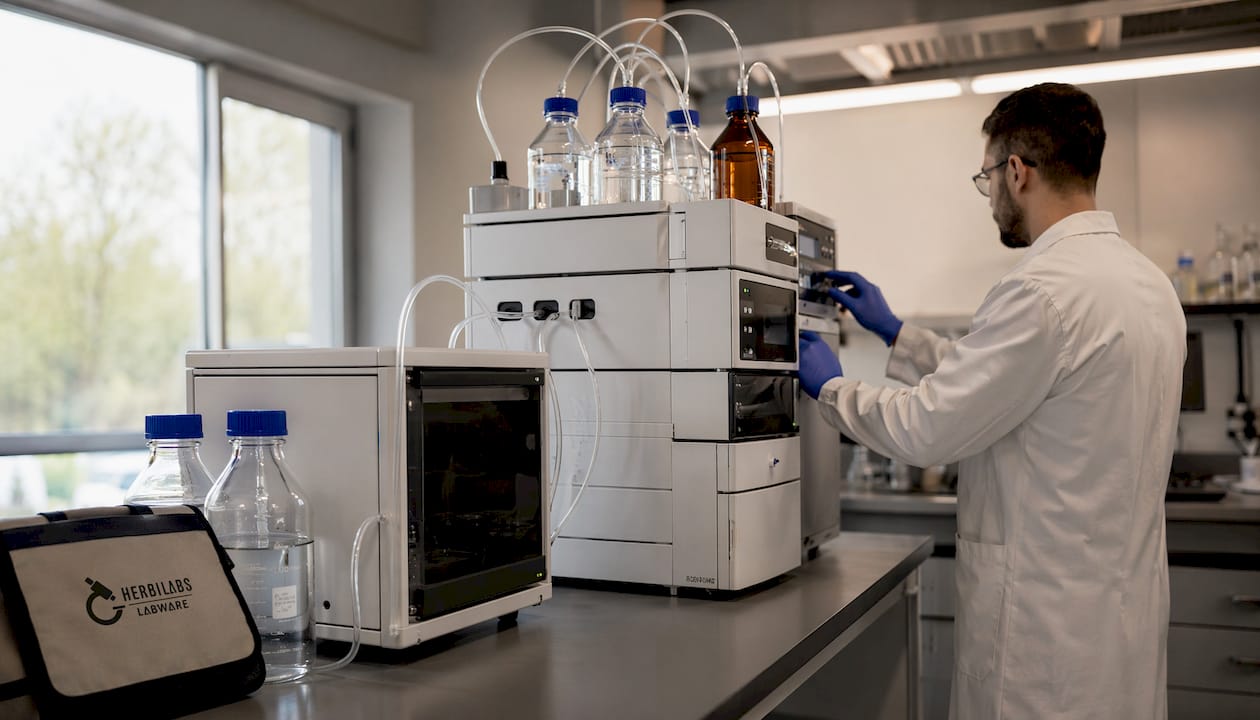
Why high-quality solvents matter for research accuracy
Solvent purity grade is the single most misunderstood variable in laboratory procurement. Researchers frequently assume that a 99.5% purity label guarantees consistent performance. It does not. Solvents with identical purity percentages can perform very differently due to variations in contaminants like moisture, stabilizers, and residue. That remaining 0.5% is where your experiment lives or dies.
The nature of trace impurities matters far more than their quantity. A solvent containing residual water behaves differently in anhydrous reactions than one containing trace metals or plasticizers. In chromatography, these contaminants produce ghost peaks, shift retention times, and corrupt quantitative results. In synthesis, they can catalyze unwanted side reactions or inhibit the target reaction entirely.
The effects are especially pronounced in LC-MS analysis. High-purity LC-MS grade solvents undergo extra purification steps to reduce trace metals and impurities critical for sensitive analyses. Using insufficiently pure solvents in this context produces adduct ions, baseline drift, and reduced sensitivity. That means false positives, missed analytes, and data you cannot publish or defend.
Impurity profiling goes beyond a simple purity percentage. Researchers should examine the Certificate of Analysis (CoA) for each solvent lot. The CoA reveals the actual impurity profile, including water content, non-volatile residue, and specific contaminants that a purity number alone never discloses. Batch-to-batch variation is real, and the CoA is your only reliable window into it.
- Ghost peaks in HPLC: Non-volatile residues from low-grade solvents accumulate in the mobile phase and appear as spurious signals.
- Retention time drift: Trace stabilizers alter the polarity of the mobile phase, shifting analyte elution.
- Reaction inhibition: Trace metals in solvents quench catalysts in palladium-catalyzed cross-coupling reactions.
- Spectroscopic interference: UV-absorbing impurities raise baseline absorbance in UV-Vis and HPLC-UV methods.
- Peptide degradation: In peptide research, oxidizing impurities attack methionine and cysteine residues, compromising sample integrity.
Pro Tip: Always request the CoA for each new solvent lot and compare water content and non-volatile residue values against your method’s tolerance limits before use.
How solvent impurities damage equipment and raise costs
Low-grade solvents do not just corrupt data. They physically degrade the instruments that generate it. Non-volatile residues accumulate in HPLC lines and pumps, leading to ghost peaks and costly downtime. A blocked pump seal or a fouled column costs far more to replace than the price difference between solvent grades.
The damage follows a predictable pattern. Residues deposit on pump pistons and check valves, increasing back pressure and causing erratic flow rates. Columns accumulate particulates that compress the bed and reduce efficiency. Ion sources in mass spectrometers become contaminated with involatile salts, requiring frequent cleaning and recalibration. Each of these failures translates directly into lost research time and unplanned maintenance expenditure.
Proper solvent handling reduces these risks significantly. Filtering solvents before use prevents system blockages and ghost peaks, even when using high-purity grades. Storage conditions also matter. Solvents stored in inadequate containers or exposed to light and heat degrade faster, introducing new impurities that were absent at the point of manufacture. Herbilabs addresses this directly through its sterile solution storage guidance for lab researchers.
The operational cost argument for premium solvents is straightforward:
- Reduced column replacement frequency. High-purity mobile phases extend column lifetime by preventing particulate fouling and chemical degradation of the stationary phase.
- Fewer instrument service calls. Clean solvents reduce pump seal wear and ion source contamination, cutting scheduled and unscheduled maintenance.
- Lower reanalysis rates. Consistent solvent quality produces reproducible results, eliminating the need to repeat runs due to unexplained variability.
- Shorter troubleshooting cycles. When a method fails, solvent quality is eliminated as a variable immediately, focusing diagnostic effort where it belongs.
Pro Tip: Implement a solvent filtration step using a 0.2-micron membrane filter before loading any solvent into an HPLC or LC-MS system, regardless of its stated purity grade.
Key solvent quality parameters beyond purity
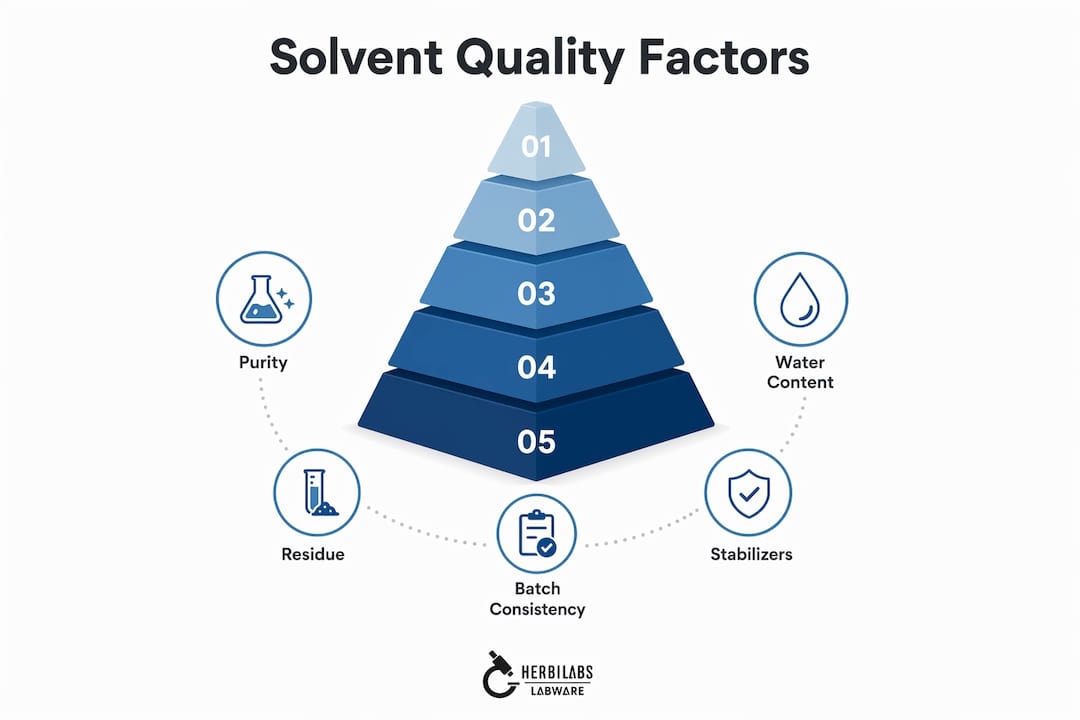
Purity percentage is a starting point, not a specification. Researchers selecting solvents for demanding applications need to evaluate a set of parameters that the purity number never captures. Understanding these parameters is the practical core of choosing the right solvents for your work.
Water content variation among solvents affects reaction stability, drying time, and coating defects even when purity appears identical. Moisture differences influence evaporation rates and film formation in industrial uses, and the same principle applies in pharmaceutical synthesis and analytical chemistry. A solvent labeled anhydrous must be verified by Karl Fischer titration, not assumed from the label.
The table below summarizes the key parameters researchers should evaluate when procuring solvents for specific applications.
| Parameter | What it measures | Why it matters |
|---|---|---|
| Water content (ppm) | Residual moisture by Karl Fischer titration | Critical for anhydrous reactions and moisture-sensitive analytes |
| Non-volatile residue (NVR) | Mass of residue after evaporation | Directly causes ghost peaks and instrument fouling in chromatography |
| UV cutoff (nm) | Lowest wavelength with acceptable transmittance | Determines compatibility with UV detection methods |
| Stabilizer content | Type and concentration of added inhibitors | Stabilizers like BHT interfere with mass spectrometry and some reactions |
| Batch consistency | Lot-to-lot variation in key parameters | Reproducibility across experiments depends on consistent solvent composition |
Stabilizers deserve particular attention. Solvents like tetrahydrofuran (THF) and diethyl ether are routinely stabilized with butylated hydroxytoluene (BHT) to prevent peroxide formation. BHT is a potent mass spectrometry interferent and a known UV absorber. Researchers running LC-MS or HPLC-UV methods must use stabilizer-free grades, not simply high-purity grades. The distinction is not always obvious from catalog descriptions, which is why matching solvent grade to assay requirements avoids unnecessary costs and potential reaction interference.
Batch consistency is the parameter most frequently ignored during procurement. A solvent that performs perfectly in method development can produce inconsistent results in routine analysis if the supplier changes manufacturing processes between lots. Requesting batch-specific CoAs and archiving them against your analytical records is the only reliable way to trace variability back to its source.
Common misconceptions about solvent interchangeability
The most expensive assumption in laboratory procurement is that solvents with the same purity specification are interchangeable. Procurement based solely on purity percentage risks hidden costs like supplier switching friction, process adjustment, and product rework. Two solvents with identical specifications can perform differently across production cycles and climates. This is not a theoretical risk. It is a documented operational failure mode.
The misconceptions that drive poor solvent decisions include:
- “Same purity means same performance.” Purity percentage describes the major component. It says nothing about which impurities are present, at what concentrations, or how they interact with your specific chemistry.
- “Switching suppliers saves money.” Switching from high-quality to lower-grade solvents caused analytical issues such as baseline drift and inconsistent retention times, leading to costly reanalysis. The savings on solvent purchase price are routinely consumed by reanalysis costs and lost instrument time.
- “Technical grade is fine for preparative work.” Technical grade solvents contain higher levels of residual metals and organic impurities that affect yield and product purity in synthesis, even when the product is not intended for analytical use.
- “Higher purity is always better.” Matching solvent grade to application need avoids paying for unnecessary purification. Using LC-MS grade solvents for routine extraction work is wasteful. The goal is fit-for-purpose selection, not maximum purity at all times.
The hidden cost calculation for lower-grade solvents must include reanalysis time, instrument downtime, column replacement, and the cost of invalidated batches. Researchers who have switched back to premium grades after a cost-cutting exercise consistently report that the total cost of ownership favors the higher-grade product. For researchers working on peptide purity verification, purity testing alone is not sufficient to guarantee reliable results. Solvent quality is an equally critical variable in that equation.
The practical solution is to select solvents by application category, not by price tier. Define the minimum acceptable specification for each method, document it in your standard operating procedure, and enforce it during procurement. That discipline eliminates the false economy of solvent substitution.
Key Takeaways
Solvent purity grade, impurity profile, and batch consistency collectively determine whether your research produces valid, reproducible data or costly failures.
| Point | Details |
|---|---|
| Purity percentage is insufficient | Always review the full CoA, including water content, NVR, and stabilizer type, before use. |
| Impurities damage instruments | Non-volatile residues foul HPLC pumps and columns, increasing maintenance costs and downtime. |
| Grade must match application | LC-MS grade is required for mass spectrometry; technical grade introduces interferents that corrupt sensitive analyses. |
| Batch consistency drives reproducibility | Request lot-specific CoAs and archive them to trace analytical variability to its source. |
| Lower-grade solvents cost more overall | Reanalysis, instrument repair, and lost time routinely exceed the purchase price savings from cheaper solvents. |
Solvent quality is a workflow decision, not a purchasing one
I have reviewed procurement decisions across research environments where solvent grade was treated as a cost variable rather than a scientific variable. The pattern is consistent. Labs that cut solvent budgets spend the savings twice over in troubleshooting, reanalysis, and instrument repair. The researchers who understand this earliest are usually the ones who have experienced a catastrophic method failure traced back to a solvent lot change.
The deeper issue is that solvent selection rarely appears in method development documentation with the rigor it deserves. Researchers specify column chemistry, mobile phase composition, and gradient conditions in exhaustive detail, then list the solvent supplier as “any HPLC grade.” That gap is where reproducibility problems enter. A robust solvent strategy that includes auditing, standardizing, and training improves lab productivity and safety while reducing waste. That is not a procurement recommendation. It is a scientific one.
My practical advice is to treat solvent selection as part of method validation, not as a separate purchasing decision. Document the specific grade, supplier, and lot number used during validation. Require that any substitution triggers a partial revalidation. That single policy change eliminates most of the solvent-related variability I have seen derail otherwise well-designed studies. The advantages of research-grade solutions are not abstract. They show up in your data quality on every run.
— Ragnar
Herbilabs: research-grade solvents and reagents for demanding science
Researchers who need consistent, contaminant-free solvents and reconstitution solutions for peptide research and analytical work can find them at Herbilabs. The Herbilabs product range is manufactured to strict purity standards in a dedicated facility, with rigorous quality control at every production stage.
Herbilabs supplies research-grade reagents and sterile reconstitution solutions to research institutions, universities, and independent researchers across the UK and Europe. Every product ships with full documentation to support your quality records. For researchers working with peptides and injectable solutions, the Herbilabs shop offers bacteriostatic water, sterile diluents, and reconstitution solutions built for the precision your work demands. Wholesale pricing is available for resellers and institutional buyers.
FAQ
What does solvent purity grade mean?
Solvent purity grade classifies a solvent by its intended application and the maximum allowable levels of specific impurities. Common grades include technical, reagent, HPLC, and LC-MS, each with progressively stricter impurity limits.
Why do two solvents with the same purity percentage perform differently?
The purity percentage describes only the major component. The remaining fraction contains different impurities depending on the manufacturer and production process, and those impurities directly affect reaction outcomes and analytical results.
How does solvent quality affect HPLC and LC-MS results?
Non-volatile residues and trace metals in low-grade solvents cause ghost peaks, baseline drift, adduct ion formation, and reduced detector sensitivity. These effects compromise data integrity and force costly reanalysis.
What parameters should I check beyond purity when selecting a solvent?
Evaluate water content, non-volatile residue, UV cutoff, stabilizer type and concentration, and batch-to-batch consistency. Each parameter affects specific applications in ways the purity number does not capture.
Is it safe to switch solvent suppliers between experiments?
Switching suppliers mid-study introduces uncontrolled variables. If a supplier change is unavoidable, request the new lot’s CoA, compare it against the original, and run a parallel analysis to confirm method equivalence before proceeding.