Private Label, White Label, Wholesale partnerships available - EU, USA and UK - Free shipping from €75

Why Independent Researchers Need Pure Reagents
Learn why independent researchers need pure reagents. Discover how reagent purity affects reproducible results and your research credibility.
TL;DR:
- Pure reagents are essential for reliable, reproducible scientific results, especially for independent researchers lacking internal quality control. Verifiable, batch-specific Certificates of Analysis ensure reagent purity and help prevent experimental errors caused by contaminants and lot variability. Proper sourcing and storage of high-quality reagents maintain their integrity and ensure credible, publishable data.
Pure reagents are the foundation of credible, reproducible scientific research. Without verified purity, every data point you generate carries an unknown variable. Independent researchers face a sharper version of this problem than institutional labs do. You typically lack in-house quality control infrastructure, which means the purity documentation your supplier provides is your only line of defense. Understanding why independent researchers need pure reagents is not an abstract concern. It is the difference between results you can publish and results you cannot explain.
Why independent researchers need pure reagents for valid results
Reagent purity is defined as the degree to which a chemical substance is free from contaminants that could alter experimental outcomes. In practice, even trace impurities can confound sensitive assays. A peptide with an incorrect sequence, endotoxin contamination in a cell-based experiment, or a buffer with residual heavy metals can each produce false signals that look like real biology.
Reagent variability is now recognized as a leading cause of irreproducible biomedical research. That finding matters because reproducibility is the minimum standard for publishable science. If your reagent batch changes between experiments, your results change with it, even when your protocol stays identical.
The impact of reagent quality extends beyond individual experiments. Journals and institutional review boards increasingly require documented provenance for all research materials. Without it, your findings face rejection or retraction regardless of how sound your methodology is.
Independent researchers working outside institutional frameworks carry this burden alone. You cannot rely on a central procurement team to vet suppliers. The responsibility for reagent quality sits entirely with you.
Key ways impure reagents distort results:
- False positives: Contaminants trigger responses that mimic the effect you are testing for.
- False negatives: Inhibitory impurities suppress real signals, making active compounds appear inactive.
- Batch drift: Inconsistent purity across lots makes longitudinal studies unreliable.
- Calibration failure: Impure reference standards produce inaccurate concentration calculations.
- Wasted resources: Low-quality reagents force repeated assay failures, consuming time and budget that independent researchers cannot afford to lose.
What does a Certificate of Analysis actually tell you?
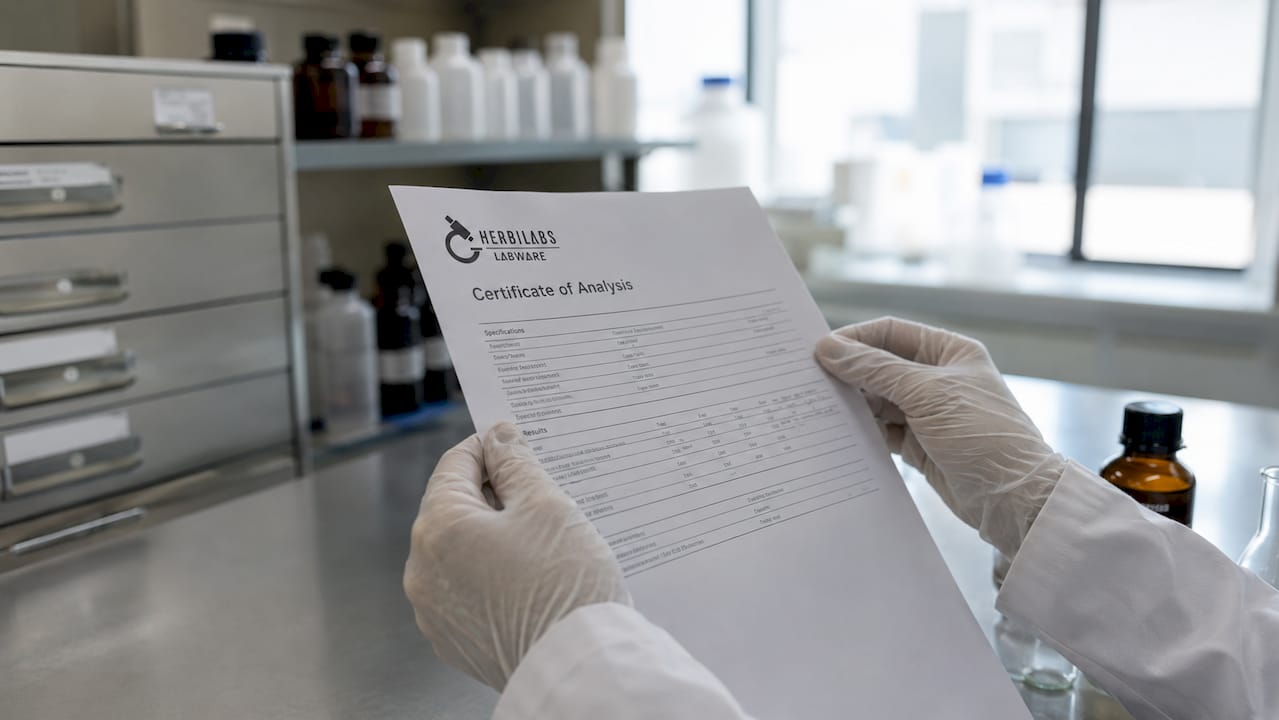
A Certificate of Analysis, or COA, is a document issued by a manufacturer or testing laboratory that records the purity, composition, and contaminant profile of a specific reagent batch. The key word is “batch-specific.” A COA that covers a product line rather than an individual lot number tells you almost nothing useful.
A trustworthy COA contains the following:
- Lot or batch number that matches the product you received.
- Purity percentage measured by a validated analytical method such as HPLC or mass spectrometry.
- Contaminant limits for substances relevant to your assay type, including endotoxins, residual solvents, and heavy metals.
- Testing laboratory identity, including whether testing was performed internally or by an external lab.
- Test date and expiry, confirming the data is current and not recycled from a previous production run.
The problem is that many vendor COAs are neither batch-specific nor independently verified. A supplier’s internal QC team has a financial interest in passing product. External verification removes that conflict. The gold standard is a COA from a laboratory accredited to ISO 17025, the international standard for testing and calibration laboratory competence. ISO 17025 accreditation means the testing methods, equipment, and personnel meet independently audited requirements.
Journals and IRBs now treat verifiable batch-specific COAs as a publication prerequisite. Failure to provide one can result in a paper retraction or an outright rejection at submission. For independent researchers, that outcome is catastrophic.
Pro Tip: When you receive a COA, cross-reference the lot number on the document against the lot number printed on the product label before you open the vial. A mismatch is an immediate red flag.
How to choose the right purity grade for your research
Not every experiment requires the highest available purity grade. Choosing the wrong grade in either direction wastes money or invalidates data. The table below maps common reagent grades to their appropriate applications.
| Grade | Purity standard | Typical applications | Key limitation |
|---|---|---|---|
| Research grade | Highest purity, batch-specific COA, third-party tested | Sensitive cell-based assays, quantitative analysis, publication-grade work | Higher cost per unit |
| Reagent grade | Tight impurity limits, batch documentation required | Calibration, analytical chemistry, most biomedical protocols | Not suitable for ultra-trace work without verification |
| Lab grade | General purity, minimal documentation | Non-critical preparatory tasks, equipment cleaning, buffer preparation | Not suitable for quantitative or sensitive assays |
| Technical grade | Lowest purity, no formal documentation | Industrial processes only | Never appropriate for research |
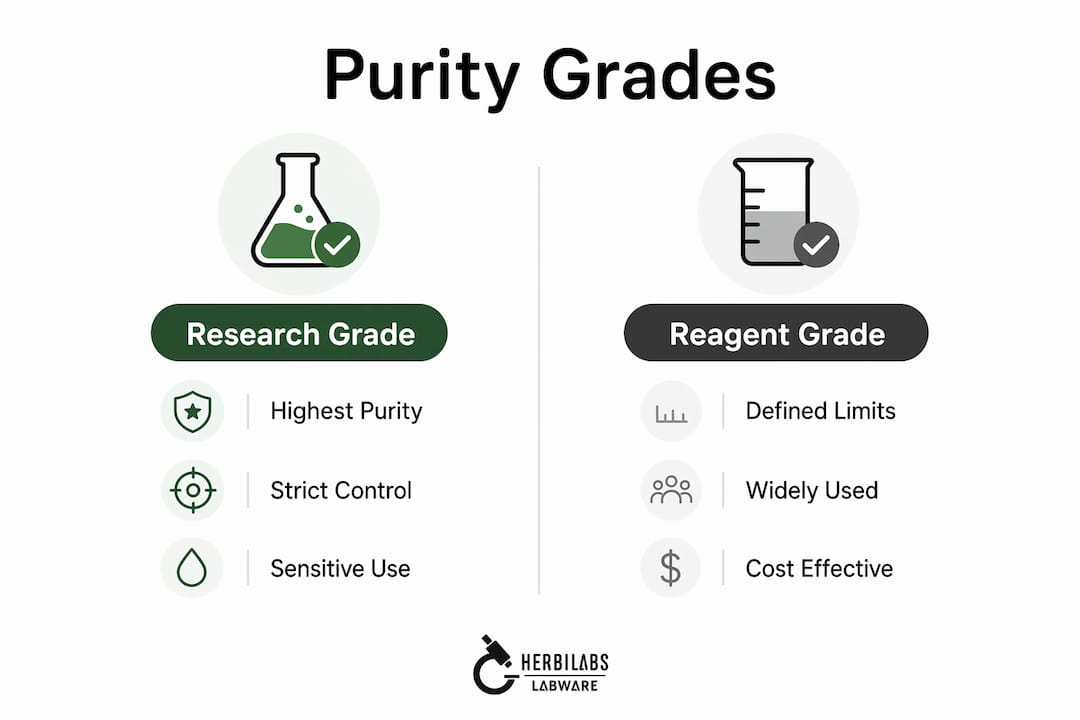
Reagent-grade chemicals undergo tighter manufacturing controls than lab-grade equivalents, including defined impurity limits and batch-specific documentation. Lab-grade chemicals are suitable only for non-critical tasks where trace purity is not a factor. Using lab-grade reagents in a quantitative assay is one of the most common and least obvious sources of experimental error.
Purity percentage alone does not guarantee suitability. Specific contaminants like endotoxins or incorrect peptide sequences can confound immune and cell-based experiments even when the overall purity figure looks acceptable. You need to match the contaminant profile in the COA to the sensitivity requirements of your specific assay. A 98% pure peptide with endotoxin contamination will produce unreliable results in any immune cell experiment, regardless of that 98% figure.
For consistent reagent quality in peptide research specifically, the contaminant profile matters as much as the headline purity number.
Best practices for sourcing and handling pure reagents
Independent researchers benefit most from suppliers who treat documentation as a core product feature, not an afterthought. Evaluating a supplier before you order protects you from discovering quality problems mid-experiment.
Criteria for evaluating a reagent supplier:
- Batch-specific COAs available before purchase. A reputable supplier publishes or provides COAs on request before you commit to an order.
- Third-party testing disclosure. The supplier clearly states whether COAs come from internal QC or an accredited external laboratory.
- Traceability chain. You can trace the reagent from raw material source through manufacturing to the specific lot you received.
- Focused catalog. Suppliers with focused catalogs and deep documentation for each product are more reliable than broad distributors with thin quality records.
- Responsive support. A supplier who answers technical questions about their COAs and testing methods is one who stands behind their product.
Sourcing is only half the equation. Improper storage and handling degrade reagent purity after delivery, regardless of how pure the product was when it left the manufacturer. Temperature excursions, light exposure, and contamination from repeated access all reduce effective purity over time. Follow the storage guidelines specific to each reagent class. Reconstitution solutions and sterile diluents require particular care because contamination introduced during handling is invisible until it shows up as a failed experiment.
Proper qualification of high-purity reagents requires both chemical composition review and validation in real assays. Running a new batch through a qualification experiment before committing it to critical work catches batch-to-batch variation before it costs you a full study.
Pro Tip: Keep a reagent log that records the lot number, COA reference, storage conditions, and date of first use for every reagent in your workflow. This log becomes your traceability record if you ever need to defend your methodology to a journal or IRB.
Key Takeaways
Pure reagents are the single most controllable variable in independent research, and verified purity documentation is the minimum standard for credible, publishable science.
| Point | Details |
|---|---|
| Purity drives reproducibility | Reagent variability is a leading cause of irreproducible results across biomedical research. |
| COAs must be batch-specific | Demand lot-specific COAs from ISO 17025 accredited labs, not generic product-level documents. |
| Grade selection matters | Match reagent grade and contaminant profile to your assay sensitivity, not just the purity percentage. |
| Supplier transparency is non-negotiable | Choose suppliers who provide third-party testing records and full traceability before purchase. |
| Storage preserves purity | Correct handling after delivery is as critical as the purity level at the point of manufacture. |
The cost of cutting corners on reagent quality
I have watched independent researchers repeat the same experiment six or seven times before tracing the problem back to a reagent lot that passed its own supplier’s internal QC. The frustration is real. The wasted weeks are real. And the worst part is that the failure looked like a protocol problem for most of that time.
The conventional wisdom says you buy the cheapest reagent that meets your stated purity threshold. That logic collapses the moment you factor in the true cost of a failed experiment. Repeated assay failures, recalibration, and inconclusive data consume far more budget than the price difference between a verified research-grade reagent and a cheaper alternative. High-quality reagents save time and money by preventing the kind of misleading results that send you chasing phantom variables.
The other thing I have learned is that independent researchers are often more rigorous about documentation than institutional labs, precisely because they have no institutional safety net. That rigor is an asset. Pair it with a supplier who matches your standards for traceability and you eliminate the largest uncontrolled variable in your workflow. The reproducibility crisis in biomedical research is not primarily a statistics problem or a publication bias problem. It is a reagent quality problem. Treating it as anything else is expensive.
— Ragnar
Herbilabs supplies verified reagents for independent researchers
Independent researchers need a supplier who treats purity documentation as a standard deliverable, not a special request. Herbilabs manufactures bacteriostatic water, sterile diluents, and reconstitution solutions to strict purity standards in a dedicated facility, with batch-specific quality control built into every production run.
Every product from Herbilabs comes with transparent quality documentation so you can verify what you are working with before your experiment begins. For researchers working in peptide science across the UK and Europe, Herbilabs provides the traceability and reliability that credible research demands. The research reagents supply chain guide on the Herbilabs site walks through sourcing and verification in practical detail. You can also review the full product range at the Herbilabs shop to find reagents matched to your specific research requirements.
FAQ
What are pure reagents in scientific research?
Pure reagents are chemical substances manufactured to defined purity standards, with documented contaminant limits and batch-specific quality records. They are used in research to minimize unknown variables and produce reproducible, credible results.
Why does reagent purity affect reproducibility?
Impurities in reagents introduce uncontrolled variables that change experimental outcomes between runs. Reagent variability is a recognized leading cause of irreproducible biomedical research, making verified purity a prerequisite for consistent data.
What should a valid COA include?
A valid COA must include the batch or lot number, purity percentage measured by a validated method, contaminant limits relevant to your assay, the identity of the testing laboratory, and the test date. COAs from ISO 17025 accredited external labs provide the highest level of confidence.
Is reagent-grade the same as research-grade?
No. Reagent-grade chemicals meet defined impurity limits and require batch documentation, making them suitable for most analytical and biomedical protocols. Research-grade chemicals meet the highest purity standards, include third-party verified COAs, and are required for the most sensitive assays and publication-grade work.
How should independent researchers store pure reagents?
Store reagents according to the manufacturer’s specifications for temperature, light exposure, and humidity. Keep a reagent log recording lot numbers, storage conditions, and dates of first use to maintain traceability and detect any degradation that could affect experimental validity.