Private Label, White Label, Wholesale partnerships available - EU, USA and UK - Free shipping from €75

Why consistent reagent quality is crucial for peptide research
Discover why consistent reagent quality is crucial for peptide research. Learn how to protect your results and avoid costly errors.
TL;DR:
- Reagent lot variability can lead to false assay failures and data contamination, undermining reproducibility.
- Implementing independent verification, thorough documentation, and standardized QC protocols enhances research reliability and confidence.
You run the assay, the numbers come back off, and you spend three days chasing a ghost. The peptide, the protocol, the equipment — all get interrogated. The real culprit? The reagent lot you swapped in last week. Understanding why consistent reagent quality is crucial is not an abstract concern for quality managers; it’s a daily operational reality that determines whether your data is worth publishing or worth scrapping. This guide cuts through the confusion around purity labels, explains what variability actually costs you, and gives you a concrete framework for protecting your research from the ground up.
Table of Contents
- Understanding reagent purity: what purity numbers really mean
- How reagent variability impacts experimental reliability and data integrity
- Standards and best practices for ensuring reagent consistency
- Practical steps to verify and maintain reagent quality in peptide research
- Comparing reagent quality control strategies: manufacturer CoAs versus independent verification
- Why embracing rigorous reagent quality control transforms peptide research outcomes
- Explore trusted reagents and labware solutions at Herbilabs
- Frequently asked questions
Key Takeaways
| Point | Details |
|---|---|
| Purity metrics vary | Peptide purity numbers can be misleading without understanding actual peptide mass content affected by salts and moisture. |
| Consistency prevents errors | Consistent reagent quality reduces false failures and improves reliability of peptide research results. |
| Follow standards | Adhering to ICH and ISO guidelines ensures reagent stability and traceability across batches. |
| Verify on receipt | Independent verification of reagent lots with in-house testing prevents introducing variable batches into experiments. |
| Combine QC methods | Best practice integrates manufacturer data with third-party controls for confident reagent quality assurance. |
Understanding reagent purity: what purity numbers really mean
The number on a Certificate of Analysis can feel definitive. “98% purity” reads like a guarantee. It isn’t. What that figure typically describes is chromatographic purity — specifically, the area percentage a peptide peak represents on an HPLC trace. It tells you how much of the UV-absorbing signal belongs to your target compound relative to everything else. It says nothing about how much actual peptide mass is in the vial.
This distinction has real consequences. A peptide labeled 98% pure by HPLC may contain only 70-80% actual peptide due to counterions and moisture. The gap between the purity label and the true peptide content comes primarily from two sources:
- Residual TFA (trifluoroacetate) counterions: TFA is used in reversed-phase HPLC purification and clings to peptide molecules as a salt form. It is UV-invisible in many detection windows, so it does not appear as an impurity on the trace, yet it contributes significant mass.
- Moisture content: Lyophilized peptides are hygroscopic. Even well-sealed vials accumulate water, which adds mass without adding peptide.
- Other non-peptide mass contributors: Residual solvents, excipients, and buffer salts from the manufacturing process can account for additional weight not reflected in the purity figure.
This is why peptide mass quantification must accompany purity for dosing accuracy. If you are ensuring lab purity for peptides correctly, you are not relying on a single number. You are cross-referencing HPLC area purity with absolute peptide content measurements and confirming molecular identity with mass spectrometry. MS is not optional for quantitative work. It confirms you have the right molecule, not just a pure molecule.
How reagent variability impacts experimental reliability and data integrity
Once you understand purity metrics, the next question is what happens when those metrics shift between lots. The impact of reagent consistency runs deeper than most researchers initially expect.
The most immediate effect is batch failure that looks like a formulation or process problem. Your assay readings fall outside specification, you trigger an investigation, and you spend time examining variables that were never the cause. Inconsistent reagent performance creates false failures and prolongs investigations, undermining process control. That investigation time is not free. It consumes analyst hours, delays timelines, and introduces doubt into datasets that were otherwise valid.
Here is how the cascade typically unfolds in a peptide research setting:
- A new reagent lot arrives with slightly different effective peptide content, undetected because only the CoA purity figure was checked.
- Assay responses shift by 10-15%, falling outside the established control limits.
- The researcher assumes a process problem and begins root cause analysis.
- Days pass. Resources are consumed. The actual source, lot-to-lot reagent variability, goes unidentified.
- The new lot gets deployed anyway, contaminating the data trend with a systematic offset.
“The costliest reagent quality failure is not the failed assay. It is the assay that passes with wrong data.”
Beyond wasted resources, variable reagents undermine the importance of reagent quality for long-term reproducibility. If you cannot reproduce your results six months later because the reagent quality shifted, your findings cannot be independently verified. In peptide research, where subtle dose-response relationships matter enormously, that reproducibility gap is the difference between publishable science and noise.
Standards and best practices for ensuring reagent consistency

You do not have to invent your own framework. The regulatory and scientific community has developed well-established standards that translate directly into practical reagent QC protocols.
Key standards to know:
- ICH Q1A(R2): Governs stability testing for pharmaceutical and research materials. Long-term stability testing requires data from at least 3 batches tested at multiple intervals, giving you a statistically meaningful picture of how a reagent behaves over time and across production runs.
- ISO 17025: The gold standard for testing and calibration laboratory accreditation. ISO 17025 requires independent verification of each reagent lot against certified values with documented uncertainties to ensure batch consistency.
- CLSI EP15: A protocol for verifying precision and estimating bias in clinical and research laboratories. Particularly useful for detecting lot-to-lot shifts before they corrupt datasets.
Certified Reference Materials (CRMs) are one of the most underused tools in independent research labs. A CRM gives you a traceable, independently verified benchmark against which you can measure every new reagent lot. If your in-house result for a CRM falls outside the certified uncertainty range, you know something is wrong before you deploy the reagent.
| Standard | Primary application | Key benefit |
|---|---|---|
| ICH Q1A(R2) | Stability testing across batches | Confirms shelf-life and lot consistency |
| ISO 17025 | Lab accreditation and lot verification | Ensures traceable, documented QC |
| CLSI EP15 | Lot-to-lot bias detection | Early warning of reagent shifts |
| CRM protocols | Independent reference verification | Removes dependence on supplier data alone |
A practical reagent quality control workflow combines stability data from the manufacturer with independent lot verification in your own lab. Neither alone is sufficient.
Pro Tip: Request stability data covering at least three production batches before committing to a supplier long-term. A single batch’s CoA tells you about that batch. Three batches tell you whether the manufacturer’s process is actually under control.
Good quality control in reagent production at the supplier level is necessary, but it is not a substitute for what you verify yourself.
Practical steps to verify and maintain reagent quality in peptide research
Standards give you the framework. Here is how to execute it in a working peptide research lab without a dedicated QC department.
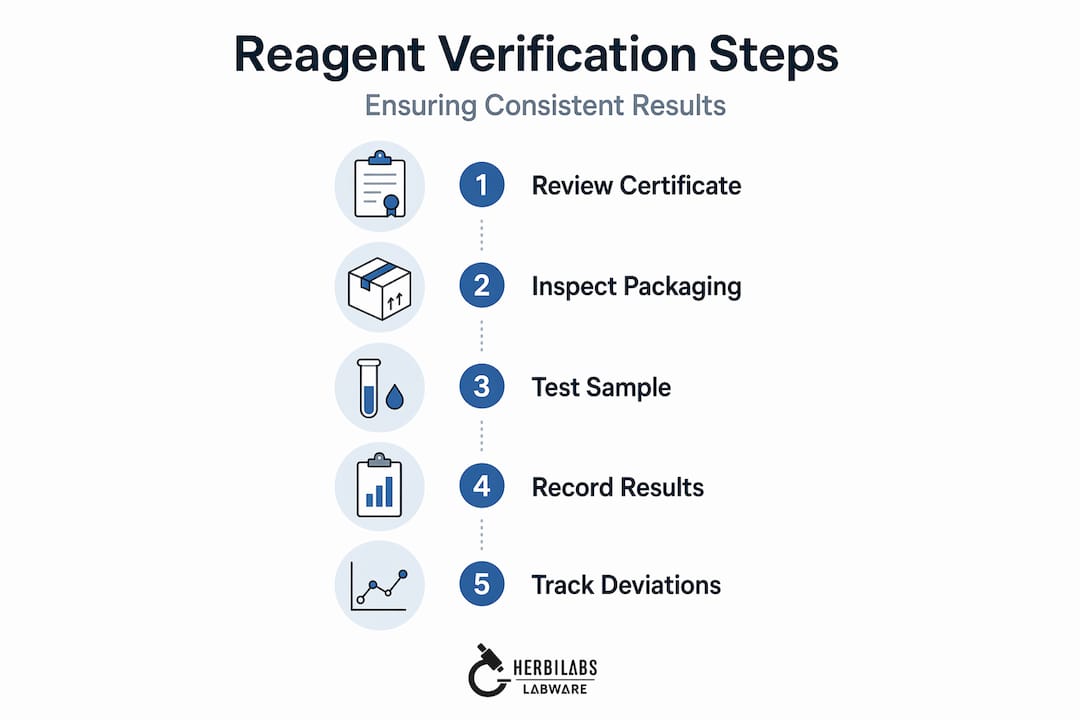
- Test in parallel at receipt. When a new lot arrives, run it side by side with the tail end of your current lot using the CLSI EP15 approach. Parallel testing of old and new lots using CLSI EP15 can detect lot-to-lot bias early, preventing variable batch deployment. Even three to five matched comparisons give you enough signal to catch meaningful shifts.
- Run in-house RP-HPLC and MS on every new peptide lot. New peptide reagent lots should be verified with in-house RP-HPLC and mass spectrometry on receipt for quantitative studies. Do not assume the supplier’s data reflects what arrived in your hands after shipping and storage.
- Document everything, not selectively. Lot numbers, receipt dates, storage conditions, QC results, and the names of assays where each lot was used should all be captured. If a data anomaly appears six months from now, you need to be able to trace it to a specific reagent lot without guesswork.
- Establish control charts. Plot your QC results over time. Trends matter more than individual data points. A reagent that slowly drifts toward the edge of your acceptance range is far more dangerous than one that fails outright, because the drift goes unnoticed until it has already corrupted your data.
- Implement daily QC checks for active reagents. One data point per lot at receipt is not enough for long-running studies. Reagents degrade. Proper storing of research reagents reduces that degradation, but it does not eliminate it. A daily QC sample catches drift before it becomes a crisis.
Pro Tip: Create a simple reagent log template that auto-flags any result outside two standard deviations from your historical mean. You can build this in a spreadsheet in under an hour, and it pays for itself the first time it catches a failing lot before it contaminates your study data. Also review your safe reagent handling guide to make sure storage and reconstitution practices are not introducing variability you are incorrectly attributing to the reagent itself.
Comparing reagent quality control strategies: manufacturer CoAs versus independent verification
Most researchers receive a CoA with every reagent shipment and treat it as the final word on quality. That assumption creates real risk.
| QC method | Strengths | Limitations |
|---|---|---|
| Manufacturer CoA | Convenient, no additional cost, covers basic identity and purity | Standards vary by supplier, may lack traceability, does not reflect shipping conditions |
| Independent third-party testing | Unbiased, traceable, validates chain of custody | Adds cost and time, requires access to instrumentation |
| In-house verification | Fast, contextual, catches lot-specific issues | Requires trained staff and calibrated equipment |
| Combined approach | Highest confidence, full traceability, catches gaps | Requires planning and resource investment |
Relying only on manufacturer CoAs can create traceability gaps; independent verification is essential as supplier standards vary. This is not an indictment of suppliers. It is a recognition that CoA generation methods differ widely. Some suppliers use validated in-house methods against certified standards. Others run a single HPLC trace and report the area percent. You often cannot tell which is which from the document itself.
The benefits of high-quality reagents are only fully realized when you can verify those claims independently. Key advantages of layering independent verification onto supplier CoAs include:
- Chain of custody assurance: You know the reagent was handled correctly from production to your bench.
- Method validation: Your in-house data confirms the supplier method yields comparable results in your conditions.
- Regulatory defensibility: If your research feeds into any regulatory submission, independent verification is not optional.
- Supplier benchmarking: Over time, your independent data tells you which suppliers consistently deliver what they claim.
Understanding why lab quality control is foundational helps reframe this not as extra work but as essential infrastructure. The researchers who routinely verify reagent quality are the ones who can defend their data when it matters most.
Why embracing rigorous reagent quality control transforms peptide research outcomes
Here is the perspective that rarely gets said plainly: most researchers who struggle with reproducibility are not bad scientists. They are working with reagents they do not fully understand, using quality information they have not verified, in a culture that treats QC as overhead rather than investment.
The impact of reagent consistency is not a statistical abstraction. It shows up as confidence. When you know your reagent quality is controlled, you can interpret a surprising result as a genuine finding instead of reflexively blaming the materials. That shift in confidence changes how you design experiments, how quickly you publish, and how defensible your conclusions are when other labs try to replicate your work.
The uncomfortable truth is that ignoring reagent variability does not make it disappear — it just makes it invisible until the damage is done. Labs that treat reagent QC as a compliance box to check tend to discover that reality during manuscript peer review or, worse, after a study has been built on a compromised dataset.
The experienced labs we have seen get this right view reagent quality control as a competitive advantage. When your data is clean and traceable, you spend less time in investigation cycles and more time doing actual science. You also build the kind of supplier relationships that give you early access to lot data before shipment, because you are the kind of customer who can evaluate it. Explore the importance of reagent quality as a lens through which every experimental decision becomes clearer, not just a procedural obligation.
Why reagent purity matters is ultimately a question about what your research is actually for. If the goal is to generate trustworthy knowledge, then the materials generating that knowledge have to be trustworthy first.
Explore trusted reagents and labware solutions at Herbilabs
Implementing the practices in this article is significantly easier when your supplier has already done the hard work on quality before the product reaches you. Herbilabs supplies research-grade bacteriostatic water, sterile diluents, and reconstitution solutions to independent researchers and peptide enthusiasts across Europe, manufactured to strict purity standards with documented quality control at every production stage.

Every product in the Herbilabs range is designed to support reproducible peptide research, with clear lot traceability and consistent manufacturing standards that make your own QC verification straightforward rather than guesswork. Browse the full range of quality control products and supporting labware, or check the bacteriostatic water FAQs for detailed product and reconstitution guidance. Ready to order? Visit the Herbilabs shop for secure ordering with Europe-wide shipping.
Frequently asked questions
Why can’t I rely solely on the peptide purity percentage provided by suppliers?
Supplier purity percentages describe chromatographic purity, not actual peptide mass content, which can be 15-30% lower due to TFA counterions and moisture. A peptide labeled 98% pure by HPLC may contain only 70-80% actual peptide, making independent content verification essential for accurate dosing.
How does inconsistent reagent quality affect experimental results?
Variable reagent lots introduce systematic offsets that trigger false failures and launch unnecessary investigations. Inconsistent reagent performance prolongs investigations and undermines process control, eroding confidence in data that may otherwise be scientifically valid.
What quality control measures should I implement for reagent consistency?
Run parallel lot testing using CLSI EP15 at receipt, verify new peptide lots with in-house RP-HPLC and mass spectrometry, and maintain a documented trend log with daily QC monitoring. Parallel testing of old and new lots using CLSI EP15 catches lot-to-lot bias before it contaminates active studies.