Private Label, White Label, Wholesale partnerships available - EU, USA and UK - Free shipping from €75

Lab storage guide: safe practices for peptides, 28 days
Learn safe storage practices for peptides, bacteriostatic water, and lab reagents. Covers the 28-day rule, temperature requirements, and common mistakes to avoid.
TL;DR:
- Proper storage prevents contamination, degradation, and financial loss in lab research.
- Accurate labeling, environment control, and regular temperature checks are essential for product safety.
- Consistent discipline and good habits are key to effective storage beyond just equipment choices.
Storing lab reagents and peptides incorrectly is one of the fastest ways to compromise months of research and waste significant money. A single temperature spike, a missed expiry date, or an unlabeled vial can render an entire batch of bacteriostatic water or reconstituted peptide unusable. This guide walks you through exactly how to store your lab products safely, covering the essential equipment, step-by-step procedures, and the most common errors independent researchers across Europe make. Whether you work from a dedicated lab space or a compact home setup, these practices apply directly to your workflow.
Table of Contents
- Essential lab products and storage requirements
- Preparing your lab: Tools and environment for safe storage
- Step-by-step: Storing bacteriostatic water and sensitive reagents
- Troubleshooting and avoiding common mistakes
- What most guides miss about lab storage safety
- Find trusted storage solutions for your lab
- Frequently asked questions
Key Takeaways
| Point | Details |
|---|---|
| Follow storage rules | Store unopened products at recommended temperature and start a new log after each opening. |
| Prioritize refrigeration | Cold storage significantly prolongs peptide and reagent stability after opening. |
| Track expiry dates | Mark opening dates and always discard solutions 28 days after puncture. |
| Prevent common errors | Label containers clearly, keep logs, and discard at first sign of contamination. |
Essential lab products and storage requirements
Before you can store anything correctly, you need to understand what you are actually working with and why each product behaves differently under various conditions.
Peptides are short chains of amino acids used extensively in research. They are sensitive to heat, moisture, light, and repeated freeze-thaw cycles. Even minor deviations from recommended storage conditions accelerate degradation and reduce biological activity.
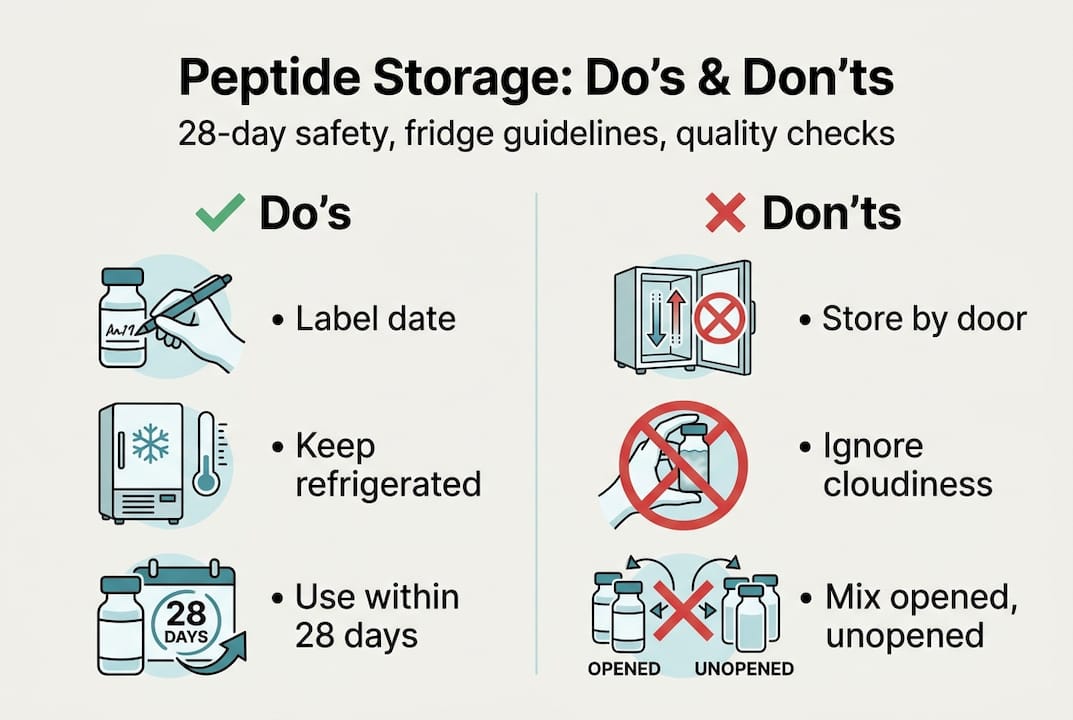
Bacteriostatic water (bac water) is sterile water containing 0.9% benzyl alcohol, which inhibits bacterial growth and allows multi-dose use over time. Understanding what is bacteriostatic water is essential before you begin any reconstitution work, because confusing it with plain sterile water leads to serious handling errors. The key difference between bacteriostatic vs sterile water matters enormously for storage duration and safety.
Lab reagents vary widely but share a common vulnerability: exposure to the wrong temperature, light, or humidity degrades their chemical integrity and makes results unreliable.
Why does improper storage matter so much? Because degraded products do not just give poor results. They can introduce contamination, skew assay data, or in the case of injectable research compounds, create safety risks. The financial cost of replacing ruined stock adds up quickly for independent researchers operating without institutional budgets.
Here is a practical summary of storage requirements by product type:
| Product | Unopened storage | After opening | Shelf life |
|---|---|---|---|
| Bacteriostatic water | 15-30°C, room temp | 2-8°C, refrigerated | 2-3 years unopened; 28 days opened |
| Lyophilized peptides | -20°C, dark, dry | -20°C or 2-8°C | 12-24 months |
| Reconstituted peptides | 2-8°C short term | 2-8°C, use quickly | Days to weeks |
| Sensitive reagents | Per manufacturer spec | Sealed, refrigerated | Varies |
Key storage principles to keep in mind:
- Always check the manufacturer’s certificate of analysis for product-specific guidance
- Avoid repeated freeze-thaw cycles for peptides; aliquot before freezing
- Keep light-sensitive products in amber vials or foil-wrapped containers
- Never store reagents near strong-smelling chemicals that could permeate seals
28-day rule: Bacteriostatic water lasts 2-3 years unopened at room temperature, but only 28 days after opening, with refrigeration strongly preferred.
This 28-day window is non-negotiable. Missing it is one of the most common and costly mistakes in independent research settings.
Preparing your lab: Tools and environment for safe storage
With the basics and requirements in mind, the next step is ensuring your lab setup minimizes risks and supports best practice storage.
Your storage environment is not just a background detail. It is an active variable in your research quality. A poorly organized fridge, inconsistent room temperature, or missing labels will undermine even the best products.
Essential storage equipment:
- Dedicated lab refrigerator or pharmaceutical-grade fridge (2-8°C range, stable)
- Light-proof or amber glass vials for light-sensitive compounds
- Waterproof, chemical-resistant labels and a permanent marker
- Temperature data logger or min/max thermometer
- Separate sealed containers or racks for opened vs. unopened stock
- Humidity indicator cards for dry storage areas
One of the most overlooked decisions is whether to use a domestic fridge or a dedicated lab fridge. Here is how they compare:
| Feature | Domestic fridge | Lab/pharmaceutical fridge |
|---|---|---|
| Temperature stability | Moderate, fluctuates with door opening | High, designed for consistent 2-8°C |
| Temperature alarm | Rarely included | Standard feature |
| Humidity control | None | Often regulated |
| Contamination risk | Higher (food odors, cross-contamination) | Lower (dedicated use) |
| Cost | Low | Higher upfront investment |
For researchers storing high-value peptides or reconstituted compounds regularly, a dedicated lab fridge pays for itself quickly in avoided losses. That said, a well-managed domestic fridge with a separate sealed container for lab products is far better than a lab fridge used carelessly.
The key is to store bacteriostatic water safely by keeping it at 2-8°C once opened, away from the fridge door where temperature fluctuates most. Unopened stock should be stored at 15-30°C in a cool, dark cupboard rather than on an open shelf.
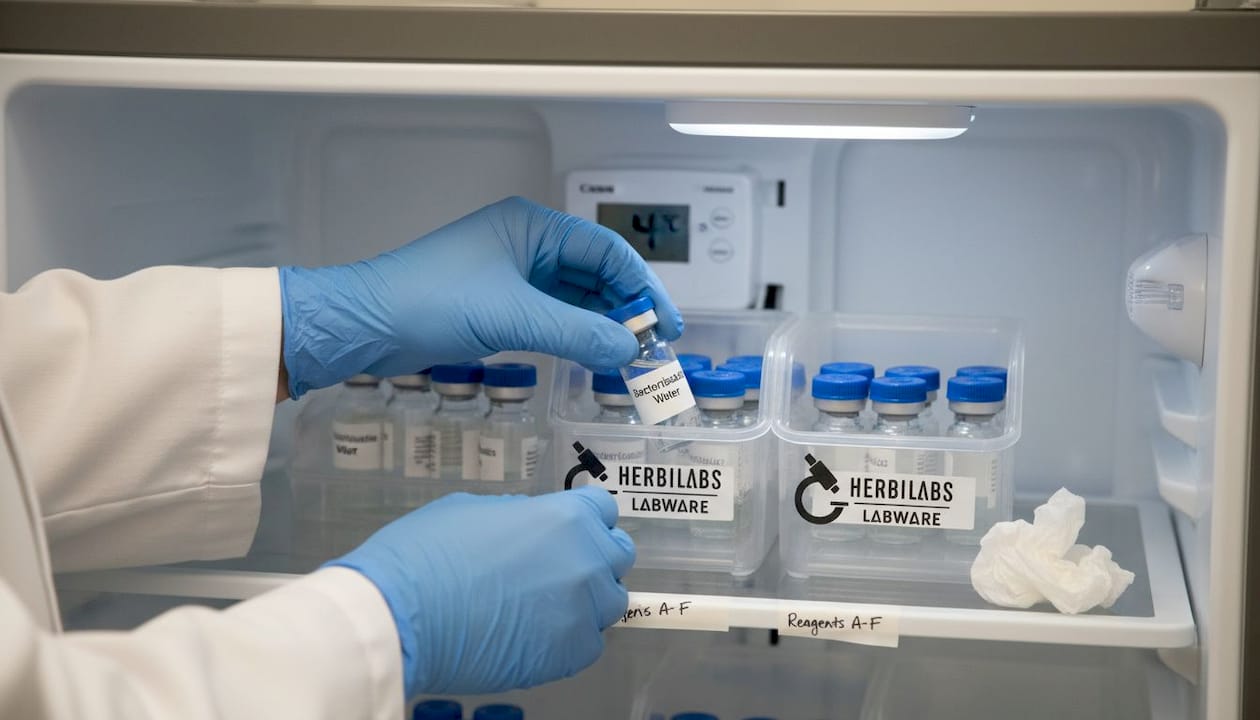
Regular environmental checks matter more than most researchers realize. Temperature spikes of even a few degrees, sustained over hours, can cause measurable degradation in sensitive peptides. Log your fridge temperature at least twice a week. If you notice repeated fluctuations, investigate before they cost you a batch.
Pro Tip: Isolate opened containers from unopened stock in clearly labeled separate sections of your fridge. This one habit eliminates confusion about expiry status and prevents accidentally using a product past its post-opening window.
Step-by-step: Storing bacteriostatic water and sensitive reagents
Once your environment is set, the true impact comes from following consistent, stepwise procedures whenever you store new materials.
Here is a practical checklist to follow every time new stock arrives or you open a product for the first time:
- Receive and inspect. Check the outer packaging for damage, moisture, or signs of temperature excursion (e.g., melted ice packs, swollen vials). Do not use any product that shows physical damage on arrival.
- Verify documentation. Confirm the certificate of analysis, batch number, and expiry date match the order. File this documentation immediately.
- Label before storing. Write the date of receipt and, critically, the date of first puncture on every vial before it goes into storage. Use waterproof labels.
- Separate opened from unopened. Place unopened bacteriostatic water in cool, dark storage at room temperature. Move opened vials to the refrigerator at 2-8°C immediately.
- Log the storage event. Record the product name, batch number, storage location, date opened, and calculated discard date in your logbook or tracking app.
- Position correctly. Store vials upright, away from the fridge door, and out of direct light. Avoid placing items near the cooling element where freezing can occur.
- Verify temperature. Check that the storage environment is within the correct range before walking away.
Discard warning: Once punctured, bacteriostatic water is only safe for 28 days, preferably refrigerated. Using it beyond this window risks bacterial contamination regardless of how it looks.
For peptide solutions, the stakes are even higher. Reaction rates double every 10°C increase in temperature, meaning a fridge versus room temperature difference slows degradation by 4 to 8 times. That is not a minor advantage. It is the difference between a peptide that remains active for weeks and one that loses potency in days.
Understanding bacteriostatic water shelf life in detail helps you plan orders and avoid holding excess opened stock. And if you are ever uncertain about safety, the guidance on is bacteriostatic water safe covers the key considerations clearly.
Pro Tip: Always record the date of first puncture directly on the vial, not just in a logbook. If the logbook is unavailable, the label on the vial is your last line of defense against using expired product.
Troubleshooting and avoiding common mistakes
Executing perfect storage is not enough if you do not recognize and manage hazards that occur over time.
Even researchers with solid procedures make recurring errors. The most common ones are not dramatic failures. They are quiet, gradual oversights that accumulate until something goes wrong.
Top storage mistakes to watch for:
- Mislabeling or skipping labels entirely. Memory is unreliable. A vial without a date is a liability.
- Improper sealing after use. Leaving vials loosely capped or using damaged septa invites contamination and evaporation.
- Ignoring expiry dates. Products that look fine can be chemically or microbiologically compromised. Appearance is not a reliable safety indicator.
- Temperature drift. A fridge that runs slightly warm over weeks causes cumulative degradation that is invisible until results become inconsistent.
- Storing incompatible products together. Some reagents off-gas or absorb moisture in ways that affect neighboring vials.
- Using the same needle twice on a vial. This introduces contamination risk even with bacteriostatic water.
Knowing when to discard is just as important as knowing how to store. Any bacteriostatic water or reagent showing cloudiness, floating particles, or past its post-puncture period should be discarded immediately. Color changes, unusual odors, or visible precipitate in a previously clear solution are all red flags.
If you suspect a product is compromised, the action steps are straightforward: stop using it, quarantine the vial, document the issue with batch number and date, dispose of it according to your local lab waste regulations, and reorder from a verified supplier. Do not attempt to “use it up quickly” before it gets worse.
For answers to specific edge cases and handling questions, the bacteriostatic water FAQs resource covers a wide range of real-world scenarios.
Pro Tip: Use a simple digital logbook or even a shared spreadsheet to track every opened vial, its discard date, and storage location. Set a weekly calendar reminder to review the list and pull anything approaching expiry.
What most guides miss about lab storage safety
Most storage guides focus on equipment specs and temperature ranges. Those matter. But in our experience working with independent researchers and peptide users across Europe, the failures almost never come from buying the wrong fridge. They come from daily discipline breaking down.
A researcher who logs every opening for three months and then skips it twice in a row because they are busy has introduced exactly the kind of gap that leads to a compromised batch. Trusting memory, assuming a colleague logged something, or deciding a vial is “probably fine” because it looks clear: these are the real failure modes.
The uncomfortable truth is that storage safety is a habit system, not a one-time setup. The best equipment in the world does not protect you if someone forgets to note the date of first puncture. Training everyone who touches your lab materials, including occasional collaborators, matters as much as your fridge’s temperature alarm.
Building lab reliability and quality assurance into your daily routine, rather than treating it as a checklist you complete once, is what separates researchers who consistently get reliable results from those who face recurring unexplained variability.
Find trusted storage solutions for your lab
Putting these practices into action starts with having products you can trust from the moment they arrive. At Herbilabs, we manufacture bacteriostatic water and research reagents to strict purity standards, with full documentation so your storage records start on solid ground.

If you want to go deeper on any aspect of handling and storage, our detailed guide on safe storage for bacteriostatic water covers the full picture. For specific handling questions, the more storage FAQs page addresses the scenarios independent researchers encounter most often. When you are ready to order quality-controlled products built for research use, visit the Herbilabs Shop and explore our full range.
Frequently asked questions
How long can I use bacteriostatic water after opening?
Once opened, bacteriostatic water should be used or discarded within 28 days maximum, with refrigeration at 2-8°C strongly recommended throughout that period.
What is the ideal temperature to store peptide solutions?
Most peptides should be stored refrigerated between 2-8°C, since reaction rates double every 10°C rise in temperature, meaning room temperature storage degrades them 4 to 8 times faster.
How do I know if my reagent or water has gone bad?
Discard any product showing cloudiness, floating particles, color changes, or that has passed its post-puncture window, even if it appears visually normal.
Can I store unopened bacteriostatic water at room temperature?
Yes, unopened bacteriostatic water can be stored at 15-30°C for up to 2-3 years, but must be moved to refrigerated conditions immediately after the first puncture.