Private Label, White Label, Wholesale partnerships available - EU, USA and UK - Free shipping from €75

Sterile Water for Peptides: Safe Reconstitution Explained
Learn how sterile water works for peptide reconstitution, when to use it vs. bacteriostatic water, and how to avoid common contamination mistakes in your lab.
TL;DR:
- Sterile water is highly purified, single-use, free of additives, and ideal for fresh peptide reconstitution.
- Bacteriostatic water contains preservatives, making it suitable for multi-dose peptide protocols over 28 days.
- Proper handling and understanding water types prevent contamination, degradation, and invalid research results.
Choosing the wrong water for peptide reconstitution is one of the most common and costly mistakes in private research. Many researchers grab whatever purified water is available, not realizing that sterile water, bacteriostatic water, and regular distilled water behave very differently in peptide solutions. Use the wrong one and you risk contamination, degraded samples, or skewed results that invalidate your entire experiment. This guide cuts through the confusion, explains exactly what sterile water is, how it compares to bacteriostatic water, and gives you a clear, practical process for safe reconstitution.
Table of Contents
- What is sterile water for peptides?
- Sterile water vs. bacteriostatic water for peptide research
- How to safely reconstitute peptides with sterile water
- When NOT to use sterile water: Pitfalls and alternatives
- A research-tested perspective: What most guides get wrong about sterile water for peptides
- Where to find trusted sterile water and peptide labware in Europe
- Frequently asked questions
Key Takeaways
| Point | Details |
|---|---|
| Single-use safety | Always use sterile water vials just once to ensure peptide purity and avoid contamination. |
| Right solvent matters | Choose sterile or bacteriostatic water based on how many doses and the peptide’s properties. |
| Step-by-step protocol | Follow best practices for handling, reconstitution, and storage of peptides and diluents. |
| Avoid common pitfalls | Never store or reuse opened sterile water vials to minimize research risks. |
What is sterile water for peptides?
Sterile water for peptide use is not just clean water from a filtered tap or a distillation unit. It is a highly purified solution that has been processed to eliminate all microbial life, particulates, and dissolved impurities. The production process typically involves multiple filtration stages, followed by terminal sterilization using autoclaving or membrane filtration to achieve a product free of bacteria, fungi, and endotoxins.
The key characteristics that make it suitable for peptide research are:
- No preservatives or additives that could interfere with peptide structure or assay results
- Pyrogen-free formulation, meaning no bacterial byproducts that trigger immune-like responses in biological tests
- Precise pH, usually close to neutral, which protects sensitive peptide bonds
- Sealed single-use vials that maintain sterility from production to point of use
That last point is critical. As noted by researchers focused on single-use reconstitution, sterile water for injection is purified and preservative-free, meaning the entire vial must be used immediately to avoid contamination risks. Once you puncture the stopper and the seal is broken, the clock starts. There are no preservatives inside to suppress microbial growth.
This is why sterilization tips for injectable peptides always emphasize single-use protocol. Even a brief exposure to non-sterile air or an ungloved hand can introduce contamination into what was a perfectly clean vial.
Important: Sterile water is not the same as “water for injection” (WFI) used in pharmaceutical manufacturing, though both share high purity standards. For private peptide research, single-use sterile vials designed for laboratory reconstitution are the appropriate choice.
The role of sterile water in peptide research is straightforward. Lyophilized (freeze-dried) peptide powders need a liquid carrier to become usable solutions. Sterile water provides that carrier without introducing any variables. Understanding sterility in peptide lab products is the first step toward consistent, reproducible results.
Sterile water vs. bacteriostatic water for peptide research
Once you understand what sterile water is, the next question almost always becomes: what about bacteriostatic water? This is where most researchers either overcomplicate things or oversimplify them.
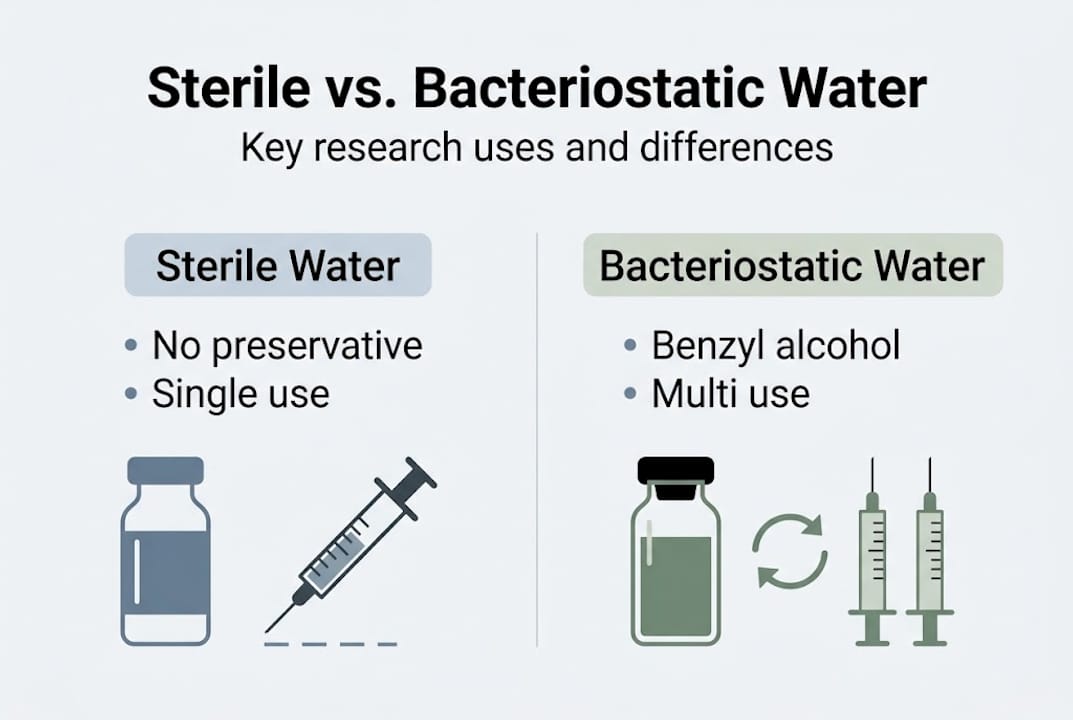
Bacteriostatic water (often called BAC water) contains 0.9% benzyl alcohol as a preservative. That single ingredient changes everything about how you use it. Benzyl alcohol inhibits microbial growth, which means the vial remains usable across multiple punctures over time, typically up to 28 days after first use under proper storage conditions.
Sterile water has no such protection. One puncture and the contamination window opens immediately.
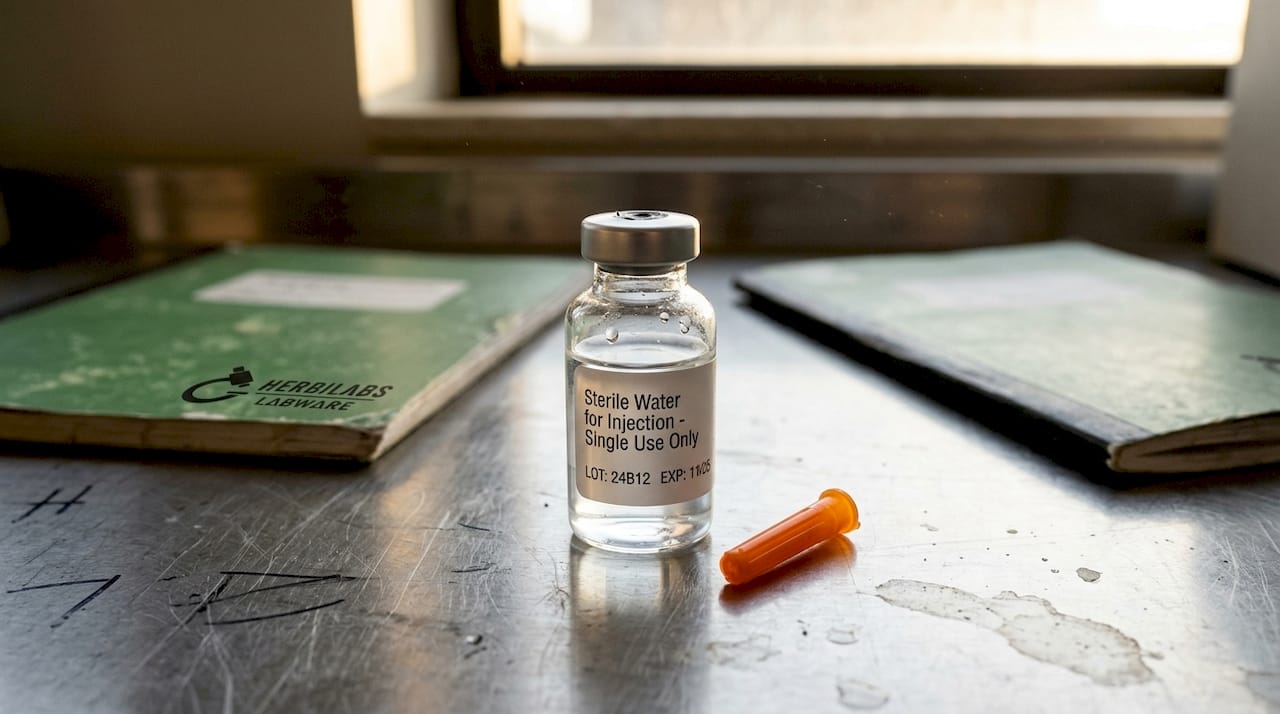
Here is a direct comparison to clarify when to use each:
| Factor | Sterile water | Bacteriostatic water |
|---|---|---|
| Preservative | None | 0.9% benzyl alcohol |
| Uses per vial | Single-use only | Multi-dose (up to 28 days) |
| Storage after opening | Discard immediately | Refrigerated, use within 28 days |
| Peptide compatibility | All peptides, single-dose protocols | Most peptides; not for benzyl alcohol-sensitive applications |
| Cost efficiency | Lower per vial, higher per dose | Higher per vial, lower per dose |
| Contamination risk | Higher if mishandled | Lower due to preservative action |
As confirmed by reconstitution guides for researchers, BAC water is preferred over sterile for most research peptides like BPC-157 and semaglutide due to multi-dose practicality, while sterile water fits single-use or acidified mixes best. Understanding the distinction between bacteriostatic vs. sterile water helps you select the right tool for each protocol.
Pro Tip: If you are working with a peptide that requires acidification (e.g., diluted acetic acid as a carrier), always start with sterile water as your base and skip BAC water entirely. Benzyl alcohol can interact unpredictably with acidified peptide solutions.
Knowing whether bacteriostatic water is safe for your specific application matters as much as knowing how to use it. The bacteriostatic water guide at Herbilabs breaks down compatibility in more detail for researchers who work across multiple peptide types.
How to safely reconstitute peptides with sterile water
Knowing which water to use is half the battle. Actually executing the reconstitution correctly is the other half. Many contamination events happen not because the wrong water was chosen, but because the right water was used incorrectly.
Here is the complete process for safe research peptide reconstitution using sterile water:
- Gather your supplies. You need: a sterile water vial, a peptide vial, an appropriately sized syringe with a fresh needle, sterile gloves, and alcohol swabs. Having essential labware for peptides ready before you begin prevents rushed improvisation.
- Prepare your workspace. Wipe down your bench surface with 70% isopropyl alcohol. Allow it to dry completely before placing any vials or equipment on it. A laminar flow hood is ideal but not always available in private labs.
- Don your sterile gloves. Do not touch your face, hair, or any non-sterile surface after gloving up.
- Swab both vial stoppers. Use a fresh alcohol swab on the sterile water vial stopper and again on the peptide vial stopper. Allow both to air dry for 10 to 15 seconds.
- Draw up the sterile water. Insert the syringe into the sterile water vial and draw the precise volume specified for your peptide concentration. Avoid introducing air bubbles.
- Inject slowly into the peptide vial. Direct the stream of water down the inside wall of the vial, not directly onto the lyophilized cake. This reduces mechanical disruption to the peptide structure.
- Swirl gently, never shake. Rotate the vial slowly between your fingers until the powder dissolves fully. Shaking can denature sensitive peptides and create unwanted aggregates.
Pro Tip: Use the entire sterile water vial in a single session. Reconstitution safety guidelines are clear that leftover sterile water in a punctured vial should never be saved for later use. Discard it after each session.
Common errors to avoid: touching the stopper with bare fingers, re-entering a used sterile water vial, and using a syringe that has already touched a non-sterile surface. Each of these mistakes introduces a contamination variable that can ruin the peptide batch entirely.
When NOT to use sterile water: Pitfalls and alternatives
Sterile water is not a universal solution, and treating it as one is where many private researchers run into problems.
The clearest case against sterile water is any multi-dose peptide protocol. If your research design calls for drawing from the same reconstituted vial over several days or weeks, sterile water creates an open contamination window the moment you puncture the stopper. Without a preservative, bacteria can multiply quickly inside the vial between doses, especially if storage conditions are not perfect.
Here are specific situations where sterile water is the wrong choice:
- Multi-dose peptide regimes such as daily injections from a single reconstituted vial
- Long-duration studies where reconstituted peptide needs to remain stable for more than 24 to 48 hours
- Shared lab environments where vials may be accessed by multiple people or stored in busy refrigerators
- Peptides requiring specific preservative environments to maintain structure
As research reconstitution data confirms, BAC water is preferred for peptides like BPC-157 and semaglutide precisely because multi-dose practicality demands a preservative-protected carrier.
| Peptide | Recommended diluent | Reason |
|---|---|---|
| BPC-157 | Bacteriostatic water | Multi-dose, long-term storage |
| Semaglutide | Bacteriostatic water | Multi-dose protocol |
| Epitalon | Sterile water or BAC water | Short or single-use compatible |
| PT-141 | Bacteriostatic water | Multi-dose practicality |
| CJC-1295 (no DAC) | Bacteriostatic water | Frequent dosing schedules |
| Single-use peptides | Sterile water | Entire vial used in one session |
Watch for these warning signs that you have chosen the wrong diluent: unexpected cloudiness after reconstitution, off smell when opening the vial, or visible particulates floating in solution. Any of these signals potential contamination or incompatibility.
The best way to avoid diluent errors is to check choosing the right diluent resources before starting any new peptide protocol, not after something goes wrong.
A research-tested perspective: What most guides get wrong about sterile water for peptides
Most reconstitution guides present sterile water as either the gold standard or the unsafe fallback, depending on who wrote them. Neither framing is accurate.
The reality in European private research labs is messier. Researchers often work with limited budgets, inconsistent supply chains, and protocols designed for pharmaceutical-grade facilities. Textbook instructions say always use fresh vials, always work in a laminar flow environment, always discard after single use. That advice is correct in theory. In practice, the biggest risk is not the water type, it is the confidence gap.
Many researchers trust a “sterile” label without verifying the vial’s integrity, checking the seal, or confirming that storage conditions were maintained during shipping. A vial stored at room temperature for weeks before use may technically be “sterile” on the label but compromised in practice. This is why labware selection and peptide reliability matters far beyond brand recognition.
The cost argument also distorts decision-making. Choosing sterile water over BAC water to save money on a multi-dose protocol is a false economy. You will spend more replacing contaminated peptides than you saved on the cheaper diluent. Following sterilization best practices consistently costs almost nothing in time and materials but prevents the majority of avoidable errors.
Where to find trusted sterile water and peptide labware in Europe
With this guide in hand, sourcing quality supplies should be your next priority. The quality of your diluent directly affects your research outcomes, and cutting corners on labware never pays off.
At Herbilabs, we supply research-grade sterile reconstitution solutions and peptide labware to independent researchers and private customers across Europe. Our sterile reconstitution solution (30ml) is produced under strict purity standards with rigorous quality control at every stage. If you want to compare options before purchasing, our safe lab application guide walks you through real-world diluent selection scenarios. We also offer wholesale pricing for resellers and institutions who need reliable supply at scale.
Frequently asked questions
Can sterile water be reused for multiple peptide doses?
No, sterile water vials are strictly single-use. As reconstitution safety guidelines confirm, reusing a punctured sterile water vial increases contamination risk significantly because there are no preservatives to inhibit microbial growth.
What is the difference between sterile water and bacteriostatic water?
Sterile water contains no preservatives and is designed for single-use protocols only. Bacteriostatic water contains 0.9% benzyl alcohol, which inhibits bacterial growth and makes it suitable for multi-dose peptide use over up to 28 days.
Which peptides should not be reconstituted with sterile water?
Multi-dose peptides like BPC-157 and semaglutide should use bacteriostatic water instead. As research protocols indicate, BAC water is preferred for these peptides due to the practicality of multi-dose regimens.
Is there a risk of peptide degradation with sterile water?
Sterile water itself does not degrade peptides. However, as reconstitution guidelines note, improper handling and repeated vial entry after opening can introduce contaminants that damage the peptide solution over time.