Private Label, White Label, Wholesale partnerships available - EU, USA and UK - Free shipping from €75

Top Sterile Solutions for Research: Safe Reconstitution
Discover the essential sterile solutions for research that ensure safe reconstitution, safeguarding your samples and data integrity. Click to learn more!
TL;DR:
- Choosing a sterile solution depends on your workflow’s specific demands and exposure frequency. Bacteriostatic water is ideal for multi-day peptide access due to its preservative, while sterile water suits single-use, immediate reconstitution when purity is paramount. Technique discipline, storage hygiene, and proper documentation are equally critical to prevent contamination and ensure reproducible results in peptide research.
Choosing a sterile solution sounds simple until you realize that nearly every vial on the shelf looks identical. The real difference lives in the chemistry inside, and getting it wrong does not just ruin a run; it can compromise sample integrity, invalidate weeks of data, or create genuine safety concerns. Whether you are working through a multi-week peptide research protocol or conducting a single-use reconstitution, the choice between bacteriostatic vs sterile water matters far more than most researchers initially appreciate. This guide breaks down what actually separates these solutions, when each is appropriate, and how to use them correctly every time.
Table of Contents
- Key criteria for choosing sterile solutions
- Bacteriostatic water: Preserved, multi-use solution
- Sterile water for injection: Preservative-free, single-use approach
- Comparison of sterile solutions: Which is best for your workflow?
- Technique matters: Best practices for peptide reconstitution
- Our perspective: Why overthinking sterile solutions can hurt your research
- Get reliable sterile solutions and expert support
- Frequently asked questions
Key Takeaways
| Point | Details |
|---|---|
| Multi-use needs preservative | Bacteriostatic water is ideal for repeated vial access as it suppresses microbial growth. |
| Immediate use prefers purity | Sterile water is suitable for single-use when maximum purity or preservative-free conditions are required. |
| Technique protects results | Careful, gradual diluent addition prevents peptide loss and ensures experiment reproducibility. |
| Regulations shape selection | European GMP and sterility controls affect which solution is right for your research application. |
| Storage matters most | Clean habits and proper storage have a bigger impact on safety than which sterilized water you buy. |
Key criteria for choosing sterile solutions
The first question is not “which solution is better?” It is “what does your workflow actually demand?” Before you order anything, three core factors should drive your decision.
Frequency of vial access is the most overlooked variable. If you will puncture the same vial once and use the entire volume immediately, preservative content is largely irrelevant. But if your protocol requires drawing from the same vial over multiple days, you need antimicrobial protection built into the diluent. Sterile water is preservative-free and suitable only for single-use, whereas bacteriostatic water contains benzyl alcohol as a preservative that suppresses microbial growth between uses.
Peptide compatibility is the second factor. Most standard peptides tolerate benzyl alcohol without issue, but certain sensitive sequences can react to even trace preservative concentrations. If you are working with a peptide that has documented sensitivity to additives, purity becomes a priority over multi-use protection. Reading your peptide’s certificate of analysis alongside compatibility data will tell you everything you need to know before you choose.
Regulatory and quality controls matter especially in a research context across Europe. Research-grade sterile solutions should come with documented batch numbers, purity certificates, and ideally GMP-aligned manufacturing records. This is not bureaucratic box-ticking. It is what separates a reproducible result from one you cannot defend in documentation.
Key criteria to evaluate before ordering:
- Single-use or repeated vial access
- Peptide sensitivity to benzyl alcohol or other additives
- Required documentation: batch records, CoA, sterility data
- Volume per vial relative to your protocol needs
- Cold-chain storage requirements and shelf-life post-puncture
Pro Tip: Review your entire protocol before choosing a diluent. If you use a peptide across five sessions from one vial, bacteriostatic water is not optional. It is the only responsible choice.
Bacteriostatic water: Preserved, multi-use solution
Bacteriostatic water is the default choice for most peptide research workflows, and the reasoning is straightforward. It is sterile, nonpyrogenic, and contains benzyl alcohol (0.9% to 1.1%) as a preservative, supplied in multi-dose containers specifically designed for drug dilution and dissolution. That benzyl alcohol content is not an impurity; it is the active element that suppresses bacterial growth each time you puncture the stopper and withdraw a volume.
For researchers working with growth hormone peptides, research proteins, or any lyophilized compound that will be used across multiple sessions, bacteriostatic water is the practical backbone. Once you reconstitute a peptide vial, you are creating a solution that will be accessed repeatedly. Without a preservative, that reconstituted solution becomes a contamination risk within hours at room temperature or even days under refrigeration.
The pH of bacteriostatic water sits at approximately 5.7. This slightly acidic environment helps maintain stability for many peptides during storage, though it is worth confirming compatibility for any compound with a known narrow pH window.
Important limitations you need to know:
- Not appropriate for neonates: benzyl alcohol-containing solutions must not be used for neonates due to documented toxicity risk
- Not a fluid replacement or hydration solution under any circumstances
- Must be stored correctly (typically refrigerated) after first puncture
- Discard within the manufacturer’s recommended period post-opening
“Bacteriostatic water is specifically designed for multi-dose scenarios where the vial stopper will be punctured multiple times. The preservative is what makes this safe. Without it, you are relying entirely on aseptic technique between every use, and that is not a reliable safeguard.”
For a thorough breakdown of how this product works across different research contexts, the complete guide to bacteriostatic water covers formulation details, storage, and protocol recommendations in full. You can also cross-reference dosing volumes with a peptide reconstitution dosing guide to confirm you are diluting accurately before you begin.
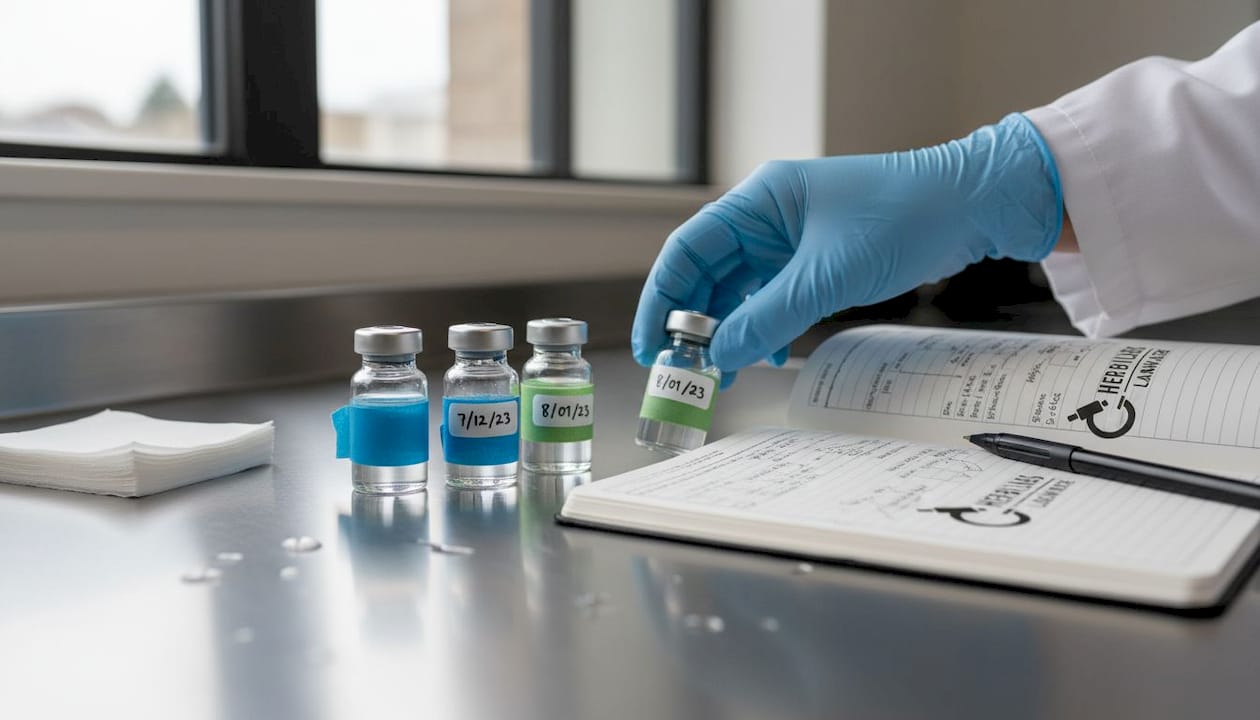
Pro Tip: Mark the date on every vial the moment you first puncture it. Bacteriostatic protection is real but not indefinite. Most formulations carry a 28-day post-opening window. Track it.
Sterile water for injection: Preservative-free, single-use approach
Sterile water for injection is exactly what it sounds like: ultrapure water, sterilized, with no additives whatsoever. Its defining strength is also its defining limitation. The absence of preservatives makes it the cleanest possible diluent, ideal when you need to eliminate every variable, but it also means any microbial contamination introduced at the moment of access has nothing standing in its way.
For single-use peptide reconstitution, sterile water is entirely appropriate and sometimes preferable. If your protocol involves reconstituting a full peptide vial and using the entire volume in a single session, there is no need for preservative content. You gain the absolute purity of a clean diluent without introducing any additive that might interact with a sensitive compound.
The risk emerges when researchers try to use sterile water as if it were bacteriostatic water. Drawing from the same sterile water vial multiple times removes the safety net entirely. Sterile water lacks post-access preservative protection, and multiple withdrawals introduce significant contamination risk. This is one of the most common practical mistakes in independent research settings.
| Feature | Bacteriostatic water | Sterile water |
|---|---|---|
| Preservative | Benzyl alcohol 0.9-1.1% | None |
| Multi-use from same vial | Yes, designed for this | No, single-use only |
| Antimicrobial protection after access | Yes | No |
| Best for | Repeated-access peptide protocols | Single-session reconstitution |
| Compatibility concern | Benzyl alcohol-sensitive peptides | None |
| Post-puncture contamination risk | Low | High if reused |
For researchers who use sterile water in GMP-aligned or single-use applications, peptide water for injection solutions with rigorous purity documentation are available and verifiable. The key is matching the product to the protocol, not selecting based on availability or price alone.
Pro Tip: If you open a single-use sterile water vial and have leftover volume, discard it. The cost of a second vial is negligible compared to the risk of contaminating a peptide batch you have already invested in.
Comparison of sterile solutions: Which is best for your workflow?
At this point, the core distinction is clear. Peptide-focused protocols consistently favor bacteriostatic water for multi-day access due to its preservative, and sterile water for immediate single-use applications due to its purity. But “which is best” is always workflow-specific. There is no universal winner.
Use bacteriostatic water when:
- Your reconstituted peptide will be accessed over multiple days or weeks
- You are working with standard peptides that have no documented preservative sensitivity
- Your workflow involves multiple doses from a single reconstituted vial
- You need consistent, documented antimicrobial protection between uses
Use sterile water when:
- The full vial volume will be used in one session
- Your peptide has documented sensitivity to benzyl alcohol
- Your protocol explicitly requires a preservative-free diluent
- GMP compliance or regulatory documentation demands a clean, additive-free solution
The most common workflow mistake is not choosing the wrong product. It is choosing correctly and then not following the protocol that product demands. Researchers who pick bacteriostatic water and then fail to refrigerate or discard after 28 days lose the benefit entirely. Researchers who use sterile water correctly for a single session but attempt to reuse the vial later create contamination risk they likely never measure or detect.
For a detailed sterile vs bacteriostatic comparison covering regulatory notes, European supply considerations, and product specifications, reviewing the full breakdown before making a bulk order decision is time well spent.
Technique matters: Best practices for peptide reconstitution
Selecting the right diluent is step one. How you actually perform the reconstitution determines whether that choice pays off. Poor technique destroys peptide integrity regardless of solution quality.
Follow these steps every time:
- Prepare your workspace. Clean surface, fresh gloves, sterile swabs for vial stoppers. No shortcuts here.
- Bring your solution to room temperature. Cold diluent added directly to a lyophilized peptide can cause localized aggregation. Allow the solution vial to equilibrate for 5 to 10 minutes.
- Insert the needle at a shallow angle into the rubber stopper. This creates a clean entry point and minimizes stopper particulate.
- Inject the diluent slowly, directing the stream along the inner wall of the vial. Do not aim directly at the lyophilized cake. Injecting slowly along the vial wall reduces foaming and mechanical disruption, which protects peptide structure at a molecular level.
- Allow the peptide to dissolve passively. Tilt or gently rotate the vial if needed. Never shake. Shaking introduces mechanical shear stress and aeration, both of which accelerate degradation.
- Inspect before use. The solution should be clear and free of particulates. Any cloudiness, color change, or visible debris is a reason to discard.
“The lyophilized peptide cake is fragile. Direct, forceful injection disrupts its matrix and can permanently alter bioactivity. Slow, wall-directed technique is not overcaution; it is the difference between a functional reconstitution and a wasted vial.”
For a detailed walkthrough with volume calculations and dilution ratios, the step-by-step peptide reconstitution resource provides practical tables alongside technique guidance. For solution selection at the reconstitution stage, safe reconstitution explained covers both sterile water and bacteriostatic water applications with protocol-specific context.
Pro Tip: Use an insulin syringe for small-volume reconstitutions under 2 mL. The fine gauge and precision markings reduce waste and give you much more control over slow, wall-directed injection than a standard research syringe.
Our perspective: Why overthinking sterile solutions can hurt your research
Here is something the product comparisons rarely say: the choice between bacteriostatic and sterile water is the easy part. What actually causes contamination events and data variability in independent research is almost never solution composition. It is technique and workflow discipline.
We have seen researchers obsess over sourcing ultra-pure alternatives or asking whether their specific lot number could affect outcomes by fractions of a percentage point. Meanwhile, they are reconstituting over an unclean bench, drawing from the same sterile water vial three times over a week, or storing reconstituted peptide solutions in a shared fridge without proper labeling or temperature monitoring.
The uncomfortable truth: your workflow habits are a bigger contamination variable than whether your bacteriostatic water is 0.9% or 1.1% benzyl alcohol. The solution matters. But the technique running alongside it matters just as much.
Routine discipline around three areas delivers the most real-world reliability:
Batch and lot verification. Every order should come with a certificate of analysis tied to a specific lot number. Cross-check it. Do not assume lot-to-lot consistency without documentation, especially when ordering from new suppliers. This is where sourcing from verified producers matters.
Storage hygiene. Proper bacteriostatic water storage means refrigerated, sealed, dated, and away from light. These are not suggestions. They are the conditions under which the preservative system maintains efficacy. Storing at room temperature or in a frost-prone fridge erodes that protection silently.
Access protocol. Every time you puncture a vial stopper, you introduce a contamination risk. Clean the stopper with 70% isopropyl alcohol before every single draw, even if you just did it 15 minutes ago. This discipline costs nothing and eliminates a vector that solution chemistry alone cannot address.
The researchers who get consistent, reproducible results are not the ones who found some exotic diluent. They are the ones who treat every reconstitution as a repeatable, documented procedure.
Get reliable sterile solutions and expert support
Choosing the right diluent is just the beginning of a dependable research workflow. At Herbilabs, we supply GMP-aligned bacteriostatic water and sterile water specifically manufactured for peptide research and scientific reconstitution applications across Europe.
Whether you are new to reconstitution or optimizing an established protocol, our product range and supporting resources are built for exactly your use case. Explore our bacteriostatic water FAQs for quick answers to the questions researchers ask most, review the complete bacteriostatic water guide for formulation and compatibility depth, or go directly to our sterile water for peptides page to find single-use solutions for your current protocol. Every product ships with full documentation, and our support team is available for pre-order questions and bulk or wholesale inquiries.
Frequently asked questions
What is the difference between sterile water and bacteriostatic water?
Sterile water is preservative-free and intended for single-use only, while bacteriostatic water contains benzyl alcohol as a preservative that supports multi-use microbial suppression between vial accesses.
Why can’t bacteriostatic water be used for neonates?
Bacteriostatic water must not be used for neonates because benzyl alcohol is toxic to newborns and is expressly contraindicated in neonatal applications under all clinical and research guidelines.
Can I use sterile water repeatedly from the same vial?
No. Sterile water lacks post-access protection, and drawing from the same vial multiple times creates a contamination risk that nothing in the formulation will counteract. Use it once and discard.
What is the best water for reconstituting sensitive peptides?
Preservative-free sterile water is preferred when a peptide has documented sensitivity to benzyl alcohol, provided the entire reconstituted volume will be used immediately in a single session.
How can I prevent peptide degradation during reconstitution?
Slow, wall-directed diluent addition and avoiding any shaking of the vial are the two most impactful practices for preserving peptide structure and bioactivity throughout the reconstitution process.