Private Label, White Label, Wholesale partnerships available - EU, USA and UK - Free shipping from €75

Diluents in lab protocols: a peptide research guide
Discover the crucial role of diluents in laboratory protocols to enhance your peptide research. Avoid costly mistakes and elevate your results!
TL;DR:
- Treating diluents as passive solvents is a common and costly mistake in peptide research that can lead to aggregation, degradation, and irreproducible results.
- Selecting appropriate diluents based on peptide chemistry and controlling their properties throughout storage and assay conditions are essential for ensuring stability and accuracy.
Treating diluents as passive solvents is one of the most common and costly mistakes in peptide research. The role of diluents in laboratory protocols extends far beyond simply making a concentrated solution less concentrated. Choose the wrong diluent, and you risk peptide aggregation, degradation, skewed assay readings, and results that cannot be reproduced across runs. This guide addresses diluent selection criteria, solubility considerations, and practical workflow decisions that directly affect the quality of your peptide research, whether you are working in an independent facility or a university lab.
Table of Contents
- Understanding the fundamental role of diluents in lab workflows
- Choosing diluents based on peptide chemistry and solubility needs
- How diluent selection influences experimental stability and assay outcomes
- Comparison of common diluents and best practices for laboratory use
- Practical workflow for selecting and using diluents in peptide research
- Why treating diluents as mere solvents undermines peptide research quality
- Resources and products for optimal diluent use in peptide research
- Frequently asked questions
Key Takeaways
| Point | Details |
|---|---|
| Diluent role is critical | Diluents provide precise dilution medium essential for accurate concentration and reproducible assays in peptide research. |
| Match diluent to peptide | Select solvents based on peptide charge and hydrophobicity to ensure solubility and prevent aggregation. |
| Diluent affects stability | Physicochemical properties of diluents influence peptide stability and experimental outcomes significantly. |
| Use serial dilution | Perform multi-step dilutions for large factors to maintain dilution accuracy and assay reliability. |
| Follow best lab practices | Gentle mixing, proper temperature control, and careful solvent addition enhance peptide reconstitution success. |
Understanding the fundamental role of diluents in lab workflows
A diluent is any solvent or aqueous medium used to reduce the concentration of a stock solution to a working concentration suited for a specific assay or protocol. That definition sounds straightforward, but the practical implications are anything but simple, particularly in peptide research where concentration precision is non-negotiable.
The core role of a diluent is to provide a controlled medium for diluting solutions to accurate target concentrations, whether via a fixed dilution factor or a structured serial dilution series. Serial dilution, where a solution is diluted in multiple successive steps rather than one large jump, is especially important when working with peptides at nanomolar or picomolar concentrations. Attempting a 1:10,000 dilution in a single step introduces unacceptable pipetting error. Breaking it into four sequential 1:10 steps solves that problem.
The calculation most researchers rely on is C1V1 = C2V2, where C1 and V1 represent the initial concentration and volume, and C2 and V2 represent the desired final values. For serial dilutions, the overall dilution factor is the product of each individual step. A 1:10 dilution followed by another 1:10 gives an overall factor of 1:100. Simple multiplication, but the errors that come from rushing these calculations or using the wrong diluent volume are a significant source of irreproducible data in peptide quantification work.
For researchers new to calculating these steps, preparing safe peptide solutions provides a practical walkthrough covering volume planning and concentration verification.
Common dilution errors to avoid:
- Adding diluent to a dry peptide without pre-wetting with an appropriate co-solvent
- Assuming all diluents are interchangeable because the target concentration looks the same
- Performing large single-step dilutions where pipetting variability compresses your accuracy
- Skipping concentration verification after dilution, especially with hydrophobic peptides
- Using diluents stored at incorrect temperatures, altering their chemical composition before use
Choosing diluents based on peptide chemistry and solubility needs
Not every peptide dissolves readily in water. The physical chemistry of each peptide sequence determines which diluent will work, and selecting based on convenience rather than peptide properties is a fast route to poor solubility, pellet formation, and lost sample.
The governing variables are net charge, hydrophobicity, and secondary structure tendency. Peptide reconstitution protocols recommend water or bacteriostatic water for water-soluble peptides, dilute acetic acid (typically 10 to 30%) for basic or positively charged peptides, and DMSO or DMF for hydrophobic peptides before dilution into aqueous buffer. Each solvent choice targets a specific chemistry problem.
Key diluent selection criteria by peptide type:
- Hydrophilic peptides with net negative charge: Sterile water or phosphate-buffered saline (PBS) typically works without modification
- Basic peptides (net positive charge): Dilute acetic acid helps by protonating charged residues and improving aqueous dispersibility
- Hydrophobic or poorly water-soluble peptides: Start with a small volume of DMSO or acetonitrile to wet the pellet, then dilute stepwise into aqueous buffer
- Peptides prone to aggregation: Avoid neutral pH and high ionic strength buffers during initial dissolution; consider urea-containing solvents for strongly aggregating sequences
- Peptides requiring long-term storage in solution: Bacteriostatic water with 0.9% benzyl alcohol provides microbial inhibition without compromising stability for many sequences
The “pre-dissolve then dilute” approach is worth standardizing in your workflow. Add a minimal volume of the primary solvent (DMSO, acetic acid) to wet the lyophilized pellet fully, then dilute progressively into aqueous buffer. This dramatically reduces the risk of aggregation compared to adding buffer directly to a dry hydrophobic peptide.
Pro Tip: When using sterile water for reconstitution, do not add the full target volume at once. Add 50% of the volume, swirl gently until dissolved, then bring to final volume. This prevents incomplete dissolution in the first contact zone.
Buffer composition matters more than most researchers acknowledge. Phosphate buffers can cause precipitation with calcium or magnesium ions. TRIS buffers affect amine-reactive assays. Always confirm that your chosen diluent is compatible with the downstream assay chemistry, not just the peptide itself. For a detailed breakdown of when bacteriostatic water outperforms sterile water and vice versa, the bacteriostatic water comparison guide is worth reviewing before you commit to a protocol.
How diluent selection influences experimental stability and assay outcomes
Even when a peptide appears fully dissolved, the diluent’s physicochemical properties continue to affect stability throughout storage and assay incubation. pH drift, ionic strength mismatch, and solvent polarity all shift the equilibrium between soluble and aggregated forms.
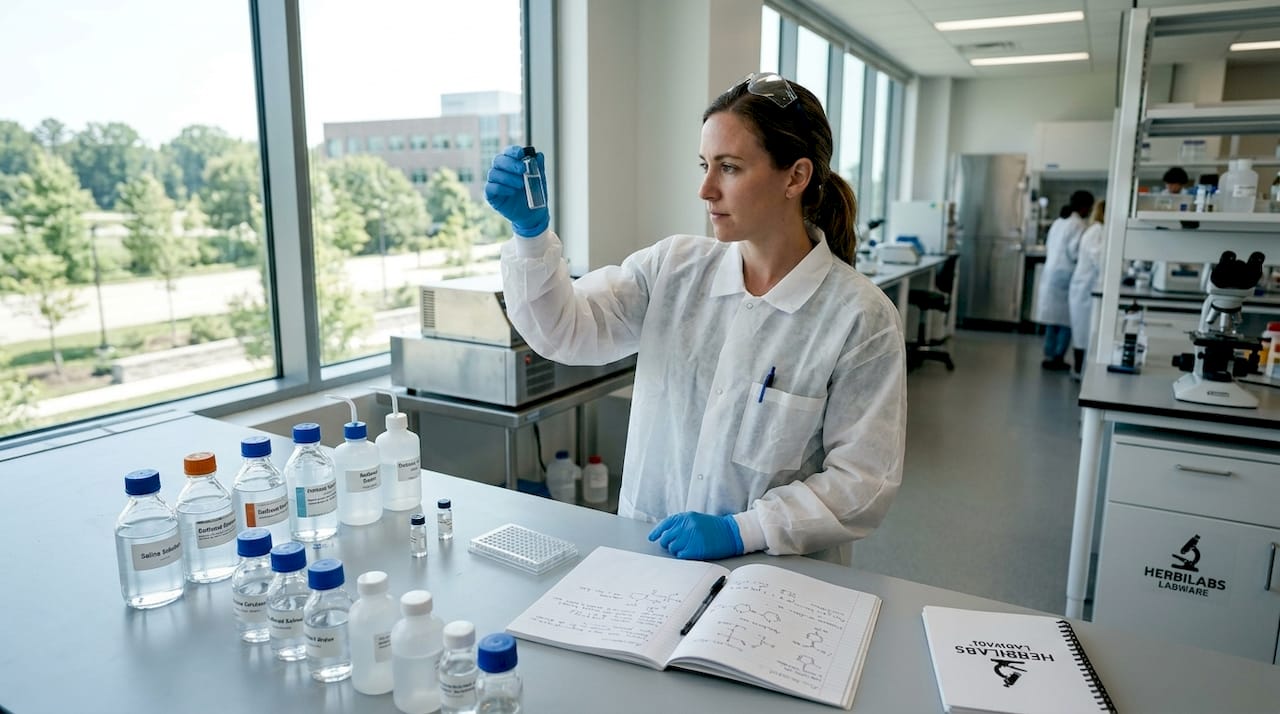
Diluent choice sets the physicochemical conditions that govern stability and performance of the compound being studied. In a practical sense, a peptide reconstituted in a slightly acidic bacteriostatic water solution and one reconstituted in neutral PBS can behave as if they are different compounds in a cell-based assay, even at identical concentrations.
Stability risks associated with poor diluent selection:
- Aggregation: Hydrophobic peptides in incompatible aqueous buffers form insoluble aggregates that remove peptide from solution and produce falsely low assay signals
- Degradation: Basic conditions accelerate asparagine deamidation and aspartate isomerization in susceptible sequences
- Assay interference: High percentages of DMSO (above 1% final concentration) can disrupt cell membranes in bioassays or inhibit enzyme activity in enzymatic assays
- Precipitation: Mixing incompatible buffers (for example, a phosphate-buffered stock with a calcium-containing diluent) causes immediate precipitation at the point of mixing
Pharmaceutical formulation data reinforces this point: diluents are not neutral carriers. Even in solid dosage forms, microcrystalline cellulose changes tablet hardness and disintegration behavior, demonstrating that every diluent decision has measurable downstream consequences on the material it carries.
In peptide research, this translates to reproducibility failure. If your diluent varies between batches in ionic strength, pH, or contamination level, your results will vary even when the peptide, assay format, and operator remain constant. Treating diluent as a quality control variable rather than a commodity input is what separates reliable data from data you cannot publish.
Comparison of common diluents and best practices for laboratory use
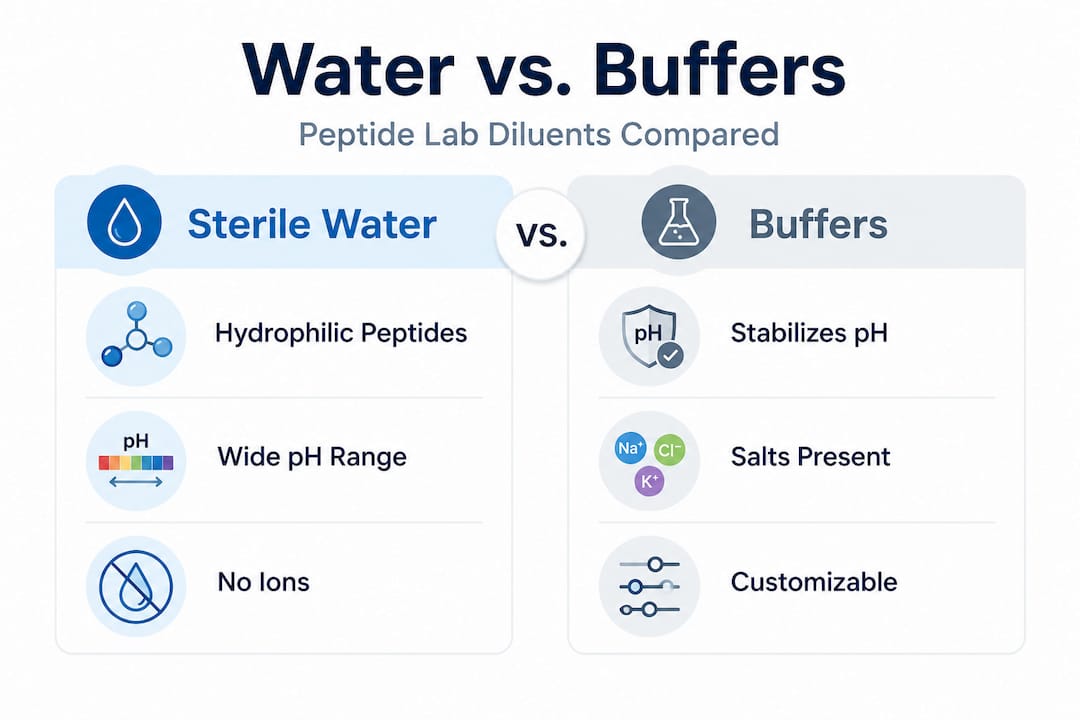
The table below summarizes how the most frequently used diluents in peptide research compare across the variables that matter most.
| Diluent | Best for | pH range | Preservative | Key limitation |
|---|---|---|---|---|
| Sterile water | Hydrophilic peptides, short-term use | ~6.5 to 7.0 | None | No microbial inhibition; single-use only |
| Bacteriostatic water | Multi-use peptide stocks | ~4.5 to 7.0 | 0.9% benzyl alcohol | Not suitable for neonatal or certain cell assays |
| Dilute acetic acid (10 to 30%) | Basic/cationic peptides | 2.5 to 4.5 | None | Incompatible with base-sensitive assays |
| DMSO | Hydrophobic peptides (stock only) | Neutral | None | Cell toxicity above 0.5 to 1% final concentration |
| PBS (pH 7.4) | General aqueous assays | 7.2 to 7.4 | None | Can precipitate with divalent cations |
Following peptide charge and hydrophobicity guidelines when selecting from this table will prevent the majority of solubility and stability problems encountered in lab practice.
Step-by-step dilution protocol for hydrophobic peptides with organic co-solvents:
- Equilibrate the lyophilized peptide vial to room temperature before opening to prevent condensation
- Add a minimal volume of DMSO (typically 5 to 10% of final target volume) to wet the pellet fully
- Vortex gently or swirl until the pellet is completely dissolved; confirm by visual inspection
- Add aqueous buffer or sterile diluent in small increments, swirling between additions
- Bring to final target volume and check for clarity; if cloudiness appears, brief bath sonication at low power may clarify the solution
- Confirm final DMSO percentage remains below 1% for cell-based assays or below 5% for biochemical assays
Pro Tip: Never add water or aqueous buffer directly to a dry hydrophobic peptide. The peptide wets incompletely and forms a film that resists further dissolution. Organic pre-wetting changes the surface energy of the pellet and makes aqueous dilution far more effective.
Practical workflow for selecting and using diluents in peptide research
A reliable diluent selection workflow reduces guesswork and prevents the downstream errors that compound across a multi-week study. The following sequence applies across most peptide research contexts.
Sequential decision process:
- Identify peptide net charge at physiological pH using sequence analysis tools or supplier data sheets
- Assess hydrophobicity index; sequences with more than 50% hydrophobic residues typically require organic pre-dissolution
- Confirm assay compatibility requirements: cell-based assays restrict DMSO, enzymatic assays restrict certain ions
- Select primary diluent and co-solvent based on the above, consulting dilution factor calculation methods for accurate concentration planning
- Prepare diluent fresh or verify stored diluent pH and sterility before use
- Document lot numbers, pH readings, and preparation dates for every diluent batch used
The table below illustrates a typical serial dilution series for a peptide stock at 1 mg/mL being prepared for a dose-response assay:
| Step | Starting concentration | Dilution factor | Volume transferred | Final concentration |
|---|---|---|---|---|
| 1 | 1 mg/mL | 1:10 | 100 µL into 900 µL | 100 µg/mL |
| 2 | 100 µg/mL | 1:10 | 100 µL into 900 µL | 10 µg/mL |
| 3 | 10 µg/mL | 1:10 | 100 µL into 900 µL | 1 µg/mL |
| 4 | 1 µg/mL | 1:10 | 100 µL into 900 µL | 100 ng/mL |
Multi-step dilution planning like this allows you to span a wide concentration range while keeping pipetting error at each step within a manageable tolerance.
Procedural checklist for peptide reconstitution:
- Allow vials to reach room temperature before opening (reduces condensation-driven concentration errors)
- Use calibrated pipettes verified within their maintenance window
- Add diluent gently along the vial wall, not directly onto the lyophilized cake
- Mix by gentle swirling or inversion, never by vigorous vortexing that creates foam
- Inspect visually for full dissolution before proceeding to dilution steps
- Label each working solution with peptide name, concentration, diluent identity, date prepared, and expiry
Pro Tip: When working with peptide research solutions across multiple assay days, prepare your dilution series fresh from the primary stock each session rather than storing intermediate dilutions. Intermediate stocks at low concentrations adsorb to tube walls and degrade faster than concentrated stocks.
Review your water handling practices as well, since even trace contaminants in your aqueous diluent can compromise downstream results when you are working at sub-microgram concentrations.
Why treating diluents as mere solvents undermines peptide research quality
Here is the uncomfortable reality: most reproducibility problems in peptide research are not caused by the peptide itself. They are caused by what the peptide is dissolved in.
We have seen this pattern repeatedly. A researcher meticulously controls incubation time, temperature, cell passage number, and assay timing, but switches bacteriostatic water batches between experiments without logging the change. The next run produces a 30% signal shift. The instinct is to question the peptide or the assay. The actual culprit is the diluent, and nobody checks it because it was treated as inert.
Diluents are not passive fillers. They are added for specific functional purposes, including controlling delivery, maintaining stability, and supporting manufacturing consistency. That framing from pharmaceutical science applies directly to research protocols. Every diluent brings a pH, an ionic environment, a potential interaction with your peptide’s charged residues or hydrophobic patches. None of those variables are neutral.
The fix is straightforward in principle, though it requires a genuine shift in lab culture. Diluent selection and batch documentation belong in your standard operating procedures alongside assay reagents and equipment calibration records. Staff training should cover not just how to dilute but why the diluent choice matters for that specific peptide and assay format. When researchers treat diluents as active contributors to experimental design rather than background items, reproducibility improves. It is that direct.
The same quality control rigor you apply to antibodies, enzymes, and consumables needs to extend to diluents. When it does, the number of unexplained result variations drops substantially.
Resources and products for optimal diluent use in peptide research
Getting diluent selection right starts with having access to reagents manufactured to a standard that matches the precision your research demands.

Herbilabs supplies research-grade bacteriostatic water and sterile diluents produced under strict purity controls, specifically for the peptide research community across Europe and the UK. If you are unclear on when to use bacteriostatic water versus sterile water, the complete bacteriostatic water guide covers everything from mechanism to storage. For side-by-side comparisons, the bacteriostatic water vs sterile water breakdown makes the decision straightforward. Answers to the most common practical questions are available in the bacteriostatic water FAQ. When you are ready to order, the Herbilabs shop carries premium diluents in research-appropriate formats, with wholesale pricing available for labs ordering at scale.
Frequently asked questions
What is the primary purpose of a diluent in peptide laboratory protocols?
A diluent serves as a controlled medium to reduce a concentrated peptide solution to the working concentration needed for accurate assay results. Its core function is to provide a consistent, inert environment where peptide concentration can be precisely managed.
How does diluent choice affect peptide stability during experiments?
Diluent properties including pH, ionic strength, and solvent polarity directly shape the physicochemical environment around the peptide. Poor diluent conditions can trigger aggregation, accelerate chemical degradation, or interfere with assay signals in ways that are difficult to trace back to the diluent.
When should I use DMSO as a diluent for peptides?
Use DMSO only as a primary solvent for highly hydrophobic peptides that resist aqueous dissolution, then dilute progressively into aqueous buffer to keep final DMSO concentration below 1% for cell-based work.
Why is serial dilution recommended over a single large dilution step?
Large single-step dilutions accumulate pipetting error that becomes proportionally larger as the dilution factor increases. Serial dilution distributes that error across multiple manageable steps, significantly improving final concentration accuracy.
What are best practices when reconstituting peptides with diluents?
Warm the vial to room temperature before opening, add diluent gently along the vial wall, mix by swirling rather than vortexing, and confirm full dissolution visually before proceeding. Proper reconstitution technique also includes documenting the diluent identity, batch, and preparation date for every working solution.