Private Label, White Label, Wholesale partnerships available - EU, USA and UK - Free shipping from €75

Advantages of Lab-Grade Reagents for Scientific Research
Discover the advantages of lab-grade reagents for scientific research. Improve reproducibility and manage costs without sacrificing quality.
TL;DR:
- Lab-grade reagents offer sufficient purity for routine laboratory procedures at a lower cost compared to reagent-grade chemicals. They enable reproducible results when sourced from reliable suppliers and properly documented with lot records, supporting experimental integrity and audit readiness. Matching reagent grade to application sensitivity optimizes budgets and maintains data quality across diverse research workflows.
Lab-grade reagents are defined as chemical substances manufactured to a specified purity range suitable for general laboratory work, routine experimentation, and preparatory procedures where ultra-trace sensitivity is not required. Known formally as laboratory-grade or technical-grade chemicals, they occupy a deliberate position in the reagent hierarchy: purer than industrial-grade materials, yet less rigorously documented than reagent-grade or ACS-certified chemicals. For researchers managing both experimental integrity and procurement budgets, understanding the advantages of lab-grade reagents is not academic. It directly shapes reproducibility, cost control, and the defensibility of your data.
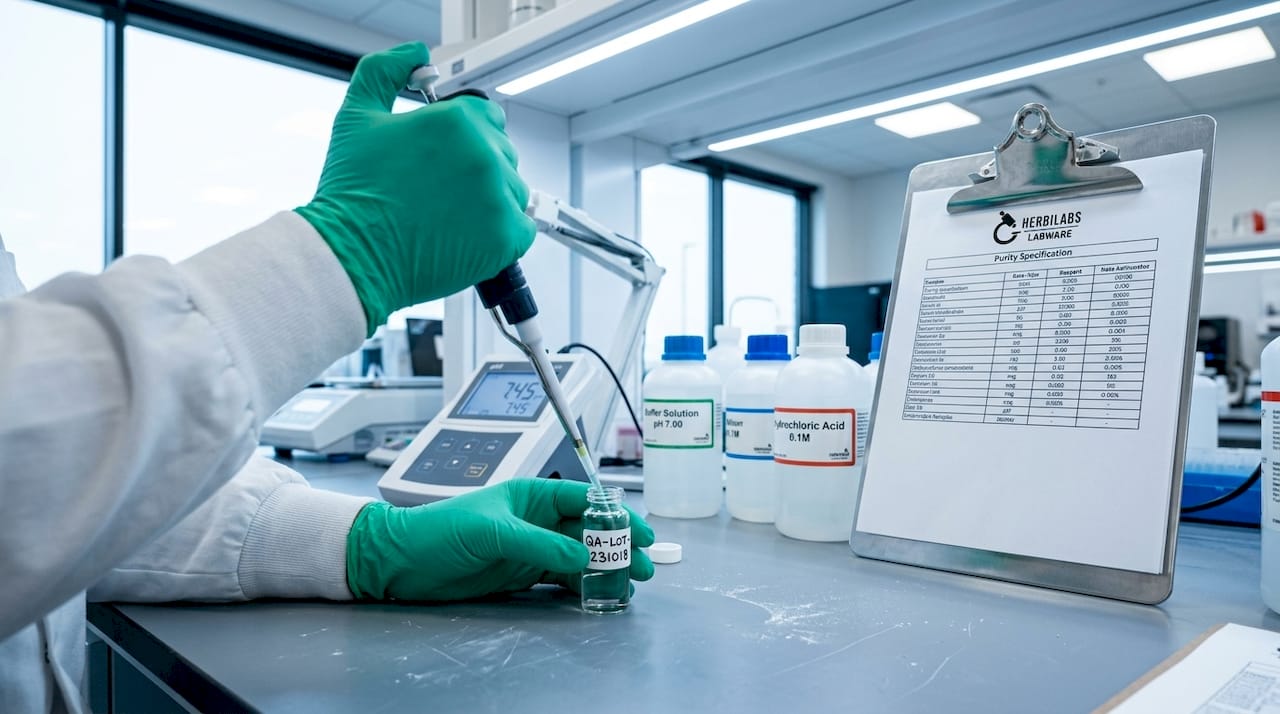
1. The core advantages of lab-grade reagents: purity meets practicality
Lab-grade reagents deliver a functional purity level that satisfies the demands of most routine laboratory procedures without the cost premium attached to higher-grade materials. Laboratory-grade chemicals carry broader purity ranges and fewer quantified impurity limits, making them cost-effective for high-volume, non-trace-sensitive applications. That cost efficiency matters: when a procedure calls for buffer preparation, media formulation, or equipment cleaning, paying for ACS-grade purity adds expense without adding scientific value.
The advantages of high-purity reagents at the lab-grade level are most visible in settings where volume is high and method sensitivity is moderate. Routine quality control checks, educational laboratory exercises, and early-phase exploratory experiments all fall squarely into this category. Choosing the correct grade from the start prevents both under-specification (which risks data quality) and over-specification (which wastes budget).
Key practical advantages include:
- Cost efficiency at scale: Lab-grade materials cost significantly less per unit than reagent-grade equivalents, which matters when running dozens of preparatory procedures weekly.
- Sufficient purity for non-trace methods: For procedures not requiring quantification at parts-per-billion levels, lab-grade purity is scientifically appropriate.
- Broad availability: Lab-grade chemicals are widely stocked, reducing lead times and supply disruptions.
- Reduced waste risk: Using a lower-cost grade for preparatory or cleaning steps means less financial loss when procedures are repeated or scaled.
Pro Tip: Before ordering any reagent, check your method’s sensitivity threshold. If your assay does not require impurity quantification below the parts-per-million level, lab-grade is the correct choice, not a compromise.
2. How lab-grade reagents compare to reagent-grade chemicals
Understanding lab-grade reagent quality requires a direct comparison with reagent-grade materials, since the two are frequently confused in procurement decisions. Reagent-grade materials generally include batch-specific purity data and impurity limits that aid traceability, while lab-grade materials are designed for routine use with broader impurity ranges and less documentation. The distinction is not about one being defective. It is about fitness for purpose.
| Feature | Lab-grade | Reagent-grade (ACS) |
|---|---|---|
| Purity specification | Broad range, functional threshold | Tight limits, validated test methods |
| Impurity profiling | Partial or absent | Complete, batch-specific |
| Certificate of Analysis | Basic or limited | Full CoA with lot data |
| Regulatory suitability | Routine and preparatory work | Validation, calibration, regulatory submission |
| Cost | Lower | Higher |
| Typical applications | Buffers, media, cleaning, education | Trace analysis, pharmacopeial testing, audits |
ACS reagent standards specify purity and test methods that support defensible and reproducible measurement integrity, which is the defining feature that separates them from lab-grade materials. For researchers running validated analytical methods or preparing submissions for regulatory review, reagent-grade is the correct choice. For everyone else running the bulk of daily laboratory operations, lab-grade reagent reliability is sufficient and more economical.
The cost versus performance trade-off is real. Reagent-grade chemicals can cost two to five times more per unit depending on the compound and supplier. Applying that cost to every procedure in a busy lab is rarely justified by the science.
3. Why documentation and traceability still matter at the lab-grade level
Lab-grade reagents do not carry the full documentation suite of reagent-grade materials, but the traceability they do provide still delivers measurable advantages. Even partial impurity profiling supports method validation by establishing a known baseline for what is present in your reagent matrix. This matters when troubleshooting unexpected results or defending data under peer review.
Reagent standards complement pharmacopeial standards by anchoring the quality of lab measurement materials, making results defensible especially under audit or regulatory review. Even when using lab-grade materials for non-regulated work, maintaining lot records and basic CoA documentation protects your research from questions about reagent variability.
The documentation advantages of lab-grade reagents include:
- Lot traceability: Knowing which batch was used in a given experiment allows you to isolate reagent variability as a variable when results shift unexpectedly.
- Baseline impurity data: Partial impurity profiles help you rule out reagent contamination as a source of assay interference.
- Audit readiness: Even in academic settings, grant audits and institutional reviews increasingly require documentation of materials used.
- Reproducibility support: Consistent lot documentation enables you to replicate conditions across experiments conducted weeks or months apart.
“Many analytical failures attributed to instruments originate from variability in the chemical reagents themselves due to impurities and lot-to-lot variation.” ACS
This insight reframes how you should think about reagent documentation. The CoA is not paperwork. It is a diagnostic tool. When your assay drifts, the first question should be whether the reagent lot changed, not whether the instrument needs recalibration.
4. Reproducibility: the most underrated benefit of lab-grade reagents
High-purity chemical standards directly impact metrological traceability, experiment reproducibility, and confidence in data interpretation. Lab-grade reagents, when sourced from a reputable supplier with consistent manufacturing controls, deliver lot-to-lot stability that underpins reproducible results across experimental runs. This is the benefit researchers most frequently overlook when evaluating reagent grades.
Reproducibility failures in laboratory research are rarely dramatic. They appear as subtle baseline shifts, slightly elevated background signals, or results that fall just outside expected ranges. ACS emphasizes that reducing variability in reagent purity prevents these baseline shifts and method instability. Lab-grade reagents sourced from suppliers with documented quality control processes deliver this stability for routine work without requiring the full validation infrastructure of reagent-grade procurement.
The practical implication is straightforward. If your buffer preparation uses the same lab-grade sodium chloride from the same supplier with consistent lot documentation, your baseline is controlled. Switching suppliers or grades mid-study without documentation is where reproducibility breaks down, not the grade itself.
Pro Tip: When reproducibility is a priority, standardize on a single supplier for your lab-grade reagents and record lot numbers in your experimental logbook. This single habit eliminates the most common source of unexplained result variation.
5. Specific applications where lab-grade reagents provide the most value
The importance of lab-grade reagents becomes clearest when mapped to specific laboratory workflows. Not every procedure in your lab requires the same reagent specification, and matching grade to application is where real efficiency gains appear.
- Buffer and media preparation: Phosphate-buffered saline, cell culture media, and chromatography buffers are prepared in large volumes where ultra-trace purity is irrelevant. Lab-grade salts and solvents are the standard choice here.
- Equipment cleaning and decontamination: Acid washes, solvent rinses, and surface decontamination procedures consume large reagent volumes. Lab-grade materials perform identically to higher grades for these purposes at a fraction of the cost.
- Early-phase exploratory research: When testing a new assay format or screening conditions before committing to a validated method, lab-grade reagents reduce the cost of iteration without compromising the exploratory data.
- Educational and training laboratories: University teaching labs and training programs run high volumes of repeated procedures. Lab-grade reagents make this economically viable while still delivering real chemical behavior.
- Quality control procedures: Routine QC checks that monitor process consistency rather than trace-level quantification are well served by lab-grade materials.
- Reconstitution and dilution steps: When preparing working solutions from concentrated stocks, the diluent grade matters less than the stock purity. Lab-grade water or solvents are appropriate for most dilution workflows.
Freeze-dried reagent systems now extend the practical reach of lab-grade materials further by enabling storage and transport without refrigeration, then reactivation on-site. This development is particularly relevant for decentralized research settings and field laboratories where cold-chain logistics are a constraint.
Pro Tip: Map your lab’s procedures by sensitivity tier before your next procurement cycle. Assign reagent grades to tiers rather than to individual procedures. This prevents the common mistake of defaulting to the highest available grade for every application.
Key takeaways
Lab-grade reagents deliver the best return when matched deliberately to application sensitivity, with documentation practices that protect reproducibility and audit readiness regardless of grade.
| Point | Details |
|---|---|
| Grade matching saves budget | Assign lab-grade reagents to routine, non-trace-sensitive procedures to avoid unnecessary cost. |
| Documentation protects reproducibility | Record lot numbers and retain basic CoA data even for lab-grade materials used in routine work. |
| Reagent variability causes most drift | Baseline shifts and assay instability most often trace back to reagent lot changes, not instrument faults. |
| Reagent-grade is not always better | ACS-grade materials are justified for trace analysis and regulatory submissions, not for buffer prep or cleaning. |
| Supplier consistency matters | Standardizing on one supplier for lab-grade reagents controls variability more effectively than upgrading grade. |
What I’ve learned about matching reagent grade to research reality
I have watched researchers default to reagent-grade materials for every application in their lab, convinced that higher purity is always safer. The result is predictable: procurement budgets run short by Q3, purchasing decisions get made under pressure, and supplier consistency breaks down. That inconsistency introduces more variability than the original grade difference ever would have.
The smarter approach is to treat reagent grade as a method parameter, not a status signal. When I review a lab’s reagent procurement against their actual method portfolio, the pattern is almost always the same. Roughly 60 to 70 percent of procedures genuinely require nothing above lab-grade. The remaining 30 to 40 percent, typically validated analytical methods, regulatory submissions, or trace-level quantification, justify reagent-grade or higher. Spending ACS-grade budget on buffer salts and cleaning solvents is a procurement error, not a quality decision.
The quality control practices behind your supplier’s manufacturing process matter more than the grade label on the bottle. A lab-grade reagent from a supplier with rigorous in-house QC will outperform a nominally higher-grade material from a supplier with inconsistent batch controls. Audit your supplier’s documentation standards before you audit your reagent grades.
One more observation worth sharing: the researchers who maintain the most reproducible results are not the ones buying the most expensive reagents. They are the ones who document lot numbers, standardize suppliers, and match grade to method with discipline. That habit costs nothing and delivers more than any grade upgrade.
— Ragnar
Source your lab-grade reagents from a supplier that takes quality seriously
Herbilabs supplies research-grade reagents and reconstitution solutions manufactured to strict purity standards, with rigorous quality control at every production stage. Whether you are formulating buffers, preparing reconstitution solutions, or sourcing bacteriostatic water for peptide research, Herbilabs provides the documentation and consistency that routine laboratory work demands. Explore the reagent quality resources on the Herbilabs site to understand how manufacturing standards translate into reliable experimental outcomes. For researchers in the UK and Europe, the Herbilabs shop offers wholesale pricing, secure ordering, and supply options designed for both institutional and independent research settings.
FAQ
What makes lab-grade reagents different from reagent-grade?
Lab-grade reagents have broader purity ranges and less complete impurity documentation than reagent-grade materials. Reagent-grade chemicals, including ACS-certified products, include batch-specific CoA data and validated test methods required for trace-sensitive or regulatory workflows.
Are lab-grade reagents reliable enough for reproducible results?
Yes, when sourced from a supplier with consistent manufacturing controls and documented lot data. Reagent variability is a leading cause of assay drift, so supplier consistency and lot tracking matter more than grade alone for routine reproducibility.
When should I choose reagent-grade over lab-grade?
Choose reagent-grade for trace-level quantitative analysis, method validation, calibration standards, and any workflow requiring regulatory submission. Lab-grade suits routine preparation, buffer formulation, cleaning, and early-phase exploratory work where ultra-trace purity is not a method requirement.
Does using lab-grade reagents compromise audit readiness?
Not if you maintain lot records and retain available CoA documentation. Even partial impurity data supports traceability and helps isolate reagent variability during result review or institutional audit.
Can lab-grade reagents be used in peptide research reconstitution?
Lab-grade diluents and reconstitution solutions are appropriate for many peptide research workflows, provided the supplier’s manufacturing standards and purity documentation meet the requirements of your specific protocol. Always verify the grade against your method’s sensitivity and documentation requirements before use.