Private Label, White Label, Wholesale partnerships available - EU, USA and UK - Free shipping from €75

How to Store Research Reagents for Reliable Results
Learn how to store research reagents for reliable results. Ensure optimal stability and avoid costly data errors with our comprehensive guide.
TL;DR:
- Proper storage, labeling, and aliquoting are essential to maintain reagent integrity.
- Disciplined processes outweigh expensive equipment in achieving reproducible experimental results.
- Regular visual inspections and temperature logs help verify ongoing reagent quality.
Unreliable data rarely comes from bad science. More often, it traces back to a single overlooked variable: how reagents were stored before the experiment even started. Peptide solutions degrade faster than most researchers expect, and reconstituted peptides stored improperly lose stability within days, throwing off dose-response curves, binding assays, and comparative studies. This guide walks you through every critical step, from gathering the right materials to verifying ongoing reagent quality, so your storage protocol becomes your strongest asset rather than your biggest liability.
Table of Contents
- Essential materials and preparation steps
- Step-by-step guide to storing research reagents
- Common mistakes and troubleshooting tips
- How to verify reagent quality during storage
- Why process matters more than technology in reagent storage
- Your next steps for safe reagent storage
- Frequently asked questions
Key Takeaways
| Point | Details |
|---|---|
| Aliquot after reconstitution | Dividing reagents into small portions prevents damaging freeze-thaw cycles and preserves functionality. |
| Maintain 2–8°C cold storage | Most research reagents and reconstituted peptides stay stable for weeks at this temperature range. |
| Check and log reagent integrity | Routinely inspect and record reagent condition to quickly identify potential degradation and maintain experimental validity. |
| Label and date everything | Accurate labeling and dating help avoid mix-ups and ensure compliance with good lab practices. |
Essential materials and preparation steps
Before you pipette a single microliter, your storage setup needs to be ready. Disorganized or underprepared storage environments are where most reagent failures begin. Skipping this phase leads to mislabeled vials, temperature excursions, and contaminated batches that only reveal themselves mid-experiment.
Core materials you need:
- Low-binding microcentrifuge tubes or amber glass vials (1.5 mL and 2 mL sizes cover most use cases)
- High-quality bacteriostatic water (0.9% benzyl alcohol, research grade) for peptide reconstitution
- Waterproof cryogenic labels that adhere at temperatures well below freezing
- Permanent fine-tip markers rated for cold storage surfaces
- A calibrated refrigerator maintaining a steady 2–8°C for short-term storage
- A dedicated freezer capable of holding minus 20°C for long-term dry peptide storage
- A reagent inventory logbook or digital tracking spreadsheet
- Sterile filter tips and pipettes rated for accurate low-volume transfers
An aliquot is a precisely measured portion split from a larger sample and stored separately. This is a foundational concept in reagent management. Rather than repeatedly accessing a single master stock, you split it into multiple smaller working volumes, each used once and then discarded. Aliquoting post-reconstitution prevents freeze-thaw damage, which is critical for multi-experiment reliability.
Understanding safe peptide storage practices before you begin will clarify which container types are appropriate for your specific reagents. Likewise, knowing your reliable labware types ensures you don’t inadvertently introduce adsorption losses by using the wrong tube material.
Preparation workflow:
| Step | Action | Why it matters |
|---|---|---|
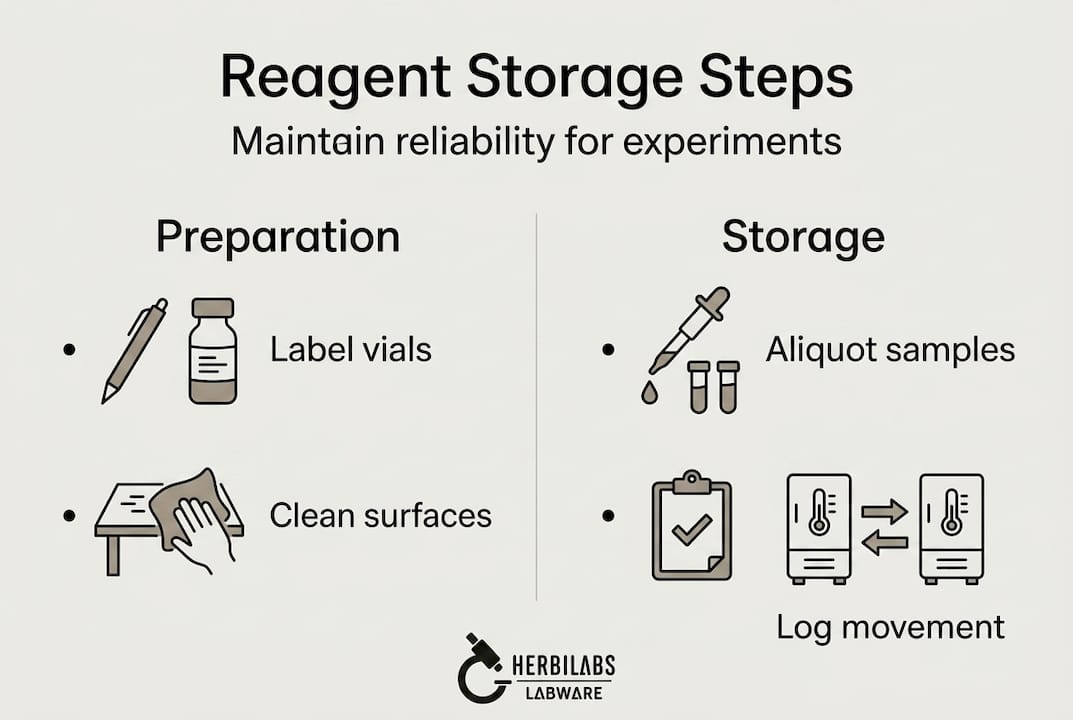
| 1 | Wipe work surfaces with 70% ethanol | Removes microbial contamination |
| 2 | Pre-label all vials before adding reagent | Prevents mix-ups during handling |
| 3 | Confirm cold storage temperature with calibrated probe | Catches equipment drift before reagents are placed |
| 4 | Verify bacteriostatic water batch and expiry | Ensures reconstitution medium is viable |
| 5 | Prepare reagent log with batch numbers and dates | Creates traceability from day one |
Pro Tip: Always maintain a secondary cold storage unit. Refrigerators fail unexpectedly, and having a backup unit dedicated solely to critical reagents can be the difference between a minor inconvenience and losing weeks of reconstituted stock.
Your prep environment also matters beyond the bench surface. Cold storage units should be positioned away from heat sources such as autoclaves or incubators, and their door seals should be inspected monthly. A unit that cycles between 4°C and 10°C due to a worn door gasket is just as damaging as no cold storage at all.
Step-by-step guide to storing research reagents
Now that your materials are assembled and your workspace is prepped, here is the actual storage process you should follow every single time you handle research reagents. Consistency is not optional here. Each deviation from your established protocol is a potential source of variability in your data.
Step 1: Label every vial before filling it
Write the reagent name, concentration, reconstitution date, batch number, and your initials on each label before adding any liquid. Labeling after filling risks spills, and labeling from memory later is how critical details get lost. Use cryogenic-rated labels to ensure text remains legible through freeze-thaw exposure.
Step 2: Reconstitute with bacteriostatic water
For peptides, bacteriostatic water is strongly preferred over sterile water for multi-use scenarios. The 0.9% benzyl alcohol acts as a preservative, inhibiting microbial growth within the solution. Add the diluent slowly along the inner wall of the vial and rotate gently. Never vortex peptide solutions. Vigorous mixing introduces air bubbles and can damage peptide structure, particularly for longer chains. If you’re unsure about the differences between these diluent types, the comparison in bacteriostatic vs sterile water clarifies the practical implications for storage duration and safety.
Step 3: Aliquot immediately after reconstitution
Divide the reconstituted solution into single-use volumes before placing anything in storage. If your experiment calls for 200 µL per run and you have 1 mL total, prepare five 200 µL aliquots. Place them in separate labeled vials. Peptide solutions reconstituted in bacteriostatic water remain stable for weeks at 2–8°C when handled this way, and each vial is opened only once, eliminating freeze-thaw cycles entirely.
Step 4: Store according to reagent type
Use this comparison table to apply the right conditions for different reagent categories:
| Reagent type | Short-term storage | Long-term storage | Key risk |
|---|---|---|---|
| Reconstituted peptides | 2–8°C in bac water | Minus 20°C dry | Freeze-thaw degradation |
| Enzyme solutions | 2–8°C in buffer | Minus 80°C in glycerol | Activity loss on warming |
| Small molecule chemicals | Room temp or 2–8°C | Minus 20°C sealed | Moisture ingress |
| Antibodies (liquid) | 2–8°C short-term | Minus 20°C with glycerol | Aggregation and oxidation |
Step 5: Log every storage movement
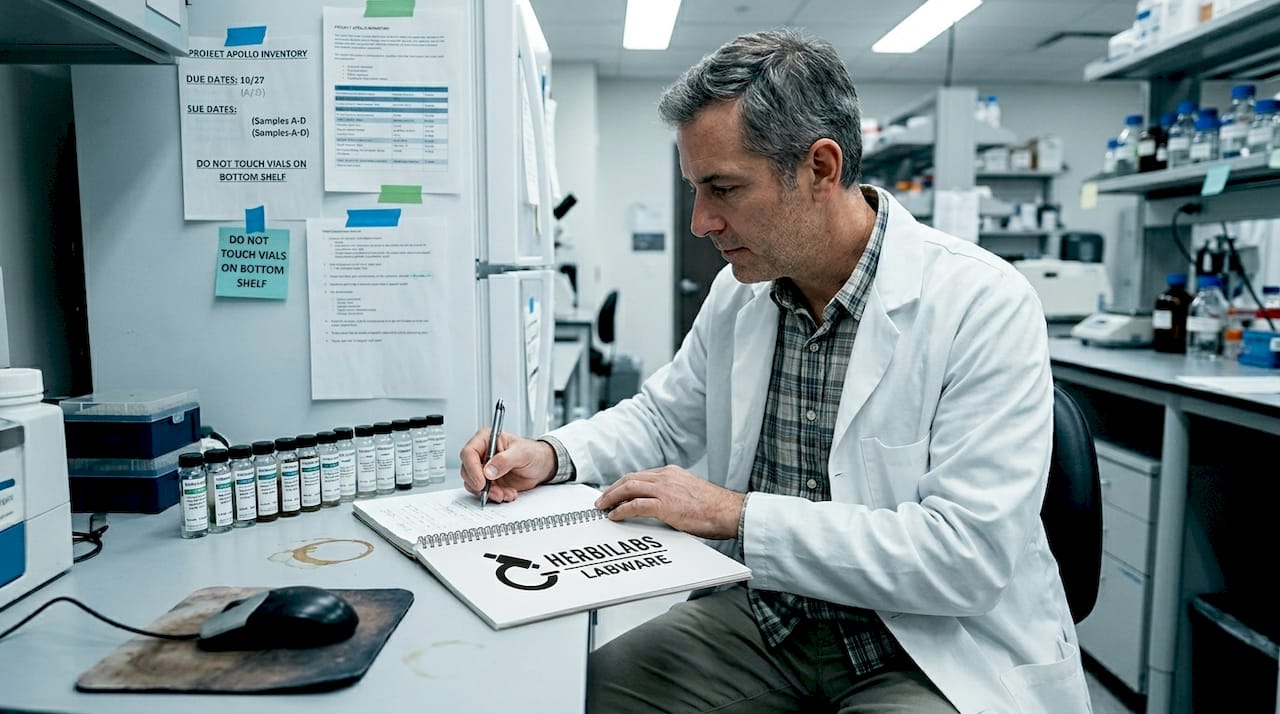
Every time a vial enters or exits storage, the event should be recorded. This includes date, vial ID, who handled it, and the reason for removal. This sounds like administrative overhead, but this log is what lets you trace the origin of anomalous results weeks later.
Pro Tip: Take a photo of your cold storage arrangement each time you add new aliquots. A visual record takes five seconds and provides irrefutable documentation of storage conditions if your data comes under scrutiny.
For specific guidance on the diluent itself, reviewing the protocol for storing bacteriostatic water safely prevents the common mistake of storing your reconstitution medium improperly before it even contacts your peptides.
Common mistakes and troubleshooting tips
Even experienced researchers make storage errors, usually during high-pressure periods when protocols get shortcut. Recognizing these failure points in advance lets you build safeguards into your workflow before a mistake costs you a batch.
The most frequent storage errors:
- Skipping label updates after concentration changes or partial usage. A vial labeled 1 mg/mL that has been partially used is now mislabeled. Update it immediately or discard it.
- Ignoring freeze-thaw cycles with reconstituted peptides. Each cycle stresses the peptide structure. Aliquoting after reconstitution is the most effective way to prevent this damage entirely.
- Co-storing opened reagents with non-sterile materials. An open vial placed next to an unsterile brush or sponge picks up environmental contamination even without direct contact.
- Overlooking condensation inside cold storage. When warm humid air enters a cold refrigerator repeatedly, condensation accumulates on vial surfaces and labels. This accelerates label failure and can introduce moisture into improperly sealed vials.
- Relying on memory for storage duration. “I think I reconstituted this last month” is not a data point. Your log is.
“Aliquoting after reconstitution is not optional. It is the best way to protect sensitive peptides for future experiments and the single most impactful habit you can build into your storage routine.”
One of the more subtle issues is temperature stratification inside refrigerators. The top shelf of most standard lab refrigerators runs warmer than the middle shelves because heat rises and cold air settles. Placing temperature-sensitive peptide aliquots on the top shelf can mean they’re sitting at 9–10°C rather than the intended 4°C. Always use a calibrated probe to map your unit before deciding where to place reagents.
For any researcher working with injectable peptide preparations, understanding lab sterilization tips reinforces the sterility discipline that storage alone cannot guarantee. Contamination that enters during reconstitution will persist through storage and invalidate your results regardless of how perfectly controlled the refrigerator temperature is.
Pro Tip: Set a recurring weekly calendar reminder to physically check all stored reagents. Even a 90-second visual scan catches labeling issues, unexpected precipitates, or vials that have been accidentally left outside cold storage before the damage becomes irreversible.
How to verify reagent quality during storage
Storing reagents correctly is only half the equation. Verifying that stored reagents maintain their integrity over time closes the loop and gives you defensible confidence in your experimental inputs.
Step-by-step verification process:
-
Visual inspection at every use. Before drawing from any aliquot, hold the vial up to a good light source and look for turbidity (cloudiness), visible precipitates, color changes, or unusual particulate matter. A clear peptide solution in bacteriostatic water should remain transparent. Any change warrants investigation before the vial is used.
-
Temperature log review. Check your cold storage temperature logs weekly. Most modern lab refrigerators have internal loggers, but an inexpensive external data logger provides an independent verification layer. Look for any excursions above 8°C or below 2°C for refrigerated reagents. Document what caused the excursion and whether affected vials should be quarantined.
-
Cross-reference storage date against expected stability. Reconstituted peptide solutions stored at 2–8°C in bacteriostatic water remain stable for several weeks, but this window is not indefinite. If a vial is approaching the outer edge of its stability window, flag it for priority use or discard. Never assume a reagent is still viable just because it looks clear.
-
Monthly reagent audit. Set aside time at the start of each month to review your full inventory. Confirm every vial is labeled correctly, that batch numbers match your purchase records, and that nothing has exceeded its storage duration. This is also when you identify reagents that are running low and need to be reordered before they become a supply gap mid-study.
-
Use a quality checklist. A simple laminated checklist mounted inside your storage unit door creates a visible prompt for the verification steps that otherwise get skipped under time pressure. Include visual inspection, date check, temperature confirmation, and log update as the minimum four line items.
For researchers running parallel experiments or managing multiple peptide analogs simultaneously, a formalized reagent quality control process is what separates reliable data from reproducibility nightmares. Reagent quality is not a one-time check at receipt. It is an ongoing commitment throughout the storage life of every vial in your inventory.
Why process matters more than technology in reagent storage
Here is something most storage guides will not tell you directly: the researchers who get the most consistent data are not the ones with the most expensive equipment. They are the ones with the most disciplined processes.
We have seen labs with calibrated minus 80°C freezers, RFID-tracked inventory systems, and sophisticated temperature monitoring platforms still produce irreproducible results because someone forgot to log a vial removal or used a master stock that had already been freeze-thawed four times. And we have seen modest independent research setups with a quality lab fridge, a simple paper log, and strict aliquoting discipline produce data solid enough to stand up to replication challenges.
The uncomfortable truth is that vigilance is harder to maintain than equipment is to purchase. A new freezer stays purchased. Daily discipline has to be actively chosen, every single day, especially when you’re fatigued, running behind schedule, or confident that this one shortcut won’t matter.
The biggest weak link in almost every storage failure story is not equipment. It is missed labeling or skipped logging at a moment when the researcher was in a hurry. Those two protocol steps take less than two minutes combined, and skipping them has derailed experiments that took weeks to set up.
Building process discipline means designing your storage workflow so that the correct behavior is also the path of least resistance. Labels should be ready to fill out before the reconstitution starts. The log should be physically sitting next to the cold storage unit, not filed away. Aliquot tubes should be pre-labeled and waiting before you reconstitute anything. When the right steps are physically convenient, they get done. Exploring practical peptide storage habits reinforces why routine behaviors, not isolated decisions, are what define the quality of your stored reagents over time.
Technology supports good process. It does not replace it.
Your next steps for safe reagent storage
With a solid protocol in place, your next move is making sure your supplies match the standard you’re working to maintain.

At Herbilabs, we manufacture research-grade bacteriostatic water and sterile diluents specifically for the peptide research community across the UK and Europe. Every batch is produced to strict purity standards and quality-controlled to ensure contaminant-free reconstitution. If you need to update your reconstitution supplies, our labware shop carries everything you need to implement the protocols covered in this guide. For answers to the most common sourcing and storage questions, the bacteriostatic water FAQs page covers the questions we hear most often from researchers like you. And if your storage setup for the diluent itself needs reviewing, the bacteriostatic water storage guide walks through every best-practice step from receipt through use.
Frequently asked questions
What is the ideal temperature for storing peptide reagents?
Peptide reagents remain stable for several weeks at 2–8°C when dissolved in bacteriostatic water and stored in properly sealed, labeled aliquots, as confirmed by established peptide storage guidelines.
Why should you aliquot reconstituted peptides?
Aliquoting prevents repeated freeze-thaw cycles that degrade peptide structure and compromise potency, ensuring each experimental run uses a fresh, undamaged sample. Post-reconstitution aliquoting is the single most protective step you can take for multi-experiment reliability.
How do you know when a stored reagent is no longer usable?
Visible cloudiness, particulate matter, or unexpected color change in a previously clear solution all indicate the reagent’s integrity is compromised and it should not be used in experiments.
Is bacteriostatic water better than sterile water for peptide storage?
Bacteriostatic water extends the usability period significantly compared to sterile water for multi-use scenarios because its benzyl alcohol content inhibits microbial growth, as validated by reconstitution stability data for peptide solutions over time.