Private Label, White Label, Wholesale partnerships available - EU, USA and UK - Free shipping from €75

European Research Regulations for Academics: 2026 Guide
Get ahead in your research! This guide will explain European research regulations for 2026, ensuring compliance and enhancing grant eligibility.
TL;DR:
- European research regulations, including GDPR, the EU Clinical Trials Regulation, and Horizon Europe mandates, require simultaneous compliance across data protection, clinical trial authorization, and open science obligations. Recent updates in 2026, especially regarding AI governance and data processing, further tighten requirements that impact grant eligibility and ethical approval. Proactive planning and thorough documentation from project inception are essential to ensure lawful, fundable, and ethically sound research within the EU framework.
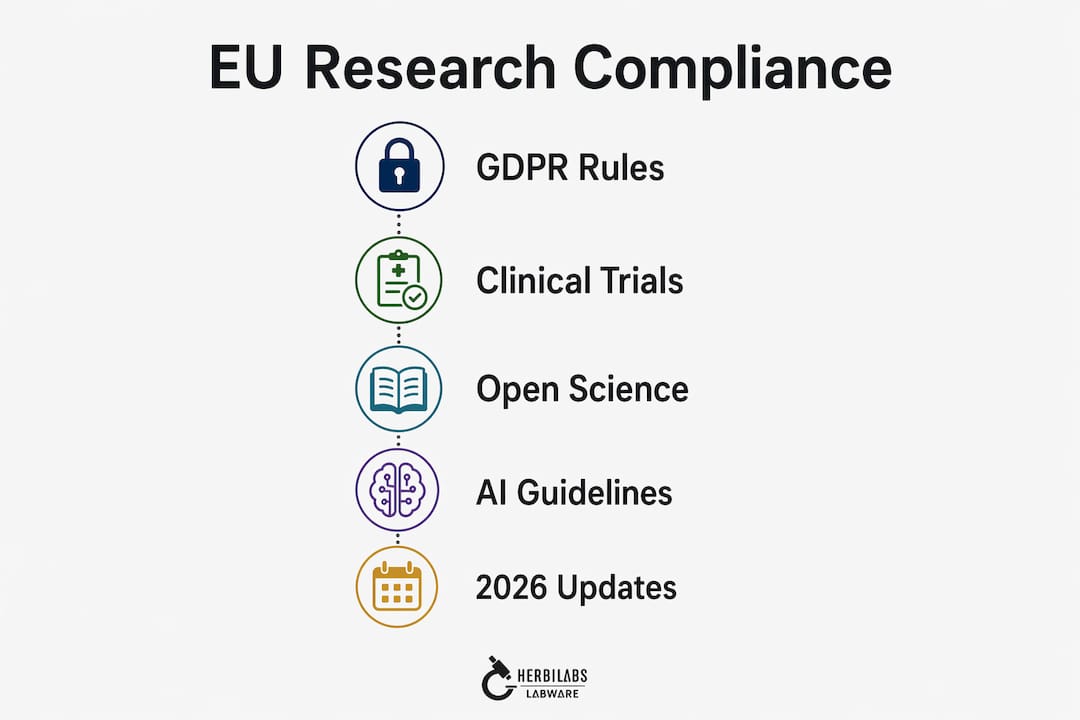
European research regulations are a structured legal framework comprising GDPR data protection rules, the EU Clinical Trials Regulation (CTR), and Horizon Europe funding conditions that every researcher operating in Europe must satisfy to conduct lawful, fundable science. The standard industry term for this framework is “EU research compliance,” and understanding it means recognizing how these three pillars interact across your project lifecycle. Recent 2026 updates, including the EDPB Guidelines 1/2026 on scientific research data processing and the ERA Living Guidelines on generative AI, have sharpened requirements in ways that directly affect grant eligibility, ethics approvals, and data stewardship. This guide explains each regulatory layer with precision, so you can plan ahead rather than scramble at submission time.
How do European research regulations apply to your work?
European research regulations require compliance across three distinct domains: personal data protection under GDPR, clinical trial oversight under Regulation (EU) No 536/2014, and open science obligations tied to Horizon Europe grants. Each domain applies at a different phase of your project. GDPR governs data collection from day one. CTR governs trial authorization before you recruit a single participant. Horizon Europe conditions govern everything from proposal submission through post-project reporting. Treating these as separate checklists is the most common mistake researchers make. They are interlocking obligations, and a gap in one area can trigger compliance failures in another.

How does GDPR apply to scientific research in Europe?
GDPR’s research-specific provisions center on Article 89, which permits derogations from standard data subject rights when processing personal data for scientific purposes, provided appropriate safeguards are in place. The critical 2026 development is the EDPB Guidelines 1/2026, which clarify that GDPR research flexibilities apply only when an activity meets six indicative factors defining genuine scientific research. Those factors assess whether the work follows systematic methodology, pursues knowledge generation rather than a commercial or administrative purpose, operates with academic autonomy, applies ethical oversight, produces results intended for public benefit, and maintains transparent reporting standards. Meeting all six is not automatic. You must document your qualification.
Appropriate safeguards under Article 89 include anonymization, pseudonymization, data minimization, and independent ethical oversight. Pseudonymization alone is not sufficient if re-identification remains technically feasible with available data. Your institution’s Data Protection Officer must be involved early, and your research protocol should explicitly map each safeguard to the personal data categories you process.
Lawful bases for research data processing most commonly used are public interest (Article 6(1)(e)) and, for special category data such as health or genetic information, Article 9(2)(j). Consent under Article 6(1)(a) is valid but creates complications when participants withdraw, since withdrawal can disrupt longitudinal datasets. Many research ethics boards now recommend a layered approach combining broad consent with robust anonymization protocols.
Pro Tip: Treat your GDPR compliance package as an evidence file, not a label. Supervisory authorities reviewing your project will expect documentation that demonstrates systematic methodology, ethical oversight, and a clear research purpose aligned with all six EDPB indicative factors. Build this file at project inception, not after a query arrives.
- Confirm your activity meets all six EDPB indicative factors before claiming research derogations
- Implement pseudonymization at the point of data collection, not retrospectively
- Appoint a Data Protection Officer contact for the project and log all processing decisions
- Document your lawful basis selection with explicit reasoning tied to your data categories
- Review consent forms against the possibility of participant withdrawal and plan dataset continuity
What are the key elements of the EU Clinical Trials Regulation and CTIS?
The Clinical Trials Regulation (EU) No 536/2014 replaced the patchwork of national trial application systems with a single centralized portal, CTIS (Clinical Trials Information System), operated by the European Medicines Agency. Every sponsor conducting a clinical trial in one or more EU Member States must submit through CTIS. This is not optional, and legacy trials that began under the prior Directive 2001/20/EC had a mandatory transition deadline that has now passed.
The dossier structure under CTR is split into two parts. Part I covers the scientific and medicinal product assessment, evaluated jointly by a reporting Member State and all concerned Member States. Part II covers national and ethics requirements specific to each country where the trial runs. Both parts must be submitted simultaneously, and CTIS validation rules govern the clock start for assessment timelines. A dossier that fails validation resets the clock, which is why internal dossier readiness reviews before submission are non-negotiable.
| Dossier component | Responsible party | Assessment timeline |
|---|---|---|
| Part I: Scientific/product assessment | Reporting Member State + concerned MSs | 30 days initial, up to 45 days with extension |
| Part II: National/ethics requirements | Each concerned Member State | 30 days, running in parallel with Part I |
| Validation check | CTIS automated + EMA review | 10 days from submission |
| Safety reporting (SUSARs) | Sponsor | 7 or 15 days depending on severity |
Sponsor obligations extend well beyond submission. You are responsible for ongoing safety reporting, including Suspected Unexpected Serious Adverse Reactions (SUSARs), protocol amendments, and annual safety reports. Transparency requirements mandate that trial results be posted in CTIS within 12 months of trial completion, and lay summaries must be accessible to the public. Deferral of result publication is permitted only under defined circumstances, such as pending patent protection, and requires formal justification.
- Confirm your trial falls within CTR scope before initiating any CTIS registration
- Assign a qualified Person Responsible for Regulatory Compliance (PRRC) to oversee dossier integrity
- Complete internal Part I and Part II readiness reviews at least three weeks before planned submission
- Set up SUSAR reporting workflows and assign pharmacovigilance responsibilities before first patient enrollment
- Schedule result posting reminders at trial completion to meet the 12-month transparency deadline
Pro Tip: CTIS assessment clocks follow validation rules, not your submission date. A dossier rejected at validation does not pause the clock. It resets it. Build a pre-submission checklist that mirrors CTIS validation criteria, and run it internally before you click submit.
How do Horizon Europe funding regulations integrate open science compliance?
Horizon Europe mandates immediate open access to all peer-reviewed publications arising from funded projects. “Immediate” means no embargo period. Publications must be deposited in a trusted repository at the time of acceptance, under a Creative Commons CC BY license or equivalent open license that permits unrestricted reuse with attribution. This applies to journal articles, conference papers, and monographs funded under the grant.
Research data management operates under the principle of “as open as possible, as closed as necessary.” This phrase has legal weight in your grant agreement. Data that can be shared must be shared. Exceptions are permitted for personal data protected under GDPR, commercially sensitive results, national security considerations, or intellectual property constraints, but each exception must be documented in your Data Management Plan (DMP).
| Requirement | Standard | Exception permitted |
|---|---|---|
| Publication open access | Immediate, CC BY license | None for peer-reviewed outputs |
| Research data sharing | FAIR principles, trusted repository | GDPR, IP, security, commercial sensitivity |
| Data Management Plan | Submitted within 6 months of project start | None |
| Metadata standards | Repository-aligned, machine-readable | None |
The DMP is not a bureaucratic formality. It is a compliance artifact that grant officers review during project monitoring. A weak DMP that lists repositories without specifying deposit timelines, metadata schemas, or responsible team members is a red flag. Marie Skłodowska-Curie Actions (MSCA) projects carry additional open science expectations, including researcher training obligations and public engagement reporting.
Most Horizon Europe projects that encounter late-stage compliance problems trace the issue to delayed repository selection and licensing decisions. Choosing your trusted repository, such as Zenodo, EUDAT B2SHARE, or a domain-specific archive, must happen at project start, not six months before the grant ends.
- Select your trusted repository and confirm its FAIR compliance before the project kickoff meeting
- Assign a data steward or open science officer to own DMP updates throughout the project
- Build publication deposit workflows into your project management system from month one
- Review licensing terms for any third-party datasets you incorporate to avoid downstream conflicts
- For MSCA projects, document researcher training activities and public engagement separately from the DMP
What are the 2026 updates affecting research compliance in Europe?
The ERA Living Guidelines updated in May 2026 introduce practical recommendations for responsible generative AI use in European research. These are not aspirational principles. They address specific operational risks, including hidden system prompts in AI tools, third-party AI interactions embedded in research workflows, and accountability gaps when AI-generated content enters published outputs. The guidelines place responsibility on researchers and institutions to document AI use, disclose it in publications, and maintain human oversight of AI-assisted analysis.
Risk management under the ERA guidelines requires identifying which steps in your research workflow involve generative AI, assessing the reliability of AI outputs against your methodology, and retaining human expert review as a mandatory checkpoint. Researchers using tools like ChatGPT, Copilot, or domain-specific AI platforms for literature synthesis, data coding, or manuscript drafting must now treat those tools as documented workflow components, not invisible productivity aids.
Horizon Europe call conditions in 2026 continue to evolve. The HaDEA 2026 EU Space Research call illustrates how program-specific budget distributions, topic-level funding caps, and strict submission deadlines operate in practice. Each call publishes its own Work Programme conditions, and compliance with those conditions is a prerequisite for funding eligibility, separate from the general grant agreement obligations. Reading the Work Programme for your specific call is not optional preparation. It is the primary compliance document for that funding round.
Researchers should also monitor the 2026 laboratory trends shaping how EU-funded labs are expected to operate, particularly around digital infrastructure and quality documentation standards that intersect with both GDPR and Horizon Europe reporting requirements.
Key takeaways
EU research compliance requires simultaneous management of GDPR data protection, CTR clinical trial authorization, and Horizon Europe open science mandates, with 2026 updates adding AI governance obligations across all three domains.
| Point | Details |
|---|---|
| GDPR research derogations require evidence | Document all six EDPB indicative factors before claiming Article 89 safeguards for your project. |
| CTIS dossier readiness is time-critical | Validation failures reset assessment clocks, so run internal pre-submission reviews before filing. |
| Open science compliance starts at kickoff | Select trusted repositories and assign a data steward before your first project milestone. |
| AI use must be documented and disclosed | ERA Living Guidelines 2026 require researchers to log generative AI tools as workflow components. |
| Call-specific conditions override general rules | Each Horizon Europe Work Programme sets its own eligibility and compliance requirements. |
Why compliance planning beats compliance recovery
Most researchers I work with encounter EU research compliance as a reactive problem. A grant officer flags a DMP deficiency at the midterm review. An ethics board queries GDPR documentation six months into data collection. A CTIS submission fails validation two weeks before the planned trial start. Every one of these scenarios is preventable, and every one of them costs more to fix than it would have cost to prevent.
The GDPR scientific research framework is genuinely researcher-friendly when you engage with it honestly. Article 89 derogations exist because the EU legislature recognized that longitudinal research cannot always operate under standard data subject rights. But those derogations require you to demonstrate that your work is real science, not a label applied to justify data retention. The six EDPB indicative factors are not a bureaucratic obstacle. They are a description of what rigorous research already looks like. If your project genuinely meets them, documenting that fact takes hours, not weeks.
The CTIS transition has been painful for many sponsors, but the underlying logic is sound. A single EU-wide authorization system with transparent timelines and public result posting is better for science than 27 parallel national processes. The operational challenge is dossier synchrony. Part I and Part II must move together, and that requires internal coordination that many academic sponsors underestimate. Hiring or designating a PRRC with real CTIS experience before your first submission is the single highest-return investment a clinical research team can make.
On Horizon Europe open science, I have seen too many projects treat the DMP as a grant application formality and then scramble at project end when datasets need depositing and nobody has agreed on a repository or a metadata schema. The fix is structural. Open science compliance is an infrastructure decision, not a documentation task. Make it in month one.
— Ragnar
How Herbilabs supports compliant European research
Compliance-grade research depends on supply-chain integrity as much as regulatory knowledge. When your protocols require bacteriostatic water or sterile reconstitution solutions that meet EU research lab standards, the quality of your reagents directly affects the reproducibility and defensibility of your results. Herbilabs manufactures research-grade bacteriostatic water and sterile diluents under rigorous quality controls designed for demanding academic and institutional laboratory environments across the UK and Europe. Every batch is produced to strict purity standards with full traceability, supporting the documentation requirements that EU-funded projects and ethics boards expect. Explore the bacteriostatic water FAQs for detailed product specifications, or review Herbilabs’ guidance on reagent storage practices to maintain sample integrity throughout your project lifecycle.
FAQ
What does GDPR Article 89 allow for scientific research?
Article 89 permits derogations from standard data subject rights, including rights of access, erasure, and restriction, when personal data is processed for scientific research purposes with appropriate safeguards such as pseudonymization and ethical oversight. Researchers must document that their activity meets the six EDPB indicative factors defining genuine scientific research.
What is CTIS and why does it matter for clinical trial compliance?
CTIS is the EU’s centralized Clinical Trials Information System, introduced under Regulation (EU) No 536/2014, replacing national application processes with a single EU-wide authorization portal. All sponsors conducting trials in EU Member States must submit through CTIS, and assessment timelines are governed by CTIS validation rules rather than prior national procedures.
What open access requirements apply to Horizon Europe grants?
Horizon Europe requires immediate open access to peer-reviewed publications under a CC BY license, with no embargo period permitted. Research data must be deposited in a trusted repository following FAIR principles, and a Data Management Plan must be submitted within six months of project start.
How do the 2026 ERA Living Guidelines affect AI use in research?
The May 2026 ERA Living Guidelines require researchers to document generative AI tools used in their workflows, disclose AI involvement in publications, and maintain human expert oversight of AI-assisted analysis. Risk management must address hidden prompts and third-party AI interactions embedded in research processes.
Where can I find compliance requirements for a specific Horizon Europe call?
Each Horizon Europe call publishes a Work Programme that sets program-specific eligibility criteria, budget caps, and submission deadlines that operate alongside the general grant agreement conditions. Researchers should treat the relevant Work Programme as the primary compliance document for their funding round, separate from the general Horizon Europe rules.