Private Label, White Label, Wholesale partnerships available - EU, USA and UK - Free shipping from €75

ISO certification in labware: a European researcher’s guide
Discover what is ISO certification in labware and how it ensures quality and compliance in your research. Avoid costly mistakes today!
TL;DR:
- Believing all labware is equivalent after shipment risks undermining research reliability due to varying ISO standards.
- Understanding ISO certifications—such as ISO 3585, ISO 9001, ISO 4787, and ISO 17025—is essential for assessing material quality, manufacturing processes, and testing accuracy.
- Verifying compliance involves checking markings, batch certificates, and accreditation numbers to ensure labware meets standards vital for reproducible, regulatorily compliant results.
If you believe all labware is equivalent once it ships in a clean box with a product label, you’re not alone — but you’re also taking a risk that could quietly undermine your research. Understanding what is ISO certification in labware is not a bureaucratic exercise. It directly determines whether your glassware holds up under thermal stress, whether your volumetric measurements are traceable, and whether your results will survive regulatory scrutiny under EU frameworks like REACH or MDR. This guide breaks down exactly which ISO standards apply to labware, what each one covers, and what you need to check before you spend a cent.
Table of Contents
- Understanding the main ISO certifications for labware
- Differences between ISO 9001, ISO 3585, and ISO 17025 and why they matter to you
- How ISO certification enhances labware quality and reliable research outcomes
- What European independent researchers and private customers need to check before buying ISO-certified labware
- Common misconceptions and nuances about ISO certification in labware usage and compliance
- Why understanding ISO certification nuances can transform your research reliability
- How Herbilabs helps European researchers source truly ISO-certified labware
- Frequently asked questions
Key Takeaways
| Point | Details |
|---|---|
| ISO standards clarify labware quality | Different ISO certifications cover glass quality, management processes, and testing lab competence vital to labware performance. |
| ISO 17025 ensures technical accuracy | Accreditation of testing labs confirms measurement accuracy and contamination control, key for reproducible research. |
| Verify certification markings and docs | Look for ISO 3585 and ISO 4787 labels, and request batch certificates linked to ISO 17025 tests before buying. |
| ISO 9001 is necessary but insufficient | Manufacturing quality management helps consistency but does not guarantee labware’s precise function or testing validity. |
| Proper certification supports EU compliance | ISO certifications help meet regulatory requirements for labware used in research, medical, and cosmetic fields in Europe. |
Understanding the main ISO certifications for labware
The ISO standards relevant to labware are not interchangeable. Each one governs a different layer of quality, from raw material specification to manufacturing process management to testing lab competence. Knowing which standard covers which layer is the foundation of any informed purchase decision.
Here are the four standards you will encounter most often:
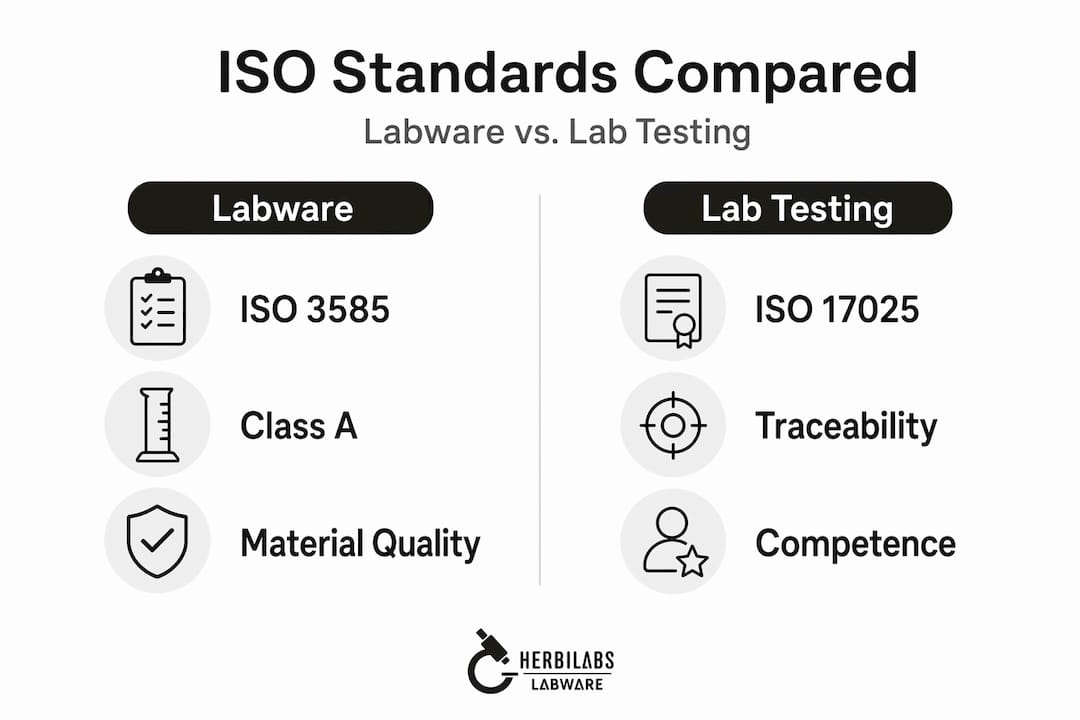
- ISO 3585 covers the material quality of borosilicate glass specifically. Borosilicate glass certified to this standard contains 12-15% boron trioxide and must withstand temperature fluctuations up to 160°C for thermal shock resistance. This is the standard that tells you the glass itself won’t crack under pressure.
- ISO 9001 is a quality management system standard. ISO 9001:2015 certification ensures that a manufacturer runs consistent, audited processes monitored through TÜV audits every one to three years. It says nothing about whether a specific pipette is accurate.
- ISO 4787 governs volumetric accuracy testing for glassware. BS EN ISO 4787 specifies testing methods for volumetric labware capacity, with Class A instruments holding tighter tolerances than Class B. If dosing precision matters in your work, this is the standard that enforces it.
- ISO 17025 is accreditation for testing laboratories themselves, not for products. ISO 17025 accreditation confirms technical competence with calibrations traceable to SI units and validated methods. This is the credential that makes a test result credible and defensible.
For a broader look at how these fit into lab product certifications explained, understanding each layer separately is the only way to ask the right questions of your supplier.
Differences between ISO 9001, ISO 3585, and ISO 17025 and why they matter to you
The confusion between these three standards is the most common mistake independent researchers make when evaluating labware. They are not competing standards. They cover entirely different ground, and treating one as a substitute for another is how measurement errors and compliance gaps develop.
Here is how they compare at a glance:
| Standard | Scope | What it guarantees | What it does NOT guarantee |
|---|---|---|---|
| ISO 9001 | Manufacturer quality system | Consistent production processes | Measurement accuracy or material quality |
| ISO 3585 | Borosilicate glass material | Chemical durability, thermal resistance | Volumetric precision |
| ISO 17025 | Testing laboratory competence | Traceable, validated test results | Manufacturing process quality |
| ISO 4787 | Volumetric instrument testing | Capacity accuracy and tolerances | Material properties |
The critical distinction is this: ISO 9001 certification verifies management systems supporting labware production, but ISO 17025 accreditation is needed for technical validity of test results, and the two must not be confused. A factory can have an immaculate ISO 9001 certificate while producing flasks with volumetric errors that would invalidate any data dependent on precise dilution.
ISO 3585 is the only standard that directly regulates the glass material itself. ISO 17025 is the standard that makes a test result legally and scientifically defensible. Together, ISO certification and laboratory accreditation distinctions ensure reproducible results critical for EU regulatory compliance like REACH. Separately, each one covers only a slice of the picture.

Pro Tip: When reviewing supplier documents, check that ISO 9001 and ISO 17025 certificates come from separate issuing bodies. A manufacturer who lists both under the same scope is likely conflating certification types, which is a red flag worth following up on.
For more on navigating lab compliance standards explained across different regulatory contexts, understanding these distinctions early will save you significant time during audits.
How ISO certification enhances labware quality and reliable research outcomes
Understanding the certifications on paper is one thing. Seeing how they translate into actual lab performance is where the value becomes real.
Here is how each standard connects to a practical outcome in your research environment:
- Thermal and chemical durability. ISO 3585 ensures borosilicate glass can handle 160°C and resist acids and bases, making it essential for safe, reliable labware used in challenging environments. If you’re autoclaving, running acid digestions, or working with aggressive reagents, this is the material standard that keeps your equipment from becoming a liability.
- Ultra-low contamination assurance. ISO 17025 accredited labs provide trace metal certifications that verify ultra-low contamination for over 65 elements, helping reduce cleaning steps in labs. For trace-element analysis or any work where background contamination can distort results, this accreditation is not optional.
- Volumetric accuracy and dosing consistency. ISO 4787 Class A labware is tested to deliver the stated volume within a defined tolerance. This matters every time you prepare a standard solution, dilute a reagent, or reconstitute a compound for peptide research. Errors at this stage compound across every downstream step.
- Reproducibility and regulatory acceptance. When your data is generated with ISO-certified labware backed by ISO 17025 tested documentation, reviewers, regulators, and collaborators can independently verify your inputs. Without that chain, your results are harder to defend.
“The value of ISO certification in labware isn’t visible until something goes wrong. It’s the infrastructure that prevents errors from being invisible.” This is the practical reality for any independent researcher working in an environment where results must hold up to external review.
For detailed guidance on contamination control in labs, the link between ISO 17025 accreditation and contaminant-free labware is particularly relevant for peptide reconstitution work. And understanding lab-grade quality importance extends well beyond glassware to every solution that touches your sample.
What European independent researchers and private customers need to check before buying ISO-certified labware
Supplier websites often feature ISO certification logos prominently without specifying which ISO standard applies or what scope it covers. Here is what to verify before committing to a purchase.
- Look for ISO 3585 markings on glassware directly. This marking should appear on the item itself, not just in the product listing. If a supplier cannot confirm the glass meets ISO 3585 requirements, assume it doesn’t.
- Check Class A or Class B labels for volumetric ware. Class A per ISO 4787 signals tighter tolerances and is appropriate for any quantitative work. Class B is suitable for approximate measurements only. The glassware grades and ISO documentation should show “ISO 3585” or “Class A per ISO 1042/4788” markings, and batch Certificates of Conformity should link to ISO 17025 tested production for audit traceability.
- Request Certificates of Conformity tied to specific batches. A blanket certificate is less useful than a batch-specific document. If the supplier cannot provide batch-level documentation, that’s a gap in traceability.
- Do not accept ISO 9001 as a proxy for measurement accuracy. Private customers often overlook that ISO 9001 ensures process consistency but not measurement accuracy. Request ISO 17025 certificates for test data to ensure reproducibility.
- Ask for the accreditation number of the testing lab. Every ISO 17025 accredited lab has a publicly searchable accreditation number. You can verify it independently through national accreditation bodies like UKAS in the UK or DAkkS in Germany.
Pro Tip: Create a simple checklist document listing ISO 3585, Class A status, batch Certificate of Conformity, and ISO 17025 accreditation number. Send it to every new supplier before ordering. Suppliers who respond thoroughly are worth your business. Suppliers who can’t answer it are telling you something important.
These checks are documented in detail through lab product certification checks and connect directly to labware sourcing tips for European buyers prioritizing compliance and traceability.
Common misconceptions and nuances about ISO certification in labware usage and compliance
Even experienced researchers carry some mistaken assumptions about what ISO certifications actually protect them from. These are the ones that cause real problems in European regulatory contexts.
- ISO 9001 is not a substitute for ISO 17025. This is the most consequential misunderstanding in the space. ISO 17025 accredited testing labs are required under EU Regulation (EC) No 765/2008 for labware compliance testing ensuring CE marking validity. A manufacturer’s quality system certificate cannot replace the technical competence accreditation of the lab that validated your labware.
- Certification does not equal compliance. Having a certified product does not automatically mean it meets every regulatory requirement in your jurisdiction. REACH, MDR, and national laboratory regulations each have specific requirements that certification must be mapped to.
- Medical labware under MDR deserves particular attention. Medical labware compliant under MDR 2017/745 benefits from ISO 17025 accredited testing providing presumption of conformity, which reduces the need for repeated testing cycles. If your labware touches any diagnostic or therapeutic application, this distinction affects your regulatory timeline.
- Ignoring accreditation scope creates blind spots. ISO 17025 accreditation is always scope-specific. A lab may be accredited for metal contamination testing but not for microbiological testing. Always check that the accreditation scope matches the type of testing relevant to your labware application.
For a thorough breakdown of lab compliance standards and how these interact in regulated European research environments, sorting out these misconceptions early saves considerable effort later.
Why understanding ISO certification nuances can transform your research reliability
Here is an uncomfortable observation: most independent European researchers treat ISO certification as a checkbox rather than a technical specification. They see the ISO logo, note that it looks official, and move on. This approach works fine right up to the moment it doesn’t.
The real risk isn’t obvious failure. It’s the subtle, accumulated error that comes from using labware where measurement traceability is assumed but never confirmed. A flask that’s nominally 100 mL but consistently delivers 99.3 mL is not a dramatic failure. It’s a small, systematic error that quietly corrupts every experiment that depends on it.
ISO certification distinguishes product quality standards from lab testing competence, and that distinction is critical for EU regulatory compliance. But in practice, the researchers who use this knowledge most effectively are those who combine it. They look for ISO 3585 material compliance and ISO 17025 testing documentation and volumetric Class A ratings together, not separately. Each certification answers a different question. Together, they give you a complete picture of what your labware can actually deliver.
Investing 20 minutes to request and review proper certification documents before placing an order is not due diligence theater. It’s the act that separates reproducible science from results you can’t confidently defend. For independent researchers operating in regulated European contexts, this distinction has real career and regulatory consequences. Full lab product certification insights can help you build that review process into your standard sourcing workflow.
How Herbilabs helps European researchers source truly ISO-certified labware
Sourcing labware that genuinely meets ISO standards across material quality, volumetric accuracy, and testing traceability requires a supplier who is transparent about each layer of compliance, not just the headline certification.
Herbilabs provides labware and research reagents with clear ISO 3585 compliance documentation and batch Certificates of Conformity linked to ISO 17025 accredited testing, giving European researchers and private customers the traceability they need for regulatory audits and quality assurance. Their lab product certification resources walk you through exactly what documentation to request and why it matters. For researchers working with peptide reconstitution, their lab-grade bacteriostatic water guide addresses the intersection of labware quality and solution purity in one place. Have questions before ordering? The bacteriostatic water FAQs cover the most common concerns from European independent researchers and private buyers directly.
Frequently asked questions
What does ISO certification mean for the quality of labware?
ISO certification indicates that labware meets defined standards for material quality, accuracy, and manufacturing processes, improving research reliability and EU regulatory compliance. Specifically, ISO certification ensures material durability, heat resistance, and tested volumetric accuracy depending on which standard applies.
Is ISO 9001 certification enough to guarantee labware accuracy?
No. ISO 9001 only certifies quality management systems in manufacturing and does not ensure labware measurement accuracy. ISO 9001 verifies management systems but ISO 17025 accreditation is needed for technical validity of test results.
How can I verify if my labware complies with ISO standards?
Check for ISO 3585 or Class A markings on the item itself, request batch-level Certificates of Conformity, and ask for the supplier’s ISO 17025 accreditation number. Verify ISO 3585 or Class A markings and request certificates linked to ISO 17025 tested production for proper audit traceability.
Why is ISO 17025 accreditation important for labs testing labware?
ISO 17025 accreditation confirms a testing lab’s technical competence, ensuring results are traceable to SI units and methods are validated. ISO 17025 confirms technical competence and validated methods for CE marking compliance under EU regulations.
Do ISO certifications affect regulatory compliance for labware in Europe?
Yes, particularly ISO 17025 accredited testing, which is often required to demonstrate conformity under EU frameworks including REACH, MDR, and cosmetics regulation. ISO 17025 accreditation is required for labware compliance testing under EU Regulation (EC) No 765/2008, directly affecting CE marking validity and market access.