Private Label, White Label, Wholesale partnerships available - EU, USA and UK - Free shipping from €75

2026 Laboratory Trends: What Researchers Need to Know
Explore the key 2026 laboratory trends shaping research. Discover how AI, energy reform, and digital pathology can optimize lab operations.
TL;DR:
- Research laboratories are experiencing rapid, structural changes driven by AI, energy reforms, and connected ecosystems. Labs are advised to prioritize energy optimization first for quick ROI, while integrating AI and digital pathology gradually to enhance efficiency and compliance. A phased approach focusing on infrastructure and staff development underpins successful adoption of these 2026 lab trends.
The pace of change inside research laboratories has accelerated sharply, and the 2026 laboratory trends driving that change are not gradual shifts. They are structural ones. AI adoption, energy reform, digital pathology, and fully connected lab ecosystems are reshaping how labs operate, make decisions, and control costs. For lab managers and researchers, the question is no longer whether to engage with these trends but how to prioritize them against budget constraints, compliance obligations, and the realities of day-to-day operations.
Table of Contents
- Key takeaways
- 1. AI and automation adoption is the defining 2026 laboratory trend
- 2. Energy optimization is no longer optional for lab operations
- 3. Digital and computational pathology is maturing into a research standard
- 4. Connected, software-defined labs are replacing isolated automation
- 5. Lab equipment advancements in 2026 are shifting toward modularity
- 6. Safety improvements and regulatory compliance are converging in 2026
- 7. Decision framework for adopting 2026 trends in your lab
- My perspective on chasing lab innovation in 2026
- How Herbilabs supports your lab through these shifts
- FAQ
Key takeaways
| Point | Details |
|---|---|
| AI adoption is accelerating fast | Over 75% of labs plan AI or ML integration within two years, making early pilot planning critical. |
| Energy costs are a solvable problem | Ventilation alone accounts for 40-70% of lab energy use, and retrofits can pay back in 2-4 years. |
| Digital pathology needs validation rigor | CAP guidelines require at least 60 validation cases before clinical or research deployment. |
| Connected labs outperform isolated automation | Software-defined ecosystems improve speed and decision clarity more than single-point automation projects. |
| Prioritize trends by lab context | Lab size, regulatory environment, and research focus should determine which trends to adopt first. |
1. AI and automation adoption is the defining 2026 laboratory trend
Over 75% of laboratories plan to implement AI or machine learning technologies within two years, making this the most widespread technology shift happening across lab settings right now. The motivation is clear: AI improves data accuracy, reduces manual processing time, and surfaces patterns that human analysts miss in large datasets.
Platforms like LabVantage Cortex are integrating AI directly into laboratory information management systems, enabling real-time workflow recommendations and anomaly detection without requiring researchers to switch between tools. The practical benefit is fewer transcription errors, faster result interpretation, and better traceability across experiments.
That said, the common misconception is that AI tools are plug-and-play. They are not. Labs must independently verify compliance and implement controls before deployment, including confirming whether AI plugins carry 510(k) regulatory clearance. For any diagnostic application, dual sign-off protocols during pilot phases are not optional extras. They are the minimum responsible standard.
Robotic automation presents a related challenge. Training flexible manipulation algorithms requires 50 to 100 expert demonstrations per task rather than fixed programming scripts, which means a significant upfront investment in data collection and validation before any efficiency gains materialize.
Pro Tip: Run AI pilots in a sandboxed environment alongside existing workflows for at least 60 days before committing to full deployment. This gives you real performance data without disrupting active research.
2. Energy optimization is no longer optional for lab operations
Laboratory buildings consume 4 to 10 times more energy per square foot than standard office buildings, and ventilation systems account for 40 to 70% of that total. For most research labs, that single figure makes HVAC the most consequential operational cost outside of staffing.
The practical solutions fall into two categories: technology upgrades and behavioral changes. On the technology side, variable air volume (VAV) fume hoods are the most impactful single investment. By reducing exhaust airflow when the sash is closed, they cut the energy load dramatically compared to constant-volume hoods running at full capacity regardless of use.
Key steps for a lab energy audit before committing capital:
- Benchmark current fume hood usage patterns with sash monitoring software
- Identify hoods running at full volume during off-hours or unoccupied periods
- Recalibrate HVAC air-change rates to match actual occupancy and ventilation demand
- Assess lifecycle cost of heating equipment including oil baths and foil insulation
- Calculate projected payback period using local utility rates and operational data
On behavioral change, foil insulation in labs deserves more attention than it gets. Contaminated foil disposed as hazardous waste can triple a reaction’s carbon footprint. Reuse policies that extend foil use 4 to 10 times before disposal are a zero-cost intervention with measurable environmental impact.
VAV fume hood retrofits typically achieve payback within 2 to 4 years depending on utility rates and usage hours. That is a favorable ROI by any capital planning standard.
Pro Tip: Before investing in electrification or renewable energy systems, optimize existing HVAC with demand-based ventilation controls. This approach can yield millions in savings for large facilities and provides a much faster return than infrastructure replacement.
3. Digital and computational pathology is maturing into a research standard
Digital pathology has moved from pilot projects to standard practice in many research institutions, and 2026 is the year where interoperability and AI-assisted diagnostics are converging. The shift is significant for any lab involved in histopathology, oncology research, or clinical trial support.
Whole-slide imaging now integrates with AI algorithms that can flag regions of interest, quantify biomarkers, and generate prognostic scores with a precision that accelerates both research timelines and diagnostic confidence. For labs running clinical trials, this capability directly affects data quality and regulatory submissions.
Adoption still faces real friction points:
- Interoperability between scanners, viewers, and LIMS platforms remains inconsistent without DICOM and HL7 standards enforcement
- Regulatory alignment between FDA guidance and institutional policies on AI diagnostic tools varies significantly
- Image storage and retrieval infrastructure adds substantial IT overhead for labs without existing digital pathology experience
“Validation sets require at least 60 cases with greater than 95% consistency between digital images and glass slides.” This is the CAP guideline standard labs must meet before deploying digital pathology workflows in any clinical or regulated research context.
For labs entering this space, the priority is not the AI algorithm. It is the validation infrastructure. Without consistent image quality, calibrated scanners, and documented concordance data, the AI layer adds complexity without adding reliability. Solid lab quality control practices are the foundation everything else is built on.
4. Connected, software-defined labs are replacing isolated automation
The most significant shift in laboratory automation trends for 2026 is not any single technology. It is the move from one-off automation projects to connected, software-defined environments where instruments, AI models, and data pipelines operate as a governed ecosystem.
Isolated automation solves one problem at one station. A connected lab solves process-level inefficiencies across the entire workflow. The difference in outcomes is not incremental. It is categorical.
What this shift looks like in practice:
- Open API standards enabling instruments from different vendors to share data without manual export steps
- Digital twin models that simulate workflow changes before physical reconfiguration
- Multimodal analytics platforms that pull from sequencing, imaging, and assay data simultaneously
- Hybrid workforce roles combining wet lab skills with data science and systems thinking
- Governance frameworks ensuring AI models embedded in workflows meet auditability requirements
The clearest evidence that connected automation outperforms isolated projects is in throughput metrics. Labs that have moved to software-defined infrastructure report faster decision cycles, fewer re-runs due to data entry errors, and better traceability for regulatory submissions.
The misconception worth addressing is that connected labs require complete infrastructure replacement. They do not. Most labs build toward connectivity incrementally, starting with LIMS integration, then instrument connectivity, then AI model governance. Understanding laboratory compliance standards at each phase determines which integration steps carry the most regulatory risk.
5. Lab equipment advancements in 2026 are shifting toward modularity
Hardware is evolving alongside software. Lab equipment advancements in 2026 reflect a clear preference for modular, upgradable platforms over purpose-built fixed instruments. The logic is straightforward: a modular liquid handling platform that accepts new pipetting heads and integrates with different detection systems has a longer useful life than a dedicated system locked to one application.
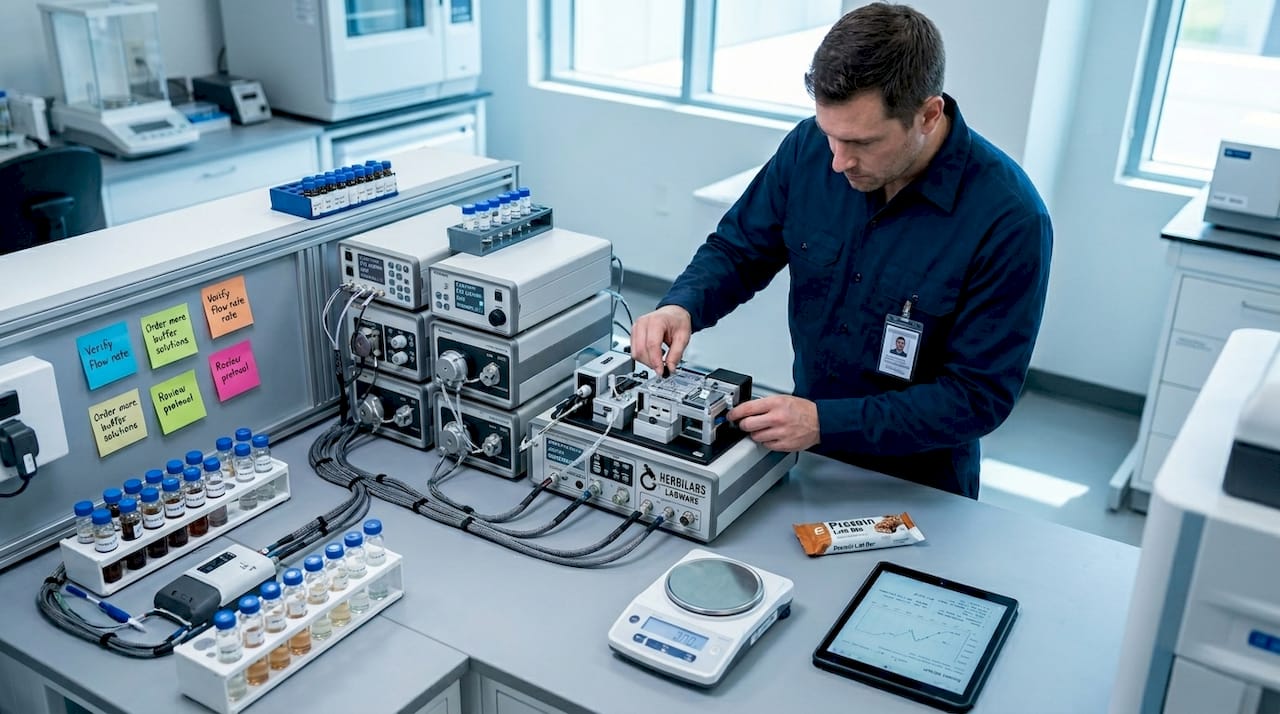
Microfluidic devices are scaling from research tools to routine lab infrastructure, enabling single-cell analysis and ultra-low-volume assays that were prohibitively expensive three years ago. Portable spectrometers and handheld analytical devices are reducing the time between sample collection and data generation in field and point-of-care contexts.
For lab managers evaluating capital equipment purchases, the key question is not just performance at purchase. It is upgrade path, software support lifespan, and compatibility with existing data systems. A high-performing instrument that generates siloed data is a liability in a connected lab environment.
6. Safety improvements and regulatory compliance are converging in 2026
Among 2026 lab safety improvements, the most consequential development is the integration of safety monitoring directly into laboratory management software. Real-time chemical inventory tracking, automated exposure alerts, and digital safety data sheet management are eliminating the paper-based systems that create compliance gaps.
Wearable monitoring devices for researchers working with hazardous materials are now compact and connected enough to integrate with lab safety dashboards. Exposure data logs automatically, reducing the administrative burden of manual recording while improving the completeness of safety records.
Regulatory bodies are also tightening expectations around contamination control documentation, particularly for labs handling injectables, biological reagents, and peptides. Labs that cannot produce traceable contamination control records face increasing scrutiny during audits. Building this infrastructure now, rather than retrofitting it after a compliance event, is the more cost-effective path.
7. Decision framework for adopting 2026 trends in your lab
Not every trend applies equally to every lab. The right starting point depends on your specific context. The table below offers a practical comparison:
| Trend | Best fit | Investment level | Time to impact |
|---|---|---|---|
| AI and ML integration | High-throughput, data-heavy labs | Medium to high | 6-18 months |
| Energy optimization (VAV, HVAC) | Any lab with fume hoods | Low to medium | 2-4 years ROI |
| Digital pathology | Histopathology, oncology, clinical trials | High | 12-24 months |
| Connected lab ecosystems | Multi-instrument, multi-team labs | High | 18-36 months |
| Modular equipment upgrades | Labs with aging fixed instruments | Variable | Immediate to 12 months |
| Safety monitoring integration | All regulated lab environments | Low to medium | 3-6 months |
For labs with constrained budgets, energy optimization delivers measurable financial returns faster than any other trend on this list. Start there. For labs with strong data infrastructure already in place, AI integration is the highest-leverage next step.
Phased adoption beats trying to do everything at once. Identify one trend per cycle, pilot it properly, measure outcomes against defined criteria, and then use those results to build the internal case for the next phase.
My perspective on chasing lab innovation in 2026
I have watched labs make the same mistake repeatedly: they treat emerging trends as projects to check off rather than capabilities to build. You adopt AI for one workflow, declare success, and move on. Six months later, that AI tool is generating outputs nobody fully trusts because the validation process was compressed to meet a deadline.
What I have learned from watching both successful and failed technology adoptions in research environments is that the infrastructure behind the technology matters more than the technology itself. Data governance, validation protocols, staff competency, and compliance documentation are not supporting activities. They are the actual work. The technology is just the trigger.
The energy sustainability piece is where I see the most unrealized potential. Labs spend enormous energy debating electrification strategies while their existing HVAC systems are operating at air-change rates calibrated for worst-case scenarios that never happen. Fix what you have before you buy something new. The savings fund the next project.
Staff development is the variable most often underestimated. Hybrid roles that combine bench skills with data literacy are not a future aspiration. They are what separates labs that get value from their technology investments from those that accumulate expensive tools that underperform. Invest in your people’s digital fluency with the same seriousness you apply to instrument qualification.
— Ragnar
How Herbilabs supports your lab through these shifts
As laboratory automation trends raise the bar for reagent quality and traceability, the integrity of your starting materials becomes even more important. Herbilabs supplies research-grade bacteriostatic water and sterile reconstitution solutions manufactured to strict purity standards, with full quality documentation to support compliance-conscious labs. Whether you are running peptide research, managing reconstitution protocols, or scaling up assay workflows, consistent reagent quality is the baseline everything else depends on. Explore Herbilabs’ reagent quality controls to see how their manufacturing standards align with current lab compliance expectations, or browse the full Herbilabs shop for research-grade supplies delivered reliably across the UK and Europe.
FAQ
What are the biggest 2026 laboratory trends for research labs?
The most significant trends include AI and ML integration into LIMS platforms, energy optimization through demand-based ventilation, digital pathology adoption, and the shift toward connected software-defined lab ecosystems. Each trend directly affects operational efficiency and compliance.
How quickly can labs see ROI from energy sustainability upgrades?
VAV fume hood retrofits typically achieve payback within 2 to 4 years based on local utility rates and usage data, making them one of the fastest-returning capital investments available to lab managers in 2026.
What validation is required before deploying digital pathology tools?
CAP guidelines require a minimum validation set of 60 cases with greater than 95% concordance between digital images and glass slides before deploying digital pathology workflows in clinical or regulated research settings.
Do AI tools in labs require regulatory clearance?
Yes. Labs must independently verify whether AI tools carry appropriate regulatory clearance such as 510(k) approval before clinical deployment, and should structure dual sign-off pilot protocols to manage compliance risk during rollout.
Where should a lab with a limited budget start with these trends?
Energy optimization offers the fastest financial return and lowest implementation risk, making it the most practical first step for budget-constrained labs. HVAC recalibration and fume hood sash management programs require minimal capital and deliver measurable savings within the first operating year.