Private Label, White Label, Wholesale partnerships available - EU, USA and UK - Free shipping from €75

Top must-have lab supplies for quality research in 2026
Discover the must-have lab supplies 2026 that ensure reliable, quality research. Equip your lab for success with the best tools!
TL;DR:
- Choosing high-quality, certified lab supplies ensures accurate, contaminant-free peptide research results. Proper evaluation of instruments, consumables, and storage materials based on standards like ISO 8655 is essential for reliable workflows. Building disciplined handling protocols and sourcing from reputable suppliers is key to consistent scientific outcomes.
Choosing the right lab supplies isn’t just a logistics exercise. For peptide researchers and independent scientists working across Europe, the tools you pick directly shape whether your results are reproducible, contaminant-free, and trustworthy. One compromised reagent or poorly calibrated pipette can invalidate weeks of work. With supply options multiplying and quality claims harder to verify, knowing exactly what to prioritize and why matters more than ever heading into 2026.
Table of Contents
- Key criteria for selecting must-have lab supplies
- Essential pipettes: accuracy and ergonomic solutions
- Must-have consumables for peptide work
- Comparing labware for storage and mixing
- Head-to-head: Comparison of top lab supply choices
- Expert perspective: What most lists miss about lab supplies
- Find trusted lab supplies for your research
- Frequently asked questions
Key Takeaways
| Point | Details |
|---|---|
| Quality matters most | Choosing supplies with ISO certifications and supplier documentation ensures scientific reliability. |
| Precision pipettes essential | Pipettes covering 1-1000μL offer accuracy and ergonomic safety for peptide research. |
| Sterile consumables safeguard results | Sterile and bacteriostatic water are must-haves for contamination-free experiments. |
| Proper storage prevents loss | Using glass vials and controlling conditions preserves peptide stability and usability. |
Key criteria for selecting must-have lab supplies
Before you spend a single euro on equipment, you need a clear framework for evaluating what actually belongs in your lab. Not every product marketed as “research-grade” meets the bar required for peptide work. Precision, sterility, reliability, and compliance with recognized standards should all factor into every purchase decision.
Start with accuracy. Any tool involved in measuring, dispensing, or storing peptide solutions must perform consistently within tight tolerances. A pipette that drifts even 3% off its labeled volume will introduce cumulative error across an experiment. For researchers working with expensive peptides in microgram quantities, that margin matters enormously. Always look for documented calibration data from the manufacturer.
Sterility and material compatibility are equally non-negotiable. Equipment that contacts your peptide solutions must be either single-use sterile or autoclavable. The sterile lab techniques you implement are only as good as the tools supporting them. Polypropylene and borosilicate glass are generally preferred materials for labware because they resist leaching and tolerate autoclave temperatures.
ISO certification is another key differentiator. Tools built and tested against international standards like ISO 8655 for pipettes offer independently verified performance guarantees. Suppliers that provide full documentation for their products signal a commitment to quality that budget-anonymous vendors simply cannot match.
- Verify ISO certification before purchasing critical instruments
- Confirm material compatibility with your specific peptides and solvents
- Ask for sterilization validation data for consumables
- Check whether the supplier offers batch-specific purity documentation
- Prioritize ergonomic design for tools used repeatedly over long sessions
Budget matters too, but it should be the last filter, not the first. Cutting corners on a critical item to save 20 euros can cost far more in wasted peptides and ruined runs. That said, lab purity guidance consistently shows that protocol discipline often matters more than brand prestige for maintaining high-quality outcomes.
Pro Tip: Always request a copy of the supplier’s quality certificate or Certificate of Analysis (CoA) before ordering. Reputable suppliers will have this ready without hesitation, and it gives you a clear paper trail for your own research records.
Essential pipettes: accuracy and ergonomic solutions
No single item in your lab gets used more intensively than your pipette. Whether you’re reconstituting a lyophilized peptide, preparing a dilution series, or loading samples for analysis, pipette accuracy is foundational to everything downstream. Getting this choice right is worth real thought.
Modern single-instrument solutions have changed the game. Full-range pipettes covering 1-1000μL like the DeNovix Squid eliminate the need to switch between multiple devices during a workflow, reducing contamination risk and saving bench time. The Eppendorf Reference 2 is another benchmark model, respected widely for its consistent ISO 8655-compliant performance across volume ranges.
Here’s what to evaluate in order of priority:
- Volume range and resolution: A single pipette covering 1 to 1000μL offers maximum flexibility for peptide reconstitution and dosing workflows.
- ISO 8655 compliance: This standard governs the accuracy and precision tolerances for piston-operated volumetric instruments. Non-compliant tools are a gamble.
- Autoclavability: The entire pipette or at least the lower assembly should withstand standard autoclave cycles for reliable sterilization.
- Ergonomic design: Weight distribution, grip contour, and plunger force all affect fatigue during repetitive pipetting sessions.
- Calibration visibility: A clearly readable calibration display reduces misreading errors, especially under lab lighting conditions.
“Ergonomic pipette design is not a luxury add-on. For researchers pipetting for several hours daily, poorly designed instruments directly contribute to repetitive strain injury, reduced accuracy, and increased error rates.”
The RSI angle is often underestimated. Studies in laboratory ergonomics have consistently shown that thumb force, grip span, and tip ejection effort all contribute to cumulative strain. Ergonomic models specifically designed to minimize these forces can significantly reduce injury risk over time. If you’re building a small home lab or a lean independent setup, choosing one high-quality ergonomic pipette from the start is smarter than buying three cheaper ones over three years.
Pair your pipette with the right tips. Using off-brand or improperly fitted tips will introduce volume inaccuracy and increase the risk of contamination. Filter-barrier tips, in particular, are strongly recommended for peptide work because they prevent aerosol contamination between samples.
When exploring labware types for peptides, pipettes are always at the top of the priority list. Everything else supports them.
Pro Tip: If your budget allows only one premium purchase, make it your pipette. It’s the tool that touches your most critical samples every single session.
Must-have consumables for peptide work
Consumables don’t get as much attention as instruments, but they are where contamination and degradation most often enter a workflow. Choosing the wrong water, a substandard vial, or an impure reagent can destroy your peptide sample before your assay even starts.
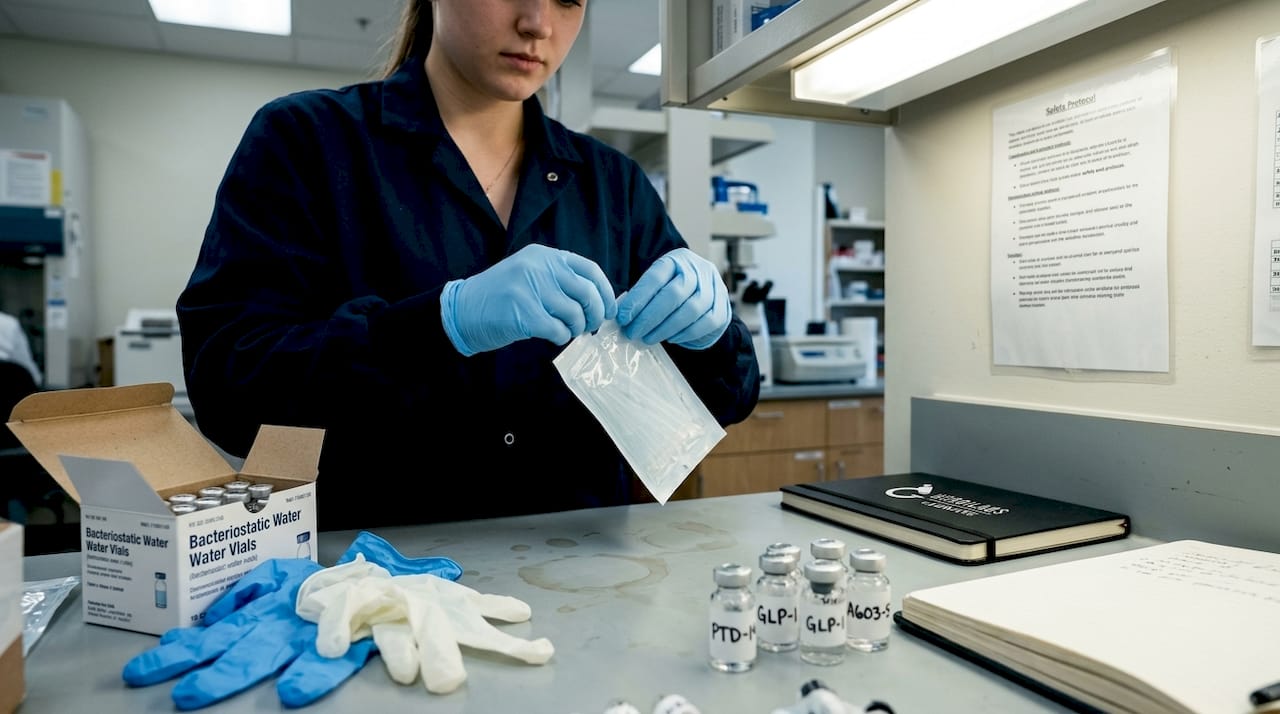
Water is the most fundamental consumable in peptide research. There are two main categories you need to understand clearly.
| Feature | Sterile water | Bacteriostatic water |
|---|---|---|
| Bacteria inhibition | No ongoing inhibition | Yes, contains 0.9% benzyl alcohol |
| Multi-use suitability | Single-use only | Suitable for multi-use vials |
| Shelf life after opening | Use immediately | Extended, typically 28 days |
| Best for | One-time reconstitution | Multi-dose peptide vials |
| Typical availability | Widely available | Specialized suppliers |
Sterile water for peptides is your default choice for single-use reconstitution events where you’re preparing a solution to be used immediately. It’s free from bacteria and particulates but offers no ongoing protection once opened.
Bacteriostatic water, which contains 0.9% benzyl alcohol as a preserving agent, inhibits bacterial growth over time. This makes it the practical choice for multi-dose vials that will be accessed repeatedly over days or weeks. For most independent peptide researchers storing reconstituted peptides across multiple sessions, bacteriostatic water is the more useful and cost-effective option.
Beyond water, your key consumables include:
- Syringes: Use only sterile, single-use syringes. Insulin-type syringes work well for small volumes common in peptide research.
- Vials: Sterile borosilicate glass vials with rubber stoppers and aluminum crimp seals offer optimal protection.
- Alcohol swabs: For surface sterilization before every vial access. A step many skip, and shouldn’t.
- Sterile filters: 0.22-micron syringe filters for sterilizing solutions prepared outside a clean-bench environment.
Following established safe research solutions protocols is not optional. Even a minor lapse in consumable hygiene can introduce bacteria or endotoxins that compromise your entire peptide batch.
Pro Tip: Store all unopened consumables in a cool, dry environment away from direct light. Even sealed sterile products can degrade if exposed to temperature extremes over time.
Comparing labware for storage and mixing
Once your consumables are in place, your labware for storage and mixing defines how well your peptide solutions hold up over time. Peptides are fragile molecules. They degrade in response to temperature fluctuations, oxidation, UV exposure, and contact with incompatible materials.
Glass is the gold standard for peptide storage. Borosilicate glass resists chemical leaching, tolerates a wide temperature range, and is easy to visually inspect for particulates. Plastic containers can leach plasticizers and are generally unsuitable for long-term peptide storage unless explicitly rated for the application.
Here’s a ranked list of recommended vial materials and sizes based on common project scales:
- 2mL borosilicate glass vials: Ideal for small-batch reconstitution and short-term storage of individual peptide samples.
- 10mL borosilicate glass vials: Better for multi-dose setups or when preparing larger solution volumes for extended experiments.
- 20mL amber glass vials: The amber tint provides UV protection for photosensitive peptides, reducing degradation from light exposure.
- Polypropylene cryovials: Acceptable for long-term freezer storage where glass breakage risk is a concern, provided they are explicitly rated as peptide-compatible.
- Screw-cap microtubes: Convenient for small-volume working stocks kept at cold temperature for short durations.
| Consumable | Recommended storage temp | Container type | Max storage duration |
|---|---|---|---|
| Lyophilized peptide | 4°C or below (frozen ideal) | Sealed amber vial | 12 to 24 months |
| Reconstituted peptide (bac water) | 4°C refrigerated | Borosilicate glass vial | Up to 28 days |
| Sterile water (opened) | Use immediately | Original sealed vial | N/A |
| Bacteriostatic water (opened) | 4°C refrigerated | Original sealed vial | 28 days |
Reviewing a detailed peptide storage guide before setting up your storage system is time well spent. Small protocol adjustments, like switching from plastic to glass or adding parafilm seals, can meaningfully extend the usable life of your samples.
Proper sealing also prevents evaporation and oxidation. Even slight evaporation from an improperly sealed vial changes the concentration of your solution, which throws off all subsequent dosing calculations. Crimped aluminum seals over rubber stoppers are the most secure option for vials accessed repeatedly. Following precise sterilization tips for your storage containers keeps contamination risk at its lowest.
Head-to-head: Comparison of top lab supply choices
With individual categories covered, here’s a direct comparison of the core supply types most peptide researchers need to prioritize.
| Supply type | Key strength | Best use case | Selection tip |
|---|---|---|---|
| Full-range ergonomic pipette | Accuracy and RSI reduction | Daily reconstitution and dosing | Confirm ISO 8655 compliance |
| Bacteriostatic water | Multi-use peptide compatibility | Multi-dose vials over days or weeks | Buy from manufacturer-certified sources |
| Sterile water | Contamination-free single use | One-time reconstitution events | Check sterility validation per batch |
| Borosilicate glass vials | Chemical resistance and clarity | All peptide storage applications | Match vial size to volume needs |
| Sterile syringe filters (0.22μm) | Eliminates bacterial contamination | Preparing solutions without a clean bench | Use immediately before filtration step |
A few key points that the table doesn’t fully capture:
- Matching supply choices to your actual project scale matters. A researcher working with five peptides over a month has different needs than someone running a single acute experiment.
- Bulk purchasing consumables like vials and swabs almost always reduces unit cost and avoids the frustration of mid-project stockouts. Suppliers offering reliable labware delivery to Europe with consistent lead times are worth prioritizing even at a slight price premium.
- For independent researchers working from home labs, reliability and simplicity should outweigh exotic features. The most sophisticated pipette means nothing if you can’t consistently source compatible tips.
Pro Tip: Order a three-month buffer of critical consumables. Supply chain delays across Europe have become increasingly common, and running out of bacteriostatic water mid-project is one of the most disruptive and avoidable problems in small-scale peptide research.
Expert perspective: What most lists miss about lab supplies
Most lab supply guides rank products by brand prestige or price point. That’s not entirely wrong, but it misses something more important: the discipline of the person using the tools.
We’ve seen researchers produce cleaner, more reproducible results with mid-range equipment and rigorous protocols than with expensive instruments and sloppy handling habits. The pipette brand matters far less than whether it gets recalibrated on schedule, stored correctly, and used with appropriate technique every single time.
Budget tools can absolutely perform reliably in peptide research when sterilization and handling protocols are followed without cutting corners. A properly autoclaved mid-market pipette with consistent operating technique will outperform a premium instrument treated carelessly. This is a point that rarely appears in gear-focused content but shapes outcomes more than any single purchasing decision.
The other trend worth acknowledging is the shift in how researchers source their supplies. Supply chain disruptions across Europe, combined with inconsistent quality from multi-product distributors, are pushing more independent researchers toward direct-from-manufacturer purchasing. Buying bacteriostatic water and reconstitution solutions directly from a dedicated, certified manufacturer reduces the risk of receiving off-spec or degraded product.
Quality in consumables is particularly unforgiving. A miscertified reagent or substandard bacteriostatic water doesn’t just produce a bad result. It can destroy a sample that took weeks to prepare. Implementing solid contamination avoidance steps protects you downstream, but the foundation starts with sourcing properly from the beginning.
The real gap in most lab supply guides is the emphasis on what you buy rather than the culture of quality you build around your work. Both matter, but the latter is what separates consistently reliable researchers from those who get occasional good results.
Find trusted lab supplies for your research
Sourcing quality lab supplies across Europe doesn’t have to be complicated when you know where to look. Herbilabs offers a focused range of research-grade bacteriostatic water, sterile reconstitution solutions, and specialist labware built to the purity standards that peptide research demands.
Browse the Herbilabs Shop to explore current stock, batch-specific documentation, and wholesale pricing options for independent researchers and resellers. If you want to go deeper on which products suit your specific workflow, the guide to labware types covers material selection and compatibility in detail. For immediate reconstitution needs, the sterile reconstitution solution is manufactured to strict purity standards and available for direct order with reliable European delivery.
Frequently asked questions
How do I ensure lab supplies meet quality and purity standards?
Verify ISO certifications and request a Certificate of Analysis from your supplier before ordering. Precision pipettes meeting ISO 8655 and reagents with documented purity testing give you the traceability your research requires.
What is the advantage of using bacteriostatic water vs. sterile water for peptides?
Bacteriostatic water inhibits bacterial growth through its benzyl alcohol content, making it suitable for multi-dose vials accessed over several days or weeks, while sterile water is intended for single-use reconstitution only.
Do ergonomic pipettes really reduce lab injuries?
Yes. Ergonomic models like DeNovix Squid are specifically engineered to reduce thumb force and grip strain, which directly lowers the risk of repetitive strain injuries during extended pipetting sessions.
What is the best way to store peptide solutions?
Store reconstituted peptide solutions in sealed borosilicate glass vials at 4°C refrigerated temperatures, and always use bacteriostatic water if the solution will be accessed more than once.