Private Label, White Label, Wholesale partnerships available - EU, USA and UK - Free shipping from €75

Top must-have labware for research: 5 essentials
Discover the top must-have labware for peptide and scientific research. Use our expert framework to choose accurate, sterile, and reliable equipment every time.
TL;DR:
- Choosing accurate, sterile, compatible, and durable labware is essential for reliable peptide research.
- Essential labware includes borosilicate glass beakers, amber vials, low-retention pipette tips, and sterile containers.
- High-quality labware prevents contamination and errors, reducing long-term costs and ensuring reproducible results.
Selecting the right labware is one of the most consequential decisions you make as an independent researcher. The wrong choice doesn’t just slow you down. It corrupts results, wastes reagents, and in peptide research, can mean hours of reconstitution work undone by a single contaminated vial. Many researchers cobble together equipment from multiple suppliers without a clear selection framework, then wonder why reproducibility suffers. This guide cuts through that noise. We cover the core categories of must-have labware for peptide and scientific research, the criteria that actually matter, and a practical comparison to help you build a reliable setup from the ground up.
Table of Contents
- How to evaluate essential labware for research
- Critical glassware and plasticware for effective experiments
- Key reagent containers and storage solutions
- Lab safety and contamination control equipment
- Comparison of must-have labware for various research situations
- The overlooked costs and consequences of cutting corners in labware
- Where to find high-quality labware for your research
- Frequently asked questions
Key Takeaways
| Point | Details |
|---|---|
| Choose quality first | Investing in reliable glassware and plasticware prevents costly mistakes and ensures accurate results. |
| Store reagents safely | Proper containers and careful labeling keep research samples usable and safe. |
| Prioritize contamination control | Sterile tools and routine cleaning are essential to avoid lost experiments. |
| Match labware to research needs | Select labware based on experiment type, from peptide synthesis to general biochemistry. |
How to evaluate essential labware for research
Before you add anything to your cart, you need a framework. Not every piece of equipment is created equal, and more expensive doesn’t automatically mean better suited for your workflow.
The four criteria that actually matter when evaluating labware are:
- Accuracy: Volumetric glassware and calibrated pipettes must meet traceable standards. Even small measurement errors compound across experiments.
- Sterility: Any contact surface in peptide handling must be demonstrably free of microbial and endotoxin contamination.
- Compatibility: Your labware materials must be inert to your solvents, buffers, and peptides. Polystyrene and strong organic solvents, for example, do not mix.
- Durability: Reusable labware needs to survive autoclaving, chemical exposure, and repeated use without degrading.
When planning your setup, reviewing labware types for peptides gives you a strong starting point for understanding which categories apply to your specific workflow. Similarly, if you are preparing reconstitution solutions, safe research solutions outlines what your labware needs to support.
A quick checklist to assess your current setup:
- Are all volumetric items calibrated and within tolerance?
- Is every item that contacts peptides either single-use sterile or autoclave-verified?
- Do your plasticware choices match the chemical resistance requirements of your reagents?
- Is your storage labware rated for the temperatures you use?
EMA guidelines emphasize resin washing and inert gas use for moisture control in synthetic peptide manufacture, underscoring that environmental precision starts with the right tools.
Pro Tip: Build your labware budget around three tiers: core consumables you replace frequently, durable glass you amortize over years, and safety equipment you never cut corners on. That mental separation prevents false tradeoffs.
Critical glassware and plasticware for effective experiments
Now that criteria are clear, let’s get specific about which labware deserves a spot in your setup.
For glassware, three items are genuinely non-negotiable:
- Borosilicate beakers: Heat resistant, chemically inert, and essential for mixing buffers and reagent preparations.
- Erlenmeyer flasks: Ideal for cultures and mixing reactions where swirling matters without splash risk.
- Amber vials: Critical for light-sensitive peptides and reagents during storage and handling.
For plasticware, your essentials are:
- Low-retention pipette tips: Peptides and proteins cling to standard tips. Low-retention versions dramatically improve dose accuracy.
- Microcentrifuge tubes (1.5 mL and 2 mL): The workhorse of sample handling, reconstitution, and short-term storage.
- Multi-well plates: Useful for parallel sample preparation or assay workflows when throughput matters.
Sterile techniques for research explains why your handling approach matters as much as the container itself. And lab product sterility gives useful context on what sterility certifications to look for.
Proper resin washing and moisture control is critical for accurate peptide synthesis, which makes contamination-free labware a direct performance variable, not just a housekeeping issue.
| Feature | Glass | Plastic |
|—|—|—|
| Chemical resistance | Excellent (most solvents) | Variable (solvent-dependent) |
| Temperature tolerance | High (autoclavable) | Limited (type-dependent) |
| Protein adsorption | Low | Higher (use low-retention) |
| Cost per use | Lower (reusable) | Higher (single-use) |
| Contamination risk | Low if sterilized | Low (pre-sterile available) |
Pro Tip: For peptide work specifically, default to single-use plasticware for any step involving reconstituted compound. Reusable glass works well for buffers and solvents but introduces risk when peptide carryover could affect downstream measurements.
Key reagent containers and storage solutions
Having covered glass and plasticware, let’s address how to protect your most valuable reagents.
For reagent containers, your must-haves include:
- Amber glass reagent bottles: The standard for light-sensitive solutions including many peptide reagents and coupling agents.
- PTFE-lined cap bottles: Essential when reagents react with standard rubber septa or plastic closures.
- Glass ampoules: Best for long-term sterile storage of small-volume reference solutions and standards.
- Cryovials: For any sample requiring storage below minus 40 degrees Celsius.
Optimal storage is systematic. Follow these steps for every reagent you handle:
- Label immediately upon receipt: compound name, concentration, date opened, and storage temperature.
- Aliquot into smaller volumes so you never expose the bulk stock to repeated freeze-thaw cycles.
- Store at the manufacturer-specified temperature and verify with a calibrated thermometer, not the freezer’s built-in display.
- Log every use: date, volume removed, and who handled it. This creates an audit trail for reproducibility.
- Inspect containers visually before each use. Any discoloration, particulate, or seal damage means discard, not second-guess.
The lab storage guide covers temperature and labeling requirements in more depth. For sterilization of containers before use, sterilization tips for labware is worth reading before you set up any storage system.
Common mistakes to avoid:
- Storing reagents in non-compatible containers (polycarbonate with aggressive bases, for example)
- Skipping aliquoting and exposing stock to repeated freeze-thaw
- Using unlabeled or partially labeled containers in shared lab spaces
- Forgetting to account for hybrid technique requirements for longer peptides when selecting vial sizes
Lab safety and contamination control equipment
Safe storage starts with the right containers, but safety also depends on your approach to contamination control.
PPE is not optional. The core items every independent researcher needs:
- Nitrile gloves: Chemical resistant, latex-free, and the right choice for most peptide handling tasks.
- Lab coat: Protects both the researcher and the sample from cross-contamination.
- Safety goggles: Non-negotiable when working with organic solvents or any pressurized system.
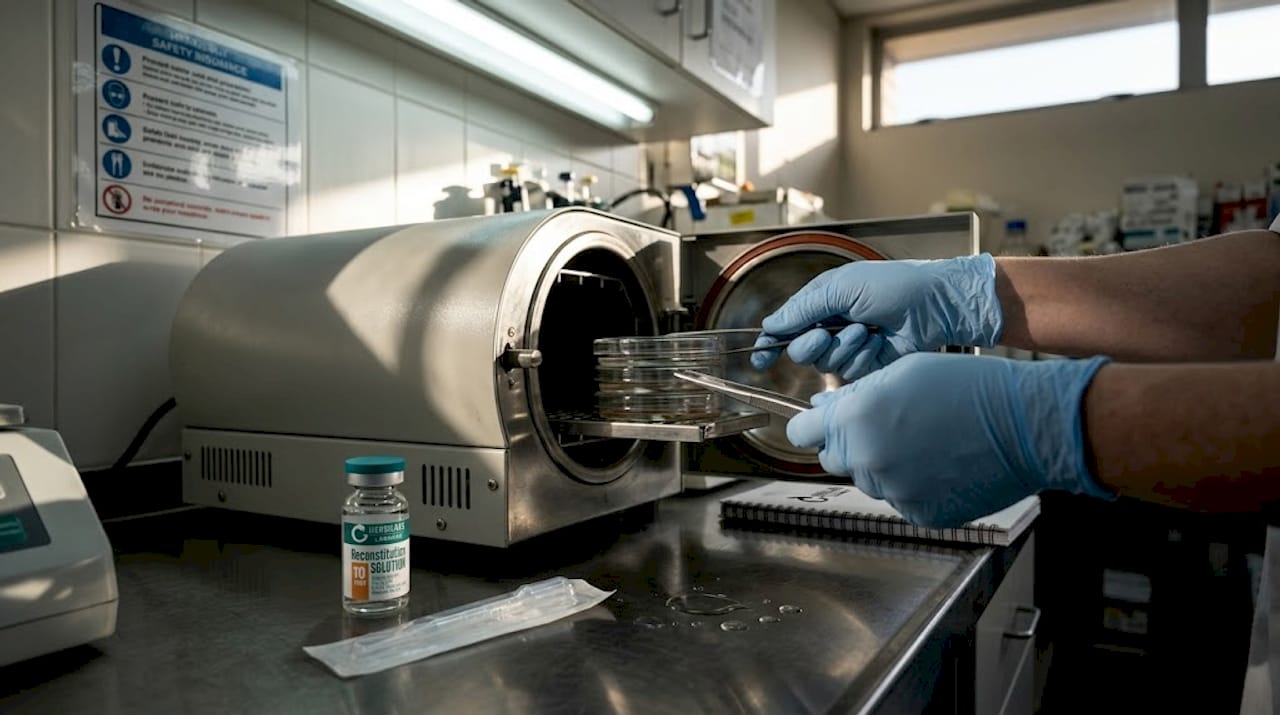
Beyond PPE, your contamination control labware must include autoclavable tools for reusable items, sterile single-use containers for sensitive steps, and lint-free wipes rated for cleanroom use.
| PPE item | Primary function |
|---|---|
| Nitrile gloves | Barrier against chemical and biological contact |
| Lab coat | Protects clothing and prevents particle shedding |
| Safety goggles | Eye protection against splashes and vapors |
| Face shield | Additional protection during high-risk procedures |
Quick cleaning steps grounded in best practice:
- Wipe all work surfaces with 70% isopropanol before starting any experiment
- Use a separate surface mat for each compound you handle
- Autoclave all reusable tools at 121 degrees Celsius for at least 15 minutes
- Dispose of single-use items immediately after contact with active compounds
- Never return unused material to the original stock container
EMA guidance stresses moisture control, inert gas use, and proper cleaning as essential to reliable synthesis, which translates directly to your day-to-day contamination protocol.
For a deeper breakdown, avoid lab contamination and ensuring lab purity are the most practically useful resources we’ve published on this topic.
Comparison of must-have labware for various research situations
With individual items covered, here’s how to select the right combination for your unique research context.
| Research type | Essential labware | Notes |
|---|---|---|
| Peptide synthesis | SPPS reaction vessels, amber vials, low-retention tips | Moisture and contamination control critical |
| General biochemistry | Borosilicate flasks, microcentrifuge tubes, pipettes | Accuracy and calibration are the priority |
| Microbial studies | Autoclavable containers, culture flasks, sterile plates | Sterility is the controlling factor |
| Reagent storage | Amber bottles, cryovials, PTFE-capped containers | Temperature stability and light protection |
Matching your research scenario to the right gear:
- Peptide synthesis: Prioritize inert materials and moisture-resistant sealing. EMA recommends hybrid SPPS/solution approaches for peptides over 70 amino acids, which demands adaptable labware that supports both solid-phase and liquid-phase steps.
- General biochemistry: Focus on volumetric accuracy. Calibrated glassware and multi-channel pipettes reduce error across large sample sets.
- Microbial work: Autoclaving capability and sterile disposables are non-negotiable. Every surface that contacts culture media is a potential contamination vector.
- Storage-heavy workflows: Invest in quality cryovials and labeled storage racks. Poor organization here causes more lost samples than any other single factor.
When it comes to actually sourcing what you need, reliable labware delivery matters more than most researchers anticipate until a delayed shipment stalls an active experiment.
The overlooked costs and consequences of cutting corners in labware
Here is what most equipment guides won’t tell you: the real cost of cheap or incomplete labware is almost never the purchase price. It is the compounding cost of failed experiments, wasted reagents, and the time you spend re-running work that should have been reproducible the first time.
We see this pattern repeatedly. A researcher saves money on unmarked, uncertified vials. A contamination event happens. The peptide batch is ruined. The cost of replacing the reagents and repeating the study dwarfs what quality vials would have cost by a significant margin. Contamination is not just a hygiene issue. It is a budget issue.
Low-quality labware also creates invisible problems. Inconsistent wall thickness in glassware affects heat distribution. Non-calibrated pipettes introduce volume errors that look like biological variability. These issues are genuinely hard to diagnose because the labware is the last thing most researchers suspect.
Quality labware is an investment in predictability. When your tools are reliable, your results tell you something real. When they are not, you are guessing. The selection framework in this guide, combined with sourcing from suppliers who prioritize labware delivery importance and quality verification, gives you a defensible, repeatable setup. Resist the shortcut. Your results will thank you.
Where to find high-quality labware for your research
Ready to level up your lab? Here’s where to get the essentials covered above.
At Herbilabs, we supply research-grade bacteriostatic water, sterile diluents, and reconstitution solutions manufactured to strict purity standards. Every product is designed for researchers who cannot afford contamination or inconsistency. Whether you are building your first independent setup or restocking a workflow that demands precision, our range covers the core labware and reagent categories discussed throughout this guide. Explore peptide labware essentials to find products matched to your research type, or browse the full explore labware catalog for everything from storage vials to sterile diluents.
Frequently asked questions
What is the most important labware for peptide research?
Accurate glassware and contamination-free storage vials are the most critical for consistent peptide results, as EMA guidelines for labware in peptide synthesis make clear.
How often should labware be sterilized in independent research labs?
Labware should be sterilized before every experiment and after use to prevent contamination, consistent with proper cleaning requirements for reliable synthesis.
Can plasticware be used for all research purposes?
Plasticware suits most applications, but glassware is recommended for reactions requiring high temperatures or strong solvents where plastic compatibility is uncertain.
What are common mistakes when handling lab reagents?
Improper labeling, incorrect storage temperatures, and unsafe transfers are the most common errors, and proper storage and labeling are directly tied to reproducible results.