Private Label, White Label, Wholesale partnerships available - EU, USA and UK - Free shipping from €75

What Is Sterile Compounding: A Guide for Professionals
Discover what is sterile compounding and learn essential procedures, standards, and practices to ensure patient safety and medication quality.
TL;DR:
- Sterile compounding involves preparing microorganisms-free medications for routes that bypass natural defenses, requiring strict environmental and personnel controls. Adherence to USP <797> standards ensures environmental classification, aseptic techniques, and quality assurance to prevent contamination and safeguard patient safety. Proper training, routine validation, and thorough cleaning are essential for maintaining sterility and accurate Beyond-Use Dates in compounded preparations.
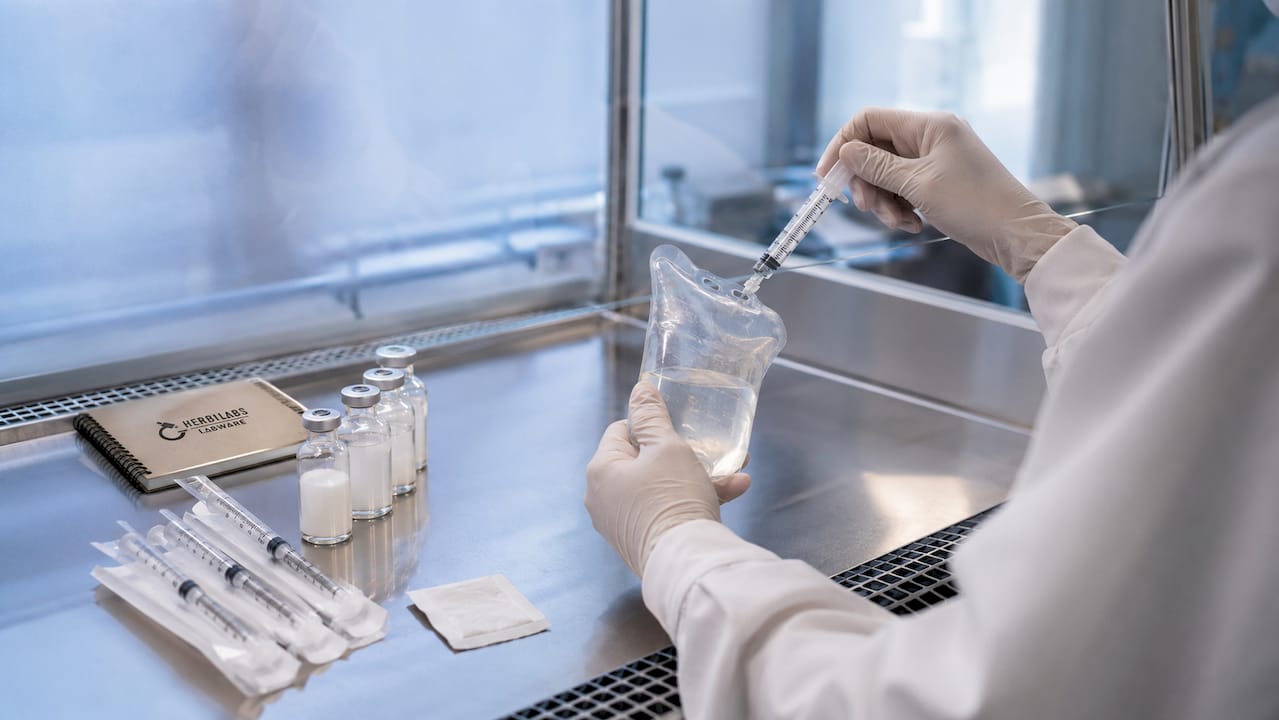
Sterile compounding is defined as the preparation of medications that must be completely free from viable microorganisms, pyrogens, and particulate matter to prevent patient harm during administration. Per USP <797>, it includes combining, admixing, diluting, pooling, reconstituting, repackaging, or otherwise altering drug products to produce sterile preparations. Simple reconstitution following FDA-approved labeling is excluded from this definition. The stakes are high: medications prepared for intravenous infusion, intrathecal injection, or ophthalmic use bypass the body’s natural defenses entirely, making any microbial contamination a direct patient safety threat. This guide covers the environmental controls, aseptic procedures, regulatory standards, and quality assurance practices every pharmacy and healthcare professional needs to master.
What is sterile compounding and what does it require?
Sterile compounding is not simply about working in a clean space. It is a disciplined, auditable system governed by USP <797>, the primary federal standard in the United States for compounded sterile preparations (CSPs). The standard defines scope, environmental requirements, personnel training, and quality controls that collectively prevent contamination at every stage of preparation.
Sterile compounded medications include IV admixtures, epidural injections, ophthalmic solutions, and intravesical preparations. These routes of administration share one characteristic: they bypass natural defenses such as skin and mucosal barriers, so any microbial contamination introduced during compounding reaches the patient’s bloodstream, spinal fluid, or ocular tissue directly. A contaminated IV bag does not produce visible signs of spoilage. This is why sterility cannot be verified by inspection alone and must be built into every step of the process.
A compounding pharmacy operating under USP <797> must maintain dedicated facilities, trained personnel, documented procedures, and ongoing environmental monitoring. The standard applies to hospital pharmacies, outpatient compounding pharmacies, and any facility preparing CSPs for patient administration.
What are the critical environmental controls required for sterile compounding?
The physical environment where sterile compounding occurs is classified by ISO particle count standards. ISO 5 is the cleanest classification, required for the direct compounding area where critical manipulations occur. ISO 7 is required for the buffer room surrounding the primary engineering control (PEC), and ISO 8 applies to the ante-room where personnel garb before entering.
Primary engineering controls are the devices that create and maintain the ISO 5 environment. The four main types are:
- Laminar Airflow Workbenches (LAFWs): Used for non-hazardous CSPs; horizontal or vertical airflow directs HEPA-filtered air across the work surface.
- Biological Safety Cabinets (BSCs): Required for hazardous drug compounding; protect both the product and the operator.
- Compounding Aseptic Isolators (CAIs): Enclosed glove-box systems for non-hazardous CSPs in non-classified environments.
- Compounding Aseptic Containment Isolators (CACIs): Enclosed systems for hazardous drugs in non-classified areas.
Certification of PECs and airflow systems must occur at least every six months and after any relocation or major service event. This frequency is not arbitrary. Airflow patterns degrade over time, HEPA filters develop micro-tears, and pressure differentials shift. A facility that skips certification is operating on assumption, not evidence.
Positive pressure differentials are maintained between ISO 5 and ISO 7 areas to push air outward and prevent contamination from entering the cleanest zones. Hazardous drug areas reverse this logic, using negative pressure to contain drug particles within the compounding space.
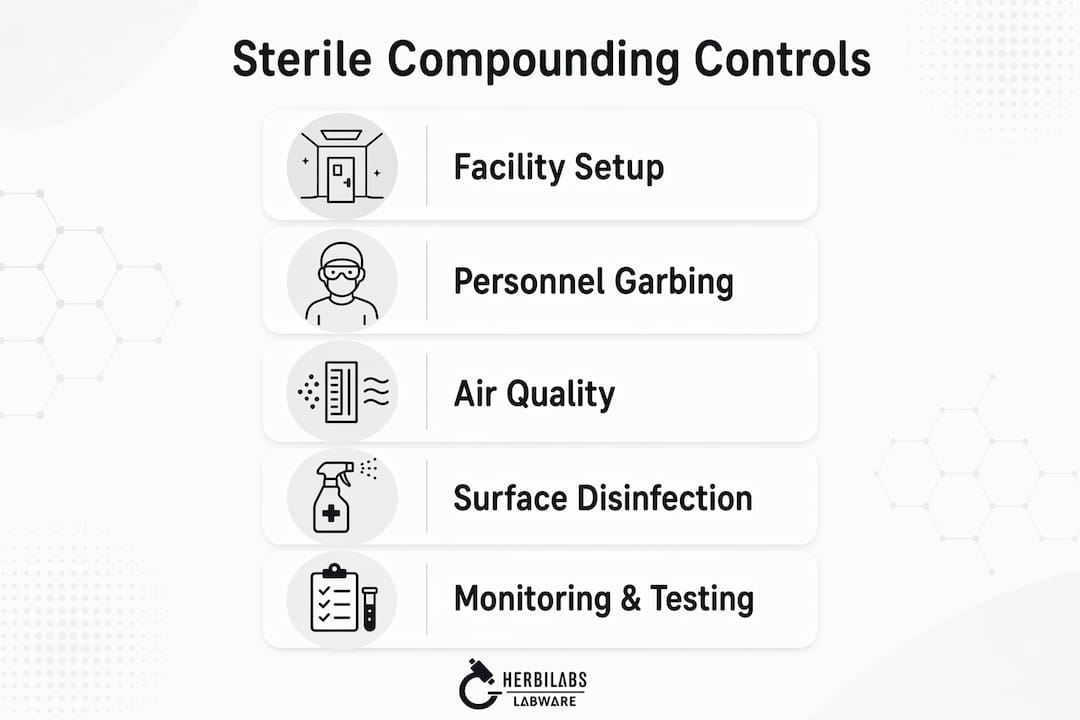
Segregated Compounding Areas (SCAs) are an alternative to full cleanrooms for facilities with lower CSP volume. SCAs house a PEC but lack a surrounding classified buffer room. USP <797> restricts BUDs for CSPs prepared in SCAs to 12 hours at room temperature or 24 hours refrigerated, reflecting the higher contamination risk.
If a PEC is powered down, it must be cleaned, disinfected, and purged for a manufacturer-specified time, commonly 30 minutes, before compounding resumes. Skipping the purge period means the first air reaching the work surface has not been fully filtered.
Pro Tip: Mark PEC shutdown times on a log sheet posted directly on the unit. When a compounder sits down to work, the purge time is visible without consulting a separate document, removing a common compliance gap.
| ISO classification | Location | Particle limit (≥0.5 µm/m³) |
|---|---|---|
| ISO 5 | Direct compounding area (inside PEC) | 3,520 |
| ISO 7 | Buffer room | 352,000 |
| ISO 8 | Ante-room | 3,520,000 |
What aseptic techniques and personnel practices ensure sterility?
Personnel are the largest contamination source in any sterile compounding environment. Skin sheds particles continuously, and respiratory droplets carry viable organisms. Garbing and aseptic technique exist specifically to create a physical barrier between the compounder and the sterile preparation.
Garbing order and rationale
Garbing follows a defined sequence designed to prevent contamination from outer clothing from reaching the cleanroom. The correct order is:
- Remove outer garments and jewelry in the ante-room.
- Apply shoe covers.
- Apply hair cover and beard cover if applicable.
- Apply face mask.
- Perform hand hygiene: wash with soap and water for 30 seconds to remove transient microorganisms.
- Don the gown.
- Apply sterile gloves as the final step inside or at the threshold of the buffer room.
Each step in this sequence has a purpose. Shoe covers prevent floor particles from tracking inward. Hair and beard covers contain shed skin cells and hair. The face mask reduces respiratory contamination. Gloves go on last because they are the only barrier between the compounder’s hands and critical sites.
Protecting critical sites and first air
A critical site is any surface that, if contaminated, could introduce microorganisms into the CSP. This includes vial stoppers, syringe tips, needle hubs, and injection ports. First air from HEPA filters must flow unobstructed over all critical sites at all times during manipulation. Placing hands, arms, or supply containers between the HEPA filter and the critical site breaks this protection.
The cleanest-to-dirtiest workflow principle applies both to cleaning and to the physical arrangement of supplies inside the PEC. Place the most critical items closest to the HEPA filter and work outward. Never reach over an open vial or syringe tip.
Competency requirements
- Glove fingertip sampling is required initially and periodically to verify that garbing technique does not introduce contamination.
- Media fill testing is required at initial training and every six months to validate that a compounder’s aseptic technique does not contaminate a simulated preparation.
- Written and practical competency assessments must be documented and retained.
Pro Tip: During media fill testing, use the same workflow and supply layout you use for actual CSPs. Changing your technique for the test produces a passing result that does not reflect real practice.
How does sterile compounding differ from nonsterile compounding?
Nonsterile compounding, governed by USP <795>, produces preparations such as topical creams, oral suspensions, suppositories, and lozenges. These products are applied to intact skin or ingested, where the body’s natural barriers provide a layer of protection against microbial contamination. Sterile compounding, by contrast, prepares medications for routes that bypass those barriers entirely.
The distinction is not about cleanliness. A nonsterile compounding area can be spotless and still be entirely inappropriate for preparing an IV medication. Sterility is a specific microbiological standard, not a housekeeping standard. A preparation is sterile when it contains no viable microorganisms, not simply when it was made in a tidy environment.
| Feature | Sterile compounding (USP <797>) | Nonsterile compounding (USP <795>) |
|---|---|---|
| Governing standard | USP <797> | USP <795> |
| Typical products | IV admixtures, ophthalmics, injectables | Creams, oral liquids, suppositories |
| Environment required | ISO 5 PEC, classified cleanroom | Controlled, but not ISO-classified |
| Primary contamination risk | Microbial, endotoxin, particulate | Chemical, physical stability |
| BUD basis | Sterility, stability, risk category | Stability and formulation data |
The clinical consequences of compromised sterility are severe. Contaminated CSPs have caused outbreaks of fungal meningitis, septicemia, and endophthalmitis. The 2012 New England Compounding Center outbreak, which resulted in 64 deaths from fungal meningitis linked to contaminated methylprednisolone acetate injections, remains the most cited example of what happens when sterile compounding standards fail at scale.
What are the best practices for cleaning and quality assurance?
Maintaining sterility requires a documented cleaning schedule that covers the PEC, surrounding surfaces, floors, walls, and all equipment that enters the cleanroom. PEC cleaning occurs before each batch, every 30 minutes during continuous compounding, and immediately after any spill or contamination event.
The standard cleaning sequence for a PEC follows these steps:
- Remove all supplies and debris from the work surface.
- Wipe surfaces with a lint-free wipe dampened with sterile water to remove gross contamination.
- Apply 70% Isopropyl Alcohol (IPA) and allow it to air dry completely before placing any supplies or beginning manipulation. Wet IPA pushed into a needle insertion site can introduce contaminants directly into the preparation.
- Apply a sporicidal agent on a defined schedule, typically monthly, to address spore-forming organisms that IPA does not eliminate.
- Document the cleaning event with compounder initials, date, and time.
Environmental monitoring and sterility testing
Environmental monitoring includes both surface sampling and air sampling to detect microbial contamination trends before they reach CSPs. Action levels trigger investigation and corrective action when colony counts exceed defined thresholds.
Beyond-Use Dates (BUDs) must be assigned based on CSP risk category, storage conditions, and available sterility and chemical stability data. Manufacturer expiration dates do not apply to compounded preparations. A CSP prepared in an ISO 5 environment with documented sterility testing supports a longer BUD than one prepared in an SCA without testing.
Terminal sterilization provides the highest sterility assurance and supports longer BUDs, but many CSPs cannot withstand the heat or radiation required. Aseptic processing is the standard approach for heat-labile drugs, placing full responsibility for sterility on the compounder’s technique and environment rather than a terminal kill step.
| Quality assurance activity | Frequency |
|---|---|
| PEC surface cleaning | Before each batch, every 30 minutes, after spills |
| Environmental surface sampling | Per USP <797> schedule, at minimum monthly |
| Media fill testing | Initial training, then every 6 months |
| PEC and airflow certification | Every 6 months, after relocation or major service |
| Sporicidal cleaning | Monthly minimum |
Key takeaways
Sterile compounding requires a documented, auditable system of environmental controls, aseptic technique, and quality assurance to produce preparations that are genuinely free from microbial, endotoxin, and particulate contamination.
| Point | Details |
|---|---|
| USP <797> defines the standard | All sterile compounding in the US must comply with USP <797> environmental, personnel, and quality requirements. |
| ISO classification drives BUD | CSPs prepared in ISO 5 PECs within classified cleanrooms qualify for longer BUDs than those from SCAs. |
| Personnel are the top contamination risk | Correct garbing order, hand hygiene, and first air protection directly determine whether a CSP is safe. |
| Cleaning schedules are non-negotiable | PEC surfaces must be cleaned before each batch, every 30 minutes during compounding, and after any spill. |
| BUDs require evidence, not assumption | Beyond-Use Dates must be based on sterility data, risk category, and storage conditions per USP <797>. |
Why sterile compounding discipline is the only standard worth holding
I have reviewed compounding workflows across hospital pharmacies and outpatient facilities, and the single most consistent finding is this: the facilities with the fewest contamination events are not the ones with the newest equipment. They are the ones where every compounder understands why each step exists, not just what the checklist says.
USP <797> can read like a compliance burden. In practice, it is an engineering specification for a system that must not fail. When a compounder reaches over an open syringe tip, they are not breaking a rule. They are introducing a contamination pathway into a preparation that will enter a patient’s bloodstream. That reframe changes how people work.
The most dangerous assumption in sterile compounding is that a clean-looking environment is a safe one. Contamination is invisible. A vial stopper that was not allowed to air dry after IPA application looks identical to one that was. A PEC that was restarted without the required purge time looks identical to one that was properly prepared. The discipline of following every step, every time, is what separates a safe CSP from one that carries risk.
For professionals building or auditing sterile compounding programs, I recommend focusing first on contamination control fundamentals and then on the specific sterile solution preparation protocols that govern your facility’s CSP types. Competency is not a one-time certification. It is a continuous practice.
— Ragnar
Sterile-grade solutions and labware for your compounding workflow
Herbilabs supplies research-grade bacteriostatic water, sterile diluents, and reconstitution solutions manufactured to strict purity standards for laboratory and research environments. Every product is produced in a dedicated facility with rigorous quality control to deliver contaminant-free preparations suitable for demanding workflows. If your research or compounding process requires reliable sterile diluents, Herbilabs offers bacteriostatic water options with documented purity and consistent batch quality. For a detailed comparison of sterile diluent types and their appropriate applications, the bacteriostatic vs. sterile water guide covers selection criteria relevant to reconstitution and research use across the UK and Europe.
FAQ
What is the sterile compounding definition per USP <797>?
Sterile compounding is defined by USP <797> as combining, admixing, diluting, pooling, reconstituting, repackaging, or otherwise altering a drug product to create a sterile preparation. Simple reconstitution following FDA-approved labeling is excluded from this definition.
What ISO classification is required for sterile compounding?
The direct compounding area inside the PEC must meet ISO 5, the surrounding buffer room must meet ISO 7, and the ante-room must meet ISO 8. These classifications are verified by particle count certification every six months.
How often must media fill testing be performed?
Media fill testing is required at initial training and every six months thereafter to validate that a compounder’s aseptic technique does not introduce contamination into a simulated preparation.
What is the difference between sterile and nonsterile compounding?
Sterile compounding produces preparations for injection, infusion, or instillation into sterile body cavities, governed by USP <797>. Nonsterile compounding produces topical, oral, or rectal preparations governed by USP <795>, which does not require ISO-classified environments.
How are Beyond-Use Dates assigned for compounded sterile preparations?
BUDs are assigned based on CSP risk category, storage conditions, and available sterility and chemical stability data. They are not derived from manufacturer expiration dates and must reflect the actual compounding environment and testing performed.