Private Label, White Label, Wholesale partnerships available - EU, USA and UK - Free shipping from €75

Research Reagents Supply Chain: A Lab Professional’s Guide
Discover what is the supply chain for research reagents and how understanding it can optimize your lab’s experiments and efficiency.
TL;DR:
- The research reagent supply chain involves raw material producers, manufacturers, distributors, and laboratories, each posing quality and logistical risks. Proper procurement practices, including thorough supplier qualification and maintaining safety stock, are essential to ensure consistent research results. Managing supply chain bottlenecks and diversifying suppliers help labs avoid experiment delays and maintain reagent quality.
The supply chain for research reagents is the end-to-end network of raw material producers, specialty chemical manufacturers, distributors, and laboratory end-users that delivers high-purity chemicals and biological materials to the bench. Understanding this network is not optional for serious researchers. A single weak link, whether a delayed phosphoramidite shipment or a failed Certificate of Analysis, can halt an entire experimental program. The reagent supply chain spans four distinct tiers, and each tier carries its own quality risks and logistics demands.
What is the supply chain for research reagents?
The supply chain process for reagents follows a sequential four-stage flow: raw material sourcing, specialty manufacturing, distribution, and end-use. Each stage adds value and introduces risk. Knowing where your reagent comes from at each stage is the foundation of reliable lab supply.
The four main stages work as follows:
-
Raw material production. Base chemicals, biological precursors, and solvents originate from commodity chemical producers. For specialized reagents like phosphoramidites used in oligonucleotide synthesis, production is geographically concentrated. Manufacturers such as NINGBO INNO PHARMCHEM CO., LTD operate primarily in China, creating geographic dependency for the entire downstream chain.
-
Specialty chemical manufacturing. Raw inputs are converted into research-grade reagents under controlled conditions. Manufacturers apply strict purity standards, analytical testing, and batch documentation. This stage determines the baseline quality of everything that follows.
-
Distribution and reseller networks. Distributors hold regional inventory, manage cold-chain logistics, and provide technical support. They translate global manufacturing capacity into local availability. For academic labs and small biotech firms, a regional distributor is often the only practical point of contact.
-
End-user laboratories. Pharmaceutical companies, biotech firms, universities, and diagnostic labs consume reagents as inputs to experiments, assays, and production processes. Their quality requirements drive specifications back up the chain.
Pro Tip: When evaluating a new reagent supplier, ask for the full chain of custody documentation, not just the Certificate of Analysis. Knowing which manufacturer produced the raw input tells you far more about consistency than a single batch report.
How does procurement shape reagent supply chain quality?
Vendor qualification is a staged, risk-reduction system designed to protect research integrity by verifying both chemical purity and supplier reliability. The procurement process covers supplier screening, technical evaluation, trial orders, and ongoing monitoring. Skipping any stage increases the probability of receiving off-spec material that invalidates experimental results.
The qualification sequence breaks down into five steps:
- Initial screening. Assess supplier capabilities, geographic location, regulatory compliance, and product catalog against your technical requirements.
- Technical evaluation. Review analytical data, production methods, and quality management systems. Request sample lots for independent testing.
- Reference checks. Contact existing customers in your sector, specifically pharmaceutical or biotech labs with comparable purity requirements.
- Trial orders. Place a small initial order and run full incoming QC before committing to volume purchasing.
- Ongoing monitoring. Conduct re-audits, maintain supplier scorecards, and track delivery performance and CoA consistency over time.
Certificates of Analysis are the primary quality document in this process. A CoA should specify purity by HPLC, water content, residual solvents, and lot-specific analytical data. Generic or incomplete CoAs are a red flag at any tier of the supply chain.
| Qualification Stage | Key Action | Risk Mitigated |
|---|---|---|
| Initial screening | Assess compliance and capability | Onboarding unqualified vendors |
| Technical evaluation | Independent sample testing | Accepting off-spec material |
| Trial order | Small-volume incoming QC | Large-batch quality failure |
| Ongoing monitoring | Scorecards and re-audits | Supplier performance drift |
Pro Tip: Build your supplier scorecard around three metrics: on-time delivery rate, CoA pass rate on incoming QC, and response time to technical queries. These three numbers predict 90% of future supply problems.
Reagent quality control at the receiving end is not redundant. Even qualified suppliers produce occasional out-of-spec batches. Incoming QC is the last line of defense before a bad reagent enters your workflow.
Domestic vs. international sourcing: costs, lead times, and risks
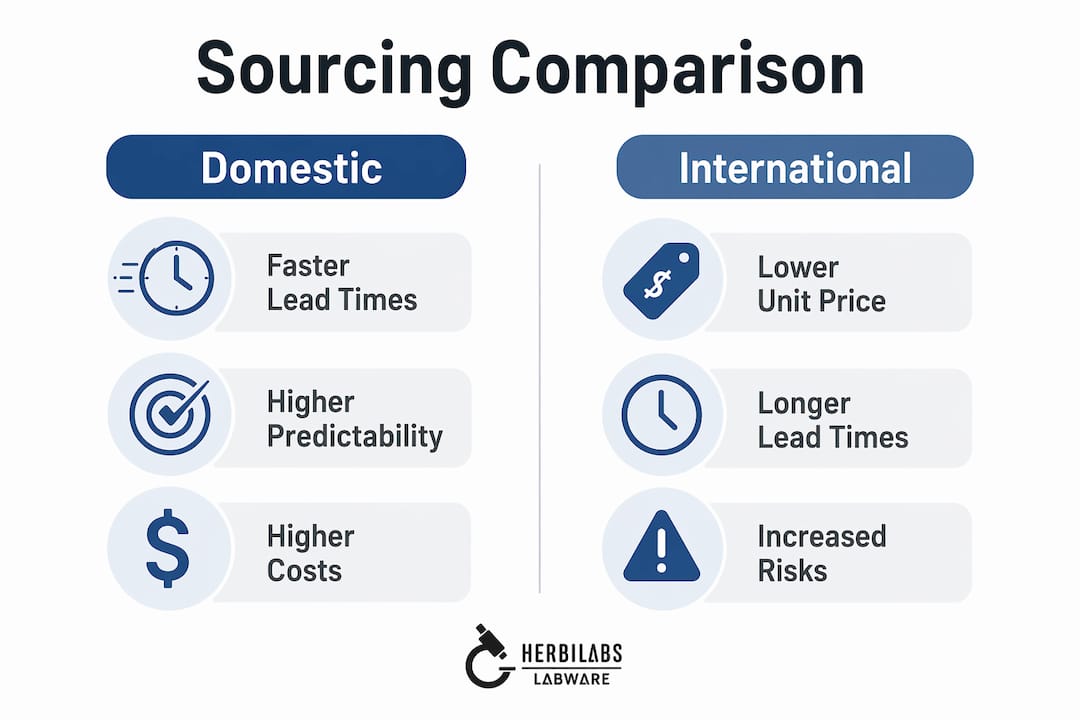
Evaluating total cost of ownership rather than unit price alone is the most important principle when choosing between domestic and international reagent suppliers. The cost difference is significant: domestic shipping runs $5–$15 per kilogram with a 2–4 week lead time, while international sourcing costs $25–$80 per kilogram and takes 8–16 weeks. That price gap closes fast once you factor in tariffs, re-testing costs, and the carrying cost of larger safety stock.
The practical implications for lab planning are direct:
- Lead time planning. An 8–16 week international lead time means you must forecast demand months in advance. Most labs underestimate this requirement.
- Inventory buffers. Maintaining a 4–8 week buffer for critical reagents with long lead times is the standard recommendation. For reagents with no domestic alternative, extend that buffer further.
- Quality re-testing costs. International shipments face higher risk of temperature excursions and documentation gaps. Budget for incoming QC on every international lot, not just the first.
- Tariff exposure. Research chemicals sourced from outside the EU or UK face import duties that can add 5–15% to the landed cost. This rarely appears in the initial supplier quote.
- Supplier concentration risk. Relying on a single international manufacturer for a critical reagent creates catastrophic exposure to geopolitical disruption, export controls, or factory shutdowns.
Supplier diversification is the primary tool for managing concentration risk. Maintaining at least two qualified sources for any reagent that is critical to ongoing research programs is standard practice in pharmaceutical procurement. Academic labs often skip this step until a supply disruption forces the issue.
The comparison is not simply domestic versus international. It is predictable cost and speed versus lower unit price with higher operational complexity. For high-volume, non-critical reagents, international sourcing often wins on total cost. For time-sensitive or purity-critical materials, domestic suppliers with shorter lead times typically deliver better value when all costs are counted.
How do supply chain bottlenecks affect reagent availability?
Supply chain bottlenecks in research reagent procurement occur most often at two points: late reorder timing and incoming quality control inspection. Both are within the lab’s control, yet both are consistently underestimated. A reagent that arrives on schedule can still delay an experiment by two weeks if incoming QC, documentation review, and approval steps are not built into the timeline.
The most effective practices for managing these bottlenecks include:
- Build QC time into lead time calculations. Lead time is not just shipping. It includes documentation review, incoming inspection, and sign-off before the reagent enters inventory. Add at least five to ten business days to any supplier-quoted lead time.
- Use demand forecasting. Track consumption rates by project and by quarter. Reagents tied to active research programs should trigger reorder at 60% of safety stock, not when the bottle is nearly empty.
- Communicate proactively with suppliers. Notify key suppliers of upcoming high-volume periods or new project starts. Many supply disruptions are avoidable with four to six weeks of advance notice.
- Centralize supplier coordination. Marketplace platforms can consolidate hundreds of suppliers into a single purchasing interface, improving visibility and reducing administrative overhead for procurement teams.
Pro Tip: Set calendar-based reorder reminders for every reagent with a lead time over three weeks. Waiting for a visual stock check is how labs end up with a two-week experimental gap in the middle of a funded project.
Emerging AI-powered inventory tools are beginning to automate demand forecasting for laboratory consumables. These systems analyze historical consumption data and flag reorder points automatically. For labs managing more than 50 active reagents, the time savings justify the implementation cost.
Key takeaways
The research reagents supply chain runs from raw material producers through specialty manufacturers and distributors to end-user labs, and every stage requires active quality management and procurement discipline to protect experimental outcomes.
| Point | Details |
|---|---|
| Four-stage chain structure | Raw materials, manufacturing, distribution, and end-use each carry distinct quality and logistics risks. |
| Vendor qualification is non-negotiable | Screen, test, trial, and monitor every supplier before committing to volume orders. |
| Total cost of ownership matters | International unit prices look attractive until tariffs, shipping, and re-testing costs are added. |
| Buffer stock prevents delays | Maintain 4–8 weeks of safety stock for critical reagents with long or international lead times. |
| QC time is part of lead time | Build documentation review and incoming inspection into every delivery timeline, not just shipping days. |
What i’ve learned about reagent supply chains that most labs get wrong
Most procurement problems I see in research settings are not caused by bad suppliers. They are caused by labs treating procurement as an administrative task rather than a scientific one. The decision of where to source a reagent directly affects experimental reproducibility. A phosphoramidite from a manufacturer with inconsistent lot-to-lot purity will produce variable coupling efficiency, and that variability will show up in your data before it shows up on a CoA.
The vendor qualification process exists for a reason, and the labs that skip the trial order step are the ones that call me six months later with reproducibility problems they cannot explain. I have seen this pattern repeatedly. A supplier looks credible on paper, the price is right, and the first batch passes incoming QC. Then batch three or four drifts, and by then the lab has no qualified backup source and no time to qualify one.
My strongest recommendation is to treat supplier diversification as a research continuity requirement, not a procurement preference. For any reagent that appears in more than one active protocol, qualify two sources before you need them. The cost of qualification is trivial compared to the cost of a delayed experiment or a failed study.
Documentation discipline also matters more than most researchers expect. Keeping organized records of CoAs, supplier audit reports, and incoming QC results by lot number is not bureaucracy. It is the evidence base you need when a result is questioned or a regulatory submission requires traceability. Herbilabs builds this documentation standard into its own supply process, and it is the right model for any lab that takes reproducibility seriously.
— Ragnar
How Herbilabs supports your reagent sourcing
Herbilabs manufactures and supplies research-grade bacteriostatic water, sterile diluents, and reconstitution solutions to labs across the UK and Europe. Every product is manufactured to strict purity standards with full CoA documentation, giving you the traceability that rigorous research demands.
If you are building or reviewing your lab’s reagent sourcing strategy, the Herbilabs shop carries a curated range of high-purity reconstitution solutions and sterile diluents ready for immediate dispatch. For researchers working with peptides and sensitive compounds, understanding how to store research reagents correctly is as important as sourcing them from a qualified supplier. Herbilabs provides both the products and the guidance to keep your supply chain performing at the level your research requires.
FAQ
What are research reagents?
Research reagents are chemicals, biological materials, and solutions used in laboratory experiments to detect, measure, or produce specific reactions. They include solvents, buffers, enzymes, antibodies, and specialty compounds like phosphoramidites used in oligonucleotide synthesis.
How many stages does the reagent supply chain have?
The reagent supply chain has four main stages: raw material production, specialty chemical manufacturing, distribution, and end-user laboratory consumption. Each stage adds quality requirements and logistics complexity.
What is a certificate of analysis and why does it matter?
A Certificate of Analysis is a batch-specific document confirming a reagent’s purity, composition, and analytical test results. It is the primary quality verification tool in reagent procurement and is required for experimental reproducibility and regulatory compliance.
How long does international reagent sourcing take?
International sourcing typically takes 8–16 weeks from order to lab delivery, compared to 2–4 weeks for domestic suppliers. Labs should maintain a 4–8 week safety stock buffer for any reagent sourced internationally.
How do you reduce supply chain risk for critical reagents?
Qualify at least two suppliers for every critical reagent before a shortage occurs. Combine this with demand forecasting, proactive supplier communication, and centralized procurement tracking to maintain consistent availability.