Private Label, White Label, Wholesale partnerships available - EU, USA and UK - Free shipping from €75

Top US Labware Options for Researchers in 2026
Discover the top US labware options for 2026, ensuring safety, precision, and compliance. Choose the best supplies for your research needs.
TL;DR:
- Herbilabs offers research-grade labware made from certified borosilicate glass and premium plastics for high-purity applications.
- Selecting the right materials, supplier, and documentation improves data reproducibility, safety, and long-term costs in U.S. laboratories.
Top US labware options combine high-purity borosilicate glass and premium plasticware built for safety, consistency, and compliance with ISO and ASTM standards. The global labware market reached $4 billion in 2024 and is projected to hit $5 billion by 2035, driven by demand for precision and chemical durability. For U.S. laboratory professionals, the right labware choice directly affects data reproducibility, personnel safety, and long-term procurement costs. Material quality, supplier reliability, and regulatory conformance are the three criteria that separate functional lab supplies from genuinely research-grade equipment.
1. Top US labware options by category
The four core labware categories in U.S. labs are glassware, plasticware, consumables, and safety equipment. Each serves a distinct function, and selecting the wrong category for a given application creates reproducibility problems that compound over time.
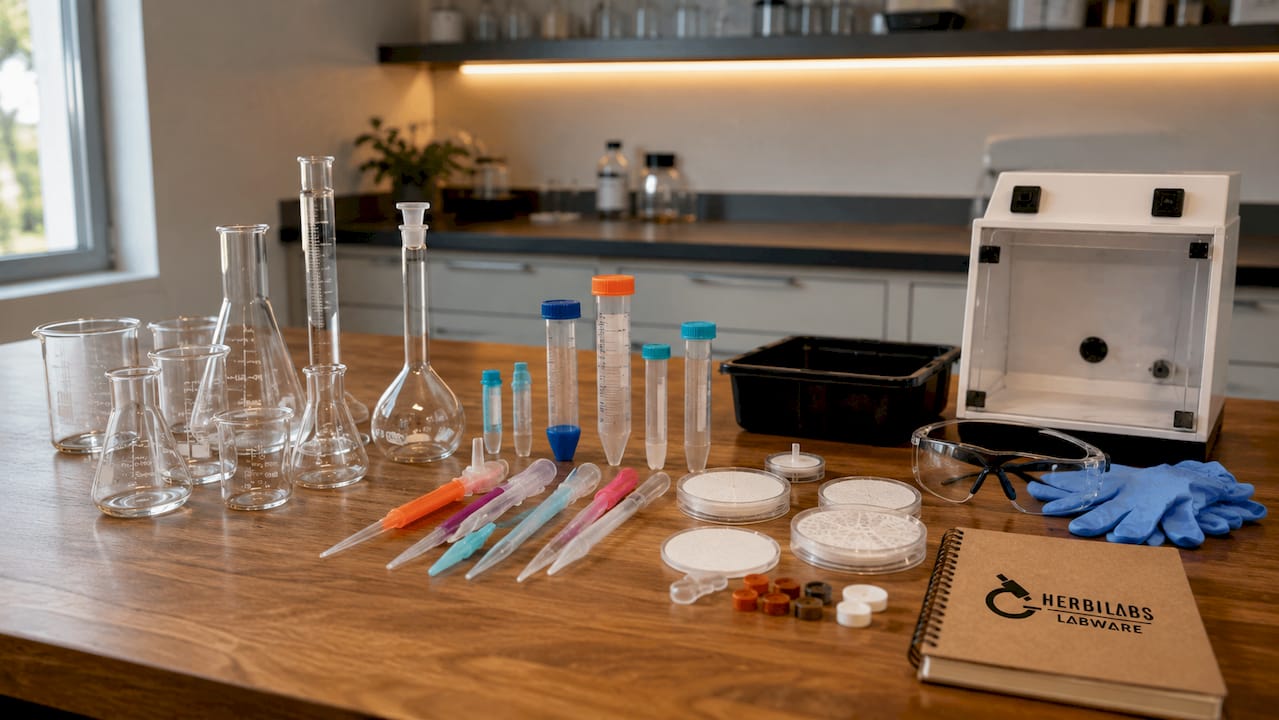
Glassware remains the dominant category by market value. Beakers, Erlenmeyer flasks, volumetric flasks, and reagent bottles made from borosilicate glass deliver the chemical inertness and thermal stability that analytical and pharmaceutical research demands. These items are the workhorses of any research-grade lab setup.
Plasticware covers pipettes, centrifuge tubes, microplates, and single-use consumables. This category grows fastest by unit volume because clinical and high-throughput labs prioritize contamination control and turnaround speed over long-term reuse.
Consumables include filters, septa, stoppers, and tubing. These items are often overlooked in procurement planning but account for a significant share of ongoing lab operating costs.
Safety equipment rounds out the category list with fume hoods, spill containment trays, and certified personal protective equipment. Stricter safety regulations globally are pushing labs toward branded, certified safety products that support research consistency and personnel protection.
2. Glassware: the gold standard for analytical work
Glassware is the category most closely associated with research precision. Borosilicate glass, the material behind brands like Pyrex and Schott Duran, withstands temperatures from well below freezing to over 500°C without warping or leaching contaminants. That thermal range matters in autoclaving, reflux reactions, and cryogenic storage.
Glass offers superior consistency, lower extractables, and better stability under extreme temperatures compared to single-use plastics. This is not a minor performance gap. Extractables from plastic containers can interfere with sensitive assays, skewing results in ways that are difficult to trace back to the container rather than the sample.
Volumetric glassware calibrated to Class A tolerances under ASTM E288 or ISO 1042 standards delivers the measurement accuracy that regulatory submissions require. Researchers working in GMP or GLP environments cannot substitute commodity glass for certified Class A equipment without risking audit findings.
3. Plasticware: where convenience and hygiene win
Plasticware dominates unit volume in U.S. labs because single-use items eliminate cross-contamination risk between samples. Polypropylene (PP) and polyethylene (PE) tubes, tips, and plates are autoclavable, chemically resistant to most aqueous buffers, and available in bulk at low per-unit cost.
The tradeoff is consistency. Plastic formulations vary between manufacturers, and lot-to-lot differences in surface chemistry can affect cell culture adhesion, protein binding, and reagent stability. Labs running long-term studies need to document the plastic grade and supplier for every consumable used.
Environmental impact is a growing procurement consideration. Single-use plastics generate significant laboratory waste, and several U.S. research institutions now require sustainability assessments as part of their procurement approval process. Biodegradable and recycled-content plasticware options are entering the market, though performance data for these alternatives remains limited.
4. Material choice: glass versus plastic in practice
Borosilicate glass commands 45–55% of reagent bottle market value despite lower unit volume. That premium reflects its status in regulated, high-purity applications where contamination risk carries real consequences.
Pro Tip: Never substitute commodity-grade plastic reagent bottles for borosilicate glass in analytical workflows where extractables could interfere with your assay. The cost difference per bottle is small. The cost of a failed batch or a retracted result is not.
The practical decision framework comes down to three questions:
- Does the application require sterilization by autoclaving? Glass wins.
- Does the workflow involve high sample throughput with contamination risk between runs? Single-use plastic wins.
- Does the reagent have known reactivity with plastic polymers (e.g., organic solvents, lipophilic compounds)? Glass wins.
A hybrid procurement strategy uses borosilicate glass for processes needing chemical inertness and sterilizability, and single-use plastic for convenience and contamination risk reduction. This approach balances cost and quality without forcing a single-material policy across all lab functions.
5. Reagent bottles and reconstitution vessels
Reagent bottles are among the most procurement-critical items in any lab. Certified reagent bottles carry a premium price but are necessary for high-purity applications to avoid contamination risks associated with commodity-grade bottles. Documented sterility and traceable manufacturing records are non-negotiable for GMP and clinical research environments.
Glass vials used for reconstitution solutions require Type I borosilicate glass per USP <660> and ISO 4802 standards. These specifications limit leachable metals and silica that could degrade sensitive biological reagents. Labs sourcing reconstitution vessels outside certified channels introduce a variable that most quality systems cannot adequately control.
Herbilabs supplies sterile reconstitution solutions in premium glass vials manufactured to strict purity standards. For researchers working with peptides or biological reagents, the container is as important as the solution inside it.
6. What separates premium labware suppliers from commodity vendors
Leading labware companies differentiate themselves by offering integrated digital platforms, portfolio breadth, and value-added technical services, not just products. A supplier that provides only a product catalog forces your procurement team to manage compliance, documentation, and technical support independently.
“Procurement teams should seek labware vendors offering predictive maintenance and integrated digital services, not just low unit prices. The total value delivered by a supplier extends well beyond the invoice.”
The characteristics that define a premium supplier for U.S. labs include:
- ISO and ASTM certification documentation available for every product line, not just on request
- Digital ordering and inventory integration that connects to lab information management systems (LIMS)
- Technical support from staff with actual laboratory experience, not just sales training
- Supply chain transparency with clear lead times, lot traceability, and backup sourcing plans
Portfolio breadth also matters. A supplier covering glassware, plasticware, safety equipment, and reagents reduces the number of vendor relationships your procurement team manages. Standardization across a single supplier’s product lines also simplifies SOPs and training.
7. Total cost of ownership: the metric most labs undervalue
Purchase price is the wrong metric for labware procurement. Total cost of ownership favors glassware over plastics long-term due to durability and less price volatility, despite higher upfront costs and cleaning demands. Experienced lab managers prioritize TCO rather than just purchase price.
The full TCO calculation for glassware includes acquisition cost, cleaning labor, autoclave energy, breakage replacement rate, and storage footprint. For single-use plastics, it includes per-unit cost multiplied by annual volume, waste disposal fees, and the staff time spent managing consumable inventory.
Labs that switch from reusable glass to single-use plastic for convenience often find that waste disposal costs and consumable reorder frequency erode the anticipated savings within 18 months. The calculation shifts further when you factor in the risk cost of a contamination event traced to a non-certified plastic container.
8. How to choose labware for specific U.S. lab contexts
The right labware choice depends on the research environment, not a universal ranking of materials or brands. Match your selection to the application first.
Analytical and pharmaceutical labs require Class A volumetric glassware, certified reagent bottles, and ASTM-compliant storage vessels. Compliance documentation must accompany every lot. Cutting costs on container grade in these environments creates audit liability.
Clinical and diagnostic labs benefit most from single-use plasticware for sample handling, with glass reserved for reagent storage and calibration standards. Contamination control between patient samples is the primary design constraint.
Academic and independent research labs have more flexibility but should still follow lab supply best practices for sourcing certified materials. Reproducibility problems in academic research are frequently traced to inconsistent consumable grades across experiments.
Pro Tip: Build a critical materials register for your lab. List every consumable that directly contacts your sample or reagent, document the grade and supplier for each, and review the register annually. This single practice prevents the most common source of unexplained variability in experimental results.
The scalability question matters for growing labs. A supplier that handles both small research orders and bulk institutional purchasing gives you room to scale without switching vendors mid-project.
Key takeaways
The best labware choices for U.S. labs combine certified borosilicate glass for high-purity applications, single-use plastics for high-throughput workflows, and suppliers who deliver compliance documentation alongside the product.
| Point | Details |
|---|---|
| Glass for high-purity work | Borosilicate glass delivers lower extractables and better thermal stability than plastic for analytical and pharmaceutical applications. |
| Hybrid material strategy | Use glass for sterilizable, repeatable processes and single-use plastic for contamination-sensitive, high-throughput workflows. |
| Certified bottles matter | Commodity-grade reagent bottles introduce contamination risk. Certified grades provide documented sterility and traceable manufacturing. |
| TCO beats purchase price | Long-term glassware costs are lower than single-use plastics when cleaning, waste disposal, and supply chain volatility are included. |
| Supplier value beyond product | Choose vendors offering ISO/ASTM documentation, digital integration, and technical support, not just competitive unit pricing. |
What I’ve learned about labware procurement after years in the field
The most expensive mistake I see U.S. lab managers make is treating labware as a commodity purchase. They optimize for the lowest unit price, switch suppliers when a cheaper catalog appears, and then spend months troubleshooting reproducibility problems that trace back to a container grade change nobody documented.
Glass is not interchangeable. A borosilicate reagent bottle from a certified manufacturer and a commodity glass bottle from an unverified source are not the same product, even if they look identical on a shelf. The difference shows up in your data, not in the packaging.
The hybrid strategy works, but only when it is deliberate. Labs that use glass everywhere out of habit and labs that switched to plastic everywhere for convenience both make the same error: they let inertia drive a decision that should be driven by application requirements. The labs I have seen run the cleanest data are the ones with a written material selection policy tied to specific assay types.
Vendor relationships also matter more than most procurement teams admit. A supplier who picks up the phone when you have a quality question, provides lot-specific certificates of analysis without a three-day wait, and flags supply chain disruptions before they affect your orders is worth paying a modest premium for. That relationship is part of your quality system, whether it appears in your SOPs or not.
My practical recommendation: audit your current labware against your actual application requirements once a year. You will almost always find at least one place where you are using an underspecified material for a critical application, and at least one place where you are paying for certified glass in a workflow where a quality plastic would perform identically.
— Ragnar
Herbilabs labware solutions for U.S. researchers
Herbilabs supplies research-grade labware and reconstitution solutions built to the purity standards that demanding lab environments require. Every product ships with quality documentation, and the manufacturing process prioritizes contaminant-free results for researchers who cannot afford variability in their reagents or containers.
If you work with peptides, biological reagents, or any application requiring sterile diluents, the bacteriostatic water FAQs on the Herbilabs site answer the most common questions lab professionals ask about reconstitution solutions, storage, and compatibility. For researchers building out a complete lab supply chain, the Herbilabs shop carries sterile solutions in certified glass vials with wholesale pricing available for institutional and reseller orders.
FAQ
What is the best labware material for analytical chemistry?
Borosilicate glass is the standard material for analytical chemistry because it offers low extractables, chemical inertness, and thermal stability. Class A volumetric glassware certified to ASTM or ISO standards is required for regulatory submissions.
When should a lab use single-use plastic instead of glass?
Single-use plastic is the right choice for high-throughput workflows where cross-contamination between samples is the primary risk. Clinical sample handling, PCR setup, and cell culture work in multi-well plates are the clearest use cases.
How do I evaluate total cost of ownership for labware?
Calculate TCO by adding acquisition cost, cleaning labor, autoclave energy, breakage replacement, and waste disposal fees. Glassware typically wins on TCO over a two-year horizon despite higher upfront cost.
What certifications should I require from a labware supplier?
Require ISO 9001 manufacturing certification, ASTM or ISO product compliance documentation for volumetric ware, and lot-specific certificates of analysis for reagent bottles and reconstitution vessels.
What is bacteriostatic water used for in lab research?
Bacteriostatic water is a sterile diluent preserved with benzyl alcohol, used to reconstitute peptides and biological reagents for research applications. It extends the usable life of reconstituted solutions compared to plain sterile water.