Private Label, White Label, Wholesale partnerships available - EU, USA and UK - Free shipping from €75

Types of EU Academic Labware: 2026 Research Guide
Explore the essential types of EU academic labware in our 2026 research guide. Ensure accurate experiments with the right equipment today!
TL;DR:
- EU academic labware includes containers, measurement tools, and processing equipment used in European laboratories for scientific experiments. Proper selection based on function, accuracy class, and material standards ensures reproducibility, safety, and compliance with EU regulations. Using Type I borosilicate glass and obtaining traceability certificates for critical workflows are essential for reliable research results and audit readiness.
EU academic labware is defined as the collection of containers, measurement tools, and processing equipment used in European university and research laboratories to conduct, measure, and control scientific experiments. The types of EU academic labware span three core functional categories: bulk containment and mixing, precise measurement and dispensing, and specialized separation and processing. Each category carries specific material standards, accuracy classifications, and EU compliance requirements that directly affect experimental reproducibility. Selecting the wrong category or grade is not a minor inconvenience. It can invalidate results, fail audits, and compromise safety.
1. containment and mixing labware in EU academic labs
Beakers, Erlenmeyer flasks, and round-bottom flasks are the workhorses of any wet lab. Each serves a distinct purpose that shapes which one you reach for first.
- Beakers handle bulk liquid storage, mixing, and heating. Their wide mouth makes them easy to fill and stir, but they are not designed for accurate volume measurement.
- Erlenmeyer flasks are the standard for swirl-mixing and culture work. The conical shape reduces evaporation and splash during agitation, making them the default for microbiology and cell culture media prep.
- Round-bottom flasks distribute heat evenly across their curved surface. They are the correct choice for rotary evaporation and reflux setups where thermal stress would crack flat-bottomed glass.
Material selection is not optional in regulated European labs. Borosilicate glass compliant with European Pharmacopeia glass Type I (DIN ISO 3585) is the material standard for repeatable, sterilizable, and chemically resistant scientific glassware. This matters because repeated autoclave cycles degrade lower-grade glass, introducing contamination risk and dimensional drift over time.
Pro Tip: When selecting glassware for workflows that require repeated autoclaving, specify Type I borosilicate glass and confirm the supplier provides a certificate of compliance with DIN ISO 3585. Generic “lab glass” without this designation may not survive 50+ sterilization cycles without leaching.
2. measurement and dispensing labware: accuracy classes explained
Volumetric flasks, graduated cylinders, burettes, and pipettes are the measurement tier of academic laboratory equipment. Their defining characteristic is not shape but accuracy class.
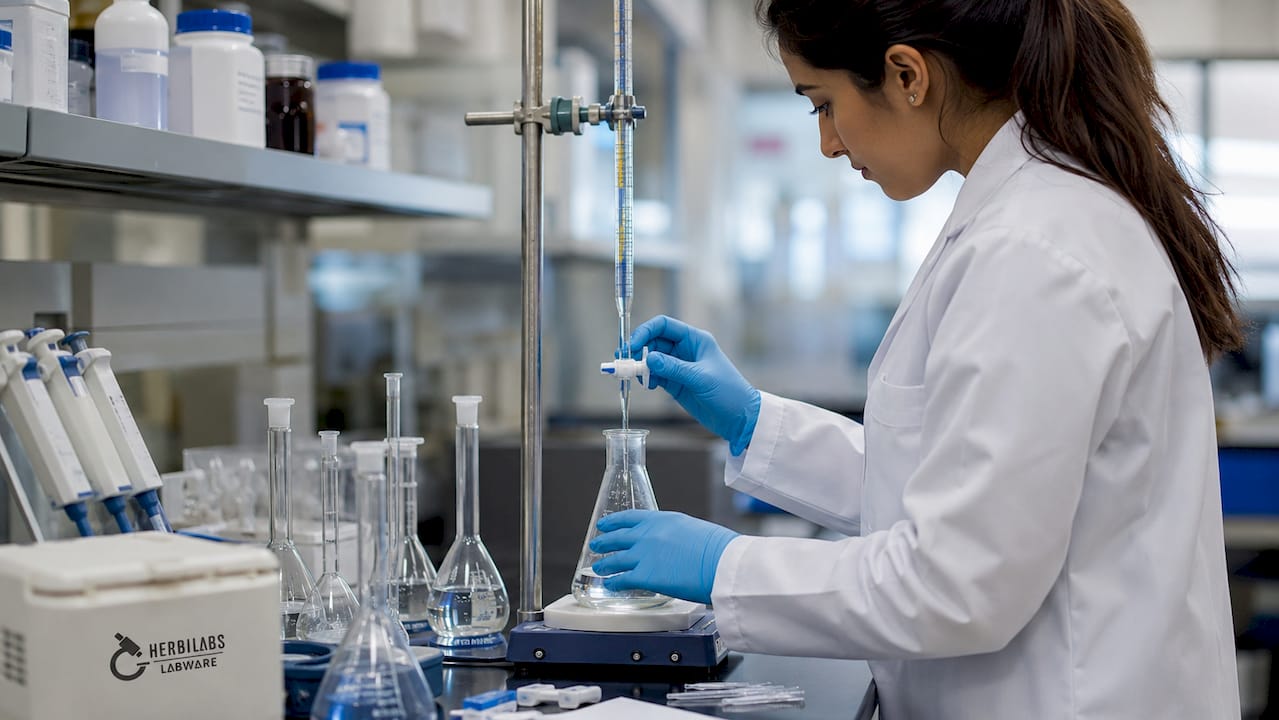
Class A labware is calibrated to tighter ISO/ASTM tolerance limits than Class B. Class B tolerances generally double the error of Class A. For a 100 mL volumetric flask, that difference translates directly into whether your prepared standard solution is fit for analytical use or only suitable for general reagent prep.
The table below shows the practical difference between Class A and Class B across common labware types:
| Labware Type | Class A Use Case | Class B Use Case | Governing Standard |
|---|---|---|---|
| Volumetric flask | Analytical standards, HPLC mobile phases | General reagent preparation | ISO 1042 |
| Burette | Titration in regulated workflows | Teaching labs, approximate titrations | ISO 385 |
| Graduated cylinder | Reference volume checks | Routine liquid transfers | ISO 4788 |
| Pipette (volumetric) | Trace analysis, pharmaceutical assays | General dispensing | ISO 648 |
Class A is required for analytical chemistry and any regulated workflow in EU labs. Class B is appropriate for teaching environments and non-critical transfers. Choosing Class B for a workflow that demands Class A does not save money. It generates data that cannot be defended under audit.
Pro Tip: Always request a traceability certificate linked to the specific accuracy class and batch when purchasing volumetric glassware for QA-adjacent research. Without it, you cannot prove which tolerance applies to a critical transfer step during an inspection.
For labs that need a structured overview of must-have labware for research, the functional categories above provide a solid procurement framework.
3. specialized labware for separation, filtration, and biosafety
This category covers the equipment that handles the most demanding steps in a research workflow: distillation, sterile filtration, and biological containment.
Distillation and condensation glassware
Condensers and distillation assemblies are built from the same Type I borosilicate glass as standard labware, but their geometry is purpose-built for vapor management. Liebig condensers handle simple distillation. Graham and Allihn condensers increase surface area for more efficient cooling in fractional or reflux setups. Choosing the wrong condenser type for a high-boiling-point solvent is a common error that reduces yield and increases solvent loss.
Sterile filtration membranes
Sterile disposable filtration membranes for sample and media preparation commonly use 0.22 µm PES filters for sterilizing filtration to remove bacteria, and 0.45 µm membranes for pre-filtration particle removal. Membrane material matters as much as pore size. PES (polyethersulfone) membranes have low protein binding, making them the standard for biological media. Nylon and PVDF membranes suit organic solvents but adsorb proteins, which reduces assay yield. Selecting the wrong membrane material can reduce protein recovery by a measurable margin without any visible sign of failure.
For detailed guidance on sterile solution preparation including membrane filter selection, Herbilabs provides a step-by-step protocol covering safety and best practices.
Biosafety cabinets and EN 12469 compliance
Biosafety cabinets (BSCs) are the most regulated item in this category. Class II BSCs make up about 98% of the microbiological safety cabinet market in Europe and must follow the EN 12469 series for safe operation in academic labs. A 2026 update to EN 12469 splits the standard into parts covering BSC Classes I through III, with expanded requirements on installation, testing, maintenance, and end-of-life handling. This is not a paperwork update. New parts including EN 12469-5 now specify routine performance checks that lab managers must schedule and document.
BSCs require not only purchasing but also proper installation, qualification, maintenance, and planned decommissioning to meet EU standards. A cabinet that passes factory certification but is installed against a wall with insufficient clearance will fail its on-site performance test.
Cell culture consumables
TC-treated surfaces support adherent cell cultures. Non-TC or ultra-low attachment surfaces suit suspension or 3D cultures. Formats range from 6-well to 96-well plates. The surface treatment is the deciding variable, not the plate format. Ordering standard TC-treated plates for a suspension culture experiment will cause cells to adhere and differentiate incorrectly, producing results that cannot be replicated.
4. how to choose the best labware for your EU research application
Selecting academic laboratory equipment starts with three questions: What is the function? What precision is required? What regulatory context applies?
The answers determine your category, accuracy class, and material specification before you look at a single product listing.
Decision criteria by research type
- Pharmaceutical and bioanalytical research requires Class A volumetric glassware, Type I borosilicate material, and full traceability documentation for every critical transfer step.
- Microbiology and cell culture prioritizes sterile disposables, correct surface treatment (TC vs. non-TC), and BSC compliance with EN 12469.
- Organic chemistry and synthesis demands material compatibility with solvents. Borosilicate glass handles most organic solvents. PTFE-lined fittings are needed for concentrated acids and halogenated solvents.
- Teaching and general research can use Class B glassware for non-critical steps, reducing procurement cost without compromising safety.
The table below maps common EU research applications to the appropriate labware specifications:
| Research Application | Recommended Labware | Accuracy Class | Key Standard |
|---|---|---|---|
| Analytical chemistry | Volumetric flasks, burettes, pipettes | Class A | ISO 1042, ISO 385 |
| Microbiology | BSC Class II, sterile filtration units | N/A (regulatory) | EN 12469 |
| Cell culture | TC-treated plates, culture flasks | N/A (surface treatment) | Supplier specification |
| Organic synthesis | Round-bottom flasks, condensers | General grade | DIN ISO 3585 |
| Pharmaceutical QC | Full Class A volumetric set | Class A | ISO/ASTM, traceability cert |
The role of traceability in labware selection
Traceability certificates linked to accuracy class and batch are required in regulated-adjacent EU research labs for audit compliance and result integrity. This applies to any lab that submits data to a regulatory body, publishes in peer-reviewed journals with reproducibility requirements, or operates under ISO 17025. Buying Class A glassware without a certificate is the same as buying it without the classification. The certificate is the proof.
For labs navigating laboratory compliance standards, Herbilabs has published a detailed breakdown of accuracy-critical labware types and the calibration standards that govern them.
Key takeaways
EU academic labware selection is determined by three factors: functional category, accuracy class, and material compliance with EU standards such as DIN ISO 3585 and EN 12469.
| Point | Details |
|---|---|
| Categorize by function first | Assign labware to containment, measurement, or processing before evaluating brands or grades. |
| Class A vs. Class B is non-negotiable | Use Class A for analytical and regulated workflows; Class B is only appropriate for teaching or non-critical transfers. |
| Material standard matters for durability | Specify Type I borosilicate glass (DIN ISO 3585) for any labware that undergoes repeated sterilization. |
| BSC compliance requires active management | EN 12469 now mandates installation, routine testing, and decommissioning documentation, not just purchase. |
| Traceability certificates protect your data | Batch-linked accuracy certificates are required for audits and reproducibility claims in EU research settings. |
What i’ve learned about labware choices in european academic labs
The most common mistake I see in EU academic labs is treating labware procurement as a purchasing decision rather than a scientific one. A researcher specifies “volumetric flask, 100 mL” and the procurement team buys the cheapest option. Nobody checks the accuracy class. Nobody requests the traceability certificate. The data gets published. The audit comes. The problem surfaces.
Class A and Class B are not marketing tiers. They are defined tolerance bands with specific ISO standards attached. The difference between them is not visible to the eye. That invisibility is exactly why it causes problems.
The 2026 updates to EN 12469 are worth taking seriously. The new parts on installation and routine maintenance are not bureaucratic additions. They reflect real failure modes that have been documented in field use. A BSC that was certified at the factory and then installed incorrectly is a safety liability, not a safety control. Lab managers who treat the new standard as a checkbox exercise will eventually face a failed performance test at the worst possible time.
On the disposables side, I think the industry underestimates how much surface treatment affects cell culture outcomes. Researchers spend significant effort optimizing media formulations and then use whatever plates are in stock. The surface treatment is part of the experimental system. Treating it as interchangeable is a reproducibility problem waiting to happen.
The practical advice I give to any lab setting up or auditing its labware inventory is this: start with function, confirm the accuracy class, verify the material standard, and collect the documentation before you need it. Every shortcut in that sequence creates a problem that is harder to fix after the fact.
— Ragnar
Where Herbilabs supports your EU lab workflow
Academic labs across Europe need more than a product list. They need suppliers who understand compliance requirements, provide documentation, and deliver consistently.
Herbilabs supplies research-grade reconstitution solutions, sterile diluents, and bacteriostatic water manufactured to strict purity standards for EU academic and research environments. Every product ships with quality documentation suited to demanding lab workflows. If your research involves peptide reconstitution or sterile reagent preparation, the Herbilabs shop carries products built to the standards your protocols require. For labs working through reagent selection, the bacteriostatic water guide covers everything from purity standards to storage requirements in a European research context.
FAQ
What are the main types of EU academic labware?
EU academic labware categories include containment and mixing items such as beakers and Erlenmeyer flasks, measurement and dispensing tools such as volumetric flasks and burettes, and specialized items such as biosafety cabinets and filtration membranes. Each category serves a distinct function in research workflows.
What is the difference between class a and class b labware?
Class A labware meets tighter ISO/ASTM tolerances than Class B, which typically doubles the allowable error. Class A is required for analytical chemistry and regulated EU lab workflows; Class B suits teaching labs and non-critical transfers.
Which glass standard applies to EU academic labware?
Type I borosilicate glass compliant with DIN ISO 3585 is the material standard for scientific glassware in European labs. It withstands repeated sterilization and resists chemical leaching, which protects both results and equipment longevity.
What does EN 12469 require for biosafety cabinets?
EN 12469 governs Class I through III biosafety cabinets in Europe, covering design, performance, installation, and maintenance. The 2026 update added specific requirements for routine performance checks and end-of-life handling that lab managers must now document.
When is a traceability certificate required for labware?
Traceability certificates are required whenever labware is used in regulated or QA-adjacent workflows, including labs that submit data to regulatory bodies or operate under ISO 17025. The certificate links the specific batch to its accuracy class and confirms which tolerance standard applies.