Private Label, White Label, Wholesale partnerships available - EU, USA and UK - Free shipping from €75

What Is Research Grade Purity? A Scientist’s Guide
Discover what is research grade purity and its significance in experiments. Learn how to ensure reliable results and avoid costly mistakes.
TL;DR:
- Research grade purity standards range from 95% to 99% and are verified primarily through HPLC and MS confirmation. A batch-specific Certificate of Analysis is essential to verify actual purity and identity before use; without it, the label offers limited assurance. Variability among suppliers means researchers must critically evaluate documentation because “research grade” lacks a universal regulatory definition.
Research grade purity is defined as a compound’s minimum purity threshold of 95–99% or higher, measured by High-Performance Liquid Chromatography (HPLC), intended strictly for in-vitro and preclinical research rather than human therapeutic use. The formal industry designation is Research Use Only (RUO), and understanding what that label actually guarantees, and where it falls short, is what separates reliable experimental results from wasted reagents. Standards from bodies like the American Chemical Society (ACS) and the National Institute of Standards and Technology (NIST) provide the closest thing to a universal benchmark, though no single regulatory definition covers all research grade materials. This guide covers the analytical methods behind purity verification, how research grade compares to other chemical grades, and what researchers must check before ordering.
What is research grade purity and how is it measured?
Research grade purity is defined by manufacturers as a purity threshold of 95–99% or higher, verified by HPLC and confirmed for compound identity by mass spectrometry (MS). That threshold means the target compound makes up the vast majority of the material, with residual impurities kept below levels that would interfere with standard assays. The RUO designation signals that the product is produced under GMP-like conditions but is exempt from FDA or CE-IVD regulatory approvals, which keeps costs lower while maintaining high purity for research applications.
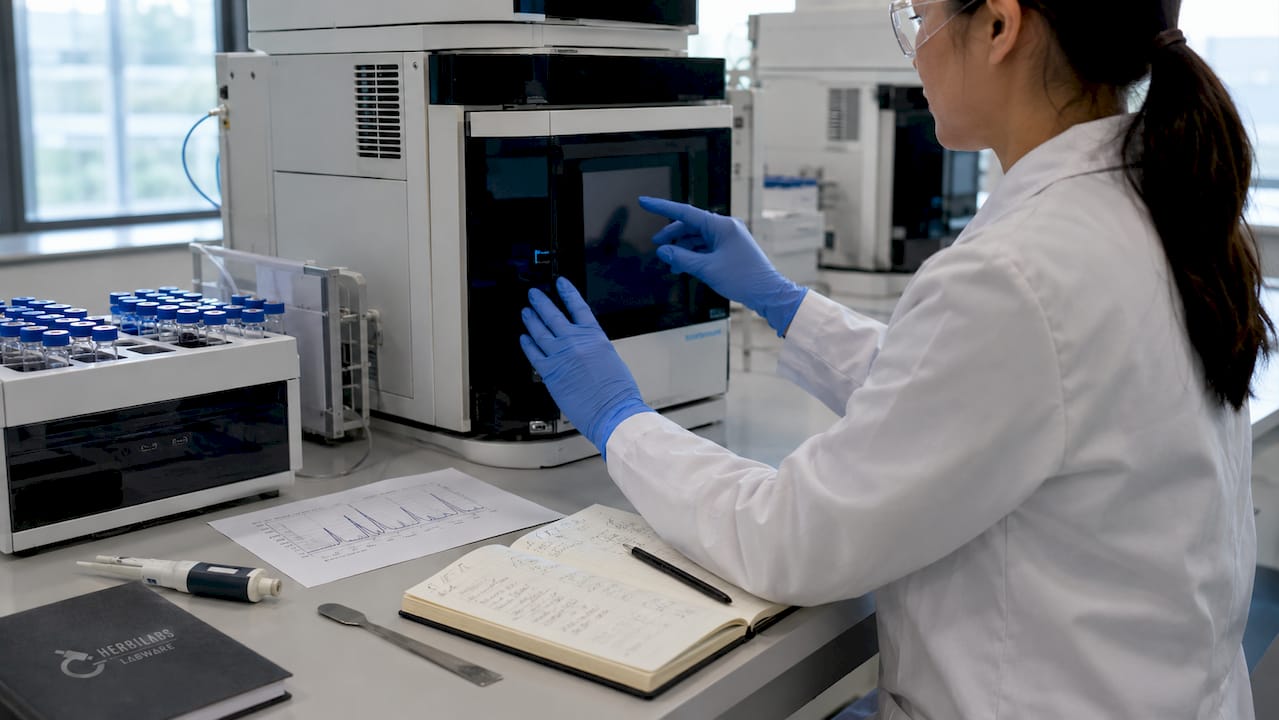
HPLC works by separating the components of a sample through a column and measuring the area each component occupies in the resulting chromatogram. The target compound’s area, expressed as a percentage of the total, gives the chromatographic purity figure. Mass spectrometry then confirms the molecular identity of that compound by measuring its mass-to-charge ratio.
A Certificate of Analysis (COA) is the document that ties all of this together. A credible COA includes the HPLC trace, the MS result, the lot number, and the purity percentage for that specific batch. Without a batch-specific COA, the research grade label provides limited assurance of what you are actually working with.
What a COA should contain
- HPLC chromatogram with labeled peaks and purity percentage
- Mass spectrometry data confirming molecular weight and identity
- Lot or batch number tied to the specific production run
- Moisture and counterion content where relevant (especially for peptides)
- Supplier name, manufacturing date, and storage conditions
Pro Tip: Always request a batch-specific COA, not a generic product COA. Generic documents may reflect a different production run with different impurity profiles.
How does research grade compare to other chemical grades?
The term “research grade” sits within a broader system of chemical purity classifications, each designed for a different application. ACS grade chemicals meet American Chemical Society purity standards, typically at or above 95%, and are suitable for analytical laboratory work. USP grade meets higher purity and safety standards for pharmaceutical use, generally at or above 99%, with additional testing for toxicology, sterility, and endotoxins.
Research grade occupies a practical middle ground. It delivers the biochemical consistency needed for experimental reproducibility without the premium cost of clinical-grade documentation. That distinction matters enormously for labs running early-stage assays where pharmaceutical-grade documentation would add cost without adding scientific value.
| Grade | Typical purity | Verification method | Intended use |
|---|---|---|---|
| Research grade (RUO) | 95–99%+ | HPLC, MS | In-vitro and preclinical research |
| ACS grade | ≥95% | Wet chemistry, HPLC | Analytical laboratory work |
| USP grade | ≥99% | HPLC, sterility, endotoxin | Pharmaceutical manufacturing |
| Technical/industrial grade | Variable, often <90% | Basic QC | Manufacturing processes |
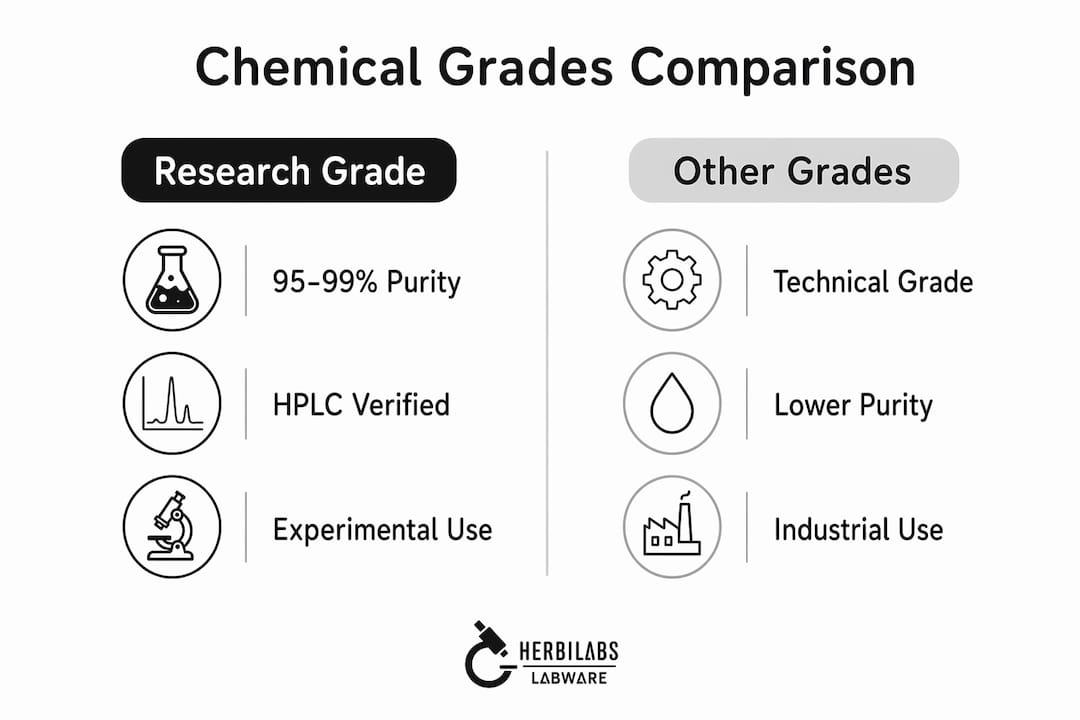
Technical or industrial grade materials carry the lowest purity requirements and the least documentation. Using them in research assays introduces uncontrolled variables that can invalidate results entirely. The cost savings are real but the scientific cost is higher.
Pro Tip: Match reagent grade to research phase. Early-stage screening rarely justifies USP-grade pricing. Reserve pharmaceutical-grade documentation for studies moving toward regulatory submission.
Common misconceptions about research grade purity labels
The biggest misconception researchers encounter is treating the HPLC purity number as equivalent to the actual mass of active compound in the vial. A compound labeled as 98% pure by HPLC often contains only 70–80% of the active substance by mass. The remaining mass consists of counterions, moisture, and inorganic salts that do not show up as distinct peaks in the chromatogram but still contribute to the total weight.
This gap between chromatographic purity and absolute compound content has direct consequences for assay design. If you calculate a dose based on the labeled weight without accounting for net peptide content, you are working with a lower concentration than intended. That error compounds across replicates and can produce dose-response curves that do not replicate between labs or suppliers.
The second major misconception is that “research grade” represents a standardized, regulated category. Because research grade lacks a universal regulatory definition, quality and purity thresholds vary significantly among suppliers. One supplier’s 98% research grade may be verified by three independent analytical methods. Another’s may rest on a single internal HPLC run with no MS confirmation.
Key verification steps before using any research grade material
- Confirm the COA is batch-specific, not a master lot document
- Check that both HPLC purity and MS identity data are present
- Request net peptide content or net active compound content if working with peptides
- Verify the supplier’s testing is performed in-house or by an accredited third-party lab
- Cross-reference the molecular weight on the COA against published literature values
Pro Tip: For peptide research, always ask for net peptide content alongside HPLC purity. The two numbers together give you the actual usable compound mass, which is what your assay actually sees.
Practical considerations for sourcing high purity research materials
Sourcing decisions made at the procurement stage directly affect the reproducibility of every experiment that follows. The first principle is simple: supplier documentation must be transparent, batch-specific, and available before you place an order. Suppliers who cannot provide this before purchase are not worth the risk, regardless of price.
The second principle is matching grade to phase. Researchers running initial target validation do not need USP-grade reagents. Research grade at 95–99% HPLC purity delivers the consistency needed for in-vitro assays at a fraction of the cost. Procurement teams that distinguish research grade from clinical grade early in the budget cycle avoid overspending on documentation that adds no scientific value at that stage.
NIST’s development of Research Grade Test Materials (RGTMs) represents the most significant push toward standardization in this space. RGTMs are designed to harmonize analytical measurements across laboratories for complex substances, including mRNA and DNA analytical tests. The goal is to reduce inter-lab variability caused by inconsistent reagent quality, which is one of the most underappreciated sources of irreproducible results.
Beyond purity, scientific integrity standards set by organizations like the International Society for Stem Cell Research (ISSCR) require documentation of experimental conditions, cell line characterization, and reporting criteria. Purity alone does not satisfy these requirements. Researchers need to document the full chain of reagent quality from supplier COA to experimental protocol.
Good procurement practices for research grade reagents
- Build a supplier qualification checklist that includes COA format, testing methods, and batch traceability before approving any new vendor.
- Request sample lots with full documentation before committing to bulk orders.
- Store COAs alongside experimental records so purity data is traceable to specific results.
- Review supplier documentation annually, since testing practices and quality controls can change between orders.
- Use the research reagents supply chain as a framework for evaluating vendor reliability across multiple reagent categories.
For labs working with reconstitution solutions and sterile diluents, purity standards extend beyond the active compound to the solvent itself. Bacteriostatic water and sterile diluents used in peptide research must meet their own purity and sterility criteria, since contaminants in the solvent can interfere with assay results just as readily as impurities in the compound.
Key Takeaways
Research grade purity, defined as 95–99%+ by HPLC with MS identity confirmation, is the minimum standard for reproducible in-vitro and preclinical research, and no batch should be used without a lot-specific Certificate of Analysis.
| Point | Details |
|---|---|
| Purity threshold | Research grade materials meet 95–99%+ HPLC purity, verified by mass spectrometry for identity. |
| COA requirement | Always request a batch-specific COA with HPLC traces and MS data before using any reagent. |
| HPLC vs. net content | HPLC purity and actual active compound mass differ; peptide researchers must request net peptide content. |
| Grade matching | Match reagent grade to research phase to control costs without sacrificing experimental consistency. |
| Supplier variability | “Research grade” has no universal regulatory definition; supplier transparency is the only reliable safeguard. |
Why purity labels alone are not enough
I have reviewed COAs from dozens of suppliers over the years, and the single most common mistake I see researchers make is treating a high HPLC number as a guarantee of experimental success. A 99% purity figure is meaningful only when it comes with MS confirmation, a batch number, and a net content figure for the specific compound class. Without those three elements, the number is marketing, not science.
The procurement side of this problem is equally underappreciated. Labs that buy the highest grade available for every reagent, regardless of research phase, waste budget that could fund additional replicates or more informative assays. The advantages of research-grade solutions are real precisely because they deliver the consistency you need at the stage where you need it, without the overhead of clinical documentation.
What I find genuinely encouraging is the trajectory of initiatives like NIST’s RGTMs. Harmonizing measurement standards across labs addresses a problem that purity thresholds alone cannot solve: inter-lab variability caused by inconsistent reagent characterization. The field is moving toward a world where “research grade” means something specific and verifiable across suppliers, not just within one manufacturer’s internal standards. That shift will make reproducibility easier to achieve and easier to defend in publication. Until that standardization arrives, critical evaluation of every supplier remains the researcher’s primary tool. Pair that with documentation practices aligned with ISSCR reporting standards, and you have a foundation that holds up to scrutiny.
— Ragnar
Herbilabs research-grade reagents: verified purity, every batch
Researchers who need verified purity without the documentation gaps that plague lower-tier suppliers will find Herbilabs built around that exact requirement.
Herbilabs manufactures bacteriostatic water, sterile diluents, and reconstitution solutions to strict research grade purity standards, with batch-specific quality control at every production run. Every product ships with full traceability documentation, so your experimental records reflect the actual purity of the material used. The Herbilabs shop carries RUO-designated reagents designed for the peptide research community across the UK and Europe, with wholesale pricing available for institutions and resellers. For researchers working through reconstitution protocols, the bacteriostatic water guide covers purity standards, storage, and application in detail.
FAQ
What is the purity range for research grade materials?
Research grade materials are defined by manufacturers as having a purity of 95–99% or higher, measured by HPLC. This threshold is designed for in-vitro and preclinical research applications, not human use.
How does HPLC purity differ from net compound content?
HPLC purity measures the target compound’s percentage of the total chromatogram area, while net compound content measures actual active mass excluding salts, moisture, and counterions. A compound showing 98% HPLC purity may contain only 70–80% active substance by mass.
Is research grade the same as pharmaceutical grade?
Research grade and pharmaceutical grade are distinct classifications. Pharmaceutical grade (USP) requires purity at or above 99% with additional sterility, endotoxin, and toxicology testing. Research grade (RUO) meets a lower documentation threshold and is not approved for therapeutic use.
What should a valid Certificate of Analysis include?
A valid COA must include the batch or lot number, HPLC chromatogram with purity percentage, mass spectrometry identity confirmation, and storage conditions. Generic COAs not tied to a specific production batch provide insufficient quality assurance.
Why does research grade purity vary between suppliers?
“Research grade” has no universal regulatory definition, so purity thresholds and testing methods differ between manufacturers. Researchers must evaluate each supplier’s documentation practices independently rather than relying on the label alone.